
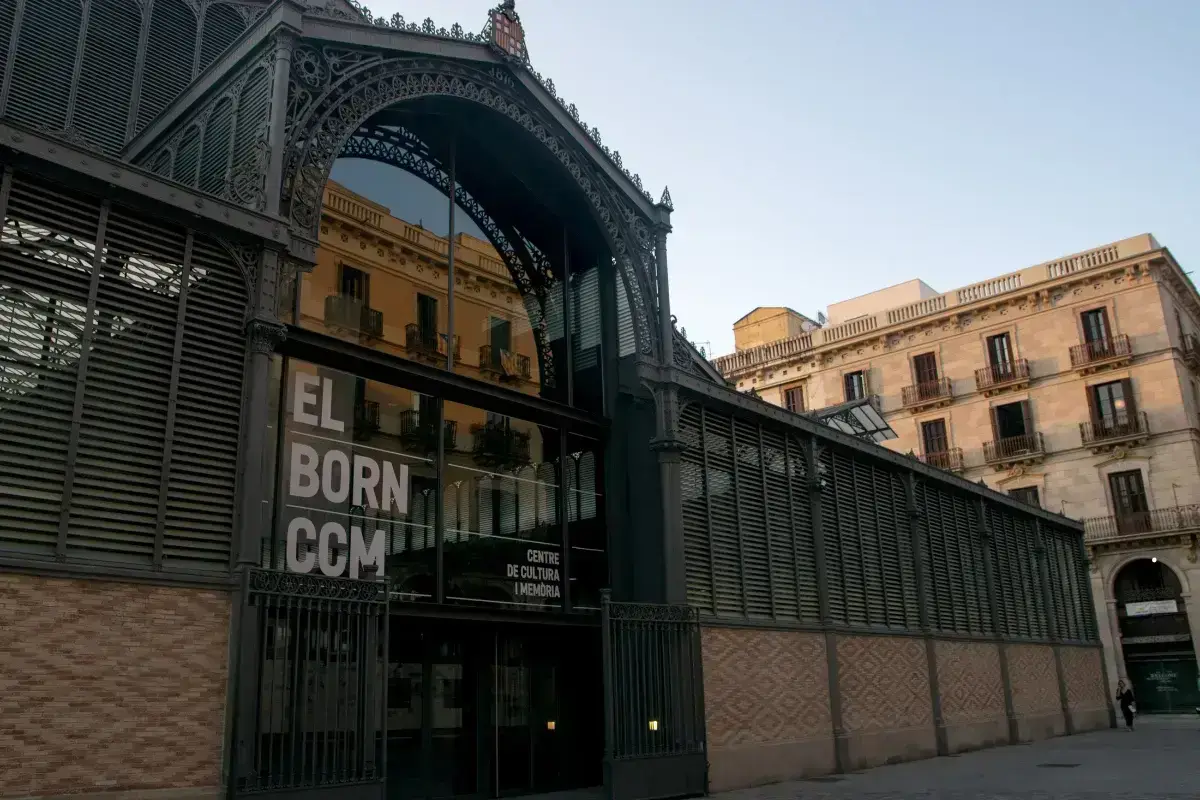

The thing to understand about El Born is that the neighborhood you see today is built on the ruins of a neighborhood that was deliberately destroyed. In 1714, after the military defeat that ended the War of Spanish Succession, Felipe V ordered the demolition of the Ribera district — the area immediately north of what is now El Born — to build the Ciutadella fortress. Thousands of residents were displaced. The physical record of that neighborhood was erased.
Or so it seemed.
In 2001, when the city began preparing to demolish the 19th-century Mercat del Born iron market to build a library, workers broke through the floor and found the preserved street grid, house foundations, shop interiors and domestic objects of the demolished neighborhood, buried under three centuries of infill. Complete. Intact. Datable.
The discovery stopped the demolition. The iron market became a protective shell over the archaeology instead of rubble to be cleared away. Today the Born Centre de Cultura i Memòria is the most historically significant site in the neighborhood — the place where the 1714 event that shaped modern Catalan identity is not described but physically present under your feet.
This is the framework for understanding El Born. Not a “trendy neighborhood” that gentrified in the 1990s — a district where layers of history from the 14th century to the present are simultaneously visible, and where the most important layer is the one underground.
What the Architecture Timeline Actually Looks Like
El Born doesn’t have a single historical moment. It has four distinct architectural layers that coexist in less than one square kilometer:
14th century: Santa Maria del Mar (1329–1383) and the original Passeig del Born as a public ceremonial space for tournaments and executions.
19th century: The Mercat del Born (1874–1876), one of the largest iron-and-glass market structures in Europe when it was built, and the Mercat de Santa Caterina’s predecessor.
Early 20th century: The Palau de la Música Catalana (1905–1908), the apex of Catalan Modernisme and the only Modernista building listed UNESCO World Heritage alongside Gaudí’s work.
Contemporary: The Born Centre de Cultura i Memòria (2013) — the preservation and presentation of the 1714 archaeological site under the Mercat del Born — and the Mercat de Santa Caterina redesigned by Enric Miralles and Benedetta Tagliabue (2005) with the undulating mosaic roof.
Every decade of serious architectural production from the 14th century to the present is represented in this neighborhood. That’s the actual reason to spend time here.
Santa Maria del Mar: What Makes It Architecturally Unusual
What is Santa Maria del Mar? A Gothic basilica built between 1329 and 1383 in the Ribera district of Barcelona — in 55 years of uninterrupted construction. The result is a single unified Gothic style with no mixed-period disruptions. The interior has three naves of nearly equal height with octagonal columns 13 meters apart. The Fossar de les Moreres memorial square beside it marks the burial site of defenders who died in the 1714 siege. Free entry during Mass; small fee for tourist visits.
The speed of construction is the architectural fact that defines Santa Maria del Mar. 55 years from foundation to completion for a building of this scale is near-unprecedented in Gothic architecture. What that speed produced: absolute stylistic unity. There are no Romanesque remnants from an earlier building, no Baroque additions from later centuries, no disruptions from changing architectural fashions. It’s Gothic Catalan — the specifically austere, structural, light-focused variant that emerged in Catalonia — from the first stone to the last.
The Interior Logic
The three naves of nearly equal height create what architects call a hall church — a space where no nave dominates the others vertically. The 13-meter column spacing is structurally ambitious for the period: the nave vaults are transferring significant lateral thrust to columns that are slender relative to the span they’re supporting. The engineering calculation that made this possible is the reason the building still stands.
The stained glass is relatively sober by Gothic standards — the dominant light quality is diffuse and cool, creating an atmosphere that contrasts sharply with the ornate Baroque interiors elsewhere in Barcelona. This sobriety was a deliberate aesthetic choice, consistent with the ethos of the merchant-class community that funded the construction.
The bastaixos — the harbor porters — carried the stone from the Montjuïc quarries to the construction site on their shoulders. Their contribution is commemorated in two relief sculptures on the main facade. The historical novel The Cathedral of the Sea by Ildefonso Falcones (2006) dramatized this contribution and drove significant international attention to the building.
The Fossar de les Moreres, the memorial square immediately beside the church, is one of the most important historical sites in Catalonia that most visitors walk past without stopping. A permanent flame and a Catalan-language inscription mark the burial site of Catalans who died defending the city in the 1714 siege. It’s visited regularly by residents and almost invisible to tourists who don’t know what they’re looking at.
The Born Centre de Cultura i Memòria: The Archaeological Site That Changed the City’s Self-Understanding
The discovery of the 1714 neighborhood wasn’t merely an archaeological find. It was politically and culturally significant in ways that changed the official narrative of Barcelona’s history.
The neighborhood that was demolished by Felipe V’s order was the Ribera district — one of the wealthiest and most commercially active areas in the city. The demolition wasn’t collateral war damage. It was deliberate urban destruction as a political act: eliminating the physical community that had organized the resistance, and replacing it with a fortress that would control the city from within.
For nearly 300 years, this demolition was discussed in historical texts but had no physical presence. The discovery in 2001 made it tangible. Streets, house thresholds, tavern floors, dropped objects — the material evidence of daily life stopped abruptly in 1714, preserved by the infill that covered it.
The exhibition in the Born Centre de Cultura i Memòria explains the historical context in detail. The archaeology is visible from elevated walkways over the site. The building that protects it — the 19th-century Mercat del Born iron structure — creates an extraordinary visual juxtaposition: Victorian iron and glass enclosing 18th-century foundations.
Visiting effectively: read the exhibition before descending to the archaeology level. The material remains without context are ruins. With context, they’re evidence of a specific political event. That shift in how you see the same objects is the point.
For the broader Civil War and political history underground, the Refugio 307 guide in Poble Sec covers the 1936 anti-aircraft tunnels — a different layer of Barcelona’s underground history, accessible with advance booking.
The Palau de la Música Catalana: The Most Elaborated Surface in the City
The Palau de la Música Catalana was designed by Lluís Domènech i Montaner and built between 1905 and 1908 for the Orfeó Català choral society. It’s the only Modernista building listed as UNESCO World Heritage alongside the works of Gaudí — a status reflecting both its architectural significance and the quality of its preservation.
The exterior facade is elaborate. The concert hall interior surpasses it.
The ceiling is a 2,000-piece stained-glass skylight that floods the space with natural light during daytime performances. The entire hall surface — columns, walls, stage surround — is covered with mosaics, ceramics, sculptures and ornamental ironwork without leaving any surface untreated. This isn’t decoration for its own sake; it’s Domènech i Montaner’s argument that a building dedicated to music should itself be experienced as a total sensory environment.
How to Actually See It
Guided tour: daily in multiple languages, the only way to access the interior outside performance hours. Book through palaumusica.cat. High-season tours sell out days in advance.
Attending a concert: the program runs from classical and choral music through jazz and flamenco. The experience of the stained-glass ceiling changing quality as afternoon light shifts during a performance is something a guided tour cannot replicate. For any visitor with genuine interest in the building, a concert is the correct form of the visit.
The rear facade: the main facade is internationally known and constantly photographed. The rear of the building, with Oscar Tusquets’ 2003 extension, is equally detailed and almost nobody photographs it. Worth a deliberate circuit around the entire perimeter.
The Parc de la Ciutadella: The Park That Replaced a Fortress
The Parc de la Ciutadella is the largest green space in central Barcelona and the immediate consequence of the same 1714 event that created the archaeology under the Born Centre.
Felipe V built the Ciutadella fortress between 1715 and 1720 specifically to control Barcelona from within. It required the demolition of the Ribera district — documented in the archaeology now visible under the Mercat del Born. For over 150 years the fortress functioned as a symbol of Bourbon military control over Catalonia.
When General Prim ceded it to the city in 1869, Barcelona demolished it with a speed that was also a political statement. The park was designed for the 1888 Universal Exhibition. The cascade — designed by Josep Fontserè with a young Gaudí as assistant — is the most photographed element. The Parlament de Catalunya occupies the original arsenal building, the only structure preserved from the fortress.
The relationship between the park’s geography and the 1714 events is direct: the former neighborhood is under the Born Centre; the former fortress is under the park. The same event produced both, and the city chose to preserve the archaeology of the neighborhood and demolish the fortress that replaced it.
The Fossar de les Moreres and the market nobody visits
The Fossar de les Moreres is three meters from the most popular part of the neighborhood and almost completely invisible to visitors. It’s not marked prominently, it doesn’t have a ticket booth, and the permanent flame doesn’t announce itself loudly. Dozens of tourists pass within arm’s length of it every minute without registering what it is.
The Mercat de Santa Caterina — the neighborhood’s actual functioning market, redesigned by Enric Miralles and Benedetta Tagliabue with the undulating mosaic roof in 2005 — is visited far less than the Mercat del Born despite being one of the most architecturally interesting contemporary buildings in the city. It’s also fully operational as a market, with bar counters serving food and vermouth at neighborhood prices. It’s the version of the market visit that actually feels like attending a market.
The back streets of El Born are consistently more interesting than the Passeig del Born itself. The Carrer dels Flassaders, the Carrer del Rec and the Carrer del Parlament have the highest concentration of independent retail, galleries and restaurants in the neighborhood — and significantly fewer people than the central promenade. For coffee during the circuit, the specialty coffee route guide identifies the best roasters, including Nomad Coffee Lab in the Passatge Sert — a covered historic alley that runs between Carrer de Sant Pere Més Alt and Carrer de Trafalgar, 5 minutes from Santa Maria del Mar.
Is It Worth a Full Day?
Yes — for any visitor with architectural or historical interest.
Santa Maria del Mar alone justifies the visit. The Born Centre is the most intellectually serious cultural site in the neighborhood. The Palau de la Música is one of the most elaborated architectural interiors in Europe. The Parc de la Ciutadella connects the same history to green space.
When it’s not the right investment: if you want a relaxed afternoon in a pleasant neighborhood, the Passeig del Born terraces and the back streets deliver that without the museum entries. El Born works as both a serious cultural circuit and as a comfortable place to spend time without an agenda.
The specific failure mode: arriving expecting a “hip neighborhood” experience and finding the historical density disconcerting. El Born is genuinely layered. The yachting-club demographic of the Passeig del Born terraces sits 200 meters from a memorial to 1714 dead and 500 meters from an underground demolished neighborhood. That juxtaposition is the neighborhood’s character, not an inconsistency.
How to Organize the Visit
2 hours (minimum meaningful visit): Santa Maria del Mar → Fossar de les Moreres → Passeig del Born.
Half day: Add Born Centre de Cultura i Memòria (reserve 90 minutes including the exhibition). Walk the Carrer dels Flassaders and Mercat de Santa Caterina.
Full day: Half-day circuit above → Palau de la Música (guided tour or evening concert, book in advance) → Parc de la Ciutadella → dinner in the neighborhood interior streets.
Getting here: Metro L4 to Barceloneta or Jaume I. Metro L1 to Arc de Triomf for the northern section. On foot from the Gothic Quarter in 5 minutes or from El Raval across Las Ramblas in 10 minutes.
Mistakes to Avoid
- Walking past the Fossar de les Moreres without stopping — it’s beside Santa Maria del Mar, takes 3 minutes to understand, and is one of the most historically significant spaces in Catalonia. The permanent flame is the marker.
- Visiting the Born Centre archaeology without reading the exhibition first — ruins without context are visually uninteresting. The exhibition is the content; the archaeology is the evidence.
- Not booking the Palau de la Música guided tour in advance — in high season tours sell out days ahead. A concert works better anyway — book through the Palau website.
- Staying only on the Passeig del Born — it’s the most tourist-dense and least representative part of the neighborhood. The parallel streets on both sides are where El Born actually lives.
- Confusing El Born with the Gothic Quarter — they’re adjacent but historically distinct. The Gothic Quarter has the Roman and medieval layers; El Born has the maritime-commercial medieval layer plus the 1714 history and the Modernisme of the Palau. Different heritage, different character.
Reference Table
| Site | Type | Admission | Hours |
|---|---|---|---|
| Santa Maria del Mar | Gothic basilica | Free (Mass) / Small fee (tourist) | Check website |
| Born Centre de Cultura i Memòria | Archaeological site + museum | Fee | Closed Mondays |
| Palau de la Música Catalana | Modernista concert hall | Guided tour fee / concert ticket | Daily tours |
| Mercat de Santa Caterina | Working market | Free | Market hours |
| Parc de la Ciutadella | Park | Free | Always open |
| Fossar de les Moreres | Memorial square | Free | Always open |
Are El Born and the Gothic Quarter the same neighborhood?
No. They’re adjacent but historically distinct. The Gothic Quarter has the Roman and medieval city layers; El Born (officially Sant Pere, Santa Caterina i la Ribera) has the maritime-commercial medieval heritage and the 1714 historical significance. Different urban morphology, different character, different history.
What is the Born Centre de Cultura i Memòria?
The preservation of an entire neighborhood demolished in 1714 by Felipe V’s order to build the Ciutadella fortress, discovered in 2001 under the floor of the Mercat del Born iron market. The 19th-century iron structure now protects the archaeology. Visible from elevated walkways inside the building.
How do you visit the Palau de la Música Catalana?
By guided tour (book at palaumusica.cat — sells out in advance in high season) or by attending a concert. The concert is the superior experience: the building is functioning as intended and the stained-glass ceiling changes with the light during the performance.
What is the Fossar de les Moreres?
A memorial square immediately beside Santa Maria del Mar, marking the burial site of Catalan defenders who died in the 1714 siege. Permanent flame, Catalan inscription. One of Catalonia’s most significant memorial sites, passed by thousands of tourists daily without recognition.
Is Santa Maria del Mar free to enter?
Free during Mass. A small tourist admission applies outside Mass hours. The interior is best visited on a weekday morning for lower crowds and better light conditions in the nave.
What is the best time to visit El Born?
Weekday mornings for Santa Maria del Mar (less crowded, natural interior light). The Born Centre can be visited any day the museums are open. The Passeig del Born works better as an afternoon/evening destination. Late-night weekends are active with bar life if that’s the objective.
Where should I eat in El Born without tourist pricing?
Avoid the terrace restaurants directly on the Passeig del Born. The Mercat de Santa Caterina bar counters serve at neighborhood prices. The Carrer dels Flassaders and Carrer del Rec have independent restaurants with better quality-to-price ratios than the central promenade.
Final Insight
El Born is the neighborhood where Barcelona’s most politically significant event — the 1714 defeat and the demolition that followed — is most physically present. The church that the harbor porters built in 55 years, the archaeology of the demolished neighborhood three meters below the iron market floor, the memorial flame that residents visit but tourists pass by — these are all within 200 meters of each other. The tourist version of El Born is a pleasant bar-and-boutique neighborhood. The actual El Born is a place where the consequences of one military siege are still visible in the ground, in the architecture and in the public space of a neighborhood that was built to replace what was taken.
For the full Barcelona picture that connects El Born to the city’s other historic layers, the hidden places in Barcelona guide covers the Roman temple, the Civil War shelter and the Masonic library — the other underground and overlooked sites that form the city’s parallel history. And the Barcelona first-time visitor guide places El Born in the context of the full city for visitors building their first itinerary.