
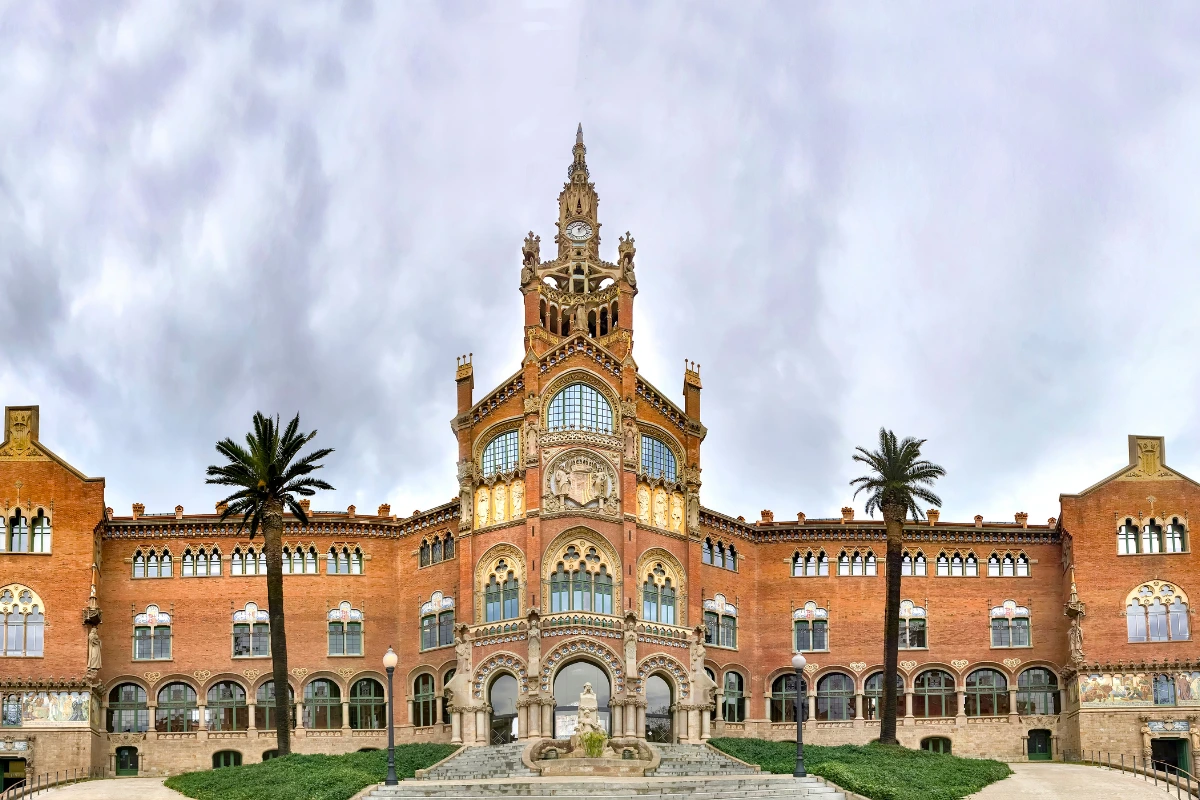

Catalan Modernisme was built by over 100 architects across roughly 40 years. The near-exclusive association with Gaudí — justified by the scale of his work — obscures a movement that produced everything from the world’s most important collection of Modernista hospital architecture to neighborhood pharmacies with stained-glass interiors that are still operating as pharmacies today.
Understanding Barcelona’s complete Modernista heritage means knowing at least four names beyond Gaudí, the specific differences in their approach, and where those differences are visible side by side in the same city block.
The Historical Context That Makes the Movement Legible
Catalan Modernisme emerged from a specific convergence: the demolition of the medieval city walls in 1854, the expansion of the Eixample according to Cerdà’s grid plan, and the economic rise of Barcelona’s industrial bourgeoisie. This new class needed architecture that expressed power and aspiration — and found in Modernisme the perfect vehicle.
Unlike French Art Nouveau or German Jugendstil — primarily aesthetic styles — Catalan Modernisme carried explicit ideological weight: it reclaimed Catalan medieval identity while embracing industrial technique. That’s why medieval brick, cast iron from the Industrial Revolution and Moorish ceramics coexist in the same building. The movement was simultaneously backward-looking (the Romanesque, the Gothic) and forward-looking (structural iron, photovoltaic glass, new tile systems). It was politically charged in a way that French Art Nouveau never was.
The peak period ran from approximately 1880 to 1920. Capital returning from Cuba and Puerto Rico after the Spanish-American War of 1898 accelerated construction — the bourgeoisie invested in representative buildings with urgency.
What is there to see of Modernisme in Barcelona beyond Gaudí? The Palau de la Música Catalana and the Hospital de Sant Pau — both UNESCO World Heritage — by Domènech i Montaner. The Casa Amatller and Casa de les Punxes by Puig i Cadafalch. The Casa Comalat by Valeri (two entirely different facades on two streets). The Block of Discord on Passeig de Gràcia allows comparison of three distinct styles within 100 meters. Most of these are accessible from street level without an entry fee.
Lluís Domènech i Montaner: The Intellectual Foundation of the Movement
Domènech i Montaner (1849–1923) is the architect who most shaped the Modernista generation because he was also its teacher — a professor at the Barcelona School of Architecture for decades. Puig i Cadafalch was his student. His influence was simultaneously architectural and pedagogical.
His founding principle: decoration must not conceal structure but emphasize it. In his buildings, the metal skeleton is visible, bricks carry decorative value of their own, and ceramics amplify rather than disguise how the building is made.
Palau de la Música Catalana (1905–1908)
Carrer de Palau de la Música 4–6, El Born. Metro L1/L4 (Urquinaona).
The only concert hall in the world declared a UNESCO World Heritage Site. The main hall is a glass box that receives natural light through a large inverted stained-glass dome by Antoni Rigalt — during daytime performances, the light quality changes continuously. The stage integrates sculptures by Eusebi Arnau that appear to emerge from the walls in progressive relief — part three-dimensional sculpture, part flat mosaic.
Two ways to experience the building: the guided tour (55 minutes, €22) or attending a concert. The concert is superior for anyone with genuine architectural interest — watching the dome change as an afternoon performance progresses is an experience no guided tour replicates.
The reception at the time: the building was controversial on completion. Critics found it excessive; some called it a “disgrace.” Domènech received the award of the first City of Barcelona Prize in 1909 for it anyway. Today it’s the reference against which all Modernista interiors are measured.
Recinte Modernista de Sant Pau (1902–1930)
Carrer de Sant Antoni Maria Claret 167, Guinardó. Metro L5 (Sant Pau Dos de Maig). 10 minutes on foot from the Sagrada Família along the Avinguda de Gaudí — a street designed to create a visual axis between the two buildings.
The most extensive Modernista complex in Europe. Not a conventional hospital but a garden city for the sick: 18 independent pavilions surrounded by vegetation, connected by underground tunnels, oriented to receive direct sunlight and cross-ventilation. The premise — that environment heals as much as medicine — anticipated biophilic design principles by a century.
The surgical theater has a full-wall window for natural light. The pharmacy pavilion is tiled in Valencian ceramic. The administrative buildings use brick, ironwork and mosaic in the same integrative way as the Palau de la Música, but at a larger scale and with more space to breathe.
Entry: €16 with audio guide. UNESCO since 2009. The Barcelona Modernisme route guide covers how to integrate both Domènech buildings in a single half-day.
Casa Lleó i Morera (1902–1906)
Passeig de Gràcia 35, part of the Block of Discord. Domènech renovated a pre-existing building for the Morera family, integrating a circular tribuna at the corner and a pavilion crowning the roofline. The sculptures by Eusebi Arnau on the facade, the mosaics by Lluís Bru and the furniture by Gaspar Homar inside represent the artisanal collaboration that defined Domènech’s approach. Now houses the Loewe boutique — the interior retains original Modernista elements.
Josep Puig i Cadafalch: The Medievalist Who Turned Barcelona Into a Castle
Puig i Cadafalch (1867–1956) was Domènech’s student, a medievalist art historian and a politician — he served as president of the Mancomunitat de Catalunya. His architecture carries more explicit political charge than Domènech’s: references to Catalan Gothic and Flemish architecture are national identity claims, not stylistic preferences.
Unlike Gaudí’s organic curves or Domènech’s structural rationalism, Puig works with solid geometry, carved stone and historicist iconography that reads like a medieval archaeology manual in built form.
Casa Amatller (1898–1900)
Passeig de Gràcia 41. Ground-floor chocolateria open to the public.
Commissioned by chocolatier Antoni Amatller. The facade is inspired by Catalan urban Gothic palaces and Flemish architecture — the stepped gable is the visual signature. The sculptures by Eusebi Arnau represent Sant Jordi slaying the dragon and allegories of industry and photography (the owner’s hobbies). The interior retains original furniture. Guided visits approximately €15. The combination of the Modernista exterior and the functioning chocolateria on the ground floor is one of the most civilized stops on the Passeig de Gràcia.
Casa de les Punxes — Casa Terrades (1905)
Avinguda Diagonal 416–420. Metro L3/L5 (Diagonal).
The building that looks like a Central European medieval castle inserted into Cerdà’s grid. Six towers with conical spires, stone facades with ceramic panels of nationalist iconography. Puig designed separate entrances and staircases for each of the three owner families.
Critical information that is often out of date: since 2021, the interior is no longer accessible as a museum. The building was converted into a coworking and private events space managed by Cloudworks. The exterior facade on the Avinguda Diagonal remains freely accessible at all times. Recommendations to visit the interior are still in circulation — verify before planning accordingly.
Palau Macaya (1901)
Passeig de Sant Joan 108, Eixample. Free entry. One of the most accessible and least crowded buildings in the Modernista circuit. Facade in white with sgraffito decoration and sculptures by Eusebi Arnau and Alfons Juyol. Currently a cultural center of the Fundació “la Caixa” with free exhibitions.
Josep Maria Jujol: The Collaborator Who Went Further
Jujol (1879–1949) is the most underrated figure in Barcelona’s Modernista movement. He collaborated with Gaudí on Casa Batlló, La Pedrera and Park Güell — the sinuous benches of Park Güell are Jujol’s work, not Gaudí’s. His independent work reveals an artist who anticipated early 20th-century avant-garde movements.
His most distinctive characteristic: creative recycling of discarded materials. Ceramic fragments, broken glass, porcelain pieces — all could become decorative material with their own value. He worked with very tight budgets, which forced innovation with available resources.
Casa Planells (1923–1924)
Avinguda Diagonal 332, at the intersection with Carrer de Sicília. Metro L3/L5 (Diagonal). No entry fee, exterior freely accessible.
On a triangular plot of barely 80 square meters, Jujol designed a building with sinuous forms, split-level duplexes of up to 120m², and wide balconies. Considered the last building of the Modernista period in Barcelona. The curved facade and the corner treatment make this one of the most photographically distinctive buildings in the Eixample — with almost no tourists ever in front of it.
Salvador Valeri i Pupurull: The Building Nobody Expects
Valeri (1873–1954) is the great unknown of Barcelona Modernisme. His principal work is the only building in the city with two completely different facades on two different streets.
Casa Comalat (1909–1911)
Main facade: Carrer de Còrsega 316. Rear facade: visible from Carrer de Còrsega side and the Diagonal. Private interior, both facades freely accessible.
The main facade on Còrsega has curved stone balconies with wrought iron railings. The rear facade is completely different: wooden polychrome galleries with parabolic arches in colors that suggest a harlequin costume. They don’t look like parts of the same building. They are.
The combination of the two facades in one walk — along Còrsega and then around the block — is one of the most disorienting architectural experiences in Barcelona, because the visual language shifts so completely between one street and the other.
The Block of Discord: Three Styles in One Hundred Meters
The stretch of Passeig de Gràcia between Carrer d’Aragó and Carrer del Consell de Cent offers the most compressed Modernisme comparison in the city.
Casa Lleó i Morera by Domènech (number 35): structural rationalism — the metal skeleton is visible, decoration emphasizes how the building is made. Casa Amatller by Puig i Cadafalch (number 41): Gothic historicism — solid geometry, carved stone, Catalan and Flemish medieval references. Casa Batlló by Gaudí (number 43): organic naturalism — forms evoking the sea and the Sant Jordi legend without direct historical reference.
Three buildings, the same commission (bourgeois representation architecture), three radically different answers. Walking the 100-meter stretch takes 10 minutes. Understanding Modernisme at its most contested takes the same walk.
The Everyday Modernisme Nobody Visits
The movement permeated Barcelona’s quotidian spaces. Some of those spaces are still functioning in their original form.
Queviures Murrià (Carrer de Roger de Llúria 85, Eixample) — a gourmet food shop with original period decoration: tiles, signs and posters by Ramon Casas for Anís del Mono and Codorníu cava. Still functions as a specialty food retailer. One of the best-preserved Modernista commercial interiors in the city. No entry fee — it’s a shop.
Modernista pharmacies of the Eixample — several Eixample pharmacies retain original decoration: leaded glass windows, carved wood furniture, ceramic tiles with floral motifs. Farmàcia Vilardell on Gran Via and Farmàcia Argelaguet are among the most complete. No entry fee — they are active pharmacies.
Passeig de Gràcia lamp posts and mosaics — the hexagonal lamp posts on the Passeig de Gràcia were designed in 1900 by Pere Falqués i Urpí, with hexagonal ceramic benches at the base. The hexagonal panots (mosaic tiles) on the Eixample pavements have designs attributed to Gaudí and Domènech in different sections. They have been part of the Eixample’s urban furniture for over a century.
The Route for Visitors Who Already Know the Block of Discord
For anyone who has already seen the three famous facades and wants to go beyond the main circuit:
Palau Macaya → free, no queues, Puig i Cadafalch facade with sgraffito and sculptures. Active cultural space with exhibitions.
Recinte Modernista de Sant Pau → ten times fewer visitors than the Sagrada Família, 10 minutes away on foot. €16 with audio guide.
Casa Comalat → both facades freely accessible. The rear facade on the Diagonal almost never has anyone in front of it.
Casa Thomas — Cubiñá (Carrer de Mallorca 291) → Domènech design house converted into a design furniture store. Walk in for free and see the complete Modernista ground floor.
Casa Planells (Avinguda Diagonal 332) → Jujol’s prow-shaped corner. No tourists, no queue.
Hotel España — Fonda España (Carrer de Sant Pau 9–11, El Raval) → the main dining room with Ramon Casas murals and Eusebi Arnau alabaster fireplaces. Dinner or drinks without a museum ticket.
Casa de les Punxes has been closed inside since 2021
The Casa de les Punxes is where outdated information circulates most: since 2021 the interior has not been publicly accessible. Descriptions of a museum visit inside the building no longer apply.
The second consistent gap: Jujol’s authorship of the Park Güell benches. The sinuous, ceramically-encrusted bench of the upper esplanade is among the most photographed elements in Barcelona — and most visitors attribute it entirely to Gaudí. The bench design, coloring and mosaic work are Jujol’s. Gaudí designed the structural solution; Jujol designed the surface.
What is the difference between Gaudí, Domènech i Montaner and Puig i Cadafalch?
Gaudí works with organic free forms without direct historical reference. Domènech starts from structural rationalism: decoration emphasizes how the building is made. Puig starts from medievalism: his buildings evoke Gothic castles and Flemish palaces. All three are visible side by side in the Block of Discord on Passeig de Gràcia.
Can you visit the Casa de les Punxes interior?
No, not since 2021. The building was converted into a coworking and private events space. The exterior facade on the Avinguda Diagonal is freely accessible at all times. Many current guides still describe the interior museum visit as available — it is not.
Is the Recinte Modernista de Sant Pau worth visiting?
Yes, specifically as an alternative to the Sagrada Família for visitors interested in Modernista architecture. It has significantly lower visitor volume, a UNESCO designation, and the conceptual argument — a garden city for the sick designed on biophilic principles in 1902 — is more intellectually engaging than most Modernista tours convey. Entry €16 with audio guide.
Who designed the Park Güell benches?
Josep Maria Jujol, not Gaudí. Jujol collaborated with Gaudí on the Casa Batlló, La Pedrera and Park Güell. The sinuous trencadís bench of the upper esplanade — its design, coloring and mosaic work — is Jujol’s. Gaudí designed the structural solution underneath. Jujol’s independent work (Casa Planells on the Diagonal) is consistently undervisited and underacknowledged.
Are there free Modernista buildings to visit in Barcelona?
Yes. Palau Macaya (Passeig de Sant Joan) — free entry, Puig i Cadafalch building with active cultural exhibitions. Casa Comalat facades — both freely accessible from the street. Casa Planells (Avinguda Diagonal 332) — Jujol facade, no ticket. Casa Thomas/Cubiñá (Carrer de Mallorca 291) — Domènech building open as a design furniture store. Fonda España (Carrer de Sant Pau 9–11) — Modernista dining room accessible for dinner or drinks.
The Route in Practice
The Barcelona Modernisme route guide organizes all the buildings covered here into a full itinerary with travel times between them. The Eixample neighborhood guide provides the urban context — why Cerdà’s grid exists, what the chamfered corners were designed for, and how the neighborhood’s uniform block width gave the bourgeoisie the plots where all of this was built.
Catalan Modernisme lasted roughly 40 years and changed the appearance of an entire city. More than 100 people made it. The four architects covered here are the minimum necessary to understand how.