
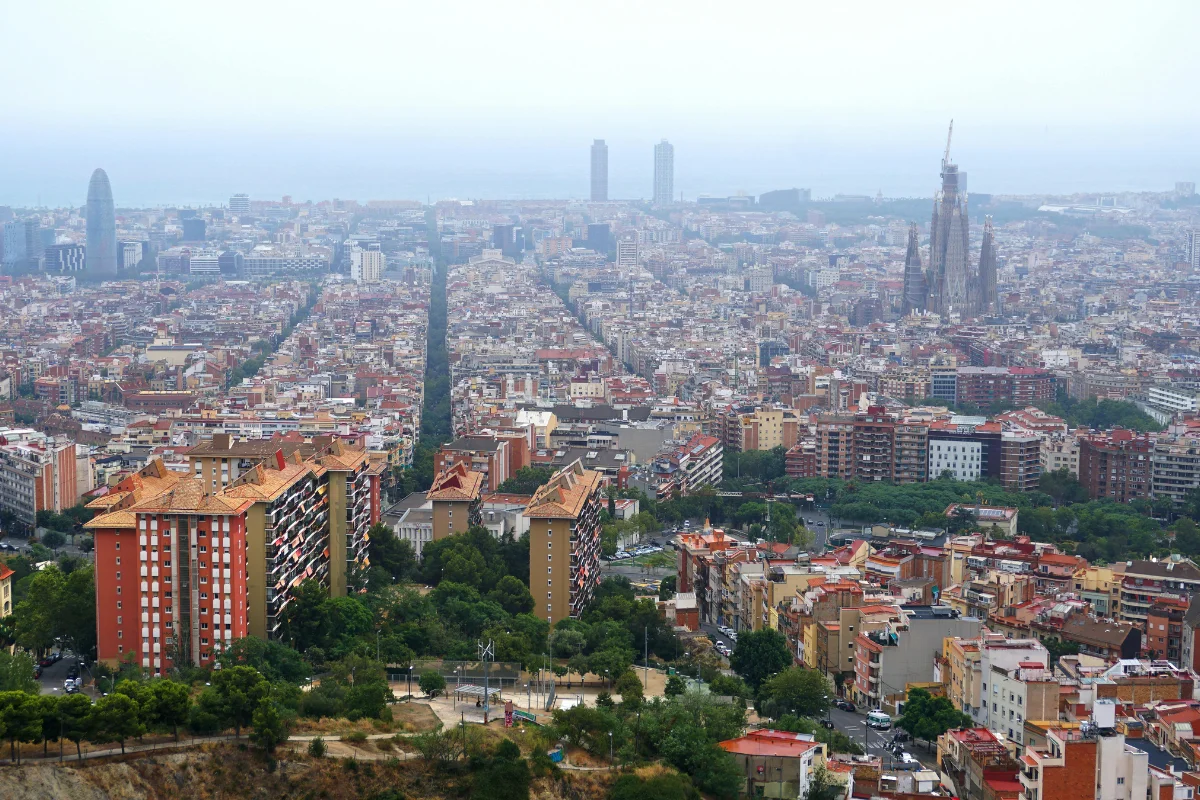

In 1859, Ildefons Cerdà designed a city grid to solve a specific problem: Barcelona’s mortality rate from infectious disease was among the highest in Europe. The solution was the octagonal block with chamfered corners — for visibility and air circulation — wide streets for ventilation and light, and the interior of every block reserved as communal garden.
The bourgeoisie who commissioned the buildings immediately started filling those gardens with warehouses, workshops, and garages. Cerdà’s vision was buried under real estate within decades of the plan’s approval.
What happened next is one of the more satisfying reversals in urban history. Since the 1980s, the Barcelona city council has been systematically recovering those interior block spaces as public gardens. Dozens are now open to the public. Almost no tourist knows they exist.
That’s the Eixample in one story: a radical public health vision, partially defeated, partially being recovered 160 years later.
Before the Architecture: Understanding What You’re Looking At
What is the Eixample and why does it matter?
The Eixample (“widening” in Catalan) is the planned 19th-century extension of Barcelona built on the plain between the old city walls and the surrounding villages of Gràcia, Sant Andreu, and others. It covers 7.46 square kilometres and contains the highest density of Art Nouveau / Modernista architecture in the world. The octagonal street blocks with chamfered corners, identical-width streets, and interior courtyard spaces make it immediately recognisable from aerial photographs. Passeig de Gràcia, its main boulevard, contains three UNESCO-adjacent buildings within a single block.
Quick Decision
- Gaudí building interior → Sagrada Família (book weeks ahead) or La Pedrera (less crowded, equally important)
- Best façade-gazing walk → Passeig de Gràcia between Carrer d’Aragó and Carrer de Provença — the Block of Discord plus La Pedrera in one 600-metre stretch
- Hidden gem most visitors miss → Jardins de la Torre de les Aigües — 1867 water tower, urban pool in summer, free, 5 minutes from Passeig de Gràcia
- Best food market → Mercat de Sant Antoni — Sunday book market outside, fresh produce inside all week
- Best street for cocktails and bars → Carrer del Consell de Cent and surroundings — the highest density of cocktail bars in the city
- Architecture without entry fees → The Block of Discord façades, Hospital de Sant Pau exterior, Fundació Tàpies façade with its wire sculpture
The Sagrada Família: The Building That Requires Its Own Day
Barcelona’s most visited monument and the most visited paid site in Spain receives 4.5 million visitors annually. The construction started in 1882 and continues. In February 2026, the Torre de Jesucristo reached 172.5 metres, making it the tallest church in Europe.
The standard guide fact — Gaudí worked on it until his death in 1926 — obscures the more interesting reality: the building has two completely distinct architectural languages. The Nativity Façade (east), which Gaudí designed, is organic, symbolic, covered in naturalistic sculpture. The Passion Façade (west), designed by Josep Maria Subirachs after Gaudí’s death, is angular, geometric, deliberately disturbing. They’re two opposing visions of the same building — and the tension between them is part of what makes the interior extraordinary.
The stained glass uses the physics of the building’s east-west orientation as a compositional tool: cool blues and greens through the Nativity side in the morning, warm oranges and reds through the Passion side in the afternoon. First entry at 9am gets you both — the morning light as you enter, the afternoon register building as you work through the space.
Booking: mandatory, weeks in advance in high season, at sagradafamilia.org. Basic entry €26; with towers €36. The tower visits require a separate booking within the same purchase.
For the full architectural reading of what Gaudí achieved structurally — the tree-column system, the hyperboloid vaults, the acoustic design — the Sagrada Família inside guide covers the technical detail that most audio guides compress into anecdote.
The Block of Discord: Three Architects, One Block, One Afternoon
The section of Passeig de Gràcia between Carrer d’Aragó and Carrer del Consell de Cent contains three Modernista buildings by three different architects in the same block — a competitive density that earned the nickname “Manzana de la Discordia” (Block of Discord).
Casa Lleó Morera (Domènech i Montaner, 1906) — the least visited of the three, partly because a 1940s intervention for a ground-floor shop partially mutilated the ground-level sculpture. What remains is still extraordinary: ceramic and glass façade work, original Eusebi Arnau sculptures on the upper floors. The least Instagram-famous; arguably the most architecturally interesting at close range.
Casa Amatller (Puig i Cadafalch, 1900) — a synthesis of Catalan Gothic and Flemish Art Nouveau that has no equivalent in the city. The stepped gable roofline, the carved stone animals on the façade, and the original Catalan tile detailing make it distinctly different from the two Gaudí buildings it sits between. The ground-floor chocolate shop continues the original function — the Amatller family made chocolate. Guided interior visits available.
Casa Batlló (Gaudí, 1906) — the most photographed of the three. The ceramic-fragment façade in blues and greens, the dragon-scale ceramic roof, and the bone-shaped window columns are the visual elements most associated with Gaudí internationally. The interior experience is the most elaborately produced of any Gaudí building — immersive audio and visual design throughout. Entry from €29. Our Casa Batlló visit guide covers what to prioritise inside and what the standard tour misses.
La Pedrera: The Building That Scandalised the City
Casa Milà — La Pedrera, “the quarry,” as neighbours derisively called it — was Gaudí’s last civilian commission, built between 1906 and 1912. When it opened, residents of Passeig de Gràcia filed formal complaints with the city council. It’s now a UNESCO World Heritage Site.
The structural innovation is the argument for the building’s importance beyond aesthetics: Gaudí eliminated load-bearing interior walls entirely, using a system of columns and beams that allowed completely free floor plan distribution. This is the structural logic Le Corbusier would later formalise as the “free plan” — Gaudí implemented it fifteen years earlier in a building on Passeig de Gràcia.
The rooftop is the most-photographed space: warrior-helmeted chimneys, ventilation shafts shaped like abstract monks, a landscape that reads as sculpture. Gaudí designed it as a habitable, sculptural space — unprecedented in 1912.
Entry: from €25 daytime, €39 for La Pedrera de Nit (rooftop concert at sunset — worth it if the programme aligns). Book at lapedrera.com.
Hospital de Sant Pau: The UNESCO Site Nobody Queues For
Ten minutes north of the Sagrada Família on Avinguda de Gaudí — the axis Gaudí himself designed to connect the two — the Hospital de Sant Pau is Lluís Domènech i Montaner’s masterwork. Twelve pavilions connected by underground galleries, each decorated with mosaics, sculptures, and ceramic domes. The complex was an active hospital until 2009.
It is architecturally equal to anything on Passeig de Gràcia. It receives a fraction of the visitors. UNESCO includes it in the same declaration as Gaudí’s works.
The 10-minute walk from Sagrada Família makes the Sagrada Família + Sant Pau combination the most efficient UNESCO circuit in the city — two world-class monuments in one geographic sequence. Entry €16.
The Hidden Interior Gardens: Cerdà’s Vision, Partially Recovered
This is what most Eixample guides entirely miss.
Cerdà’s 1859 plan reserved the interior of every octagonal block as communal garden. The bourgeoisie filled those spaces with industrial and storage functions within decades. Since the 1980s, the city has been systematically recovering them as public parks.
The result is dozens of interior block gardens — some tiny, some substantial — hidden behind the façade line, accessible through passages that look like private entrances. Almost no tourist visits them because they don’t appear on standard maps.
The most interesting:
Jardins de la Torre de les Aigües (Carrer de Roger de Llúria / Carrer del Consell de Cent) — an 1867 water tower in the centre of the garden, one of the city’s first water deposits. In summer an urban pool with sand is installed. Free entry. This is one of the only places in the Eixample where Cerdà’s communal interior garden vision is actually functioning.
Jardí de la Universitat — the garden of the University of Barcelona’s historic building, open to the public during university hours. A quiet courtyard garden in the middle of the Eixample that most people walk past.
Jardins de Rius i Taulet — interior garden of the former Saló de Sant Joan quarter, recently recovered. Accessible through a passage on Carrer d’Enric Granados.
Carrer d’Enric Granados: The Street Nobody Mentions
One block from Passeig de Gràcia, a semi-pedestrian street with trees, terraces, art galleries, and restaurants was redesigned in 2014 — reduced traffic, expanded pedestrian space. The result is one of the most pleasant walks in the Eixample: the local version of Passeig de Gràcia, without the tour groups.
The restaurant and café concentration here is better than on the main boulevard and significantly cheaper. The best brunch spots in Barcelona include several addresses on this street.
Fundació Antoni Tàpies: The Eixample’s 20th Century
In a converted Modernista publishing house on Carrer d’Aragó, the Tàpies Foundation houses the work of the most important Catalan artist of the second half of the 20th century. The wire and tube sculpture on the roof — Núvol i Cadira — is one of the Eixample’s visual landmarks that most people can’t name.
Tàpies developed a pictorial language based on material — sand, rags, ropes, thick paint — that influenced European contemporary art through the 1960s and 70s. If Modernisme is the Eixample’s 19th century, Tàpies is its 20th. Entry €12.
Mistakes to Avoid
- Putting Sagrada Família and Park Güell in the same morning — they’re 3km apart with significant uphill involved. They don’t share a logical geographic sequence. The Sagrada Família + Sant Pau combination is the correct pairing.
- Only seeing Casa Batlló and skipping La Pedrera — the structural argument for La Pedrera is stronger than the experiential argument for Casa Batlló. If you’re choosing one, La Pedrera has lower crowds and equal architectural significance.
- Not booking Sagrada Família weeks ahead in high season — the “sold out” experience at the gate is one of the most common disappointments in Barcelona travel. There is no on-site solution.
- Missing the Block of Discord on a weekday morning — the three buildings on that block have completely different characters at 8am versus 11am. Casa Lleó Morera’s ground-level detail, in particular, requires proximity that’s impossible when the pavement is crowded.
- Treating the Eixample as a transit zone between sights — the interior block gardens, Carrer d’Enric Granados, the Mercat de Sant Antoni Sunday book market, and the Fundació Tàpies are destinations in themselves.
Best Strategy
-
4 hours (architecture focus) → Block of Discord walk on Passeig de Gràcia → Casa Batlló exterior → La Pedrera (book in advance) → Carrer d’Enric Granados for lunch. All walkable, covers the Modernisme core.
-
Full day → Sagrada Família at 9am (booked weeks ahead) → Avinguda de Gaudí walk to Hospital de Sant Pau → lunch in Sant Antoni → Passeig de Gràcia afternoon → Jardins de la Torre de les Aigües → cocktails in the Eixample Esquerra evening circuit.
-
Repeat visitor → Skip the monuments and spend the day finding the interior block gardens, Fundació Tàpies, Carrer d’Enric Granados, and the Mercat de Sant Antoni. The Eixample that tourists miss is as interesting as the Eixample they visit.
The Eixample connects north to Gràcia (the Passeig de Gràcia terminates at Plaça de Gràcia), south to El Raval and the Gothic Quarter, and east to Poblenou via Gran Via. For Barcelona travel budget planning, the Eixample is where the most significant entry fee decisions cluster — the choice between Casa Batlló and La Pedrera alone is a €7 difference per person.
Inside this same grid, the Gaixample packs the highest density of LGBTQ+ bars, clubs and hotels in the city into the rectangle between Balmes, Gran Via, Comte d’Urgell and Aragó, mapped in the Barcelona LGBTQ+ guide.
Frequently Asked Questions
What is the Block of Discord in Barcelona?
The section of Passeig de Gràcia between Carrer d’Aragó and Carrer del Consell de Cent, containing three Modernista buildings by three different architects: Casa Batlló (Gaudí), Casa Amatller (Puig i Cadafalch), and Casa Lleó Morera (Domènech i Montaner). The name refers to the competitive relationship between the architects. The façades are visible from the street for free; interiors require separate tickets.
Casa Batlló or La Pedrera — which is better?
Different strengths. Casa Batlló has the more elaborate interior experience and the more immediately striking façade. La Pedrera has the stronger structural argument — the elimination of load-bearing walls was an engineering innovation — and the more extraordinary rooftop. La Pedrera typically has shorter queues and costs €7 less. If choosing one: La Pedrera for architectural significance; Casa Batlló for the immersive experience.
Are the Eixample interior block gardens open to the public?
Many are, during park hours. The Jardins de la Torre de les Aigües on Carrer de Roger de Llúria is the most remarkable — free, with an 1867 water tower and a summer urban pool. Finding them requires looking up specific addresses rather than following tourist maps, which generally don’t mark them.
How do I get to the Eixample by metro?
Passeig de Gràcia (L2, L3, L4) is the central stop. Universitat (L1, L2) for the southern Eixample. Sagrada Família (L2, L5) for the basilica. Diagonal (L3, L5) for the upper Passeig de Gràcia and La Pedrera.
Is Hospital de Sant Pau worth visiting?
Yes — especially as a combination with the Sagrada Família (10 minutes apart on foot). It’s architecturally equal to La Pedrera, UNESCO-listed, and significantly less crowded than any Gaudí building. Entry €16. One of the best value-to-impact visits in Barcelona.