
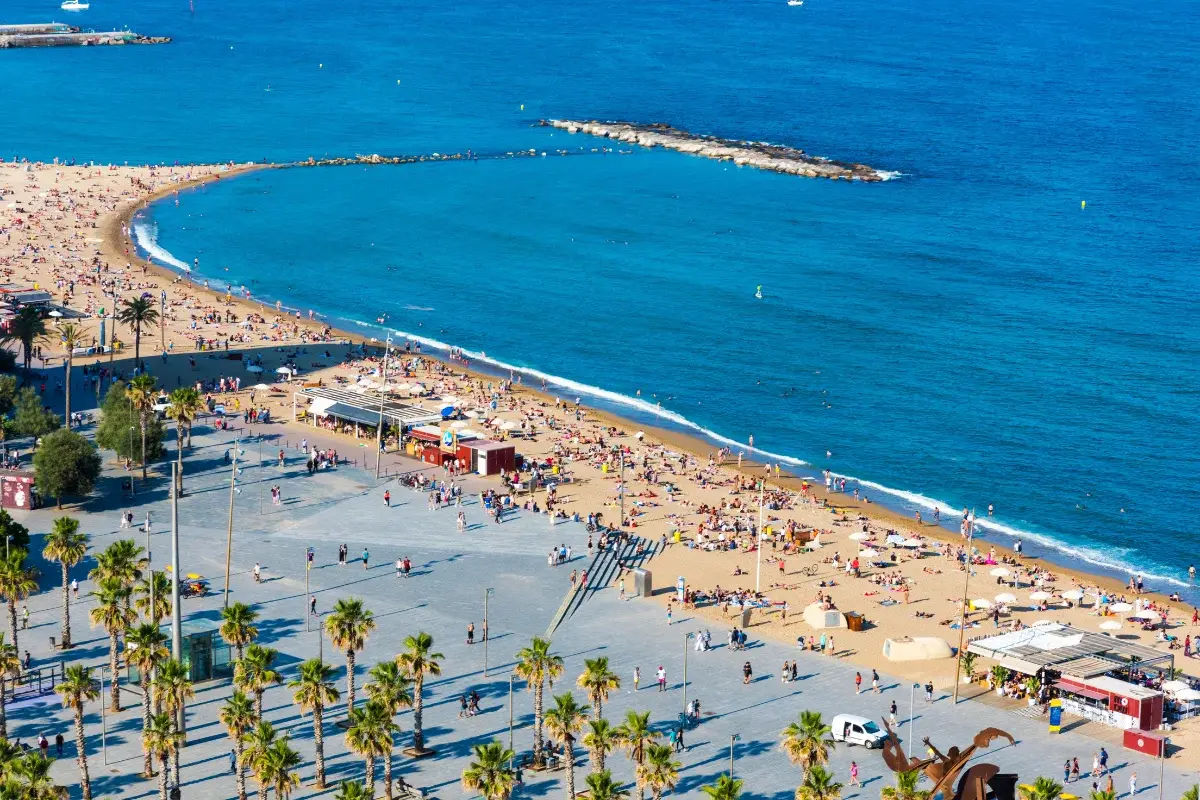

Before the 1992 Olympics, Barcelona’s seafront was an industrial barrier: shipyards, warehouses, rail tracks. Residents lived within meters of the Mediterranean with no access to it. In four years of construction, that barrier was dismantled. Rail infrastructure was buried underground, six kilometers of beaches were created with imported sand, and a yacht harbor was built on degraded industrial land. The walking route from Barceloneta to Port Olímpic covers that transformation in about 4km — from an 18th-century military fishermen’s quarter to a contemporary waterfront skyline. Metro L4, Barceloneta stop. Allow 3 hours with stops.
The most efficient starting point is actually Ciutadella Park — the same park that Felipe V built as a fortress in 1714 after demolishing the Ribera neighborhood. Ten minutes on foot from the park’s southern exit through Passeig de Joan de Borbó brings you to the beach. If you’re coming directly from the metro, exit at Barceloneta and head south.
Barceloneta — The Neighborhood Built on Military Calculations
The Barceloneta neighborhood was officially founded on February 3, 1753. It wasn’t a community initiative — it was an engineering solution. The same Felipe V who had demolished La Ribera needed to house the displaced families away from the walled city. Engineer Juan Martín Cermeño designed an orthogonal grid on a sand spit reclaimed from the sea — the former Isla de Maians, formed by Besòs river sediment — with streets oriented so the Ciutadella’s cannons could sweep any potential revolt.
Original houses had a strict height limit — ground floor plus one story — to avoid blocking artillery angles. As the population grew, floors were divided into “quarter-houses” of 25–35 m² each, producing the densest housing in Barcelona and a culture of life that happens in the street rather than at home.
The Church of Sant Miquel del Port (1753–1755) is the oldest surviving building from the founding. The Mercat de la Barceloneta, redesigned by Enric Miralles’s studio, opens Monday–Saturday from 7:30. The Bomba — a fried potato ball stuffed with meat, served with alioli and hot sauce — was invented in this neighborhood in the 1950s at La Cova Fumada, which is still open, still cash-only, still closes when the food runs out.
Time here: 30–40 minutes.
Quick Decision — How to Use This Route
- 90 minutes → Skip the neighborhood interior, start at the beach: L’Estel Ferit → El Peix → Olympic towers — the sculptural and architectural sequence
- 3 hours → Full route: neighborhood streets + Passeig Marítim + Port Olímpic with the twin tower comparison
- By bike → The seafront cycling lane covers the entire route uninterrupted; Bicing stations on Avinguda Litoral; the cycle version takes about 40 minutes without stops
- Best photography, morning → Lateral light hits El Peix’s steel “scales” directly; arrive before 10:00 in summer to avoid crowds on the beach
- Best photography, sunset → From the end of Port Olímpic’s inner harbor with the towers backlit
- With the cable car → Torre de Sant Sebastià at the southern end of Barceloneta is one station of the Barcelona cable cars that crosses the harbor to Montjuïc
The Beach and the Passeig Marítim — What Was There Before
Barceloneta Beach stretches over a kilometer. Before 1992, it was a degraded strip with informal beach bars (chiringuitos) that went back decades — structures residents defended as part of the neighborhood’s identity. The Olympic project demolished all of them.
German artist Rebecca Horn had lived in Barcelona in the 1960s and became seriously ill working with fiberglass without protection. Her sculpture L’Estel Ferit (“The Wounded Star,” popularly “the cubes”) is a ten-meter tower of four iron-and-glass cubes standing in the sea at Platja de Sant Miquel. It commemorates the lost chiringuitos and the minimal housing culture of the neighborhood. Horn’s personal biography — illness from unprotected industrial material work — is embedded in the choice of materials. Walk around it completely; it reads differently from each angle.
The Passeig Marítim runs 1.5 kilometers from the neighborhood to Port Olímpic. What is now a cycling, running, and terrace axis was previously the boundary where the city stopped and inaccessible industrial land began. The Olympic project conceived it as the city’s new public living room facing the Mediterranean — the most visible urbanism intervention of the entire 1992 reform.
Time for this section: 30 minutes walking.
El Peix de Frank Gehry — The Sculpture That Preceded the Guggenheim
At the foot of the Hotel Arts stands the most important sculpture on the seafront: El Peix (The Fish) by Frank Gehry, 56 meters long and 35 meters high in golden stainless steel. Gehry designed it using aeronautical design software — the same system he later applied to the Guggenheim Bilbao. The steel framework simulating fish scales is calculated so Barcelona’s sun changes the piece’s color through the day: intense gold in the morning, silver at noon, copper at sunset.
It is the work that best summarizes the Olympic project’s intention: using monumental-scale art as a transition between the towers’ verticality and the sea’s horizontality. Walk under it and look up — the scale only registers from beneath.
Time here: 10 minutes.
The Twin Towers — Same Height, Opposite Logic
The Hotel Arts (Bruce Graham / Skidmore, Owings & Merrill) and Torre Mapfre (Ortiz & León) are exactly the same height: 154 meters. The coincidence is planned — they were designed as a matched pair, a monumental gate to the harbor from the sea. But they are structurally opposite:
| Hotel Arts | Torre Mapfre | |
|---|---|---|
| Architect | Bruce Graham (SOM) | Ortiz & León |
| Structural system | Exposed steel exoskeleton | Slip-form concrete core |
| Use | Luxury hotel | Corporate offices |
| Aesthetic | Industrial-refined, St. Andrew’s crosses on corners | Mirror facade, sky camouflage |
The Hotel Arts exoskeleton — the white steel grid visible on the exterior — is functional: the St. Andrew’s cross bracing on the corners handles cantilever stresses from sea winds. It was one of the first buildings in Spain designed entirely with computer systems.
Time here: 10 minutes.
Port Olímpic — What It Was Built For and Where It’s Going
Port Olímpic was built on Poblenou industrial land to host the 1992 Olympics sailing events. Designed by Oriol Bohigas, Josep Martorell, David Mackay, and Albert Puigdomènech. It has 700 berths and in the years after the Games became Barcelona’s most-visited — and loudest — nightlife zone, with resident conflicts that continue today.
The current direction is the opposite: fewer clubs, more public space, focus on water sports, quality restaurants, and improved pedestrian access. The Moll de Gregal — the inner harbor — has waterfront restaurants that make a natural endpoint for the route.
For the adjacent neighborhood context, the Poblenou Barcelona guide covers the creative district immediately north of the harbor.
What stood on the Somorrostro site before the beaches
Beyond El Peix and the Olympic transformation, the layer worth knowing is what stood on the Somorrostro site before the beaches existed.
The beaches of Nova Icària and Bogatell — the ones between Barceloneta and Port Olímpic — did not exist before 1992. The ground they sit on was the Somorrostro, an informal settlement that occupied this coastline for decades. At its peak in the mid-20th century, thousands of people lived here in shacks with no running water or sanitation, separated from the city by industrial infrastructure. The Olympic construction displaced the remaining residents and reshaped the coast entirely.
Walking these beaches knowing the Somorrostro was here changes the experience. The “natural” seafront that Barcelona now presents as its identity is an engineered product, 30 years old, built over a displaced community. That history doesn’t diminish the achievement — it contextualizes it.
Practical Information
- Metro: L4, Barceloneta (start) or Ciutadella/Vila Olímpica (midpoint, near Port Olímpic)
- Summer hours: before 10:00 to avoid beach saturation; the Passeig Marítim is usable all day but Barceloneta beach fills by 11:00 in July–August
- Winter: any time — quieter, better for El Peix photography, clearer light
- Eating in Barceloneta: avoid first-line beach restaurants (tourist pricing) — the neighborhood interior has better food at honest prices
- La Cova Fumada (C/ del Baluard): the Bomba’s origin — opens in the morning, closes when the food runs out, no reservations, cash only
- Cycling: the seafront cycle lane is continuous; the Barceloneta beach section has no cycle lane, go on foot there and rejoin the Passeig Marítim after
Barcelona spent centuries turned away from the Mediterranean. Four years of work in the 1990s changed what two centuries hadn’t. The route from Barceloneta to Port Olímpic is the most direct way to understand that transformation — and to see that what now looks obvious, a city open to the sea, was for a very long time an idea nobody finished executing.
For the neighborhood in more detail: the Barceloneta guide covers the historic interior beyond the beach. For waterfront dining at the end of the route, seafront restaurants Barcelona maps the best options along the maritime front. And for the best sunset spots in Barcelona, the Port Olímpic inner harbor makes the top of the list when the towers are backlit.