
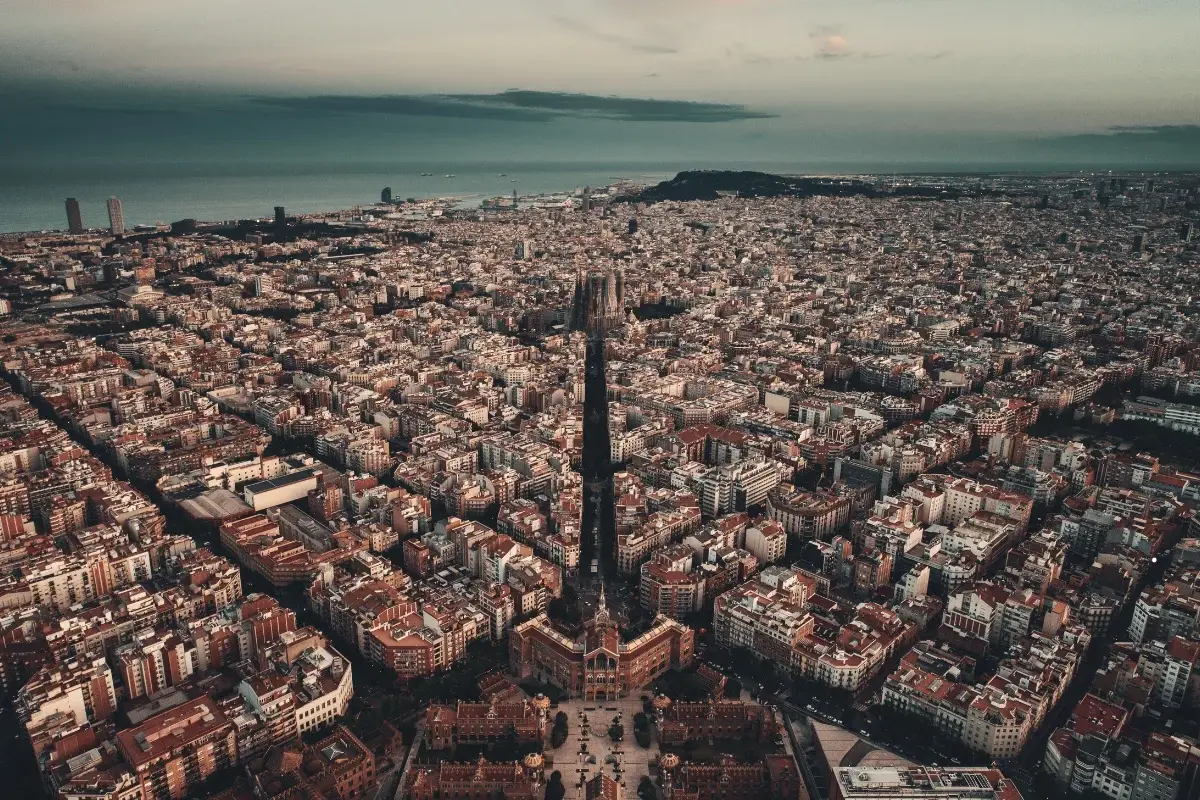

By the late 19th century, Poblenou had more factories per square kilometer than any other neighborhood in Barcelona. The nickname was earned: el Manchester català — the Catalan Manchester. Steam-powered textile mills, chemical plants, engineering workshops and food processing facilities filled the blocks between the rail lines and the sea. The labor movement that organized within those walls staged the strikes that changed Spanish labor law in 1919 (the eight-hour day, organized in the adjacent Barceloneta La Canadenca plant) and built the political culture that made Barcelona’s anarchist and socialist movements among the strongest in Europe.
The 2000 Plan 22@ converted the industrial land designation to technological and creative use. In 2006, facing pressure from heritage advocates, the city catalogued 114 specific industrial elements as protected patrimony — which is why today you can work in a co-working space with original 19th-century brick vaults overhead, or have coffee in a café built inside a former dye works.
The neighborhood that replaced the factories is not a clean-slate tech park. It’s a layered space where the physical record of the industrial era is preserved under the current uses, sometimes literally — the same walls, the same floors, the same chimney stacks.
Poblenou is worth understanding before visiting, because what you see there only makes sense with context.
The Rambla del Poblenou: Start Here
The Rambla del Poblenou runs approximately 1km from the Gran Via to the sea. It has nothing in common with Las Ramblas downtown except the name and the tree-lined format. No souvenir shops, no pavement artists working for tips, no tourist infrastructure. The Casino de l’Aliança at the far end has been the neighborhood’s cultural center since the late 19th century — still functioning, still hosting events, still used by residents.
Walk it south from the Gran Via in the morning for the first orientation to the neighborhood. The Rambla gives you the mix: old residents who’ve been here since the factory era, younger professionals who moved in with the 22@ development, and the small commercial layer that serves both. The best cafés in Barcelona guide identifies specific options along and around the Rambla for coffee stops.
The Industrial Heritage: What the Law Protected
In 2006, the 22@ plan’s heritage catalogue identified 114 elements that couldn’t be demolished or structurally altered. The result is visible throughout the neighborhood — factory buildings that now contain offices, schools, cultural centers and restaurants, with the original structural logic preserved.
Can Ricart (1852): the most complete example — a neoclassical factory complex declared a National Cultural Heritage Asset. Original structure preserved. The courtyard is accessible.
Can Felipa (1855): Parisian-aesthetic textile factory, now a Civic Center with a theater and historical archive. Free access to most of the building.
La Escocesa (1852): chemical factory for textile dye, now a visual arts center with active artist studios. Open studio sessions are periodic — check the schedule for public access.
Ca l’Alier: former textile mill, now tech offices. The contrast between the 19th-century brick structure and the contemporary office interior is visible from the street through the ground-floor windows.
The best way to see this heritage is walking without a fixed route through the streets between Carrer de Pallars and Carrer de Sancho de Ávila — the highest concentration of rehabilitated industrial buildings and street art in the neighborhood.
The Street Art: Managed and Unmanaged
Poblenou has the most organized street art ecosystem in Barcelona. The Wall Spot initiative allows the city to assign vacant lot walls to artists for legal mural production, with periodic renewal as lots are developed. This creates an outdoor museum that changes with the neighborhood’s construction timeline.
Some murals are permanent (on building facades), some are temporary (on vacant lot walls). The neighborhood looks visually different year to year.
Notable works:
The Neus Català mural (by Roc Blackblock) is one of the most discussed — a tribute to the Catalan anti-fascist resistance fighter who survived the Ravensbrück concentration camp. The political weight of the image in a neighborhood with strong labor movement history is deliberate.
The PobleZoo project (Tim Marsh) has placed geometric animals on facades across the neighborhood, visible as a parallel reality through an augmented reality app — one of the few cases in Barcelona where street art uses technology coherently rather than decoratively.
The most concentrated street art zone: the area around Carrer de Pallars and Carrer de Sancho de Ávila. Walk it without a specific destination and the art reveals itself.
Museu Can Framis: The Art Museum Nobody Queues For
The Fundació Vila Casas converted a late 18th-century cloth-making factory (fàbrica d’indianes) into a museum of contemporary Catalan painting. The architectural rehabilitation by Jordi Badia integrated the historical structure with a glass and steel intervention that frames rather than competes with the original.
The collection covers Catalan painting from the 1960s to the present — a chronological and thematic span that few Barcelona institutions document with this coherence. For visitors interested in Catalan art beyond the Modernisme generation, this is the most comprehensive single stop available.
Entry fee: check current schedule. Closed Mondays. The museum is on Carrer de Roc Boronat, 10 minutes from metro Llacuna. Visitor volume is low enough that you’ll often have galleries to yourself.
For the full picture of Barcelona’s museum landscape, the best museums in Barcelona guide places Can Framis in context alongside the MNAC, the Fundació Miró and the hidden museums guide.
IDEAL Centre d’Arts Digitals: The Immersive Experience Space
A former industrial building now housing large-format digital immersive exhibitions — 360° projections of Klimt, Van Gogh, Gaudí and other subjects, at a scale that fills the full volume of the space.
This is not a museum in the conventional sense. It’s a sensory experience designed for impact rather than scholarship. The audience tends to be different from the museum audience — families, visitors who respond to visual scale, people who want to understand an artist through atmosphere before encountering the original works.
For visitors planning to visit Casa Batlló or the Sagrada Família, a prior IDEAL session on Gaudí’s work gives visual vocabulary that the monument visits then contextualize. Entry and hours vary by exhibition — book online.
The Cemetery: The Kiss of Death
The Cementiri de Poblenou opened in 1775 as one of the first modern public cemeteries in Europe — built outside the city walls for public health reasons, anticipating the hygienic urban logic that Cerdà would formalize a century later.
The cemetery is an open-air museum of 19th and early 20th-century funerary sculpture. The industrial bourgeoisie of Barcelona’s factory era competed in the scale and quality of their family tombs here with the same energy they used on Modernista facades in the Eixample.
The most reproduced work: El Petó de la Mort (The Kiss of Death, 1930) by Jaume Barba — a winged skeleton holding a young dying figure. The image has appeared on album covers, book jackets and documentary films internationally. The original is at the main entrance.
Free entry, open during morning and afternoon visiting hours.
The Beaches: Less Crowded Than the Barceloneta
The beaches in Poblenou’s coastal section — Bogatell, Mar Bella and Nova Mar Bella — have the same Mediterranean water and same lifeguard coverage as the Barceloneta, with consistently lower density. In July and August when the Barceloneta central stretch is at maximum capacity, these beaches have space.
Mar Bella has a traditional naturism zone and is frequented by established communities who’ve used the same area for decades. Bogatell is the most serviced, with the Blue Flag standard maintained consistently.
The Passeig Marítim seafront path connecting these beaches to the Barceloneta is one of the most usable cycling routes in Barcelona — flat, parallel to the sea, separate from motor traffic. The cycling routes in Barcelona guide covers the full waterfront cycling network.
For comparison with La Barceloneta and the differences in beach culture and neighborhood character, the Barceloneta guide gives the full context.
The Palo Alto Market
The Palo Alto Market runs the first weekend of each month in a garden-integrated industrial complex — manufacturer studios active within the same space as the market stalls. The curation is genuine: the vendors are designers and producers rather than resellers, and the selection changes with each edition.
The format (food trucks, live music, workshops, designer goods) creates a full-day program rather than a shopping stop. The industrial-garden setting is specific to this market and doesn’t exist elsewhere in the city.
Not every month has an edition — verify the calendar before planning a visit. The market website publishes the annual schedule.
The Artisan Beer Scene
Poblenou has the highest concentration of craft brewery taprooms per square kilometer in Barcelona. Garage Beer Co., Edge Brewing and Cervesa del Poblenou all have their operations and taprooms in or immediately adjacent to the neighborhood.
The Fira de Cerveses del Poblenou (July, Parc del Poblenou) is the largest craft beer festival in Spain: 45+ breweries, 250+ references, approximately 25,000–30,000 attendees across the weekend editions.
Best Strategy
Half day: Rambla del Poblenou from the Gran Via south → Can Framis museum → industrial heritage walk (Carrer de Pallars area, street art circuit) → beach at Bogatell or Mar Bella.
Full day: Half day above + Palo Alto Market (first weekend of the month) or IDEAL immersive exhibition + Cementiri de Poblenou afternoon + craft brewery taproom evening.
Sunday specifically: Rambla del Poblenou → Palo Alto Market (if it’s the first weekend) → afternoon beach → evening at a taproom.
Mistakes to Avoid
- Expecting the 22@ district to look like a tech campus — it doesn’t. It looks like a neighborhood where old factory buildings have been converted to new uses while keeping their architectural character. The brick-and-glass mix is the point.
- Missing Can Framis — it’s a quiet, high-quality museum with very low visitor density. The combination of the rehabilitated factory building and the contemporary Catalan painting collection is specific and worth the detour.
- Going to the Palo Alto Market without checking the calendar — not every month has an edition, and the schedule is published on their website. Arriving on a non-market weekend finds a closed gate.
- Treating the Poblenou beaches as an afterthought — they’re significantly less crowded than the Barceloneta in peak season and have the same water quality. If beach time is part of the day, starting at Bogatell rather than the Barceloneta saves 30–60 minutes of crowding.
The district hosts the city’s light-art festival, which left the Gothic Quarter in 2018 and now draws around 300,000 people across three free February nights, as the Llum BCN guide explains. Its other landmark opened its own observation deck, described in the Torre Glòries viewpoint guide.
Final Insight
Poblenou’s industrial heritage protection law came in 2006, six years after the 22@ plan that triggered it. The law was a response to what was already being demolished. The 114 elements it protected are what survived the first six years of the tech district conversion — which means that what you see today is not all that existed, but what was preserved when someone decided the loss was worth preventing. The neighborhood’s character as a layered space rather than a clean-slate development is the result of that political decision, made under pressure, later than it should have been, but not too late.
For the full picture of Barcelona’s neighborhoods — how Poblenou connects to El Born, the Barceloneta and the broader waterfront — the Barcelona complete travel guide gives the geographic and cultural logic of the city’s eastern districts.