
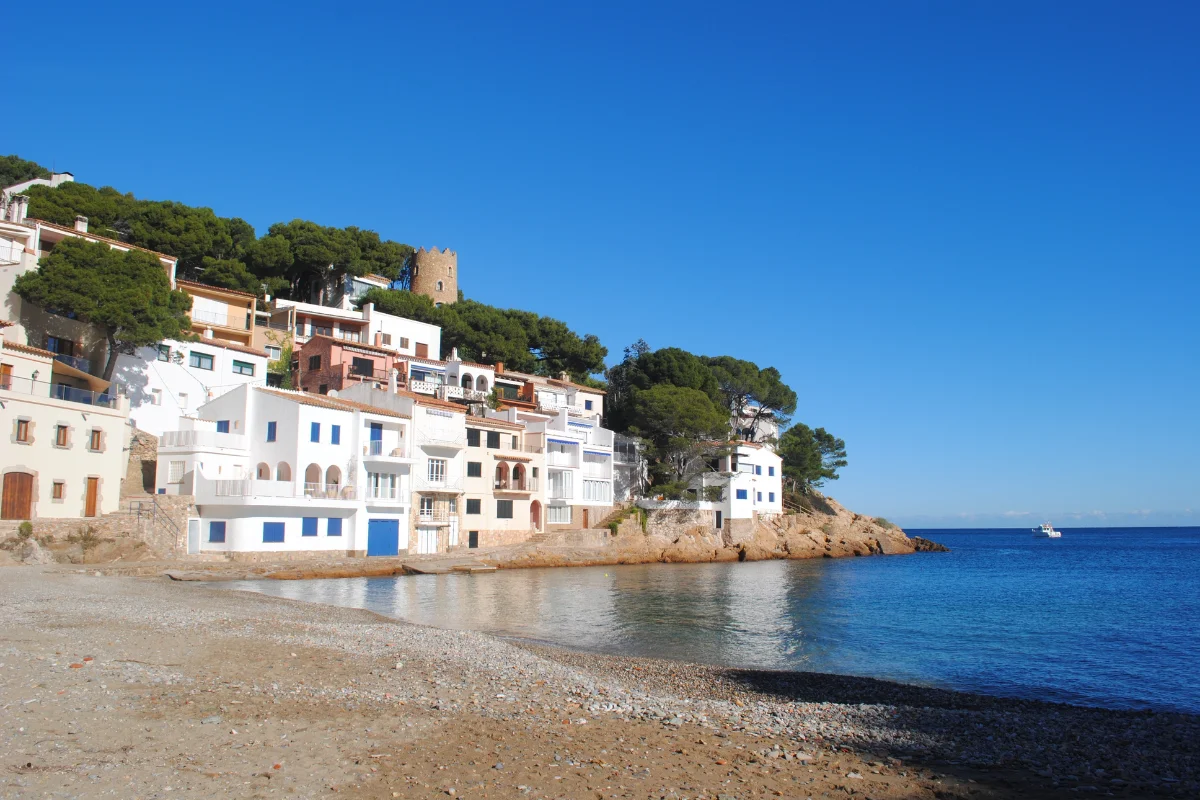

The phrase “Costa Brava” was first published in 1908. The author was journalist Ferran Agulló; the location was Fornells, one of the coves of Begur’s municipal territory. The article described a stretch of coastal rock, pine and cliff that looked nothing like the smooth sandy coastline further south, and needed a name that matched — brava meaning wild, rugged, untamed. The denomination stuck and eventually named the entire Girona coastline.
Begur is the town that named the Costa Brava, and it looks the part. The Macizo de Begur rises to 300 meters and drops directly into the Mediterranean through a series of coves cut between granite headlands. The town on top has six defensive towers built against 16th-century Berber piracy — each one a private refuge, not a public fortification — and a collection of colonial-style mansions built by emigrants who returned from Cuba and Puerto Rico in the 19th century with enough money to transform the village entirely.
These three layers — piracy defenses, Cuban colonial architecture, and coves preserved by accident and geology — are the reason Begur looks the way it does.
What should you see in Begur? The castle at the summit (10-minute walk, 360° views to Cap de Creus and Montserrat on clear days). Six defense towers distributed through the old town — each privately built under royal license in the 16th century. Indianas mansions — colonial-style houses from the 19th century with Caribbean frescos and palm tree gardens. Three Camino de Ronda sections (1.5–2.5km each). Eight coves from Aiguablava (turquoise, families) to Platja Fonda (wild, no services, steep staircase). Bus Platges connects the town to the coves June 14–September 14.
Quick Decision: Which Cove for Which Visit
- Turquoise water, fine sand, full services → Cala Aiguablava — the most photographed, most crowded, parking fills before 9:00 in July–August
- Fishing village atmosphere, colorful houses → Cala Sa Tuna — the most photographed cove in Begur; terrace restaurants directly on the sand
- Wild naturism, red rock island → Illa Roja — no services, no road access, Camino de Ronda only, nudism traditional
- Least-known cove, minimal tourists → Cala S’Eixugador — 10-minute detour off the East Camino de Ronda from Sa Tuna, not on most maps
- Dark sand, dramatic cliffs, no services → Platja Fonda — accessible only by long steep staircase, strong contrast with Aiguablava 2km away
- Beach for swimming, smaller crowds than Aiguablava → Aiguafreda — sheltered by Puig Rodó, calmest water in the area, limited paid parking
- Family beach with surf culture → Aiguadolç — surf schools, 145m, full services
The Castle and the Defense Towers
The Castell de Begur has been demolished three times — during the War of the Reapers (17th century), the Napoleonic War (19th century) and the Carlist Wars — and now functions as a consolidated ruin that serves as the best observation platform in the municipality. In clear conditions the view simultaneously captures Cap de Creus (north), the Medes Islands, Montserrat (southwest) and the Pyrenees. The 10-minute walk from the town center makes it the highest-return investment of any stop in Begur.
The six defense towers are more historically unusual than the castle. In the 16th century, as Berber piracy intensified following the fall of Constantinople and the Ottoman expansion in the Mediterranean, Begur’s wall circuit was too expensive to maintain. The solution was a decentralized private defense system: prominent families were licensed under royal authorization to build their own refuge towers. Each tower had thick walls, minimal windows and an entrance set several meters above ground level — accessible only via a retractable wooden ladder that was pulled up during attacks.
The towers functioned as a coordinated visual network with the castle. Together they created interlocking lines of sight over the territory.
Torre Pella i Forgàs (Carrer de Sant Antoni): distinctive arabesque motifs on the windows, built directly on bedrock. Connected to historian Josep Pella i Forgàs.
Torre de Can Marquès (Carrer de la Vera): two communicating levels with a rooftop designed for active defense — stone projection positions still visible.
Torre del Mas d’en Pinc (eastern outskirts): The tower where Carmen Amaya — considered by many the greatest flamenco dancer of the 20th century — lived from 1961 until her death in 1963. Amaya personally funded the first electric illumination of the Begur castle. The tower is now an interpretation center with exhibits on her life and the local environment.
The Indianas Houses: Architecture Funded by Cuba
In the mid-19th century, three simultaneous crises — the collapse of coral fishing prices, a cork sector crisis and the phylloxera plague that destroyed the vineyards — pushed approximately one quarter of Begur’s population to emigrate to Cuba and Puerto Rico. Those who made money and returned built the buildings that now define the town’s visual identity.
The recognizable features: symmetrical facades with painted frescos of Caribbean landscapes, arcaded galleries designed for tropical ventilation, palm tree gardens as status symbols, and iron railings with the owner’s initials and the construction year in relief.
Can Pere Roger (1859): one of the most palatial, with a double rear gallery. Pere Roger Puig funded it from his Havana tobacco factory “La Rosa.”
Can Bonaventura Caner (1866): linked to the cork industry, the capital reinvested locally.
Can Sora (1870): restored exterior frescos with romantic Havana landscapes in the courtyard.
Casa Paco Font (early 20th century): the last Indianas house built in Begur, incorporating Modernista elements and trencadís ceramic that distinguish it from the classical predecessors.
The Town Hall (1902): originally a private Indianas palace, neoclassical style, now housing the municipal administration.
The Casino Cultural (1870), collectively funded by returning emigrants, still functions today as a cultural center — the social hub of the 19th-century bourgeoisie that never stopped being one.
The Centro de Interpretación de los Indianos de Cataluña in the Escoles Velles has the full historical narrative of this migration period for anyone wanting the complete context.
The Three Camino de Ronda Sections
The Caminos de Ronda were originally coastal surveillance paths for piracy detection and smuggling control. Now marked hiking routes between coves.
North Section — Sa Riera to Platja del Racó: 1.6km, medium difficulty (steps), approximately 90 minutes. Passes the Cala del Rei with direct views of Illa Roja and the bay of Pals.
East Section — Sa Tuna to Aiguafreda: 1.5km, low difficulty, approximately 20 minutes. The quietest section. Cala S’Eixugador — a wild cove with virtually no visitors — is 10 minutes off this route via a signed detour. It doesn’t appear on most maps. Worth the deviation.
South Section — Aiguablava to Platja Fonda via Fornells: 2.5km, medium difficulty, approximately 2 hours. The most varied — crosses tunnels cut through rock, passes residential architecture integrated into the cliff face, ends at the dramatic contrast of Platja Fonda. The best section in the municipality for visual diversity.
The Beaches Organized by Access and Character
| Cove | Character | Services | Access | Note |
|---|---|---|---|---|
| Platja del Racó | Wide, open | Full | Bus Platges | Cold War Radio Liberty station preserved it |
| Illa Roja | Wild, red island | None | Camino de Ronda North | Traditional nudism |
| Sa Riera | Largest beach | Full | Bus Platges | Fishing village feel |
| Aiguafreda | Snorkel, calm water | Limited | Paid parking | Sheltered by Puig Rodó |
| Cala Sa Tuna | Most photogenic | Restaurants | Road (limited) | Colored fishermen’s houses |
| Platja Fonda | Dark sand, wild | None | Long steep staircase | Strong contrast to Aiguablava |
| Fornells | Village, harbor | Full | Road | Where “Costa Brava” name was coined |
| Cala Aiguablava | Turquoise, fine sand | Full | Bus Platges / Paid parking | Most crowded; park before 9:00 |
Bus Platges runs June 14–September 14 from Plaça Forgas to Sa Riera, Sa Tuna and Aiguablava — the most practical option for the coves in high season.
A Cold War transmitter is why Platja del Racó is empty
The undeveloped state of Platja del Racó is not the result of conservation planning. During the Cold War, the area housed a Radio Liberty transmitter station — an American-funded anti-Soviet broadcast infrastructure. The institutional presence of that facility for decades made real estate speculation politically inconvenient and practically impossible. When the station finally closed, the surrounding land had been untouched long enough to acquire informal protection through accumulated status. The beach today is wild because a Cold War radio station sat next to it.
This is a category of preservation that doesn’t appear in heritage documentation or tourism materials, but it’s the accurate explanation for why Platja del Racó looks different from every neighboring stretch of coast.
Esclanyà: 5km of Village Without Tourists
Five kilometers inland, Esclanyà is the quiet counterpoint to the coastal dynamism. The Church of Sant Esteve has Romanesque origins documented from 1280, with foundations from the 10th century. The Castell d’Esclanyà — a 14th-century rectangular tower with crenellations attached to a masía (farmhouse) — is designated a Bé Cultural d’Interès Nacional. One window is dated 1704, allowing the building’s functional evolution across three centuries to be traced.
For one hour of medieval architecture without other visitors: Esclanyà is the correct stop.
The Indianos Fair and the Event Calendar
The Fira d’Indians runs the first weekend of September. The town covers its streets in white sand, residents dress in white with Panama hats, and a colonial-era market sells coffee, rum, cocoa and spices. Cuban music groups, street performances and historical recreations fill the programming. It’s the most-attended event in the municipality.
Other events: the Festival de Música de Begur (July–August, 46+ editions), the Begur Film Festival (October, international comedy specialization), and the Peix de Roca Gastronomy Campaign (spring, restaurant menus built around rockfish — scorpionfish, red mullet, sea bream — from the local rocky seabed).
Who Is This Visit For
You want the most dramatic Costa Brava scenery → Camino de Ronda South section + Platja Fonda for the contrast with Aiguablava. Two-hour walk.
You want the safest family beach with the best water color → Cala Aiguablava. Arrive before 9:00 or use the Bus Platges.
You want to understand the town’s historical layers → Castle + defense towers circuit + Indianas mansions walking route + Casa de Interpretació dels Indians.
You want a cove almost nobody knows → Cala S’Eixugador, 10-minute detour off the East Camino de Ronda.
You want the most photogenic setting → Cala Sa Tuna, colored fishermen’s houses directly on the sand.
You’re combining with inland medieval villages → Begur + Peratallada (20 minutes by car) is the strongest one-day coastal-and-medieval combination in the area. The Peratallada medieval village guide covers the fortified village in detail.
Getting There
From Barcelona: Direct Sarfa (Moventis) bus from Estació del Nord or El Prat Airport. Approximately 2h35, around €26, departures every 4 hours.
From Girona: R11 train to Flaçà + bus 8B to Begur. Approximately 2 hours, around €15. The Girona from Barcelona guide covers Girona as a half-day base before continuing to Begur.
By car: AP-7 from Barcelona, approximately 100km. Town center parking: blue zone at Escoles Velles and Plaça dels Indians. Free alternative: Camp de Futbol car park, 10 minutes on foot.
Mistakes to Avoid
- Arriving at Cala Aiguablava after 10:00 in July or August without the Bus Platges — the paid parking fills completely and there’s no overflow. Use the bus or arrive at 8:30.
- Planning the Castle visit in the middle of the day — the views are best in morning or late afternoon light. Midday is flat and hot.
- Missing Cala S’Eixugador — it’s 10 minutes off the East Camino de Ronda and almost nobody goes there. The detour signs are small; look for them between Sa Tuna and Aiguafreda.
- Treating the Indianas houses as background scenery — the construction stories (tobacco factories in Havana, cork reinvestment from Puerto Rico) are what make the architecture legible rather than decorative.
- Going to Platja Fonda without the right footwear — the descent staircase is long and steep. Not a sandals situation.
Final Insight
Begur’s character is the product of three types of isolation: geographic (the Macizo makes the coves difficult to reach), economic (the 19th-century crises pushed residents away and their return capital transformed rather than developed the town), and Cold War institutional (a radio transmitter preserved one beach that speculation would have consumed). None of these were preservation policies in the conventional sense. They were accidents that produced an outcome better than planning often achieves. The “Costa Brava” that Ferran Agulló named in 1908 from Fornells is still recognizable in Begur more than any other municipality along the coastline that bears the name.
For the full picture of the Costa Brava from a different angle, the Tossa de Mar guide covers the only fully intact fortified medieval settlement on the Catalan coast — a complement to Begur’s more fragmented medieval heritage.