
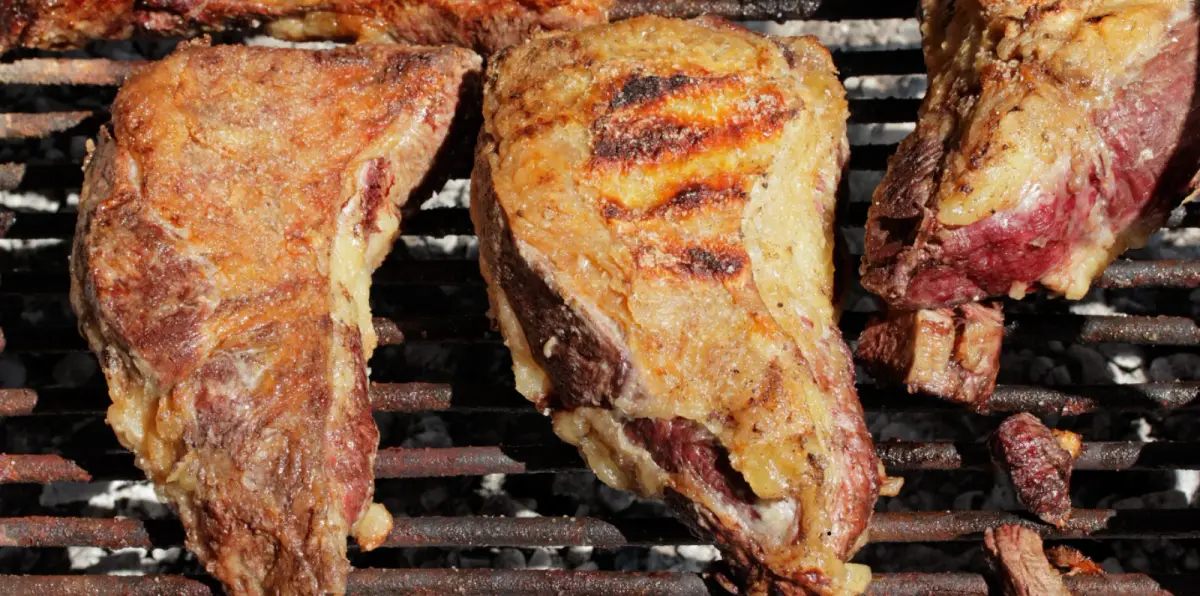

The waiter asks how you want it done and you say medium rare, and what lands is closer to well. This happens often enough in Barcelona’s Argentine grills that it deserves saying plainly: the room is packed, the fire is hot, and the words for doneness do not map cleanly between English and Spanish. Learning three of them, and learning which cut to attach them to, changes the meal more than picking the restaurant with the most stars ever will.
Order by cut, not by star rating
The single most useful skill in a Barcelona parrilla is knowing what to ask for. Entraña is the flavour-forward skirt-style cut most Argentines start with, thin and fast on the fire. Ojo de bife is the ribeye, more marbled and forgiving. Vacío is leaner flank, chewier and cheaper. Picaña, the rump cap, has a fat layer that bastes itself. Say the Spanish name and the kitchen knows you mean it.
For doneness, the words that work are jugoso for rare to medium rare, a punto for medium, and bien hecho for well done. Ask for jugoso and say it twice if it matters, because busy kitchens default upward.
Quick decision by what you want
- You want the asado as the whole evening → La Cabrera (Diputació 239) — €60 average, cuts explained and carved tableside
- You want a lot of meat for little money → Eixample neighbourhood grills — €20-30 a head, a mixed grill for two feeds three
- You’re chasing premium cuts → La Cabrera — tomahawk €90/kg, T-bone €95/kg, dry-aged €140/kg
- You only want empanadas → specialist empanaderías in Eixample and Sant Martí — €2.50-4 each, €29-30 a dozen
- You’re a large group → La Cabrera — seats up to 140, private rooms available
- You want a weekday bargain → set lunch menus in Les Corts and Ciutat Vella — around €18-20
- You want unlimited meat → all-you-can-eat grill buffet in the Eixample — around €30
Star ratings measure footfall, not the entraña
Ranking by stars and review count measures how many tourists walked past the door, not how the entraña came out. According to travel planners who track the city’s dining, a 40-cover grill on a busy Eixample street collects more opinions in a year than a neighbourhood parrilla does in 20.
The mechanism behind the numbers is specific. Several high-volume Eixample grills pour free sangria while you queue standing up, then send out a complimentary dessert or shot at the end. It works. Diners leave feeling looked after and leave 5 stars, and the steak may be solid without being exceptional. According to people who work in the trade, that single gesture explains more of the rating gap between venues than the beef ever does.
The practical filter: compare reviews relative to room size and years open, not in absolute terms. And treat the exact figures with suspicion, because the same restaurant shows wildly different counts across platforms, from 30,000 on one to 6,000 on another. Direction of travel is useful, precise numbers are not. Pair that scepticism with the best restaurants in Barcelona guide for a wider view of the city’s dining.
The two-hour table at the top end
La Cabrera sets the ceiling and carries the detail nobody mentions. It arrived from Palermo, Buenos Aires, where Gastón Riveira’s grill has spent years on Latin America’s 50 Best list, and it occupies a large room on Diputació 239 seating up to 140. The verified average is €60 per person before wine.
The distinction is ritual, not price. Staff explain each cut, chase your preferred doneness, then carve and serve at the table. Cold and hot sides and sauces arrive free in small dishes that crowd the table into cheerful chaos, and that clutter is the house signature. By the kilo, the top end reads tomahawk €90, T-bone €95, dry-aged €140.
Here is the part to know before booking: the table is yours for an estimated two hours, after which you are expected to leave. It is declared policy, not improvisation. If your plan is a long three-hour dinner with a second bottle, this is the wrong room, and knowing that in advance saves the awkwardness. Budget it against a realistic daily spend by traveller type before you commit.
Mistakes to avoid
- Saying “medium rare” in English. Ask for jugoso and repeat it. Busy kitchens overshoot when the room is full.
- Booking 9:30pm because that’s when locals eat. It is peak pressure. Arrive at 8pm for a calmer kitchen and a better cooked steak.
- Ordering a mixed grill each. A parrillada for two genuinely feeds three. Order one and add a starter.
- Judging by review count. It tracks footfall, not fire. Check reviews against room size and years open.
- Skipping the wine list check. A serious grill carries Malbec at several price points, not one token bottle.
- Expecting a long dinner at La Cabrera. Two hours, declared. Plan the night around it.
The rooms worth knowing by name
Three addresses cover most of what a visitor needs, and each solves a different problem.
La Cabrera (Diputació 239, Eixample) is the €60 ritual described above, seating 140, with the two-hour table limit. Book it when the asado is the whole evening.
Patagonia Beef & Wine (Gran Via 660, Dreta de l’Eixample) runs €30-45 and occupies the former Joieria Sunyer, seating over 100 with a private room for 12 and an imperial table for 16. Beef arrives imported from Argentina, the cellar mixes Argentine and Spanish bottles, and the room is air-conditioned, wheelchair-adapted and offers a braille menu. Metro Urquinaona. The trade-off: reviewers consistently call the atmosphere flat, so it suits business dinners rather than lively nights.
Don Asador (Comte d’Urgell 111, Esquerra de l’Eixample) is the €20-30 case study from earlier: generous parrillada, well-handled entraña and empanadas, and the small room where they pour you sangria while you stand and wait. Metro Urgell or Hospital Clínic.
La Malandrina (Pepe Rubianes 3, Barceloneta, and Bac de Roda 38, Poblenou) is the exact counterweight to La Cabrera, and has been for 20 years. Family-run, no tablecloths, no ceremony, with a mixed grill at €20.50-22.50 a head covering vacío, asado de tira, chicken, chorizo criollo and morcilla, and a typical spend of €10-20. Both sites sit on metro L4 and open every single day from 1pm to 11:30pm, which makes it the fallback when the rest of the city is shut. They pour Quilmes and Fernet-Cola, and there are vegetarian options. Two honest warnings: they take no bookings, so you queue, and reviewers consistently mention smoke in the room and sides that lag behind the meat. The kitchen is Uruguayan as much as Argentine.
Quick summary by plan
| What you want | Where to go |
|---|---|
| Premium beef and tableside ritual | La Cabrera |
| Best value for money | Don Asador |
| A large group or business dinner | Patagonia Beef & Wine |
| Cheap and filling, zero pretension | La Malandrina |
| To eat on a Monday when others close | La Malandrina |
| Empanadas only, to take away | Eixample or Sant Martí empanadería |
The practical coordinates
- La Cabrera — Eixample, Diputació 239. Metro Passeig de Gràcia (L2, L3, L4). €60 average. Best for the asado as the whole evening. Book ahead, and the table lasts 2 hours.
- Patagonia Beef & Wine — Dreta de l’Eixample, Gran Via 660. Metro Urquinaona (L1, L4). €30-45. Best for groups and business. Book ahead, private rooms for 12 and 16.
- Don Asador — Esquerra de l’Eixample, Comte d’Urgell 111. Metro Urgell (L1) or Hospital Clínic (L5). €20-30. Best for a generous grill on a budget. Booking essential Thursday and Friday.
- La Malandrina — Barceloneta (Pepe Rubianes 3) and Poblenou (Bac de Roda 38). Metro L4 for both. €10-20. Best for cheap and filling, Mondays included. No bookings, expect a queue.
Beyond the grill, empanadas, milanesa and the Italian half
Reducing Argentine food to beef is the standard error, and Barcelona has a parallel scene that often serves you better. Specialist empanaderías in the Eixample and Sant Martí consistently beat the empanadas at the grills, rating 4.8 and 4.9, at €2.50 to €4 each or €29 to €30 a dozen from the established brands.
Empanadas map to provinces, and ordering that way signals you know the food. Tucumana is the gold standard, knife-cut matambre beef with egg and cumin, traditionally baked in a clay oven. Cordobesa runs sweet-savoury with sugar, raisins and olives. Jujeña is the adventurous one, llama or goat with quinoa and real heat. Salteña is compact and baked without added fat, the lighter pick.
The other half of the menu is Italian by inheritance, because Argentina’s kitchen was built by Italian migration. Author milanesa houses in the Eixample average around €15 with beef, chicken and Angus options and generous portions. Lomiterías have imported the Córdoba steak sandwich as premium fast-casual, with a loaded lomito around €16, and many take no bookings at all, which makes them the reliable last-minute option. In the old town, Argentine-style pizza survives with fugazzeta and faina, a chickpea-flour flatbread served a caballo, riding on top of your pizza slice, a Río de la Plata habit that startles first-timers. It fits neatly alongside the Italian restaurants of Barcelona, which share the same migratory root from the other direction.
Malbec, and how to read a wine list
The wine list separates a serious asador from a tourist grill, and the test takes 10 seconds. According to experts who follow the Argentine scene, a real one carries Malbec from Mendoza at several price points rather than a single token bottle. The specialists push it further, with as much as 70% of the cellar from Argentine wineries, and that percentage is a more honest signal than any star rating.
Pairing has rules that actually work at the table. Mendoza Malbec carries fatty cuts like entraña and vacío. Ojo de bife, with more marbling, holds up better against a Cabernet Sauvignon or a blend. Offal and sweetbreads want acidity to cut the fat. And if dessert is flan with dulce de leche or a dulce de leche pancake, a sweet Torrontés finishes without cloying. Experts suggest asking directly for Mendoza and Río Negro bottles, the two regions that show up on the city’s best-built lists. If wine is its own interest, the wine tasting guide to Barcelona covers where to go deeper.
How to order, word for word
If Spanish is not your language, these 7 phrases are the script that works. Walk in and say “mesa para dos”. When the waiter asks about the meat, name the cut, not the size: “una entraña, jugosa”. If you want to share, “una parrillada para dos” feeds three. To open, “provoleta y empanadas”. For wine, “un malbec de Mendoza”. To close, “flan con dulce de leche”. And when the bill comes, “la cuenta, por favor”.
Two words do the heavy lifting. Jugosa is your defence against an overcooked steak, and repeating it is not rude, it is expected. Entraña is the cut that tells the kitchen you have done this before. Everything else on the menu is negotiable.
Frequently asked questions about Argentine restaurants in Barcelona
What should I order at an Argentinian steakhouse in Barcelona?
Order by cut, not by size. Entraña is the flavourful skirt-style cut most locals start with, ojo de bife is the ribeye with more marbling, and vacío is leaner flank. Provoleta and empanadas are the standard openers, and flan with dulce de leche closes it.
How much does an Argentine steak dinner cost in Barcelona?
Neighbourhood grills run €20 to €30 per person for a generous mixed grill. Mid-range sits at €35 to €50. La Cabrera averages €60 per person without wine, and premium cuts by the kilo reach €90 for tomahawk and €140 for dry-aged.
Why do Barcelona’s Argentine restaurants have so many five-star reviews?
Review volume measures tourist footfall, not meat quality. Several Eixample grills hand out free sangria while you wait for a table and a complimentary dessert at the end, which reliably lifts ratings. A place with 400 reviews can grill better than one with 30,000.
Do I need to book an Argentine restaurant in Barcelona?
Yes for the popular ones. Eixample grills are small rooms that fill up, especially Thursday and Friday nights, and waits happen even with a booking. La Cabrera seats up to 140 but limits your table to two hours, which is worth knowing before you sit down.
Is Argentine beef in Barcelona actually from Argentina?
Not always, and it matters less than you think. Many top grills import Argentine cuts, but others use Spanish or Angus beef cooked with Argentine technique over charcoal and wood. The tradition is the fire and the cut, not only the passport of the cow.
Learn three words, entraña, jugoso and Malbec, and Barcelona’s Argentine grills stop being a lottery and start being a choice.