
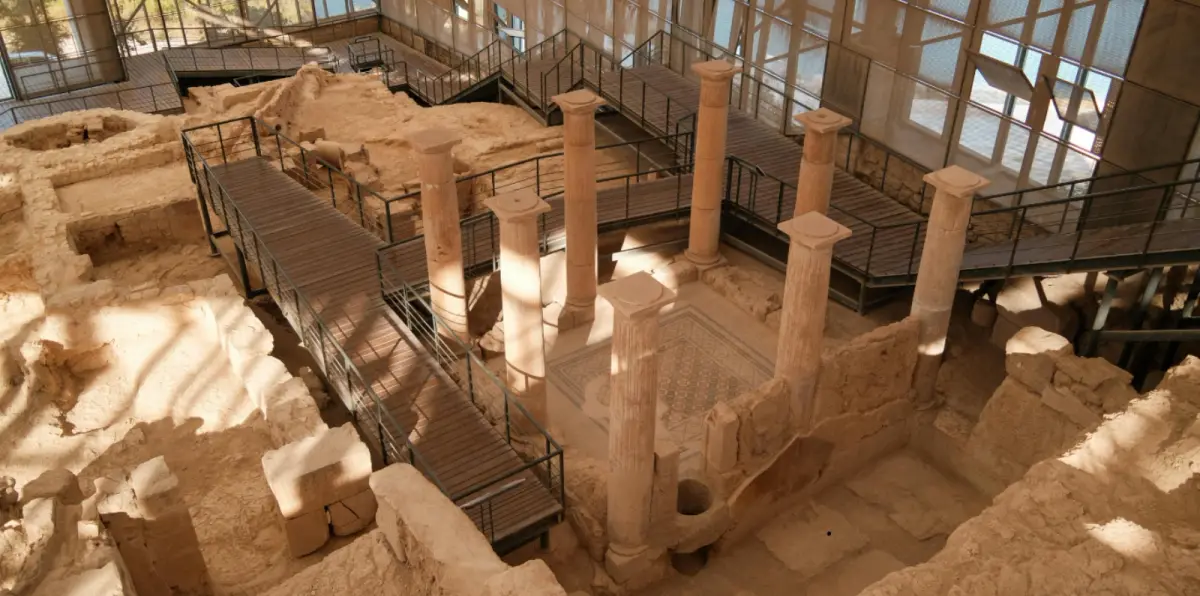

The Romans of Barcelona did not leave behind an amphitheatre or a triumphal arch. They left a laundry that ran on fermented urine, tanks where fish guts rotted in the sun into the empire’s favourite sauce, and a winery that shipped bottles across the Mediterranean. All of it sits four metres under the prettiest medieval square in the Gothic Quarter, and the only reason anyone knows it exists is that in 1931 somebody moved a palace and dug in the wrong place.
What one ticket actually buys you
Here is the thing almost every visitor gets wrong, and it costs them money. The MUHBA ticket is not a ticket to Plaça del Rei. It is a combined pass valid across every MUHBA centre in the city, roughly 15 heritage spaces scattered from the Gothic Quarter to Collserola. Most people pay, walk the underground, and never use the pass again.
The Roman ones cluster within walking distance of each other. The Temple of Augustus on Carrer del Paradís 10 hides four Corinthian columns, 9 metres tall on a 3-metre podium, inside a Gothic courtyard most tourists walk past. The Via Sepulcral Romana at Plaça de la Vila de Madrid displays tombs from the 1st to 3rd centuries lining both sides of a road, built outside the walls because Roman law banned burial inside the city. Add El Call, the medieval Jewish quarter, the Domus de Sant Honorat, and the Civil War air-raid shelter Refugi 307, and one payment covers a full day.
The strategic read: Plaça del Rei plus Temple of Augustus plus Via Sepulcral makes a half-day Roman route on foot, on a single ticket. Pair it with the wider Gothic Quarter guide and the day builds itself.
The visit in 2 minutes
- Where — Gothic Quarter, entrance on Carrer del Veguer, metro Jaume I (L4)
- How long — 1.5 to 2 hours for the full route, underground plus medieval halls
- Price — reduced entry from €5.20, free for under-16s
- When it’s free — first Sunday of the month all day, other Sundays from 3pm
- The catch — last entry is 45 minutes before closing, not 30
- What nobody uses — the ticket is combined and covers around 15 MUHBA sites
- Best for — anyone who wants the city’s origin story rather than its Modernista postcard
The 45-minute rule that locks people out
This is the operational detail that ruins visits. MUHBA Plaça del Rei opens Tuesday to Saturday from 10am to 7pm, and Sunday from 10am to 8pm, closed Mondays plus 1 January, 1 May, 24 June and 25 December. But last entry is 45 minutes before closing, and that is unique to this site: every other MUHBA centre lets you in until 30 minutes before.
Do the arithmetic before you go. Saturday’s real cut-off is 6:15pm. Sunday’s is 7:15pm. And since Sunday is free from 3pm, the actual free window runs 3:00pm to 7:15pm, not to 8pm. Turn up at 7:30pm on a Sunday believing you have half an hour and the door is shut.
Free entry applies to under-16s always, to Barcelona Card holders, on the first Sunday of the month all day, and every other Sunday from 3pm. The reduced rate is €5.20 for under-29s, over-65s, unemployed visitors and large or single-parent families. According to the museum’s own guidance, booking online in advance is the way to go, since it lets you pick a time slot and skip the queue. Set the cost against a realistic daily budget by traveller type and it is one of the cheapest serious sights in the city.
Why Barcino looks nothing like Tarraco
Understanding this before you descend changes what you see. Barcino was founded around 10 BC as a colony for army veterans of the Cantabrian Wars, on the Mons Taber, a low rise that controlled a natural harbour. It was never the capital. That was Tarraco, the political and administrative seat of Hispania Tarraconensis, with its amphitheatre, circus and monumental forum.
According to experts in urban archaeology, Barcino was built for something else entirely: trade and industry, a Mediterranean export node. That single fact explains the whole underground. There are no grand temples down there, there are factories. What survives is the economic back room of a Roman city, not its ceremonial shopfront, which is exactly the opposite of what most Spanish Roman sites preserve. If you want the monuments, they are an hour away by train in Roman Tarragona.
Worth it if you’ve already done Pompeii or Tarragona
Yes, and scale is the wrong measuring stick. Pompeii preserves an entire city frozen by an eruption, at a size the MUHBA cannot touch: these 4,000 m² would disappear inside the 44 hectares excavated in Italy. Judging them by square metres misses the point entirely.
What differs is what each one shows you. Pompeii and Tarraco display what Rome wanted seen — temples, forums, amphitheatres, patrician houses, the shopfront of imperial power. The ground under Plaça del Rei shows the opposite: the room where laundry was washed in urine and the vats where fish rotted into sauce. It is a Roman city seen from the kitchen rather than the drawing room, and that angle is rare even among far larger sites.
Then there is the argument neither of the others can make. In Pompeii, history stops in AD 79, buried in an afternoon. Here it never stops. You walk from the 1st century to the 6th underground, ride a lift, and surface in the 14th, inside a Gothic hall built from the stones of what you just walked through. That 1,500-year continuity in a single spot does not exist at Pompeii or Tarraco. Coming from either one, this does not repeat the visit. It fills in the half they leave out.
Mistakes to avoid
- Looking for the entrance on the square. It is on Carrer del Veguer. People circle Plaça del Rei for ten minutes.
- Arriving 30 minutes before closing. Last entry is 45 minutes before, unique to this site. You will be turned away.
- Using the ticket once. It covers around 15 MUHBA centres. Chain the Temple of Augustus and Via Sepulcral the same day.
- Coming on a Monday. Closed on working Mondays, along with four annual dates.
- Skipping the audio guide. The ruins are legible but not self-explanatory, and the walkways give no captions at floor level.
- Expecting monuments. This is an industrial quarter, not a forum. Come for how Romans worked, not how they postured.
Down the lift, into the industrial quarter
The route runs through a district of trades, and the 3 installations in sequence tell you how Barcino paid its bills.
The fullonica and tinctoria, from the 2nd century AD, was an industrial laundry and dye works. The Roman process mixed water, fuller’s earth and fermented urine collected from public latrines, whose ammonia acted as a natural bleach and degreaser. It is one of the best-preserved spaces in the whole site.
The salting factory, 3rd century AD, cured fish and produced its derivatives, above all garum, fish entrails fermented in the sun into a pungent sauce that official museum data describes as the luxury condiment of the empire, shipped in amphorae across Europe. The square waterproofed vats where the mixture fermented are clearly visible.
The winery, from the second half of the 3rd century, was an urban production plant at scale, with presses, channels for the must and sunken vessels that held fermentation temperature steady. Laietanian wine shipped in Dressel 2-4 amphorae, and painted inscriptions on them record a local denomination, Lauro. Three workshops, three centuries, one conclusion: Roman Barcelona lived by selling food to the rest of the empire.
The octagonal font and the century the city changed gods
The last stretch underground documents something bigger than a change of décor. The episcopal complex, made up of the bishop’s audience hall, his residence, a cruciform church and the baptistery, tracks this corner of the city from the 4th to the 8th century.
The centrepiece is the octagonal baptistery, where Barcelona’s first Christians were baptised by full immersion. The original 5th-century pool was reworked in the 6th by cutting steps into the stone to form a cross, a modification visible to the naked eye that tells the story of Christianity consolidating without a single caption. Around it, the Christian elite were buried in a cemetery running from the 4th to the 7th century. Experts recommend slowing down here, since this is the stretch where the site stops being about Rome and starts being about what replaced it.
The urban logic matters. The old Roman forum was dismantled and power moved to the northern corner of the city, where the bishop took over both political and spiritual leadership. Barcinona became a Visigothic royal seat and hosted the councils of 540 and 599. That northern corner is precisely where the Cathedral and Plaça del Rei stand today: the city has kept its centre of power in the same spot for 1,500 years.
The thousand-year jump in twenty metres
The most effective thing about this museum is not in any display case. Finish the underground route, ride up, and you emerge directly into the Saló del Tinell and the chapel of Santa Àgata, both 14th century. A few metres of lift take you from the 6th century to the 14th, from a Visigothic font to Catalan Gothic.
Above the Roman remains stands the Palau Reial Major, residence of the counts of Barcelona and the kings of the Crown of Aragon, with the Tinell as its ceremonial hall and King Martí’s watchtower completing the ensemble. Santa Àgata, built in 1302 by Jaume II, holds a first-rate Gothic altarpiece. Tradition places Columbus’s reception by the Catholic Monarchs here after his first voyage, though tradition is all it is.
What deserves more emphasis: medieval Barcelona was not built beside the Roman city, it was built on top of it and out of it, reusing ashlars and inscriptions from earlier buildings. The wall around the Gothic Quarter is a palimpsest, with large Roman blocks at the base and smaller medieval ones above. Experts in urban archaeology point to this stacking as the reason the neighbourhood’s street plan still follows Roman logic. The hidden museums of Barcelona sit in the same stratified fabric.
Practical coordinates
- Entrance. Carrer del Veguer, not the square. Metro Jaume I (L4), 2 minutes. Buses 45, 120, V17.
- Hours. Tue-Sat 10am-7pm, Sun 10am-8pm. Closed working Mondays, 1 Jan, 1 May, 24 Jun, 25 Dec.
- Last entry. 45 minutes before closing. Saturday 6:15pm, Sunday 7:15pm.
- Reduced ticket. €5.20 for under-29s, over-65s, unemployed, large and single-parent families.
- Free. Under-16s, Barcelona Card, first Sunday of the month all day, other Sundays from 3pm.
- Duration. 1.5 to 2 hours for the full route, underground plus medieval halls.
- Accessibility. Metal walkways, stair lift, adapted toilets, tactile model of the square, lifts prioritised for reduced mobility.
Frequently asked questions about Roman Barcelona and the MUHBA
Is the MUHBA ticket valid for other sites in Barcelona?
Yes, and this is the detail most visitors miss. The ticket is a combined pass covering all MUHBA centres across the city, roughly 15 spaces including the Temple of Augustus, the Roman burial road, El Call and Refugi 307. Most people use it once and never return.
What time is the last entry to the MUHBA at Plaça del Rei?
Forty-five minutes before closing, which is a rule specific to this site, since every other MUHBA centre allows entry until 30 minutes before. It opens Tuesday to Saturday 10am to 7pm and Sunday 10am to 8pm, so the real last entries are 6:15pm and 7:15pm.
Where is the entrance to the Roman ruins under Plaça del Rei?
On Carrer del Veguer, not on the square itself, which sends plenty of visitors in circles. The nearest metro is Jaume I on line 4, two minutes away, and the site sits about 102 metres from Barcelona Cathedral.
Is Roman Barcelona worth visiting compared to Tarragona?
They answer different questions. Tarragona was the provincial capital and shows monumental architecture such as the amphitheatre, circus and forum. Barcino was a commercial colony, and its underground shows the industrial back rooms: dye works, a fish-salting plant, a winery. Choose Barcino for daily life, Tarraco for spectacle.
Should I visit if I’ve already seen Pompeii?
Yes, because they show opposite things. Pompeii preserves the shopfront of a Roman city at enormous scale. The MUHBA shows the industrial back rooms, the dye works and garum vats, and adds something Pompeii cannot: unbroken continuity from the 1st century to the 14th in one spot.
How were the Roman ruins under Plaça del Rei discovered?
By accident in 1931. A Gothic palace, Casa Padellàs, was dismantled stone by stone and moved to Plaça del Rei to save it from the Via Laietana works. While digging foundations for its new location, workers hit an entire Roman city. Excavation then ran for around a decade.
Barcelona keeps its Roman past not in a display case but under the pavement, holding up a square that thousands cross daily without looking down.