

Barcelona is not a city that’s hard to visit. It’s a city that’s easy to visit badly. Most first-timers spend two days crossing the city in the wrong order, queuing for things they could have booked, and missing free alternatives that are genuinely better than the paid ones. This guide solves that problem — what to see, what it costs, what requires booking, and what to skip entirely.
Quick Answer: What are the must-see places in Barcelona?
The Gaudí axis is non-negotiable: Sagrada Família (€26, advance booking essential), Park Güell monumental zone (€18, booking recommended), Casa Batlló (from €29) and La Pedrera (from €25). The Gothic Quarter, El Born, and Barceloneta are free. The Bunkers del Carmel is the best free viewpoint in the city. Museu Picasso is free on Thursdays from 4pm and the first Sunday of every month.
Quick Picks
- Single best experience → Sagrada Família interior, first entry at 9am
- Best free viewpoint → Bunkers del Carmel (360° view, always open, no queue)
- Best value paid visit → Sant Pau Recinte Modernista (€16, UNESCO, half the crowds of La Pedrera)
- Most overpriced → Casa Batlló from €29 — skip it if budget is tight, walk past the façade instead
- Best free museum day → Museu Picasso, Thursday from 4pm
- Best neighbourhood to walk without a plan → El Born — best streets, architecture, and food in one compact area
Who Is This For?
- First-time visitor with 2–3 days → Follow the geographic order in the strategy section below — it saves 2+ hours of unnecessary transit
- Budget traveller → Bunkers del Carmel + Gothic Quarter + Santa Maria del Mar + free museum days = full cultural day at €0
- Architecture enthusiast → Sagrada Família + Sant Pau Recinte Modernista + Passeig de Gràcia walk — the three UNESCO sites in one logical circuit
- Traveller with limited time (1 day) → Sagrada Família at 9am, Passeig de Gràcia at noon, El Born afternoon, Barceloneta at sunset
- Repeat visitor who’s done the main monuments → Bunkers del Carmel at dusk + hidden churches guide for genuinely new territory
The Honest Worth-It Assessment
Before the detail, the direct answer to the question that decides the trip:
Worth every euro: Sagrada Família (nothing else in Europe looks like this), MNAC (the Romanesque murals collection alone justifies it), Fundació Joan Miró (one of the most coherent 20th-century art collections anywhere).
Worth it with caveats: Park Güell (the monumental zone is genuinely spectacular but 45 minutes is enough — don’t feel obligated to stay longer), La Pedrera (architecturally important, but the interior exhibition is weaker than the building deserves).
Skip if budget is tight: Casa Batlló from €29 — the façade from the street is extraordinary and free. The interior adds context but not €35 worth of it. Sant Pau Recinte Modernista at €16 gives more architectural impact per euro.
Always free, always worth it: Bunkers del Carmel, Gothic Quarter, El Born, Barceloneta, Font Màgica, the exterior of every Gaudí building on Passeig de Gràcia.
Sagrada Família: Why the Hour of Your Ticket Matters
The Sagrada Família receives 4.5 million visitors a year and is the most visited paid monument in Spain. Gaudí worked on it for 43 years — from 1883 until his death in 1926 — without seeing even half completed. In February 2026, the Torre de Jesucristo reached 172.5 metres, making it the tallest church in Europe, deliberately kept below the height of Montjuïc per Gaudí’s original brief.
The interior architecture uses geometric ruled forms — paraboloids, hyperboloids, helicoids — that Gaudí first experimented with at the Colònia Güell crypt. The lighting system is the critical variable most visitors don’t plan around:
- Nativity façade (east): cool-toned stained glass (blues and greens) projects its best light between 9am and 11am
- Passion façade (west): warm tones (reds and oranges) at their peak between 3pm and 5pm
Booking the first available entry (9am) and arriving early gets you both — the eastern light on arrival, and the western light by mid-morning as you work through the space.
Prices:
- Basic entry: €26
- With Nativity or Passion towers: €36
- With audio guide: €30
- Advance booking mandatory — tickets sell out weeks ahead in high season
- Weekdays (Mon–Thu) significantly less crowded than weekends
Park Güell: The Failed Real Estate Project Worth Visiting
Park Güell was originally designed as a private luxury housing development that never sold. Of 60 planned plots, only two houses were ever built — Gaudí’s own and that of the first buyer. In 1923 the city council bought it and turned it into a public park.
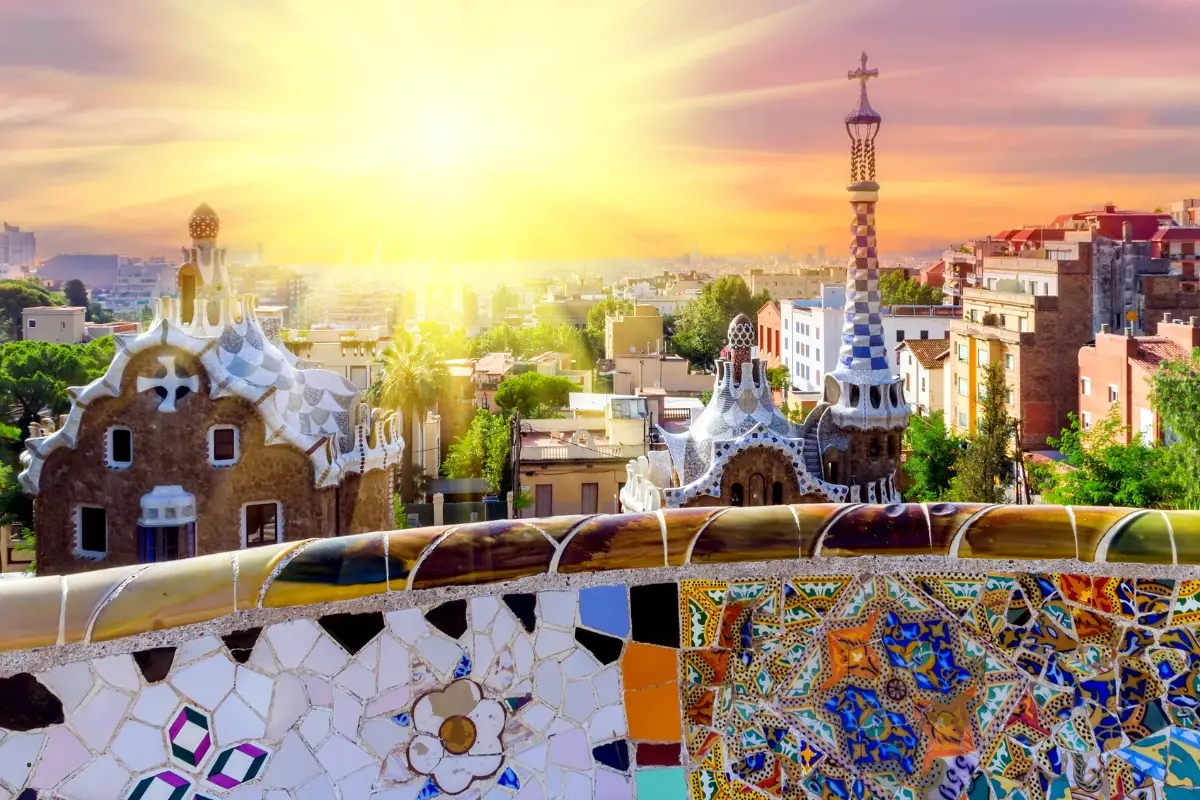
The monumental zone — the dragon staircase, the Hypostyle Hall with 86 columns, and the undulating Bench with trencadís mosaic — requires a timed entry ticket. The surrounding gardens are free.
Resident access runs from 7am to 9:30am. For everyone else, the earliest entry is 9:30am — arriving then avoids the midday peak. There’s a brief window between noon and 2pm when organised groups leave for lunch; slightly less crowded, though still busy.
Prices:
- Monumental zone: €10 (booking recommended)
- Gardens: free
- Casa Museu Gaudí (where he lived for nearly 20 years): €5.50 additional
- Metro L3 (Lesseps or Vallcarca) + 10–15 min uphill walk
Passeig de Gràcia: Three Architects, One Block, One Afternoon
The stretch of Passeig de Gràcia between Carrer d’Aragó and Carrer del Consell de Cent contains three Modernista buildings by three different architects on the same block. The rivalry between them gave the block its popular name: the Block of Discord.
Casa Batlló (No. 43) — Gaudí redesigned the building between 1904 and 1906. The trencadís glass and ceramic façade and the ceramic-scaled roof interpreting the Sant Jordi dragon legend are unmistakable. On 23 April (Sant Jordi’s Day) the façade is covered in thousands of red roses.
- Price: €35 (includes audiovisual experience)
- Advance booking strongly recommended
- Honest note: the façade from the pavement is the main event. Interior adds context but the €35 price point is steep.
La Pedrera — Casa Milà (No. 92) — Gaudí built it between 1906 and 1912. The self-supporting undulating stone façade was a structural innovation that eliminated load-bearing interior walls. The rooftop chimneys — resembling masked medieval warriors — are among the most photographed spaces in the city. UNESCO World Heritage Site.
- Price: from €25 (daytime), €39 (La Pedrera de Nit — rooftop concert at sunset)
- The permanent Gaudí exhibition occupies the noble floors
Casa Amatller (No. 41) — Josep Puig i Cadafalch, Flemish-inspired façade with stepped gable. Guided visits available; chocolate shop on the ground floor.
Casa Lleó i Morera (No. 35) — Lluís Domènech i Montaner; now houses a Loewe boutique. Original mosaics, Antoni Rigalt stained glass, and Eusebi Arnau sculptures preserved. Accessible as a shop — no entry fee.
Sant Pau Recinte Modernista: The UNESCO Site Most Visitors Miss
The Hospital de Sant Pau, also designed by Domènech i Montaner between 1902 and 1930, is UNESCO World Heritage and one of the largest Modernista complexes in the world. Eighteen independent pavilions connected by underground galleries, each with domes, mosaics, and sculptures. Architecturally equal to anything on Passeig de Gràcia — and significantly less crowded.
It’s a 10-minute walk from the Sagrada Família along Avinguda de Gaudí. Running these two back-to-back is the most efficient UNESCO circuit in the city.
- Price: €16 (with audio guide)
- Metro L5 (Sant Pau Dos de Maig)
Gothic Quarter and El Born: Two Different Logics
The Gothic Quarter is the oldest core of the city. Under the medieval streets lie the foundations of Barcino, the Roman colony founded in the 1st century BC. The Temple of Augustus (1st century BC, four 9-metre Corinthian columns) sits inside the Centre Excursionista de Catalunya on Carrer del Paradís — free entry.
Barcelona Cathedral is free until 12:30pm, then €9. The cloister with thirteen white geese (referencing Santa Eulàlia’s thirteen martyrdoms) is one of the quietest spaces in the old city. The Plaça de Sant Felip Neri preserves shrapnel craters on its walls from a Civil War bombing — a detail most visitors walk past without registering. Our guide to Barcelona’s hidden churches covers what happened there in detail.
El Born operates differently: more design, more gastronomy, slightly wider streets. Santa Maria del Mar is the most stylistically unified Gothic construction in Barcelona — built between 1329 and 1383 by the neighbourhood’s own residents and dockers, without a principal architect. Free during worship hours; €5 for the tourist visit.
The Born CCM preserves under a glass floor the archaeological remains of 1714 Barcelona — the Ribera neighbourhood demolished by Bourbon troops after the War of Succession. Entry: €6. Free first Sunday of the month.
Museu Picasso (Carrer de Montcada, 15–23) — five 15th-century medieval palaces. The collection focuses on Picasso’s formative years, with over 4,000 works. Free on Thursdays from 4pm and the first Sunday of every month. Regular price: €14.
Montjuïc: The Most Underused Mountain in Any European City
Montjuïc has museums, gardens, Olympic installations, a castle, and the best southern viewpoints in the city — and most visitors see only one or two of them. Access via funicular from Paral·lel station (metro L2 and L3) — the metro ticket covers the funicular.
Montjuïc Castle — 17th-century military fortress at the summit, views over the port and sea. Price: €12. Free first Sunday of the month and Sundays from 3pm. Our full Montjuïc Castle guide covers the history and what most visits miss.
MNAC — in the Palau Nacional built for the 1929 International Exhibition. Houses the most important collection of Romanesque mural painting in the world — rescued from Pyrenean churches of the 11th and 12th centuries. The Modernisme section includes Gaudí-designed furniture and works by Ramon Casas. The exterior terrace is accessible without paying — one of the best panoramas of the Eixample stretching to the sea. Price: €12.
Fundació Joan Miró — in Josep Lluís Sert’s rationalist building, with over 14,000 Miró works. One of the most coherent 20th-century art collections in Europe. Price: €14.
Font Màgica — water, music, and light show on the staircase leading up to the MNAC. Free. Hours vary by season — check before going.
Bunkers del Carmel: The Best Viewpoint in Barcelona (Free)
The Bunkers del Carmel sit on the Turó de la Rovira at 262 metres. They’re not bunkers in the traditional sense — they’re anti-aircraft batteries built during the Civil War to defend Barcelona from bombing. Today they offer a 360-degree view: Sagrada Família, Tibidabo, the port and sea, the Pyrenees on clear days.
Free access, always open. Bus line 119 from Alfons X (metro L4 and L5) or metro to Guinardó and 20-minute uphill walk. This is where Barcelona residents come for sunset — arrive 30–40 minutes before dusk to find a good spot.
No paid viewpoint in the city matches the panorama here. This is the local secret that isn’t secret anymore, but still far less crowded than any commercial alternative.
Price and Booking Comparison Table
| Attraction | Price | Booking | Free option |
|---|---|---|---|
| Sagrada Família | €26–36 | Mandatory | — |
| Park Güell (monumental) | €18 | Recommended | Gardens free |
| Casa Batlló | from €29 | Recommended | Façade from street |
| La Pedrera | from €25 | Recommended | — |
| Sant Pau Recinte Modernista | €16 | Optional | — |
| Museu Picasso | €14–15 | Optional | Thu 4pm+ / 1st Sun |
| Montjuïc Castle | €12 | Not needed | 1st Sun / Sun 3pm+ |
| MNAC | €12 | Not needed | Sat 3pm+ / 1st Sun |
| Fundació Joan Miró | €18 | Not needed | — |
| Born CCM | €6 | Not needed | 1st Sun |
| Barcelona Cathedral | Free until 12:30 / €9 | Not needed | Morning visit |
| Santa Maria del Mar | Free (worship) / €5 | Not needed | During services |
| Bunkers del Carmel | Free | Never needed | Always |
| Font Màgica | Free | Never needed | Always |
Mistakes to Avoid
- Booking Sagrada Família for 11am or later — the first-entry slot at 9am gets you the Nativity façade light at its best and shorter queues. Every hour later adds crowds.
- Combining Sagrada Família and Park Güell in the same morning — they’re 20 minutes apart but doing both before noon is rushed. Book them on separate days or accept that you’ll do one properly and one quickly.
- Paying from €29 for Casa Batlló without walking past first — the street-level façade is extraordinary and free. Decide after seeing it whether the interior justifies the price for your trip.
- Going to MNAC only for the views — the Romanesque mural collection is world-class and takes 90 minutes minimum to do properly. The panorama from the terrace is a bonus, not the point.
- Missing the free museum days — if your trip includes a Thursday or a first Sunday of the month, build your itinerary around the free Picasso and MNAC entries. It’s worth reorganising everything else around.
- Skipping Sant Pau Recinte Modernista — it’s UNESCO World Heritage, architecturally equal to La Pedrera, and half the price with a fraction of the tourists. The 10-minute walk from Sagrada Família makes it a natural extension of the same visit.
Best Strategy by Available Time
-
4 hours → Sagrada Família at 9am (2 hrs) + Sant Pau Recinte Modernista on the walk back (45 min) + coffee on Passeig de Gràcia. Compact, high-impact, geographically logical.
-
Full day → Sagrada Família (9am) → Passeig de Gràcia walk + La Pedrera or Casa Batlló exterior → lunch in El Born → Santa Maria del Mar + Born CCM → Bunkers del Carmel for sunset.
-
2 days → Day 1: Gaudí circuit (Sagrada Família + Park Güell + Passeig de Gràcia). Day 2: Montjuïc (MNAC + Miró + Castle) + Gothic Quarter + El Born + Museu Picasso if Thursday.
-
Budget day (€0) → Gothic Quarter + Temple of Augustus + Plaça de Sant Felip Neri + Santa Maria del Mar + El Born walk + Bunkers del Carmel at sunset. Full cultural day, zero spend.
For context on transport between these locations and a realistic daily budget breakdown, both cover the practical side of moving between them.
Three structural errors in the standard sightseeing list
Three structural errors turn up again and again in sightseeing plans:
They treat the Gaudí buildings as interchangeable. They’re not. Sagrada Família is in a different category from everything else — architecturally, emotionally, in terms of the time it deserves. Park Güell is a 45-minute experience. Casa Batlló and La Pedrera are 60-minute experiences. Treating all four as equivalent “must-dos” that fit into a single day is the origin of most disappointment.
They ignore the free museum schedules. Thursday afternoons at the Museu Picasso and first Sundays at MNAC, the Montjuïc Castle, and Born CCM are not minor footnotes. For a 3-day visit, the savings are €30–40 per person. Planning around these dates takes five minutes and is completely worth it.
They never mention Sant Pau Recinte Modernista. It is UNESCO World Heritage. It is one of the most extraordinary buildings in Barcelona. It is ten minutes from the Sagrada Família. And it appears in approximately one guide in ten. The city’s actual Modernista legacy extends well beyond Gaudí — the architecture category on this site covers what the standard city guide leaves out.
Practical Tips
- The T-Casual card (10 trips, €13) covers metro and bus including the Montjuïc funicular from Paral·lel. It does not cover airport metro stations, which require a separate airport ticket (€5.90).
- Sagrada Família, La Pedrera, and Park Güell all have last-minute cancellation releases online — check at 48 and 24 hours if you’ve left booking late.
- The Articket (€38) covers six major museums: MNAC, Fundació Joan Miró, Fundació Antoni Tàpies, MACBA, CCCB, and Museu Picasso. Worth it only if you plan to visit four or more of them in the same trip.
- Every monument listed above is accessible by public transport. You don’t need a taxi or tour for any of them.
Sunday is the day that breaks a plan built around opening hours: shops in the tourist zone open 12:00-20:00 and only from 15 May onwards, which is where the Sunday in Barcelona guide starts.
Frequently Asked Questions
Which Barcelona attractions require advance booking?
Sagrada Família requires mandatory advance booking — tickets sell out days or weeks ahead in high season. Park Güell monumental zone, Casa Batlló, and La Pedrera are strongly recommended with advance booking. All other attractions allow direct entry, though summer queues exist.
What is free to visit in Barcelona?
Museu Picasso is free Thursdays from 4pm and the first Sunday of every month. MNAC, Montjuïc Castle, and Born CCM are free the first Sunday of the month. The Castle is also free Sundays from 3pm. Barcelona Cathedral is free until 12:30pm. Bunkers del Carmel and Font Màgica are always free.
How much does it cost to visit Barcelona’s main sights?
Sagrada Família (€26) + La Pedrera (from €25) + Park Güell (€18) = €69 per person. Adding Casa Batlló (from €29) brings it to €98. To reduce costs: Sant Pau Recinte Modernista (€16) gives comparable architectural value to La Pedrera with less crowds and a lower price.
Is the Torre de Jesucristo at Sagrada Família finished?
Yes. In February 2026, the Torre de Jesucristo reached 172.5 metres, making it the tallest church in Europe. The basilica as a whole continues minor finishing works, but all main towers and the interior are complete.
What’s the best viewpoint in Barcelona?
The Bunkers del Carmel on Turó de la Rovira — 262 metres, 360-degree views, always free, always open. No paid viewpoint in the city matches it. Arrive 30–40 minutes before sunset to secure a good spot.
What is the Articket Barcelona and is it worth it?
The Articket (€38) gives access to six museums: MNAC, Fundació Joan Miró, Fundació Antoni Tàpies, MACBA, CCCB, and Museu Picasso. It’s worth buying only if you plan to visit four or more of them. For most visitors spending 2–3 days in Barcelona, individual tickets or free-entry days are more economical.