
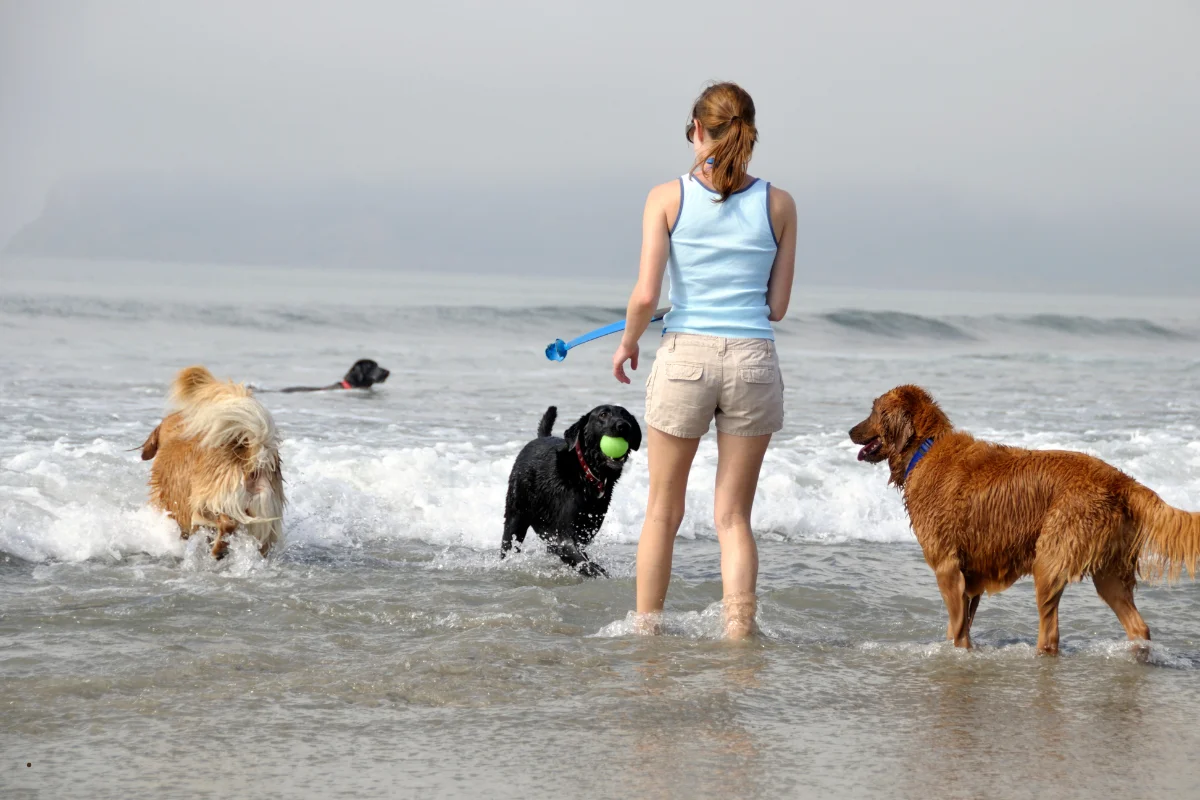

One beach. That’s the number of officially designated dog zones within Barcelona city during swimming season. One — out of ten total beaches covering 4.2 kilometers of coastline. Platja de Llevant, in the Sant Martí district, has a fenced area of 1,250–1,550 square meters with a capacity cap of 100 dogs simultaneously. It operates from approximately May 24 to September 11, between 10:30 and 19:30.
Outside the bathing season, dogs can access every single beach in Barcelona without zone restrictions. The 2026 calendar is not one continuous block: the mid season ends on 27 September and returns only on 3 and 4 October, so dogs are already allowed from 28 September to 2 October, and then from 5 October right through to 27 March. Easter week is the one spring date to watch: it falls inside a mid-season window, so the ban applies then even though it sits well before summer. That seasonal flip is the most useful logistical fact for dog owners planning a coastal day.
Beyond Llevant, the Barcelona province has a dozen options with wildly different rules. Gavà bars dogs registered outside the municipality. Arenys de Mar does the same. Cubelles and Badalona don’t. Sitges’s Cala Vallcarca has zero services but complete freedom. Understanding which is which before driving an hour is the purpose of this guide.
Where can dogs go to the beach near Barcelona? Within Barcelona city: Platja de Llevant only (fenced zone, 30 May-13 Sep 2026, 10:30–19:30, max 100 dogs). Year-round options outside the city: Les Salines in Cubelles (450m, open 365 days, no census required), Cala Vallcarca in Sitges (natural, no services), Patins de Vela in Badalona (year-round). The Maresme coast (Mataró, El Masnou, Pineda de Mar) has the highest concentration of dog beaches in the province, all reachable by the R1 Rodalies train.
Quick Decision: Which Beach for Which Visit
- Within Barcelona city, summer → Platja de Llevant — arrive before 11:00 on weekends; August fills to capacity
- Year-round, no registration required, most space → Les Salines in Cubelles — 450m, open 365 days, by car or R2 Sud train
- Natural environment, no services, total freedom → Cala Vallcarca (Sitges) — 35 min by car, combine with the Garraf Natural Park
- Closest year-round option to Barcelona → Patins de Vela in Badalona — 15–20 min by car or Metro L2
- Maresme day, train-accessible → Ocata in El Masnou (400m, fine sand) or Ponent in Mataró (1,000m², June–Sep)
- Year-round on the Maresme, no census required → El Poblenou in Pineda de Mar — only Maresme beach open 365 days
Platja de Llevant: The Rules That Actually Apply
Llevant is the most discussed dog beach in every Barcelona guide and the one most visitors get wrong.
The capacity fact: the 100-dog maximum is not theoretical. On August weekends, the zone reaches capacity and closes temporarily. The queue outside the perimeter can run 20–30 minutes. Arriving before 11:00 eliminates this problem. Arriving at 14:00 on a Saturday in August does not.
The infrastructure: the fenced zone has dedicated dog showers, drinking water fountains, wooden boardwalks to the water’s edge, visible and tactile signage, and two environmental monitors on full shift. The fence has open panels that allow dogs to enter the water — it’s not a zone that stops at the sand’s edge. This is the most complete dog-beach infrastructure in the province.
The documentation required:
- Active microchip registration
- Vaccination booklet current (rabies vaccination mandatory)
- Potentially dangerous breeds (PPP list): muzzle at all times including in the water, non-extendable leash maximum 2 meters
Outside swimming season: from early October to late March, dogs can access any Barcelona beach without zone restriction, at any hour. This is what residents with large dogs use — the long stretches of Poblenou, Nova Mar Bella and Barceloneta in autumn and winter, without competing for space in the Llevant pen.
Transport: Metro L4 to El Maresme/Fòrum, 10 minutes’ walk. Bus H16 or V27. Tram T4.
Les Salines, Cubelles: The Benchmark for a Full Dog Beach Day
Les Salines in Cubelles is the standard against which every other dog beach in the Barcelona province should be measured — not because it has the best services (it doesn’t) but because it has the most freedom in the most space across the most days.
450 meters of mixed sand and gravel. Open every day of the year. No municipal registration requirement — any dog with proper documentation can access it. No posted capacity limit. No time-window restrictions.
The honest trade-off: no dog showers, no drinking water fountains on the beach. Bring your own water. Bring your own waste bags, though bins are present. The beach is functional but not serviced in the way Llevant is.
Why this matters practically: if you’re visiting Barcelona in October, March or any month outside the Llevant window, Les Salines is the nearest large-format dog beach that works the same way every day of the year.
Getting there: 40 minutes by car from Barcelona. By train: R2 Sud from Passeig de Gràcia or Sants to Cubelles station (approximately 50 minutes), then 15 minutes on foot to the beach. The train option makes this viable without a car — the same line that serves Sitges from Barcelona continues to Cubelles.
Cala Vallcarca, Sitges: No Rules, No Services, No Other Options Like It
Cala Vallcarca sits inside the Garraf Natural Park, adjacent to a former cement works. The Sitges municipality permits year-round dog access with no time restrictions and no census requirement. What it doesn’t provide: showers, bins, lifeguards, or any infrastructure whatsoever.
The ground is a mix of sand and rounded stones — not beach-umbrella territory. The surrounding environment is garrigue scrubland and limestone cliff. The experience is qualitatively different from every other option in this guide: wild, quiet, completely free of services and of crowds.
The practical combination that makes Cala Vallcarca worthwhile: drive to Sitges (35–40 minutes from Barcelona), do the cove in the morning, walk into Sitges town for lunch. The Garraf Natural Park trails that connect the cove to Sitges pass through some of the most dramatic coastal terrain in the Barcelona province — your dog walks it on-lead but the terrain is worth it.
Why the cove looks like that: Cala Vallcarca’s isolation from development is directly linked to the former cement plant. The industrial presence deterred residential development; the Garraf Park designation formalized the protection. The cove exists as it does because nobody wanted to build next to a cement works, not because of any conservation foresight.
Getting there: by car, 35–40 minutes from Barcelona (C-31 toward Sitges, follow signs for Cala Vallcarca / Cementiri). No direct public transport to the cove — the Sitges train drops you 5km away.
Badalona: The Closest Year-Round Option to Barcelona
Platja Patins de Vela in Badalona is the nearest dog beach to Barcelona that doesn’t have either the Llevant seasonal restriction or the Gavà census requirement. Open year-round, basic services (bins, showers, lifeguard coverage), and a reasonable beach character — urban, functional, not natural, but perfectly usable.
Getting there: Metro L2 to Badalona Pompeu Fabra, 15 minutes on foot to the beach. Or 15–20 minutes by car from central Barcelona.
The honest note: Badalona’s beaches don’t have the open character of Cubelles or the natural setting of Cala Vallcarca. They’re city beaches. If you’re choosing between Badalona and Llevant for a summer visit, Llevant has better infrastructure. If you’re going outside swimming season and don’t want to drive 40 kilometers, Badalona is the answer.
The Municipality Census Rule: What Gavà and Arenys de Mar Mean for Your Visit
Two beaches in this guide actively enforce a rule that eliminates most visitors before they arrive:
Gavà Mar and Platja La Musclera/La Picòrdia in Arenys de Mar both require that the dog be officially registered (censed) in the local municipality — Gavà or Arenys respectively — to access the designated dog zone during swimming season. This is not a soft recommendation. Gavà has access control at the zone entrance. A dog registered in Barcelona, Madrid or any other municipality cannot enter.
If you live in Barcelona and are considering either of these beaches as a day trip: they are not accessible for your dog during summer swimming season. Outside that season, the restriction does not apply.
The Maresme Coast: Five Options on One Train Line
The Maresme comarca has the highest density of dog beaches in the Barcelona province. Every one of them is reachable from Barcelona on the R1 Rodalies line, which runs along the coast from Barceloneta to Blanes.
El Masnou / Montgat — Ocata and Can Teixidor
Ocata beach in El Masnou offers approximately 400 meters of dog zone with fine sand — one of the longer and better-regarded stretches in the comarca. The carnet de tinença cívica (civic ownership card) is required to let your dog off-lead within the zone. This is a municipal document that certifies compliance with local dog management rules; it’s not the same as general vaccination documentation and requires a separate step to obtain.
The access to the water at Can Teixidor has rock sections in some areas. If your dog has sensitive pads, water shoes for the transition from sand to rock are useful.
Train: R1 to El Masnou station, 15 minutes’ walk to the beach.
Mataró — Platja de Ponent
Ponent in Mataró dedicates approximately half its surface to dog use during June–September: roughly 1,000 square meters with buoy perimeter marking, recommended maximum 40 dogs, and lifeguard coverage. The balance of space and services makes it one of the better Maresme options for a full-day visit.
Train: R1 to Mataró station, 10 minutes’ walk.
Pineda de Mar — El Poblenou (Open 365 Days)
The only Maresme dog beach with year-round access, no closure for off-season and no municipal registration requirement. Over 100 square meters of fenced fine-sand zone. Limited services but consistent access.
Train: R1 to Pineda de Mar station.
Malgrat de Mar — La Conca
Next to the marina, with dog showers and capacity for up to 150 people-and-dog pairs. One of the better-equipped options in the northern Maresme. Year-round access.
Train: R1 to Malgrat de Mar station.
Comparison Table
| Beach | Municipality | Open | Census Required | Services | Transport |
|---|---|---|---|---|---|
| Platja de Llevant | Barcelona | May–Sep, 10:30–19:30 | No | Full (showers, water, monitors) | Metro L4 |
| Les Salines | Cubelles | Year-round | No | Basic (bins only) | R2 Sud train |
| Cala Vallcarca | Sitges | Year-round | No | None | Car only |
| Gavà Mar | Gavà | Jun–Sep | Yes (Gavà only) | Medium | R2 Sud train |
| Patins de Vela | Badalona | Year-round | No | Basic | Metro L2 |
| Ocata / Can Teixidor | El Masnou | Summer (carnet req.) | Carnet cívic | Medium (400m) | R1 Maresme |
| Platja de Ponent | Mataró | Jun–Sep | No | Good (1,000m², lifeguard) | R1 Maresme |
| El Poblenou | Pineda de Mar | Year-round | No | Basic (fenced) | R1 Maresme |
| La Conca | Malgrat de Mar | Year-round | No | Good (showers, 1,200m²) | R1 Maresme |
| La Musclera | Arenys de Mar | Jun–Sep | Yes (Arenys only) | Good (1,500m²) | R1 Maresme |
Taking Dogs on Public Transport to the Beach
The Barcelona metro and Rodalies train system allows dogs with conditions that change slightly by line and season.
Metro: muzzle and short leash (maximum 50cm) required. Prohibited during weekday peak hours (7:00–9:30 and 17:00–19:00). Exception: from June 24 to September 11, peak-hour restrictions are lifted — dogs can travel at any hour. Always use lifts, never escalators.
Rodalies (R1, R2 Sud) and FGC: the most permissive. No weight limit. Dogs travel free with leash and muzzle. For Media Distancia long-distance trains, dogs under 10kg travel in a carrier; dogs over 10kg can travel with a 25% supplement on the base fare.
Bus: only dogs in closed carriers of “handbag” size. Not practical for medium or large dogs.
Health and Safety: The Summer Specifics
Paw protection: sand temperature on Barcelona’s beaches exceeds 50°C between 12:00 and 17:00 in July and August. That temperature burns dog pads in seconds. Schedule beach time before 11:30 or after 18:00 during peak summer.
Hydration: offer fresh water every 15–20 minutes to prevent your dog from drinking seawater. Salt water causes vomiting, diarrhea and rapid dehydration. If your dog vomits repeatedly after beach access, seawater ingestion is the most likely cause.
Sand ingestion: dogs retrieving wet objects from the water often ingest sand. Sand accumulation in the digestive tract can cause intestinal obstruction requiring surgery. Watch for this particularly in dogs who compulsively fetch.
Jellyfish contact: wash with salt water, not fresh. Fresh water activates remaining stinging cells on skin. Remove tentacle remnants with gloves. If swelling or systemic reaction occurs, seek veterinary attention.
Heatstroke signs: excessive loud panting, foamy drooling, bright red or bluish gums, lethargy. Move to shade, cool with lukewarm (not cold) water on abdomen, armpits and paws, offer small amounts of water, seek urgent veterinary care. Heatstroke can cause brain damage within minutes — it’s a genuine emergency.
Who Is This Guide For
Barcelona city resident with no car → Platja de Llevant in summer (Metro L4). Patins de Vela in Badalona year-round (Metro L2). Les Salines in Cubelles year-round (R2 Sud train — 50 min).
Visitor to Barcelona wanting a dog beach day trip → Les Salines in Cubelles is the cleanest solution: train-accessible, year-round, no bureaucratic requirements, space to walk.
Dog owner wanting the most natural setting → Cala Vallcarca in Sitges. Bring everything you need. Go before 10:00 in summer. Combine with the Garraf Natural Park trail.
Travelling in October–April → Every Barcelona beach is dog-accessible during this period. Choose by neighborhood: Poblenou (Bogatell, Mar Bella) for the creative district combination; Barceloneta for the historic neighborhood.
Planning the Maresme for a long beach day with the dog → Mataró’s Platja de Ponent (June–Sep, well-serviced) or Malgrat de Mar’s La Conca (year-round, showers). Both work as train day trips with the R1 Rodalies.
Mistakes to Avoid
- Arriving at Platja de Llevant after midday on an August weekend — the zone can be at capacity. The queue is real and can run 30+ minutes. Arrive before 11:00 or go on a weekday.
- Planning Gavà or Arenys de Mar without checking the census requirement — dogs registered outside the municipality cannot access the dog zones during swimming season. This eliminates the beach for most visitors.
- Going to Cala Vallcarca expecting services — there are none. No water, no bins, no shade infrastructure. Self-sufficiency is the baseline requirement.
- Taking a large dog on the bus — only carrier-size animals. The metro and Rodalies train system is far more practical for dogs of any size.
- Letting your dog drink from the sea — consistent across every beach in this guide: seawater causes gastric problems within hours. Offer fresh water proactively rather than waiting for the dog to seek alternatives.
Still deciding? The municipal shelter had 250 animals waiting, 162 of them dogs: adopting a dog or cat in Barcelona covers what it takes.
Away from the sand the city runs 108 shared spaces on published time slots, and five districts have none open between 4 and 7 pm: the full breakdown is in dogs off the lead.
Final Insight
The single-beach limit within Barcelona city during swimming season is not an oversight — it reflects the tension between a densely used urban coastline and the space requirements of safe dog access. The municipality has been expanding the Llevant zone incrementally since it opened, and the year-round off-season access policy is the pragmatic solution for the months when the beach pressure drops. For visitors who want more than one designated beach, the province delivers what the city can’t: Cubelles, Sitges, Badalona and the entire Maresme line, each with different character and different rules that reward knowing the difference before you arrive.
For combining a dog beach day with Barcelona’s neighborhoods on the way back, the Barceloneta neighborhood guide covers the maritime district directly connected to Platja de Llevant, and the Poblenou guide covers the creative district behind the Bogatell and Mar Bella beaches — reachable on the same Metro L4 line used to reach Llevant.