
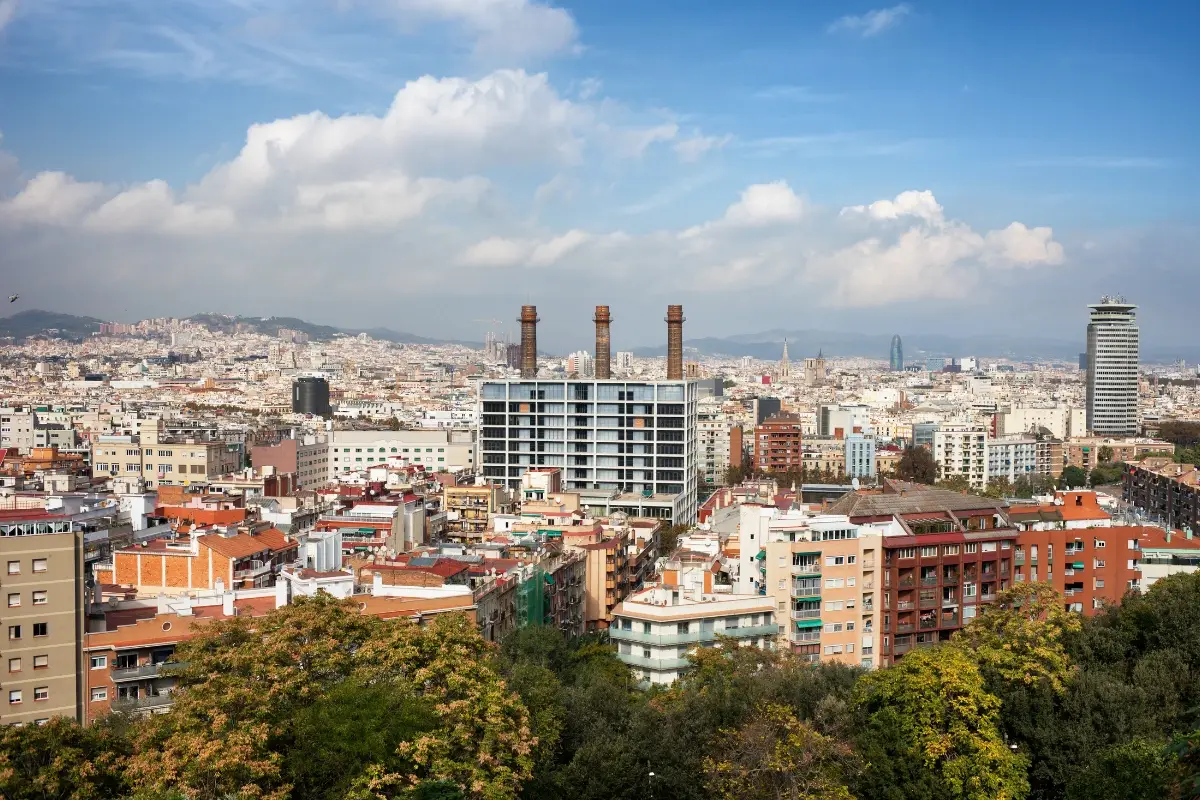

Two things to know before going to Poble Sec:
Quimet & Quimet at Carrer del Poeta Cabanyes 25 is a 1914 bodega with floor-to-ceiling bottles, approximately 30 people standing capacity, and arguably the most interesting montaditos in Barcelona. It opens only at lunchtime (roughly 12:00–16:00, Monday to Saturday) and closes entirely for the month of August. Arrive at opening time or there’s no space. These are the two most important facts about visiting this neighborhood.
The Refugio 307 at Carrer de Nou de la Rambla 169 has 400 meters of Civil War anti-aircraft tunnels hand-dug by neighborhood residents in 1937. It requires advance booking — no walk-ins, no exceptions. Price: €3.50.
Beyond those two constraints: Poble Sec has Carrer de Blai with pintxos from €2, the Paral·lel avenue where Barcelona’s entertainment district peaked at 20 simultaneous theaters in 1930, free cactus gardens on a cliff over the port, and a neighborhood that in 1919 hosted the labor strike that established the eight-hour working day as national law. All of this in under 20 minutes of walking.
Why the Neighborhood Is Called “Dry Village”
The name has a specific environmental history. Before the mid-19th century, the Montjuïc hillside was fertile — springs, vegetable gardens, the area residents called the Hortes de Sant Bertran. Between 1850 and 1860, the printed cotton (indianes) factories arrived. They needed enormous volumes of water for their steam boilers. They depleted the local aquifers. The wells went dry. The neighborhood name — Poble Sec, Dry Village — is a direct record of what industry did to the water table.
The construction pattern is also a consequence of history. The castle of Montjuïc imposed military restrictions on permanent buildings on the hillside for centuries — nothing could serve as cover from the fortress’s artillery. When those restrictions were finally lifted in 1869, development was fragmented and unplanned. The narrow streets running uphill from the Paral·lel are the result.
Carrer de Blai: The 500-Meter Pintxos Street
The Carrer de Blai is pedestrianized, approximately 500 meters long and lined with over 40 bars specializing in Basque-style pintxos at €2 per piece. The format is standing and itinerant — order, eat at the bar, move to the next place. It’s the cheapest concentrated eating-and-drinking option in the city with this variety.
It works best on weekdays late afternoon, when the scale is neighborhood-level and every bar has space. On weekends the density increases. On Thursdays during active season, “La Ruta del Poble Sec” runs with pintxo + beer for €2.
Best bars by type:
- Blai Tonight — long bar, high turnover, creative montaditos, terrace
- La Tasqueta de Blai — more classic Basque style, consistent quality
- For a seated meal on parallel streets: Mano Rota (Galician-Peruvian fusion), Palo Cortao (traditional high-execution cooking), Quirat (Michelin star, Víctor Torres’ contemporary Catalan cuisine near the Paral·lel)
For anyone doing the best tapas in Barcelona circuit, Carrer de Blai and Quimet & Quimet together cover the neighbourhood component of that search.
Quimet & Quimet: Arrive at Opening or Don’t Bother
Carrer del Poeta Cabanyes 25. The great-grandfather of Quim started selling ice and bulk wine here in 1914. The family specialized progressively in high-quality conservas combined in unexpected ways. The space is approximately 20 square meters. Walls covered in bottles to the ceiling. No tables, no chairs.
The signature montaditos: salmon with Greek yogurt and truffle honey; anchovies with butter and capers; pickled mussels. The combination of quality canned product with fresh ingredients is what turned a neighborhood bodega into an international gastronomic reference.
The operational reality: Monday to Saturday, approximately 12:00–16:00 only. Closed entire month of August. In peak season there’s a queue before opening. The only strategy is to arrive at 12:00 or slightly before. The experience lasts as long as you want to stay — there’s no pressure to leave — but you have to get in first.
Refugio 307: Tunnels the Neighborhood Dug With Pickaxes
Carrer de Nou de la Rambla 169. Guided visits only. Advance booking obligatory.
Barcelona received 192 aerial bombardments during the Spanish Civil War. The first was on February 13, 1937. The residents of Poble Sec responded by excavating Refugio 307 horizontally into the Montjuïc hillside with hand tools — no architects, no engineering plans, no state support.
The result: nearly 400 meters of tunnels, 2.10 meters high. The interior had a medical room, toilets, a direct mountain spring water source and a children’s area. The walls preserve period inscriptions: “spreading pessimism is prohibited,” “discussing politics is prohibited” — rules for maintaining order in a space where hundreds of people sheltered during bombardments.
After the war: glass storage, mushroom growing facility. Today it’s managed by the MUHBA (Barcelona History Museum) as an educational space.
Guided visits in English: Sundays at 10:30. Spanish: Sundays at 11:30. Catalan: Sundays at 12:30. Price: €3.50. Book multiple days in advance for weekends. Metro L2 and L3 (Paral·lel), 10 minutes on foot.
The hidden places in Barcelona guide includes Refugio 307 alongside other Civil War sites and archaeological spaces that require advance planning — the full context of underground Barcelona.
The Paral·lel: Barcelona’s Entertainment District, 1894–1940s
The Avinguda del Paral·lel takes its name from its exact position at latitude 41°22’34” N. Opened in 1894, it accumulated more than 20 music halls, cabarets and variety theaters by the 1940s. Barcelonans came here to see programming that was unavailable anywhere else in the city.
El Molino — opened 1898, rebranded after the Moulin Rouge in 1910. The red sails on the facade are the neighborhood’s most recognizable visual symbol. Revived after years of closure, it maintains the cabaret and variety tradition.
Teatro Apolo (1901) — consistent concert and show programming, one of the most active mid-size venues in the city. The Sala 2 offers an intimate format for smaller shows.
Teatro Victoria (1905) — under the ownership of magician Antonio Díaz (El Mago Pop), it achieved the record as the world’s most visited theater with the show “Nada es Imposible.” A concrete fact that most neighborhood guides don’t mention.
Teatre Grec — open-air theater built into the Montjuïc hillside for the 1929 International Exhibition. Hosts the summer Grec Festival (June–August) with theater, dance and music. Combined with the best live music bars in Barcelona, the Paral·lel-to-Grec route covers the full spectrum of performance in this part of the city.
The Architecture Nobody Searches For
Carrer Elkano 4 has an 1900 facade entirely covered with trencadís mosaic — not the ordered pattern of Park Güell, but a patchwork of 19th-century tiles in florals, geometrics and colors without a preceding plan. One of the most unusual examples of Modernisme applied to working-class housing in the entire city. No sign, no entry price, no visitors.
El Sortidor (Plaça del Sortidor 3) is a 1908 restaurant with a Modernista facade and original hydraulic tile floor. The interior preserves early 20th-century atmosphere. Joan Manuel Serrat — “el noi del Poble-sec” — grew up in this environment and performed in neighborhood spaces before achieving recognition beyond it.
Pavelló Mies van der Rohe (Avinguda Francesc Ferrer i Guàrdia 7) — the German Pavilion for the 1929 International Exhibition. Horizontal lines, glass and travertine marble. Demolished after the exhibition ended, rebuilt in 1986 on the same site. Entry: €10. One of the most influential buildings of the 20th century, 10 minutes on foot from Carrer de Blai.
Montjuïc From Below: The Free Gardens
The mountain begins literally at the end of the neighborhood streets. From the Paral·lel, access to Montjuïc is either by funicular (same metro ticket, L2 and L3 from Paral·lel station) or on foot up the paths through the gardens.
Jardins de Mossèn Costa i Llobera — on a south-facing cliff above the port, with a microclimate that supports over 800 species of cactus and succulent plants from deserts worldwide. Views of the Mediterranean and the commercial port are part of the route. Free access. One of the most unusual botanical gardens in southern Europe and almost nobody outside the neighborhood knows it exists.
Jardí de les Tres Xemeneies — park at the foot of the La Canadenca chimneys. The largest legal graffiti wall in the city, managed by the Wallspot platform. Murals change regularly. Skaters, visual artists and neighborhood residents share a space that’s equal parts industrial archaeology and contemporary urban culture. Free.
Parc del Mirador del Poble Sec (Passeig de Montjuïc 28) — landscape park with an 18-meter cascade between terraces and pergolas. Port and harbor views. Free.
For the full Montjuïc picture — the MNAC, Fundació Miró, the castle — the Montjuïc complete guide organizes the mountain from base to summit with the opening hours and access options that make sense depending on time available.
Best Strategy for a Half Day in Poble Sec
Morning arrival (by 11:45): Position yourself at Quimet & Quimet before 12:00 opening. Get there first.
12:00–13:30: Quimet & Quimet for montaditos and vermouth.
13:30–15:00: If you’ve booked the Refugio 307 Sunday 11:30 Spanish tour, you’ve already done it. If not, walk Carrer de Blai for pintxos.
15:00–17:00: El Sortidor for coffee. Carrer Elkano 4 facade. El Molino exterior on the Paral·lel.
17:00–19:00: Jardins de Mossèn Costa i Llobera (free, 800 cactus species, cliff views). Jardí de les Tres Xemeneies.
Evening: Descend from Montjuïc on the funicular from Paral·lel station. Dinner at Mano Rota or Palo Cortao.
Mistakes to Avoid
- Going to Quimet & Quimet in August — it’s closed for the entire month. No exceptions.
- Arriving at Quimet & Quimet after 13:00 on a weekend — the space fills within the first hour of opening.
- Trying to visit Refugio 307 without a reservation — guided tours only, advance booking required. You cannot enter without a booked ticket regardless of how short the queue looks.
- Going to El Molino expecting the original programming — the current format retains the cabaret aesthetic but the lineup is contemporary. Verify the specific show before booking.
- Skipping the Jardins de Mossèn Costa i Llobera — it’s free, it’s dramatic, it has 800 cactus species on a cliff over the Mediterranean, and almost no tourist guide mentions it.
Final Insight
Poble Sec contains the location where an electricity strike in 1919 established an eight-hour working day as national law. It contains tunnels that a neighborhood excavated by hand in 1937 to survive aerial bombardment. It contains the first chiringuito-era cabarets in Barcelona. And it contains a bodega that opened in 1914 and still closes for all of August. The neighborhood holds its history without narrating it — which is why it’s consistently underestimated and consistently rewarding to people who arrive with enough information to read it correctly.
For the broader context of what surrounds Poble Sec, the El Raval guide covers the adjacent neighborhood to the north, and the Barcelona complete travel guide places both in the city’s full geography.