
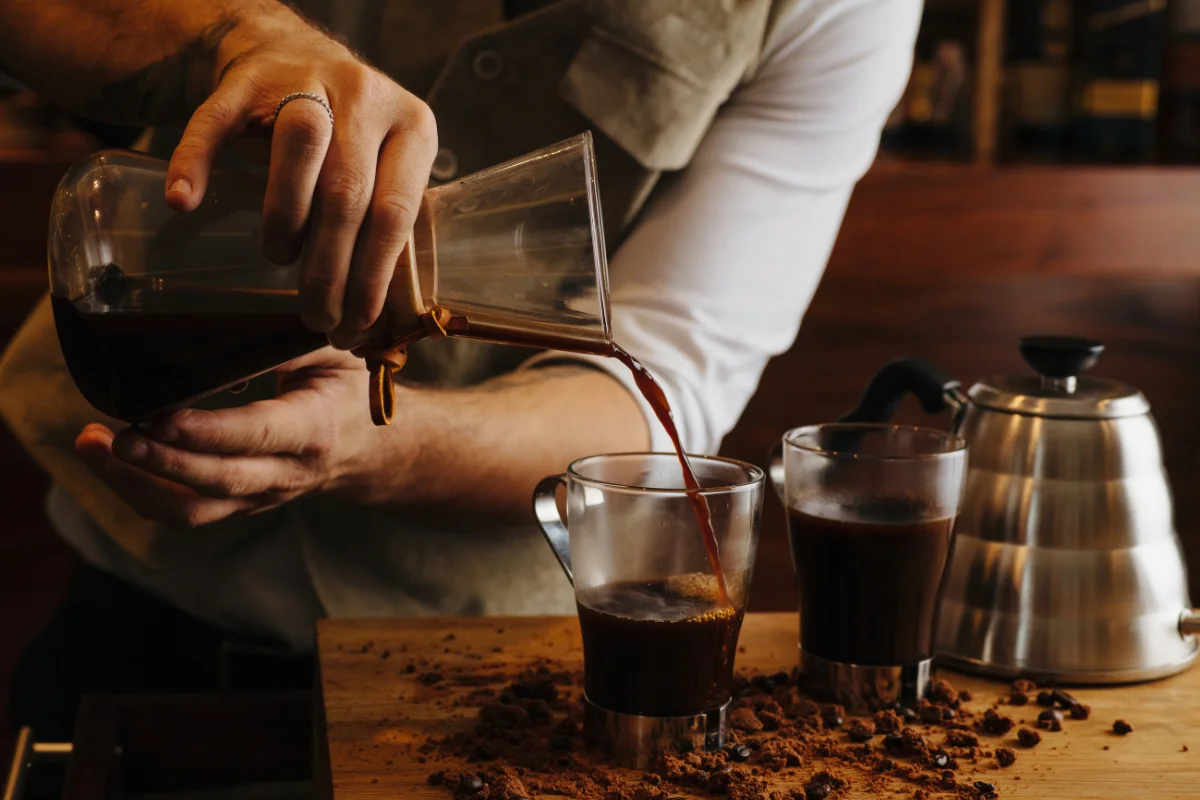

Barcelona’s specialty coffee scene wasn’t imported — it was built by a generation of baristas who trained in London, Copenhagen and Melbourne, then came back and started roasting. The result is a city with its own Direct Trade supply chains, SCA-certified training centers and award-winning cafés. These two walkable routes organize the best of that scene by neighborhood, with what technically sets each roaster apart from every place that uses “specialty” as a label without the sourcing behind it. If you’re planning a wider food day around them, the route logic pairs naturally with the one-day Barcelona food route, which threads markets and meals through the same central districts.
The orientation you need before deciding: Nomad Coffee Lab (Passatge Sert 12, Born, weekdays only) for the most internationally recognized roaster in the city; Satan’s Coffee Corner (Gothic Quarter, no Wi-Fi) for the most uncompromising espresso bar; Three Marks Coffee (Fort Pienc, open weekends, Wi-Fi available) if you need to work; Ombu Bcn (Poblenou, closed Sundays) for the roaster that earned a Global Coffee Awards Europe honour in 2025.
Want X, Go Here
- Oldest specialty roaster in the city → Cafès El Magnífico, Born — but check the limited opening days
- Direct Trade from origin, international track record → Nomad Coffee Lab, Born (weekdays only)
- Espresso without compromise, laptop-free zone → Satan’s Coffee Corner, Gothic Quarter
- Need to work with your laptop → Three Marks Coffee, Fort Pienc — the only one here with Wi-Fi
- Award-recognized roaster → Ombu Bcn, Poblenou (Global Coffee Awards Europe 2025, Honey category)
- Own-roast with sustainability focus → SlowMov, Gràcia (closed Sundays, no Wi-Fi)
- Best place to buy beans to take home → El Magnífico for widest origin selection
This kind of decision-by-profile block is the backbone of how the essential things to see in Barcelona guide handles a crowded field too — match the place to the visitor, not the other way around.
Roasting on site or weekly delivery, and why it matters here
Every café here either roasts its own coffee or works with a weekly-delivery roaster. That distinction matters more in Barcelona than in most cities — and it is the one specialty coffee articles skip.
Specialty coffee has an optimal consumption window: 7 to 30 days after roasting. Inside that window, the volatile compounds that create complexity — brightness, sweetness, the fruity or floral notes that make an Ethiopian natural taste nothing like a Colombian washed — are still alive in the bean. Outside it, you’re drinking a flatter version of what the coffee could have been. When the roaster and the café are the same project, the window is almost always respected. When a café sources from a commercial distributor, the gap between roasting and your cup is often measured in weeks.
The second thing worth knowing: the SCA scoring system. The Specialty Coffee Association rates green coffee on a 100-point scale. Above 80 qualifies as specialty, above 85 is high quality, above 90 is exceptional. All the roasters here work consistently with beans above 85. The gap from typical commercial bar coffee — which scores 60 to 70 and is often torrefacto-blended to mask defects — is not a matter of taste preference. It’s a different product.
Route 1, Born and Gothic Quarter (2–3 hours on foot)
This circuit connects three of the most established names in Barcelona’s specialty scene within a 15-minute walking radius through the historic center. It overlaps the most walkable part of El Born, so the coffee stops slot easily between the neighborhood’s landmarks.
Cafès El Magnífico, where the scene began
The specialty coffee timeline in Barcelona starts here. The Sans family has operated at Carrer de l’Argenteria 64 since 1919, but it was Salvador Sans who, in the early 1990s, began importing single-origin coffees and roasting by variety when no one else in Spain was doing it. El Magnífico built the intellectual infrastructure that made everything else in this guide possible.
Today it functions primarily as a roastery and retail counter with in-store tasting. No tables — the space is bar and counter, with the focus entirely on the beans. The origin selection is the widest of any retail point in the city: more than 8 available at any given time for espresso, filter or whole-bean to take home.
The scheduling detail that derails most visits: El Magnífico keeps limited opening days and is closed for part of the week, so confirm the current schedule before building the route around it.
Carrer de l’Argenteria 64, El Born.
Nomad Coffee Lab, the roaster that brought Direct Trade to Spain
Nomad Coffee was founded in 2014 by Jordi Mestre after years in London’s specialty scene, where he became a two-time Spanish barista champion before returning home. It was the first Barcelona roaster to build Direct Trade relationships — traveling to farms in Ethiopia, Colombia and El Salvador to select lots, paying above commodity prices based on sensory quality rather than market rate. That model, standard in Melbourne or Copenhagen, was new to Spain when Nomad introduced it.
The Passatge Sert 12 location is the original Coffee Lab — a historic covered passageway in the Sant Pere area of the Born, off the main tourist grid, with exposed brick and high ceilings. The space is deliberately minimal. Nomad has other locations in the city, but this is the home of its SCA training academy, one of the few centers in Spain authorized to deliver Q-Grader certification, the highest level of professional coffee tasting.
What to order: single-origin espresso or the filter of the day. Ask which origin has more acidity and which has more body — the team gives a real answer based on that day’s offering.
Hours: open weekdays, closed weekends. The weekend closure is the most common planning error for this route, so confirm before going.
Passatge Sert 12, El Born. Enter from Carrer de Sant Pere Més Alt or Carrer de Trafalgar.
Satan’s Coffee Corner, no Wi-Fi, no syrups, no decaf
Satan’s Coffee Corner is the bar arm of Right Side Coffee, a roastery based in Castelldefels outside the city. Joaquín Parra travels to origin, selects lots and roasts weekly, so what reaches the Call bar arrives within its consumption window — and leaves the bar without anything added, removed or adjusted.
The house policy is the most radical in this guide: no Wi-Fi, no decaf, no flavored syrups. None of it is aesthetic. It’s the answer to what compromises a bar accepts when it takes the product seriously. The space is small, intimate and quieter than you’d expect for the heart of the Gothic Quarter — the strict philosophy naturally filters the clientele.
What to order: single-origin espresso or a cappuccino. Filter of the day if it’s on the board.
Carrer de l’Arc de Sant Ramon del Call 11, Gothic Quarter.
Route 2, Eixample, Gràcia and Poblenou (half day or full day)
The Eixample and Gràcia stops are 30 minutes apart on foot. Poblenou is a metro ride or bike from Gràcia — add it if you have the afternoon.
Three Marks Coffee, own roast and a laptop-friendly room
Founded by three partners all named Marc, Three Marks has its main location at Carrer d’Ausias Marc 151 in the Fort Pienc sub-district of the Eixample. Two levels of space, a work-friendly environment and, critically, Wi-Fi — the only stop in this guide that explicitly accommodates people who need to be online.
The technical differentiator is the roasting setup: Three Marks upgraded from Probat machines to a Loring roaster, known for more precise thermal control and significantly lower energy consumption. Their batch brew — filter coffee prepared in volume, held warm and served at espresso speed — is their strongest preparation and the best entry point for anyone new to filter methodology.
What to order: flat white with the current week’s bean, or batch brew. Order the cardamom bun if it’s there; it appears in reviews more often than almost anything else on the menu.
Carrer d’Ausias Marc 151, Fort Pienc.
SlowMov, own roast, Giesen W6, no sugar at the bar
At Carrer de Neptú 36 in Gràcia, SlowMov is the most philosophically consistent project in the scene. No Wi-Fi, with a sign explicitly asking customers not to bring laptops. No sugar at the bar — the espresso is served without it because, in their logic, a coffee that needs sugar to be drinkable is a coffee with a problem.
The roast is in-house on a Giesen W6. The sourcing focus is clean-profile origins, primarily washed coffees from Central America and East Africa, with lots that rotate as availability changes. Staff explain the origin of each bean when they serve it, without prompting. SlowMov closes on Sundays, and unlike most cafés this is firm.
What to order: cortado or AeroPress with the origin of the day. Ask about the processing method, washed or natural — the difference in cup profile is the most useful thing to understand about specialty coffee, and SlowMov explains it clearly.
Carrer de Neptú 36, Gràcia.
Ombu Bcn, the roaster with recent international recognition
Founded in Poblenou in 2021 by Pablo and Chantal, Ombu Bcn earned a Global Coffee Awards Europe honour in 2025 — at the edition held in Bordeaux on 29 and 30 October, its Colombia Pink Ranger was recognized in the Honey category, alongside top European roasters like Origin Coffee and Rocket Bean. The name references the Argentine ombú tree; the sourcing philosophy centers on sustainability, fair trade and support for women producers at origin.
The Carrer d’Àvila 51 space is quiet, neighborhood-focused and a long way from the tourist circuit. The Colombia Pink Ranger appears on the menu on a recurring basis as a flagship lot. The café sits a short walk from the seafront, so it pairs well with a wider wander through Poblenou and its creative district.
What to order: filter coffee of the day — the preparation behind the award. The cappuccino also earns consistently strong marks in reviews.
Carrer d’Àvila 51, Poblenou. Closed Sundays. Metro Llacuna (L4).
Quick Reference Table
| Café | Neighborhood | Own Roaster | Wi-Fi | Open Weekends |
|---|---|---|---|---|
| Cafès El Magnífico | Born | Yes | No | Limited days |
| Nomad Coffee Lab | Born | Yes | No | Closed |
| Satan’s Coffee Corner | Gothic | Yes (Castelldefels) | No | Open |
| Three Marks Coffee | Eixample | Yes | Yes | Open |
| SlowMov | Gràcia | Yes | No | Sat only |
| Ombu Bcn | Poblenou | Yes | No | Sat only |
Best Strategy by Available Time
2 hours: Born circuit only — Nomad for filter, Satan’s Corner for espresso. Skip El Magnífico unless you’ve confirmed it’s open that day for the bean retail.
Half day: Born circuit plus Three Marks in Fort Pienc. Walk from the Gothic Quarter to Fort Pienc in 25 minutes, or metro one stop. Ends around 13:00, which pairs naturally with the best food markets in Barcelona on the way back.
Full route: Born, Fort Pienc, SlowMov in Gràcia and Ombu Bcn in Poblenou. Use metro between Gràcia and Poblenou — the walk is 45 minutes. Plan a full morning-to-afternoon day, and don’t stack more than two places per 2-hour block; the point is to slow down.
Mistakes to Avoid
- Building the route around El Magnífico without checking its days — it closes for part of the week. The most expensive planning error here.
- Bringing a laptop to Satan’s Corner or SlowMov — the no-Wi-Fi policy is intentional and enforced. Three Marks is the right choice if you need to work.
- Treating the filter option as the “light” choice — filter coffee at these places is technically more demanding to produce well than espresso, not easier. It’s a different extraction methodology.
- Only visiting on Sundays — Nomad, SlowMov and Ombu are closed. Plan a Sunday around Satan’s Corner and Three Marks instead.
- Rushing through Passatge Sert — the approach to Nomad through the historic covered passageway is worth 5 minutes of context.
- Assuming “specialty” on a sign means what it says — ask what the current SCA score is for the beans being served. The places in this guide answer immediately and specifically.
What Coffee Costs in Barcelona’s Specialty Scene
Espresso runs €2.50 to 3.50. Cappuccino or flat white, €3 to 4.50. Manual filter (V60, AeroPress), €4 to 6 depending on origin and method. Whole beans to take home, €12 to 22 per 250g bag. For visitors from London, Melbourne or New York, the prices run lower than equivalent specialty cafés in those cities for comparable quality.
Final Insight
Barcelona’s specialty coffee scene was built with something to prove. These roasters came back from cities with more established scenes and decided to build rather than import. The Passatge Sert, the Call side street, the Poblenou industrial block — none were chosen for foot traffic. They were chosen because the project could survive on the strength of the product alone. That logic is still visible in every policy: no Wi-Fi, no syrups, no decaf, no compromises. It makes the coffee better, and it makes the visit feel like something other than a coffee shop.
For the wider picture of how the city eats and drinks, the best tapas bars guide and the vermouth culture guide follow the same framework — product first, location second.