
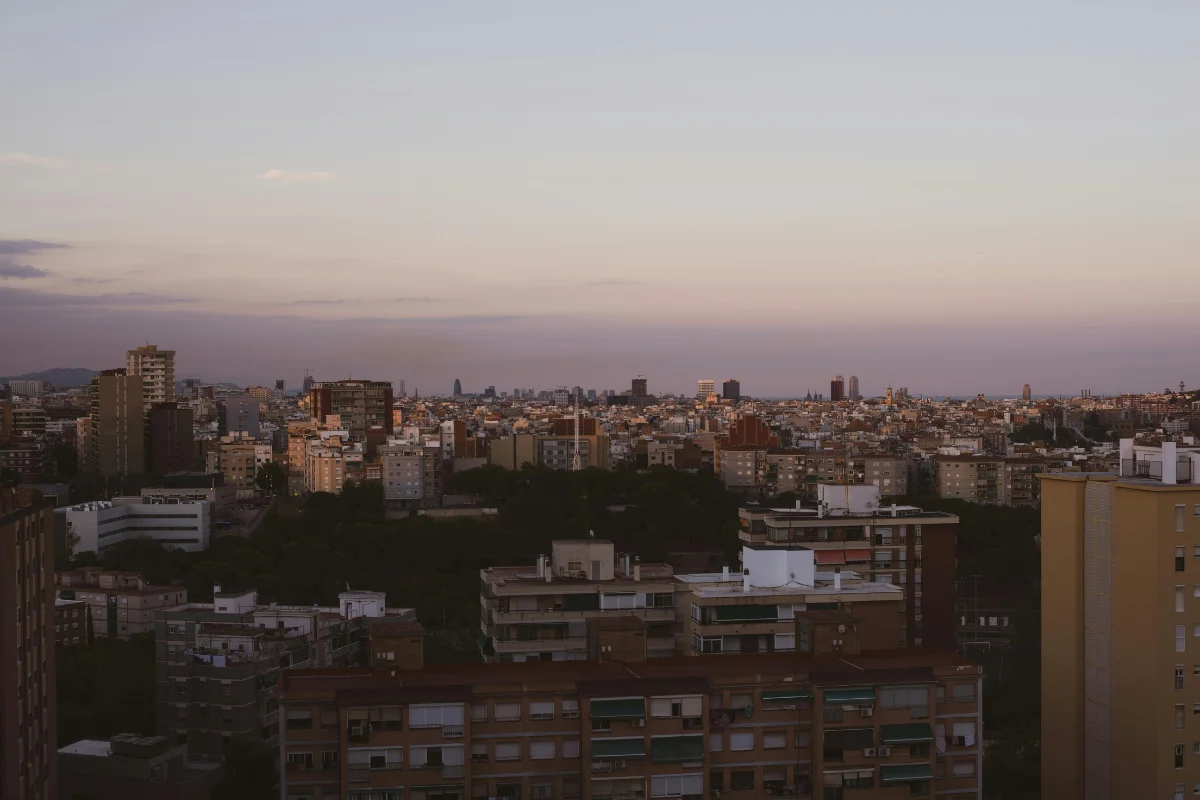

Fort Pienc sits between the Eixample’s bourgeois grid and the 22@ innovation district, which is why it contains the highest density of major cultural infrastructure in Barcelona relative to its size — and why almost no travel guide ever names it as a destination. The Teatre Nacional de Catalunya, L’Auditori, the Encants flea market, the DHub design museum, and the Biblioteca Arús are all within a 15-minute walk of each other. None of them have significant queues. The neighborhood itself won a Mies van der Rohe Award nomination for an integrated urban block. Metro L1, Tetuan stop.
The TNC and L’Auditori — The Cultural Anchor
On the Meridiana axis, facing each other, are the two flagship institutions that define Fort Pienc’s institutional profile.
The Teatre Nacional de Catalunya (TNC), opened 1996, is designed by Ricardo Bofill. The structure evokes a Greek temple wrapped in glass — columns, pediment, and a podium that elevates theatrical life to monumental scale. The transparency integrates the lobby with the exterior space: at night, the illuminated interior seen from the street produces a visual effect that no other Eixample building replicates. Programming runs theater, dance, and opera primarily in Catalan. Worth approaching even without a show, just to see the architecture from outside at night.
L’Auditori is directly opposite. Designed by Rafael Moneo with the opposite principle — a massive, contained, geometric building. 42,000 m², three concert halls, and the home of the Orquestra Simfònica de Barcelona i Nacional de Catalunya (OBC). Inside it sits the Museu de la Música, with an instrument collection including historic guitars and Baroque organs — one of the most significant instrument funds in Europe. Concert tickets start from €12; matinees are cheaper. Rated 4.6/5 with over 12,000 reviews.
What is Fort Pienc known for in Barcelona? It’s the cultural infrastructure district nobody visits as a destination. Ricardo Bofill’s TNC theater, Rafael Moneo’s L’Auditori (with the Museu de la Música inside), the Encants flea market under Europe’s largest mirror canopy, and the Biblioteca Arús (with Spain’s largest Sherlock Holmes collection) are all within a 15-minute walk. Metro L1, Tetuan.
Mercat dels Encants — The Mirror Canopy and the Oldest Market in Barcelona
Mercat dels Encants (Fira de Bellcaire) has roots tracing back to 1300. It’s Barcelona’s oldest second-hand market and one of the oldest in Europe. Its historical essence — selling on the ground, auctioning, haggling, finding — survived centuries of relocations and urban transformations.
The canopy covering it since 2013, designed by Fermín Vázquez (b720), is an asymmetric stainless steel and glass structure that acts as a kaleidoscope: it reflects all activity in the market and projects it toward the city. The effect from outside — the market visible multiplied in the mirror panels with Torre Glòries in the background — is one of the most representative images of contemporary Barcelona and has almost no queue for photographs.
Hours: Monday, Wednesday, Friday, and Saturday 9:00–20:00. Location: adjacent to Plaça de les Glòries. Over 300 stalls under 35,000 m² of canopy — clothing, furniture, books, electronics, collectibles, antiques.
Quick Decision
- 2 hours → Mercat dels Encants (Mon/Wed/Fri/Sat) + Passeig de Sant Joan walk to Arc de Triomf — highest visual density per time unit in the neighborhood
- For concerts or theater without city-center prices → L’Auditori from €12 or TNC — two of Barcelona’s most complete cultural venues outside the usual tourist circuit
- Most unexpected Fort Pienc → Biblioteca Arús (Sherlock Holmes collection) + Illa Fort Pienc — the two spaces worth a specific stop
- Combining with the Eixample → Passeig de Sant Joan connects Fort Pienc with the Dreta del Eixample and with Arc de Triomf toward the south in a direct pedestrian route
- Asian gastronomy → the Chinese community in Fort Pienc has built one of the most varied Asian restaurant axes in the city around Carrer Roger de Flor — ramen, bubble tea, dim sum, Asian supermarkets
- Combined with Poblenou and 22@ → Plaça de les Glòries and Torre Glòries are 10 minutes on foot — the Fort Pienc → Glòries → 22@ route covers the east Barcelona industrial-technological axis in a single itinerary
The Biblioteca Arús — Freemasonry and the Sherlock Holmes Collection
Passeig de Sant Joan is the green pedestrianized axis connecting Fort Pienc with Arc de Triomf and Ciutadella. The re-urbanization reduced traffic and widened the pavements to 17 meters — one of the most successful pedestrian axles in the current Eixample. Walking it reveals Modernista residential buildings that don’t appear on any organized tour.
At number 26: Biblioteca Arús — one of the most singular institutions in Barcelona and practically unknown outside the neighborhood. Founded in 1895 by Rossend Arús, a Freemason and freethinker, with the explicit objective of educating the working classes. On entering, a scale replica of the Statue of Liberty crowns the main staircase.
In 2011, Joan Proubasta donated his personal Sherlock Holmes collection to the library. With over 12,000 pieces, it’s the largest Holmes collection in Spain and one of the most significant in the world. The connection is not coincidental — both Arthur Conan Doyle and Rossend Arús shared Freemasonry membership. The collection is available for researchers.
The Illa Fort Pienc — The Urban Block That Won an Award
Fort Pienc contains one of the most recognized integrated civic building projects in contemporary Spanish architecture. The Illa Fort Pienc, designed by Josep Antoni Llinàs i Carmona and completed in 2003, resolves an entire Eixample block that had been historically fragmented by the former Carretera de Ribes railway route.
Llinàs didn’t build isolated buildings — he designed a continuous structure that defines a new interior plaza, Plaça Fort Pienc. Within the same complex: a market, a library, a school, a senior residence, and a day center. The building facing Carrer Sardanya folds so that older residents participate visually in the plaza activity below. The result is a micro-neighborhood within the neighborhood.
The project received the Premi Ciutat de Barcelona in architecture and was nominated for the European Union Prize for Contemporary Architecture — the Mies van der Rohe Award in 2005. Most Barcelona guides don’t mention it.
The Parc de l’Estació del Nord is the district’s centrepiece
Fort Pienc gets read as a transit zone, or through Razzmatazz in the adjacent Poblenou. The piece that defines it is the Parc de l’Estació del Nord as land art.
Following the undergrounding of railway tracks for the 1992 Olympics, the freed space was transformed into a park where the sculpture doesn’t sit on the land — it is the land.
American artist Beverly Pepper designed two main pieces. Sol i Ombra is a blue ceramic structure that rises from the ground like a wave — the surface reflects light across the day in a chromatic play that changes by hour. Cel Caigut simulates a fragment of sky embedded in the earth. Both pieces establish explicit dialogue with Gaudí’s trencadís — the use of fragmented ceramic as sculptural skin is a direct homage that Pepper acknowledged publicly.
The park functions as the neighborhood’s lung: sports zones, dense vegetation, and relative quiet in the middle of Meridiana and Gran Via traffic. The original facade of the Estació del Nord (Pedro de Andrés Puigdollers and Demetri Ribes Marco, 1911–1929) closes the park to the north — one of the few buildings from the historic railway environment that survived the transformation process.
Fort Pienc is the neighborhood that fell between two Barcelonas: the bourgeois Eixample and the 22@ tech district. That hinge position explains why it has the cultural concentration it does — TNC, L’Auditori, the Encants, the DHub, and the Biblioteca Arús all within 15 minutes on foot — and why almost nobody plans it as a destination. Those who go, return.
For the adjacent neighborhood: the Poblenou Barcelona guide covers the industrial-creative district one metro stop east with the same logic of heritage and transformation. Arc de Triomf and Ciutadella Park are 10 minutes on foot to the south — the natural Fort Pienc route ends at the park.