
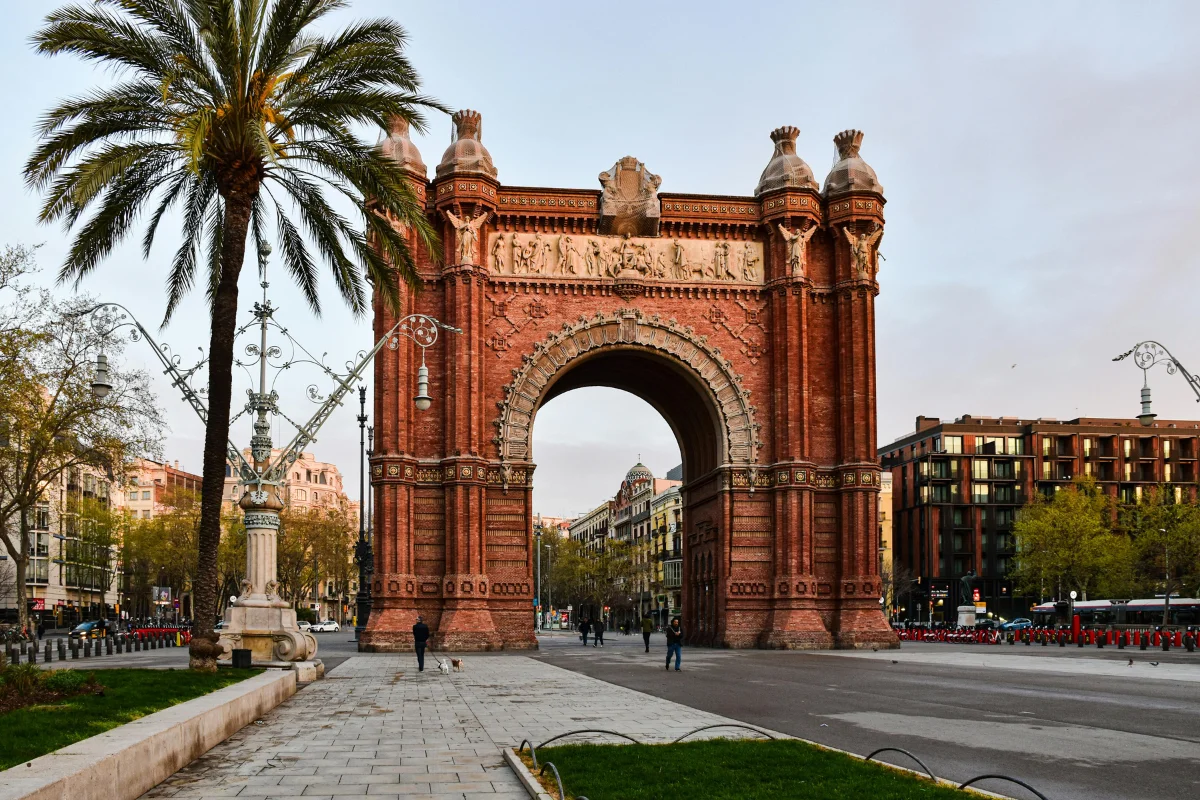

Most visitors assume Barcelona’s Arc de Triomf celebrates a military conquest — the same logic as Paris or Rome. It doesn’t. Josep Vilaseca i Casanovas designed it in 1888 as the monumental entrance gate to the Universal Exhibition, a 19th-century version of a world expo. The arch was Barcelona’s statement to Europe: the city was modern, commercially ambitious, and open to the world. That distinction changes how you read everything carved into it.
The arch stands at the exact boundary between Ciutat Vella — the medieval city — and the Eixample grid designed by Ildefons Cerdà. Standing here in 1888, you were at the edge of old Barcelona, looking toward a future the city was actively building.
What the Arch Actually Says — Reading the Sculpture
The arch has four distinct sculptural programs, each facing a different direction with a different message.
Facing Passeig de Sant Joan (the Eixample side): Barcelona rep les nacions by Josep Reynés — Barcelona welcoming the 22 nations participating in the exhibition. This is the face most visitors photograph without knowing what it means.
Facing the park: La Recompensa by Josep Llimona — Barcelona distributing prizes to exhibition winners. The ceremony, rendered in stone.
The lateral friezes: Agriculture, Industry and Commerce (Antoni Vilanova) on one side; Sciences and Arts (Torquat Tasso) on the other — the categories of human progress the exhibition was meant to showcase.
The upper buttresses: Twelve winged Fame figures by Manuel Fuxà and Pere Carbonell crown the structure. Above everything, the shields of all 49 Spanish provinces, with Barcelona’s crest at the center.
The material is deliberate: exposed ceramic brick, majolica tiles made by craftsman Magí Fita, and Portland cement artificial stone. Not marble. Not granite. Brick — the material of Catalan industrial modernism, chosen to differentiate Barcelona’s arch from every classical European precedent that came before it.
Is Arc de Triomf worth visiting in Barcelona? Yes, and it takes under 20 minutes. The arch is free, open 24 hours, and sits at the start of a pedestrian boulevard that connects directly to Ciutadella Park. The sculptural program is more layered than it looks. Combined with the park and the Born neighborhood, it anchors one of the best half-day walking routes in the city.
Quick Decision — How to use this visit
- Just passing through → 15 minutes: read the facades, walk the boulevard to the park entrance
- Combining with Ciutadella Park → 90 minutes total, straight line from arch to lake to waterfall
- Adding the Born → turn south after the arch for 10 minutes to reach Santa Maria del Mar and the Picasso Museum
- Morning photography → Passeig de Sant Joan side, early light hits the brick directly with no shadows
- Late afternoon photography → Passeig de Lluís Companys side, low sun warms the terracotta and highlights the majolica details
- Full half-day route → Arch → boulevard → Ciutadella → Born → Santa Maria del Mar: 2.5 hours without rushing
The Boulevard — Passeig de Lluís Companys
The 50-meter-wide pedestrian boulevard between the arch and the park was designed by Pere Falqués for the same 1888 exhibition. The wrought-iron lampposts are original. Eight bronze statues of notable Catalan historical figures line the sides — most visitors walk past without noticing them.
This boulevard is one of the widest car-free axles in central Barcelona. During the Barcelona Marathon and the Jean Bouin race, it serves as a finishing stretch. On regular days it hosts skaters, musicians, and occasional weekend markets.
What makes the location architecturally significant: the arch was deliberately placed at the threshold between the old and new city. It wasn’t decorative placement — it was a political and urban statement about where Barcelona was headed.
Why the arch was built in brick and not stone
The arch went up for the 1888 Universal Exhibition, and the question worth answering is why it was built in brick when every comparable European triumphal arch used stone or marble.
The choice was a manifesto. Barcelona’s industrial economy ran on ceramics, textiles, and manufacturing — not aristocratic stonecraft. Using brick and majolica was a statement that Catalonia’s modernity was industrial and bourgeois, not imperial. It’s also why the arch looks more at home next to the Palau de la Música — built a decade later with the same aesthetic DNA — than next to the Arc de Triomphe in Paris.
The other thing that goes unnoticed: the arch was built to face away from the city center, toward the sea. The main facade welcomes visitors arriving from the Eixample — the modern city — not from the Gothic quarter. The orientation tells you where Barcelona thought its future was.
Ciutadella Park — The Destination at the End of the Boulevard
Five minutes of straight walking down Passeig de Lluís Companys brings you to the main entrance of Ciutadella Park. The park was the actual site of the 1888 Universal Exhibition — the arch announced it, the park contained it.
Inside: the Monumental Cascade (Gaudí contributed to the hydraulic project as a young architecture student), the rowing lake, the Catalan Parliament, and four modernist buildings from the exhibition — the Hivernacle, Umbracle, Castell dels Tres Dragons, and Museu Martorell. Free entry, open until 22:30.
The arch-to-cascade-to-lake route is one of the most coherent historical walks in central Barcelona: every element dates from the same project, built for the same event, serving the same argument about what the city wanted to become.
The Born — 10 Minutes South
Heading south from the arch takes you directly into El Born, the neighborhood with the densest concentration of medieval streets in the historic center. The Picasso Museum, Mercat de Santa Caterina, and the Basilica of Santa Maria del Mar are all within walking distance of each other.
Santa Caterina Market — the one with the mosaic roof by Enric Miralles and Benedetta Tagliabue — is the practical alternative to La Boqueria. Same function, significantly less tourist pressure, and a contemporary architectural design that justifies the visit even if you buy nothing.
Santa Maria del Mar was built between 1329 and 1383, funded by the merchants and workers of the Ribera neighborhood. It’s the church Barcelona’s residents actually consider their own — as opposed to the Cathedral, which is the episcopal seat. Entry is free during worship hours; tower access starts from €5.
Mistakes to Avoid
- Going at midday in summer: the boulevard has almost no shade and the brick amplifies heat. Morning or evening visits are significantly better.
- Missing the sculpture detail: most visitors photograph the arch from the front and move on. Walk around all four sides — the full sculptural program only makes sense seen from all angles.
- Treating it as a standalone stop: the arch without the boulevard, park, or Born is a five-minute visit. Build it into a route and it becomes the anchor of a half day.
- Expecting to go inside: there’s no interior access. The arch is a gate, not a building. This surprises a lot of visitors who arrive expecting an observation deck.
- Coming only at night: the arch is atmospheric after dark, but the sculptural detail — which is the whole point — is only readable in daylight.
Practical Information
| Detail | Information |
|---|---|
| Entry | Free, 24 hours |
| Interior access | None |
| Metro | L1, Arc de Triomf stop — exit directly in front |
| Best light for photos | Morning (Passeig de Sant Joan side) / Sunset (boulevard side) |
| Time for the arch alone | 15–20 minutes |
| Time including park + lake | 90 minutes |
| Time including Born + Santa Maria | 2–2.5 hours |
Is the Arc de Triomf worth a special trip?
Not on its own. But as the starting point of a half-day route through the park, the Born, and the medieval waterfront, it’s one of the most coherent itineraries in Barcelona. The arch functions best as a threshold — which is exactly what it was designed to be.
How far is it from the Sagrada Família?
About 20 minutes on foot heading north up Passeig de Sant Joan, or 10 minutes by metro (L1 to L5 transfer). The two monuments share the same era of Barcelona’s urban ambition — the Eixample grid was being built at the same time the arch was going up. If you’re doing the Gaudí route, the arch works as a warm-up before heading deeper into modernisme.
The arch has been standing at this corner since 1888 and has watched the city build itself around it — the Eixample to the north, the Born to the south, the park behind it. It was built as a beginning, and it still works that way: whatever you’re doing next in Barcelona, this is a reasonable place to start.
To plan the full day from here: Barcelona first-time visitor guide integrates the arch, Born, and Ciutadella into a timed itinerary. For the neighborhood directly south, the El Born Barcelona guide covers the medieval streets, markets, and waterfront in detail. And for the modernisme connection heading north, the Barcelona modernisme route maps the full architectural circuit.