
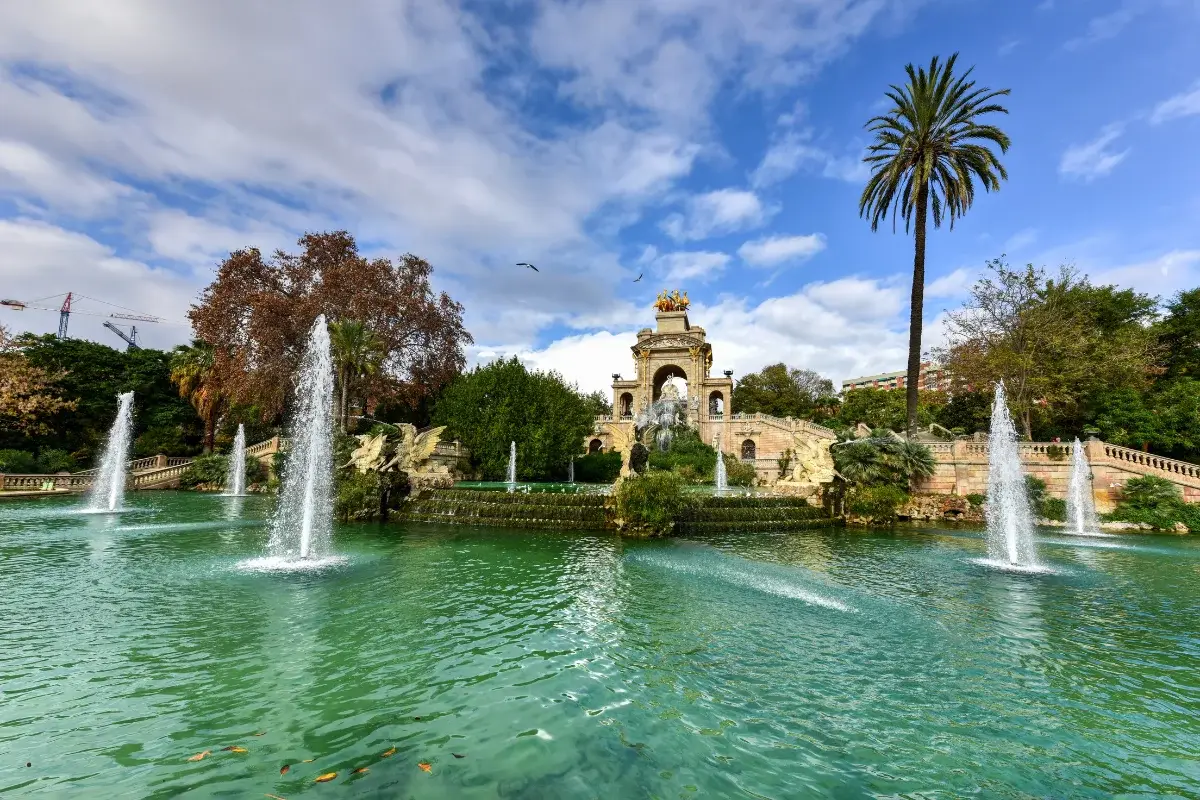

Ciutadella Park sits between El Born and Barceloneta, free to enter, open until 22:30, and contains more architectural and sculptural content than most paid attractions in the city. The Monumental Cascade involved the young Gaudí solving the hydraulic problem. Four Modernista buildings from the 1888 Universal Exhibition still stand inside the perimeter. The Catalan Parliament occupies a former military arsenal. And a 1907 mammoth sculpture was the first piece of a 12-prehistoric-animal public art project that was never completed beyond the first figure.
Most visitors arrive without knowing any of this, do the lake and the cascade, and leave. This guide maps what’s actually inside and how to plan the visit based on how much time you have.
The best entrance is via the Arc de Triomf (Metro L1). The Passeig de Lluís Companys — a pedestrianized boulevard with original wrought-iron lamp posts by Pere Falqués — leads directly to the park’s main gate in about six minutes on foot.
What’s inside Ciutadella Park and is it worth visiting? 31 hectares of free parkland open until 22:30. Inside: the Monumental Cascade (Gaudí contributed the hydraulic design as a student), a rowing lake (€7 per 30 min for 2 people), four 1888 Universal Exhibition buildings, the Catalan Parliament (free guided visits on request), 40+ sculptures, and the Barcelona Zoo (separate paid entry). Allow 2 hours minimum.
The Monumental Cascade — What Gaudí Actually Did Here
The Cascade is the park’s most photographed element and the piece that generates the most spontaneous activity on weekends: impromptu music, groups sitting on the stairways, street performers. Josep Fontserè designed the overall structure; the young Antoni Gaudí — then an architecture student — resolved the hydraulic system and designed the artificial grotto with stalactites beneath the main structure. The grotto is not open to the public, but the sculptural ensemble is fully visible: the Quadriga of Aurora by Rossend Nobas crowns the upper section; the Birth of Venus by Venanci Vallmitjana presides at the center.
The cascade has been stopped in recent periods due to water conservation measures. The structure, sculptures, and stairways remain fully visitable and photogenic without the water running. This surprises visitors who come specifically for the waterfall effect — worth checking current status before planning the visit around it.
For the Gaudí early-career context, the Gaudí route in Barcelona places this early collaboration within the architect’s complete trajectory.
Quick Decision — How to Use the Park
- 1 hour → Cascade + lake + mammoth sculpture — the three most-visited points in a direct route
- 2 hours → Add the 1888 buildings (restored Hivernacle, Castell dels Tres Dragons exterior) and the sculpture walk
- Sunday afternoon with a partner → Cascade, rowing boat (€7 for 30 min), picnic on the interior grass
- With young children → Mammoth + lake + LaLudo (free play space for 0–5 years) + Zoo if time allows
- For architecture → Hivernacle (free, recently restored) and Castell dels Tres Dragons — no zoo ticket needed
- For activity → free ping-pong tables, basketball courts, free municipal Tai Chi classes Tue/Thu 12:00–13:00
The 1888 Exhibition Buildings — The Most Ignored Part of the Park
Four structures inside the park are direct results of the 1888 Universal Exhibition, and almost no visitor enters any of them.
Hivernacle: iron-and-glass pavilion designed by Josep Amargós, restored in 2023 with €2.5 million investment. The restoration recovered the original structure and the effect of diffused light through the glass panels. Free entry. The quietest space in the park on weekday mornings.
Umbracle: also by Amargós, wood and brick structure designed for shade-tolerant tropical plants. Its comprehensive rehabilitation is planned at €1.5 million. Still visitable, with a botanical atmosphere the Hivernacle doesn’t have.
Castell dels Tres Dragons: designed by Lluís Domènech i Montaner as a café-restaurant for the Exhibition. Exposed brick, rolled iron, the Modernisme architectural language before the movement had a name. Currently under comprehensive restoration. It’s the building that best represents the moment when Barcelona’s Modernisme route was beginning to define itself.
Museu Martorell: Barcelona’s first public museum (Antoni Rovira i Trias, 1882). Recently rehabilitated as the Centro Martorell de Exposiciones, with updated content on geosciences and marine biology.
The Lake, the Mammoth and the Sculpture Route
The park lake has rowing boat rental: €7 for 1–2 people, €10 for 3, €11 for 4–5, in 30-minute periods. Service operates April–September 10:00–20:00, October–March 10:00–18:00.
The park’s sculpture collection totals over 40 pieces distributed across the avenues and plazas. Three deserve specific attention:
The Mammoth (Miquel Dalmau, 1907) was the first piece of a project by the Junta de Ciències Naturals to install twelve life-size replicas of prehistoric animals that inhabited Catalonia. Only the mammoth was executed. It’s the most photographed point in the park after the cascade — and almost no one knows the backstory.
El Desconsol (Josep Llimona): the female figure in deep melancholy facing the Parliament entrance is an exact replica. The original is preserved at the MNAC for conservation reasons. It’s one of the least-known facts about the park’s sculpture collection.
La Dama del Paraguas (Joan Roig Soler): symbol of bourgeois Barcelona from 1888, originally designed by Fontserè. Located inside the Zoo perimeter, visible from the main path.
The Parliament inside the park is a separate visit
Beyond the cascade and the lake, the Parliament visit works as a genuinely different experience from the park around it.
The Catalan Parliament occupies the former arsenal of the Bourbon military citadel (1717–1727) — the same fortress whose demolition created the space for the park in 1869. The building’s French classicist style, built with Montjuïc stone, has four interior courtyards and a ceremonial staircase that most visitors never see because they don’t know free guided visits exist.
Visits are 45 minutes, free, and include the hemicycle, the Sala dels Passos Perduts, and the Escalera de Honor. They require advance booking (minimum 2 days) at parlament.cat. Available in Catalan, Spanish, and English. On September 11 (Catalonia’s National Day) and September 24 (La Mercè), open days run without reservation. It’s the most direct way to understand that the park is not just a recreational space — it’s the site where a military occupation was literally dismantled and replaced by democratic institutions.
The Barcelona Zoo — A Separate Plan Within the Same Perimeter
The Zoo occupies a sector of the park with independent access — from inside Ciutadella or from Carrer Wellington. It opened September 24, 1892, from the private collection of Lluís Martí-Codolar and today holds approximately 2,000 specimens from 300 species.
Entry: €23 adults; €13.90 children 3–12; €11.20 over-65; €6 with 33% disability certification; free under-3. Outside food permitted; picnic areas available inside.
Since 2015 the Zoo has eliminated acrobatic dolphin shows and reoriented its model toward conservation and research. Current plans include making the enclosure permeable with the park, integrating it into the Ciutadella del Coneixement science cluster — a €290 million project expected to be 80% operational before 2027.
Practical Information
| Detail | Information |
|---|---|
| Park entry | Free |
| Opening hours | 10:00 to 22:30 (exact closing varies with sunset) |
| Zoo | Separate paid entry — not included in park access |
| Rowing boats | April–Sep until 20:00; Oct–Mar until 18:00 |
| Dogs | Permitted on leash; off-leash zone available |
| Picnic | Permitted in all grass areas |
| Parliament visit | Free, advance booking required (minimum 2 days) |
| Best access | Arc de Triomf (L1) + Passeig de Lluís Companys for main entrance; Ciutadella-Vila Olímpica (L4) for the lake side |
Start at the Cascade, cross toward the Hivernacle if it’s open, continue to the lake and the mammoth, then decide from there whether you have time for the Zoo or prefer to exit toward El Born. The Sunday afternoon dynamic — picnics and spontaneous music near the Cascade — is when the space has the most life and the least organized tourism. That timing, more than any specific itinerary, is the reason to plan the visit for late Sunday afternoon.
For what surrounds the park: the El Born Barcelona guide covers the Picasso Museum, Santa Maria del Mar, and the medieval streets 10 minutes on foot from the park’s west entrance. For the waterfront side, the Barceloneta guide covers the beach neighborhood that connects to the park’s south. And for a full-day itinerary that integrates Ciutadella, the Barcelona first-time visitor guide places the park within the wider historic center circuit.