
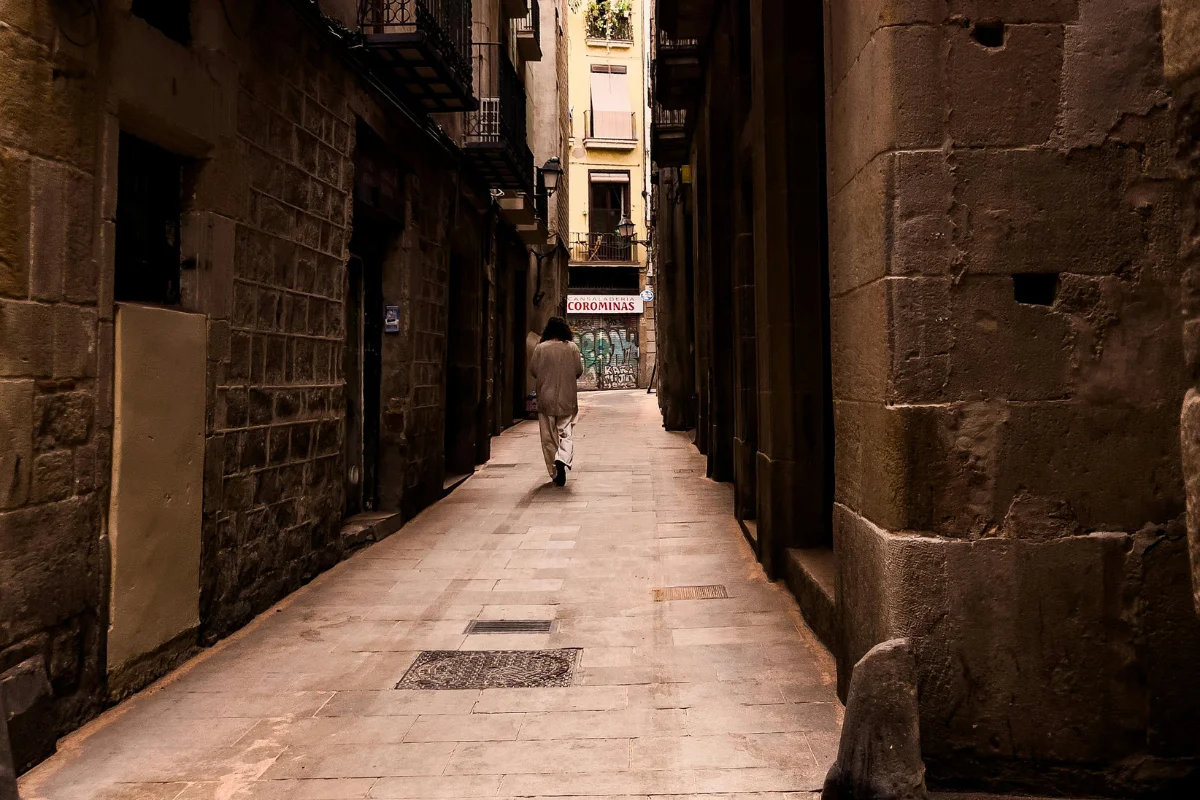

Gràcia has a village logic that no map captures well: the squares are the living rooms, the streets are the corridors, and the bodegas are the kitchen. This walking route under 2 kilometers connects all three in two hours without effort. It starts at Plaça de la Vila de Gràcia with the 33-meter clock tower, walks Carrer Verdi, reaches the Plaça del Diamant with the 1937 anti-aircraft shelter beneath the pavement, and ends with vermouth at Bodega Quimet. For the Gràcia Barcelona nightlife guide that extends the plan into the evening, the nightlife article covers the full bar circuit. Metro L3, Fontana stop.
Plaça de la Vila de Gràcia — The Natural Starting Point
Plaça de la Vila de Gràcia was the town hall square when Gràcia was an independent municipality. The 33-meter Torre del Rellotge (Clock Tower) that dominates it wasn’t built for decoration — erected in 1864, it served in 1870 as a resistance point during a residents’ uprising against forced military conscription. Residents barricaded themselves inside the tower until the army took it by force. The bell tower was preserved as a symbol.
Today the square functions as the most local meeting point in the neighborhood: terraces with residents of all ages, the Mercat de la Llibertat a hundred meters away, an unhurried pace that hasn’t changed. Have a coffee at any of the terrace tables before starting the walk.
Time: 15–20 minutes.
Quick Decision — How to Use the Route
- 1 hour → Plaça de la Vila + Carrer Verdi walk + vermouth at Bodega Quimet — the route’s core in minimum time
- Most iconic photograph → Plaça del Diamant with La Colometa statue — best at first light, almost no one there before 09:00
- Saturday visit → Start at Plaça de la Vila at 11:00, plan to arrive at Bodega Quimet by 12:30 before it fills up
- Independent design shopping → Carrer Verdi + detour down Carrer de Bonavista — highest concentration of local independent shops in the neighborhood
- To add Gaudí’s first building → Casa Vicens is 10 minutes on foot from Plaça del Diamant — entry ~€9, the exterior is free
- Evening version → The same route from 18:00–20:00 with the terraces at their best and late afternoon light on the facades
Carrer Verdi — The Independent Commerce Axis
Carrer Verdi is the neighborhood’s most active street for independent shops. Bookshops, local designer clothing, illustrators, craft, and the Cine Verdi — the oldest original-language cinema still operating in Barcelona, showing undubbed films since the 1980s. For the best independent cinemas in Barcelona, Cine Verdi is the oldest-running and most historically significant.
The practical tip: enter a maximum of two shops. The street has a lot to look at and the temptation to stop at every shopfront doubles the planned time without adding proportional value.
Optional detour: Carrer de Bonavista, one street over, has some of the most singular shops in the neighborhood — less trafficked and with more surprising window displays.
Time: 20–25 minutes.
Plaça del Diamant — The History Literally Beneath Your Feet
Plaça del Diamant takes its name from a 19th-century jeweler councilman who bought the land — the neighboring streets carry gemstone names (Ruby, Gold, Topaz). The square was immortalized by Mercè Rodoreda in her 1962 novel of the same name, and the La Colometa statue that presides over it is a direct homage to the protagonist.
What almost no one knows: beneath the square there is an anti-aircraft shelter excavated by the residents themselves in 1937, 12 meters deep, with capacity for 300 people. Visits are guided and take place on specific dates — primarily during Gràcia’s Festa Major in August, at €3 with advance booking. The shelter was built in response to the same bombing campaign that hit Plaça de Sant Felip Neri in the Gothic Quarter in 1938.
The square has a more residential character than Plaça del Sol or Plaça de la Virreina — fewer terraces, quieter neighborhood atmosphere. The best point in the route to sit on a bench for five minutes.
Time: 10–15 minutes.
Plaça de la Virreina and Plaça del Sol — Two Different Rhythms
Plaça de la Virreina is the quietest square on the route. Presided over by the church of Sant Joan, it has shaded terraces and a more relaxed atmosphere than Plaça del Sol. Its name comes from the former widow of the Viceroy of Peru, whose palace occupied this space. The square was built in 1878.
Plaça del Sol is the opposite pole: the epicenter of terraceo, with street musicians, groups of friends, and a Astrolabe statue that is one of the neighborhood’s most singular monuments. The square starts filling from 12:00 on weekends and 18:00 on weekdays. Here the Gràcia nightlife starts earlier than at any other neighborhood square — the surrounding bars have terraces that run late.
What the Cine Verdi means for Barcelona film culture
Beyond Carrer Verdi and the main squares, the piece worth understanding is the Cine Verdi’s significance within Barcelona’s film culture.
When Cine Verdi opened in the 1980s as a non-dubbed cinema, showing films in original language with subtitles was a political and cultural act in post-Franco Spain. Dubbing was associated with censorship — the Franco regime had used dubbing since the 1940s to modify dialogue and control content. An original-language cinema wasn’t just a commercial preference; it was a position.
The cinema has run continuously since then and remains the reference point for Barcelona’s international film community. Its programming has never fully crossed into the mainstream — it’s where you see films from directors the multiplex won’t carry. That continuity from political statement to cultural institution is the actual story, and it’s in this street.
Another way to cross the city on foot follows its books: Barcelona is the only real city in Don Quixote, and the literary walking routes trace where the character first sees the sea.
Bodega Quimet and Vermuteria del Tano — How to End the Route
Bodega Quimet (Carrer de Vic, 23) has been open since 1954. When the second Quimet retired, he put up a handwritten sign: “for sale, retirement.” The Montero brothers bought it and, rather than renovating, chose to preserve everything as it was — original hydraulic tile floors, wooden barrels, white marble tables. Order the Variado Quimet: draught vermouth with quality conservas and anchovies.
Vermuteria del Tano (Carrer de Joan Blanques, 17) has 4.5/5 with over 1,080 reviews — the highest-rated bar in the Plaça de la Vila area. Perucchi vermouth with a siphon bottle, anchovies, cockles, pickled mussels. Prices €1–10.
Three vermouth options to end the route based on what you’re looking for:
| Venue | Address | Atmosphere | Vermouth price |
|---|---|---|---|
| Bodega Quimet | Carrer de Vic, 23 | Classic, since 1954 | €2–3 |
| Vermuteria del Tano | C/ Joan Blanques, 17 | Pure neighborhood | €2–4 |
| Puigmartí Vermuteria | C/ Puigmartí, 1 | Contemporary | €4–6 |
Practical Notes
- Actual duration: 2 hours including vermouth. With long shop stops or long terrace breaks, plan 2.5 hours
- Best time: Saturday between 11:00 and 13:00 — the neighborhood is alive without afternoon saturation. Weekday mornings for quieter shops
- Carrer Verdi shops: typically open from 10:30–11:00; before that the street is quiet
- Anti-aircraft shelter at Plaça del Diamant: guided visits only on specific dates — check the MUHBA website in advance
- Return metro: from Plaça del Sol or Plaça de la Vila, Fontana stop (L3) is 5 minutes on foot. From Casa Vicens if you add it, Lesseps (L3) is closer
The route ends where the neighborhood really starts to function — at a bar with a glass in hand and the feeling that everything outside the neighborhood can wait a bit longer. Start at the Clock Tower, finish at the vermouth. Two hours that fit well.
To extend the day: Casa Vicens is 10 minutes on foot from Plaça del Diamant and closes the route with Gaudí’s first work. For the Gràcia neighborhood guide covering the Mercat de la Llibertat and the broader neighborhood beyond the squares, the guide has the complete picture. And for the evening continuation, Gràcia Barcelona nightlife covers the bars from vermouth hour through to 02:00.