

In 1870, Gràcia staged an armed insurrection. The cause was mandatory military conscription — quintas, the lottery system that sent young men to wars in Cuba and Morocco. The resistance lasted five days. It required 14 artillery battalions sent from Madrid to suppress. The uprising failed, but it confirmed what Gràcia had been demonstrating for decades: this was a municipality with its own political identity, its own working-class organization and its own relationship to the Spanish state.
Barcelona absorbed Gràcia administratively in 1897, at the same time it annexed Sants, Les Corts, Sant Andreu and three other surrounding municipalities. The annexation merged the street addresses and the tax base. It did not merge the identity.
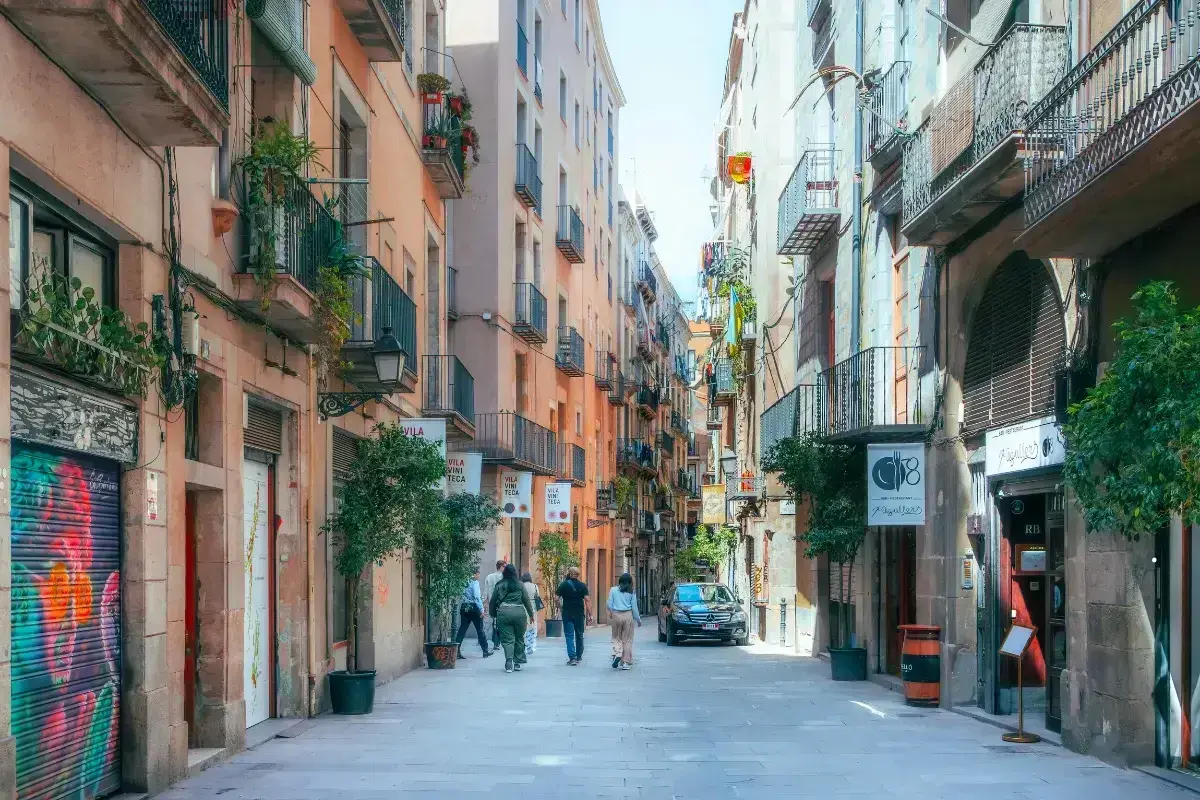
The reason Gràcia’s streets don’t follow the Eixample’s orthogonal grid is that Gràcia’s urban fabric was already built when Cerdà designed his expansion plan. The irregular streets, the small plazas, the organic neighborhood structure — all of that is the physical record of a municipality that existed before the Eixample, and whose resistance to being absorbed into the grid is still visible in every block.
This is the context for understanding what you’re looking at when you visit Gràcia today.
The Civil War shelter under Gràcia, and a free viewpoint above Park Güell
The Refugi Antiaeri del Carrer de Aldana is one of the best-preserved Civil War air-raid shelters in Barcelona, located in the subsurface of Gràcia. Visited by reservation. The experience of understanding the 1936–1939 aerial bombardments that shaped Barcelona’s political memory from inside a civilian shelter that residents built by hand is genuinely different from any surface-level museum exhibit. It sits in the same neighborhood as the plazas and markets — but almost nobody mentions it.
The second overlooked element: the Plaça del Carmel, just above Park Güell (free access, no ticket). It’s one of the broadest panoramic views of Barcelona from a public space and receives almost no visitors from outside the immediate neighborhood. The combination of the free-zone paths through Park Güell’s forest and this plaza makes a complete morning without any admission fee.
The third: the Casa Vicens. It’s in the neighborhood, it’s the correct entry point for understanding Gaudí’s development, and it consistently gets 10% of the visitors that Casa Batlló attracts.
The Architecture That Gaudí Started Here
Casa Vicens (1883–1885): Where Gaudí’s Language Began
The Casa Vicens on Carrer de les Carolines is Gaudí’s first major architectural commission. He was 31 years old. The building shows none of the organic forms associated with his mature work — instead it shows what a brilliant 31-year-old architect with deep knowledge of Orientalist and Moorish architecture, ceramic traditions and structural experimentation looked like before he found his own language.
The ceramic tile exterior (yellow and green marigold patterns), the ironwork gates (cast palm fronds), the horseshoe arches and the minaret-like tower reference North African and Middle Eastern architecture that Gaudí knew through publications and the work of other Spanish architects of the period. None of it looks like Park Güell or the Sagrada Família — and that’s precisely what makes it important. Casa Vicens shows the raw material before the synthesis.
Visitable since 2017. Entry: €16. The museum inside covers the commission, the owner (Manuel Vicens i Montaner), and the architectural decisions in enough detail to understand what you’re looking at.
For the full Gaudí sequence — from Casa Vicens through Casa Batlló, the Sagrada Família and Colònia Güell — the Gaudí route Barcelona itinerary organizes all seven UNESCO buildings with access logistics and time estimates.
Casa Fuster (1908–1911): Domènech at the Gràcia Border
On the Passeig de Gràcia corner with Carrer de Còrsega — technically on the boundary between Gràcia and the Eixample — the Casa Fuster was designed by Lluís Domènech i Montaner. One of the most elegantly proportioned Modernista buildings in Barcelona, now a five-star hotel. The facade is publicly visible; the ground-floor Café Vienès is accessible.
The Plazas: How to Use Each One
Gràcia’s plazas are not interchangeable. Each has a specific character, a specific time of day when it’s most alive and a specific community that uses it.
Plaça del Sol: The most active and the most visited. Daytime is calm — café terraces, families, the occasional street musician. From 18:00 onward on weekdays, and particularly on Friday and Saturday nights, it becomes one of the most concentrated neighborhood social spaces in the city. What makes it interesting is not its architecture (there isn’t much) but the density and genuineness of the gathering.
Plaça de la Vila de Gràcia: The institutional plaza — the historic Gràcia Town Hall (now the District headquarters) faces it, with the 19th-century clock tower that’s the neighborhood’s most recognizable visual symbol. More daytime civic energy than evening social life.
Plaça de la Virreina: The residential square. The 18th-century Baroque church of Sant Joan de Gràcia is the architectural anchor. Lower tourist density than Plaça del Sol. Consistently described by Gràcia residents as their preferred plaza because of it.
Plaça del Diamant: Small and architecturally unremarkable, but internationally known through Mercè Rodoreda’s 1962 novel La plaça del Diamant — one of the most important works of 20th-century Catalan literature. The bronze sculpture of the protagonist Colometa is in a corner of the plaza. The novel’s Gràcia is the Gràcia of the Civil War era, and reading it changes how any subsequent visit to the neighborhood feels.
Plaça de la Llibertat: The market plaza. The Mercat de l’Abaceria wraps its perimeter and drives the morning activity rhythm.
The Mercat de l’Abaceria: The Market That Works
The Mercat de l’Abaceria on Travessera de Gràcia is the oldest market in Gràcia and one of the most genuinely functional in Barcelona. The 19th-century iron building houses fresh produce stalls alongside vintage clothing, vinyl records, stamp collecting and artisan goods — a coexistence that reflects the neighborhood’s actual demographic rather than a curated market identity.
Sunday mornings: the perimeter hosts a secondhand book and collector’s market that runs until approximately 14:00. Vinyl records, stamps, coins, collectibles and used books from sellers who know what they have.
The market bar counters inside serve vermouth and tapas at neighborhood pricing. It’s one of the places where the phrase “local prices” is actually accurate rather than aspirational.
The Festa Major: August, by Residents, for Residents
The Festa Major de Gràcia runs in the week of August 15 (Sant Bartomeu). Individual streets compete to produce the most elaborated decorative installations — built entirely by resident associations using volunteer labor and collective funding over months of preparation. The results cover entire streets with themes that change yearly: science fiction, mythology, cinema, historical periods.
The competition is real; the judging is serious; the installations are sometimes extraordinary. What makes the Festa Major different from a municipal event is that the neighborhood generates it from within. The association of each participating street organizes its own design, fundraising and construction. The city doesn’t produce it — residents do.
If visiting Barcelona in the third week of August, the Festa Major is reason enough to dedicate a full day to Gràcia. The combination of the decorated streets, the outdoor concerts, the open-air chess tournament (the largest in Spain) and the correfoc (fire run) is unlike anything else in the city’s annual calendar.
Is Gràcia Worth a Dedicated Visit?
Yes — for any visitor with time beyond the Gaudí circuit and the historic center.
The plazas, the market and the street life are genuinely different from anything in the tourist circuit. Casa Vicens is the most revealing Gaudí building for anyone who wants to understand the architect’s development rather than just photograph the finished results. And the neighborhood’s political history — the 1870 insurrection, the Republican identity, the Civil War shelter under the streets — gives context to a place that looks pleasant but is actually full of specific meaning.
When it doesn’t deliver: if you arrive expecting a quiet village and find the Plaça del Sol on a Friday night. The neighborhood’s social density at peak hours is real. The calm version of Gràcia is weekday mornings.
How to Organize the Visit
2–3 hours (quick visit): Plaça del Sol → Plaça de la Virreina → Mercat de l’Abaceria (if open) → Casa Vicens exterior → Plaça del Diamant. All on foot, no metro needed.
Half day: Add Casa Vicens interior (€16, 1 hour) and walk up to the Park Güell free zone and Plaça del Carmel for the panoramic view. Finish with lunch in the neighborhood.
Full day with Park Güell: Park Güell monumental zone (booked slot, early morning) → descend on foot to Gràcia → Casa Vicens → lunch → afternoon circuit through the plazas → vermouth at Mercat de l’Abaceria bar → dinner.
Food in Gràcia: The Honest Version
The Carrer de Verdi and parallel streets have the densest food concentration in the neighborhood — independent restaurants, international kitchens and vermouth bars that change more slowly than comparable streets in more tourist-pressured neighborhoods.
For vermouth: the plaza terraces (Plaça del Sol, Plaça de la Virreina) are the most atmospheric. For coffee: the specialty coffee Barcelona guide identifies specific roasters in and near the neighborhood, including SlowMov on Carrer de Neptú (no Wi-Fi, no syrups, own roast — the neighborhood’s version of the specialty coffee ethos applied strictly).
For the brunch and breakfast circuit: the best brunch in Barcelona guide covers the specific options in Gràcia and adjacent neighborhoods.
What to avoid: any restaurant with a multilingual menu board explicitly positioned near the Park Güell descent path. These serve the tourist overflow from the park, not the neighborhood.
Getting There and Around
Metro: L3 to Fontana or Diagonal (southern Gràcia). L4 to Joanic (eastern Gràcia). L3 to Lesseps (upper Gràcia, near Park Güell).
On foot from the Eixample: 10–15 minutes north up the Passeig de Gràcia or any parallel street.
Cycling: the neighborhood’s quieter streets make it one of the more pleasant cycling circuits in central Barcelona. Cycling routes in Barcelona covers the full network if this is a priority.
Is Gràcia safe to visit at night?
Completely. It’s one of the safest neighborhoods in Barcelona, with active plaza life until late. The Plaça del Sol is particularly well-populated on evenings and weekends. Standard urban precautions apply (bags secured, phone not left on tables) but there are no specific security concerns.
Is Casa Vicens worth visiting if I’ve already seen Park Güell and the Sagrada Família?
Yes, specifically because it’s different. Casa Vicens (1883–1885) shows Gaudí before his mature language crystallized — Oriental influences, flat ceramic patterns, geometric rather than organic forms. It’s the most architecturally revealing building for understanding how Gaudí’s style evolved. Entry €16.
When is the Festa Major de Gràcia?
The week of August 15. The decorated streets are up for the full week; the main programmed events (correfoc, concerts, open-air chess tournament) run from approximately August 14–20. The street decoration competition results are announced during the week.
How is Gràcia different from the Eixample?
Gràcia was an independent municipality until 1897; its street grid is organic and predates Cerdà’s expansion plan. The streets are narrower, the plazas are smaller-scale and more neighborhood-oriented, and the architecture mixes working-class 19th-century buildings with Modernista elements rather than the systematic facade-level Modernisme of the Eixample’s main streets.
What is the Mercat de l’Abaceria and when does it open?
The main fresh produce market in Gràcia, in a 19th-century iron building on Travessera de Gràcia. Opens Monday to Saturday for the main market (hours vary by stall). The Sunday collector’s market (books, vinyl, stamps, coins) runs outside the building until approximately 14:00. Bar counters inside serve vermouth and tapas at neighborhood prices.
Final Insight
Gràcia spent the 19th century being annexed into a city it wasn’t sure it wanted to join, then spent the 20th century building a cultural identity that made the annexation irrelevant. The irregular street grid, the plaza culture, the Festa Major built entirely by resident associations — all of these are forms of the same argument: that a neighborhood can maintain its character regardless of the administrative border drawn around it. Visitors who come for Park Güell and never enter Gràcia miss the neighborhood that produced the political culture that made Gaudí’s client Eusebi Güell’s project possible — and the one that’s still, 128 years after the annexation, resisting the grid.
For visitors connecting Gràcia to the broader Barcelona picture, the Barcelona Modernisme route guide covers how the movement expressed itself across all the buildings — including Casa Vicens as the origin point — and the best neighborhoods to stay in Barcelona guide gives the practical accommodation context for using Gràcia as a base.