
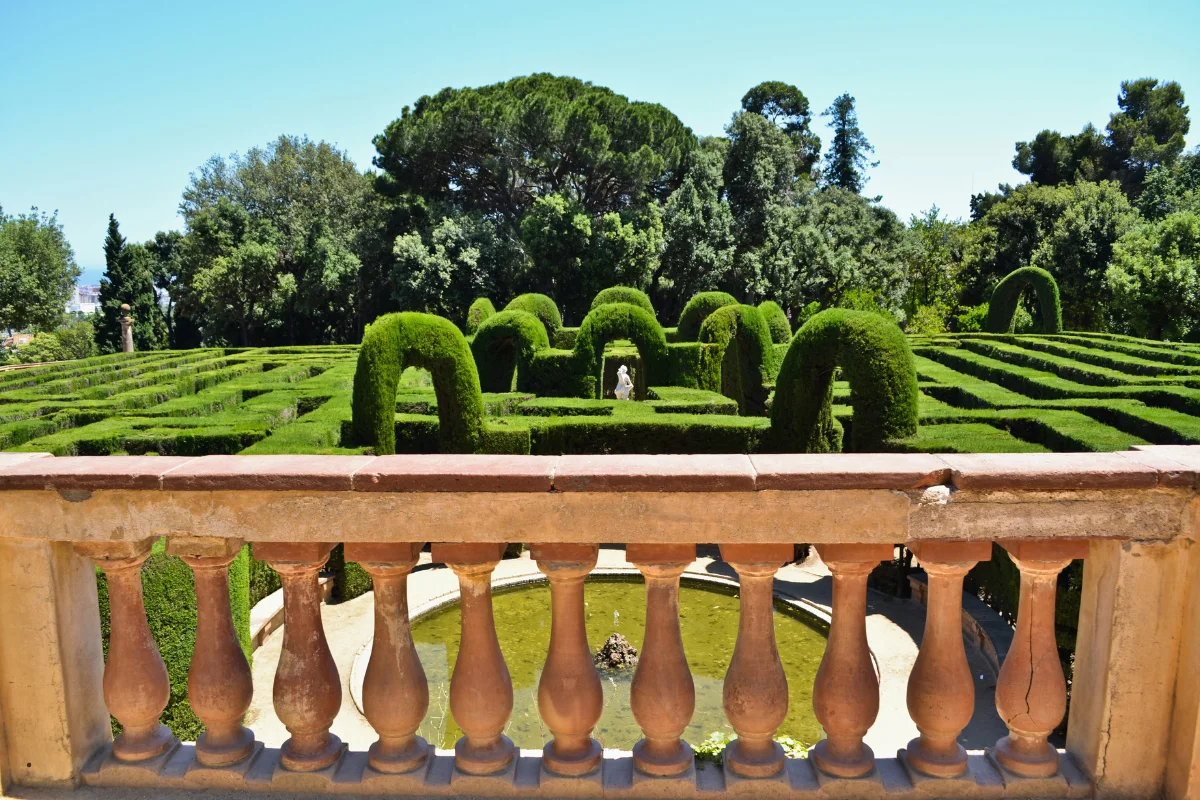

Until 1904, Horta was an independent municipality with its own church, farms, water mines and a laundry industry that supplied clean linen to the wealthy households of the Eixample. Barcelona absorbed it, but the district never fully conformed. Today Horta-Guinardó covers 1,194 hectares across 11 neighborhoods — it’s the third largest district in the city and the one that looks least like a city. The oldest garden in Barcelona is here. The best free viewpoint in Barcelona is here. A UNESCO World Heritage modernist complex with a fraction of the Sagrada Família’s visitors is here. None of it is well-signed.
The day works like this: the Parc del Laberint d’Horta (€2.23, free Wednesdays and Sundays, open from 10:00) in the morning, the Carrer Aiguafreda washerwomen’s street and the old Horta village center around midday, lunch or vermouth at Plaça d’Eivissa, then the Búnkers del Carmel (free, closes 19:30) for the afternoon panorama. The Recinte Modernista de Sant Pau (€18, opens 9:30) works as a cultural extension if you want UNESCO architecture without the queues.
Want X → Go Here
- Best free viewpoint in Barcelona → Búnkers del Carmel — arrive 45 min before sunset, closes 19:30
- Oldest garden in the city → Parc del Laberint d’Horta — weekday mornings, €2.23
- Free entry to a UNESCO site → Recinte Modernista de Sant Pau gardens — exterior free, interior €15–18 depending on season and sales channel
- Most local square in the district → Plaça d’Eivissa — Bar Quimet d’Horta open since 1927
- 19th-century street with no tourist signage → Carrer Aiguafreda — 150 meters, 8 original washerwomen’s houses
- Catalan food in a medieval farmhouse → Can Cortada (11th century) or Can Travi Nou (18th century) — book ahead on weekends
- Quietest approach to the Búnkers → Walk up from the Carmel neighborhood streets instead of arriving by GPS from the top
What you are standing on at the Búnkers del Carmel
The view from the Búnkers del Carmel is the easy part. What you are standing on is the rest of it.
The concrete platforms that visitors use as viewing decks are the original gun emplacements of a Civil War anti-aircraft battery built in 1937. Four 105mm cannons mounted here defended the civilian population from Italian and German air raids supporting Franco. After the war ended, the military infrastructure was abandoned and the site became an informal settlement — families built their own homes directly on the battery foundations, living there in precarious conditions until the late 1980s. The city cleared the settlement and recovered the space as public infrastructure in 2011. The Museu d’Història de Barcelona (MUHBA) manages a small exhibition at the site with panels on the bombardment history.
This matters for the visit because it reframes what you’re looking at. The 360° view of the Eixample, the Sagrada Família, Montjuïc and the Mediterranean is real and it’s the best in the city. But the platform you’re standing on is a piece of military history that was later a neighborhood and is now a park. That layering is what makes the Búnkers worth more than the average mirador.
Morning: Parc del Laberint d’Horta
Barcelona’s oldest surviving garden isn’t in the Gothic Quarter or on Montjuïc. It’s in the northern edge of the district, started in 1791 by the Marquis of Alfarràs as a private garden for contemplation and display. Nine hectares organized in two distinct periods: the neoclassical zone (the cypress hedge maze, Roman deity sculptures, a fountain with Eros at the center) and a 19th-century Romantic extension with an artificial waterfall, a Venetian-style canal and a neoclassical pavilion loaded with Masonic symbolism.
The maze itself runs 750 meters between cypress hedges. At the center, a Latin inscription: In labyrintho amor est, et qui invenerit eum exire potest — in the labyrinth there is love, and whoever finds it can leave. The garden was designed to be read, not just walked through.
Entry: €2.23 on weekdays. Free on Wednesdays and Sundays — though the free Sunday option brings more people and less quiet. Weekday mornings before 11:00 are when the garden operates at its intended rhythm. The park has a capacity limit to protect the ecosystem; on weekend afternoons there can be a wait at the entrance.
The garden closes its entry gate 30 minutes before official closing time. In summer it closes at 20:00; in winter it can be as early as 17:30. Check before going.
📍 Passeig dels Castanyers, Horta. Metro L3, Mundet stop.
Midday: Carrer Aiguafreda and the Old Village Core
From the Parc del Laberint to Plaça d’Eivissa is a 20-minute walk downhill. The most interesting route isn’t the most direct one — descend via Carrer d’Aiguafreda.
This 150-meter street is the most concrete surviving record of what Horta was for two centuries: the laundry district of Barcelona. The subsoil here is rich in underground aquifers with water purity that exceeded the city’s main historical supply, the Rec Comtal. That advantage generated an industry. In the 19th century, the street housed 80 laundry businesses run by approximately 400 women who processed linen for wealthy Eixample and Ciutat Vella households. Collection on Mondays, delivery on Saturdays, carts loaded with clean linen descending to the city center every week.
What remains: 8 original low-rise houses and the wells in front of their facades where the mine water surfaced for washing. There is no explanatory sign, no tourist marker. The street has a semi-private, residential character — enter respectfully, don’t stop at doorways or photograph interiors.
The old Horta village center just beyond it preserves the Plaça de Santes Creus and a network of narrow streets that predate the Eixample grid by centuries. Two-floor houses, local shops, no establishment with an English menu in the window. For visitors who’ve already covered the hidden places Barcelona guide, this neighborhood has the same quality: nothing signals that there’s something to see.
Lunch: Plaça d’Eivissa and Where Locals Actually Eat
Plaça d’Eivissa has been the social center of Horta for generations — not by design, but because the neighborhood uses it. Terraces, ice cream shops, bars with plastic chairs and a daily menu on a chalkboard. Occasional craft markets, outdoor music during the district’s festivals.
Bar Quimet d’Horta (open since 1927) is the reference point on the square: original wooden shelving, unlabeled vintage bottles and over 80 varieties of bocadillo. No tourist menu, because it never needed one. The clientele has been the same for decades.
For a sit-down meal in a historic farmhouse setting: Can Cortada is an 11th-century masía with a defense tower, now a Catalan restaurant — bacallà a la llauna, grilled meats, rice dishes. Can Travi Nou in the Vall d’Hebron has the same format with 18th-century architecture and outdoor dining surrounded by gardens. Both require a reservation on weekends.
Pastisseria Mayol (open since 1854, fifth generation of the same family) is the oldest pastry shop in the neighborhood. The borregos, cream buns and angel-hair pastries follow century-old recipes. Worth the stop before the climb to the Búnkers. Closed Mondays.
For the full context of Barcelona’s vermouth culture and how it operates in neighborhoods like this one, the vermouth Barcelona guide covers the timing, the ritual and the bars worth knowing.
Afternoon: Búnkers del Carmel
The Turó de la Rovira sits at 262 meters and provides a 360° panorama covering the Eixample grid, the Sagrada Família, Montjuïc, the port, the Mediterranean and — on clear days — the Pyrenees. It’s the most complete unobstructed viewpoint in Barcelona. Free access.
Access closes at 19:30. Arrive at least 45 minutes before sunset to have the light without the pressure of closing time. On weekday afternoons outside peak season, you can have significant stretches of the platform to yourself. On summer weekend evenings it fills up — the view is the same but the experience isn’t.
The most interesting way to get there is on foot from the Carmel neighborhood, climbing through the residential streets of the hillside rather than arriving by taxi from the top. The ascent shows you the Barcelona that grew without a plan — neighborhoods built by hand during nights and weekends in the 1950s and 60s by immigrants who couldn’t afford legal construction permits. The streets are narrow and organic in a way that has nothing to do with Cerdà. It’s the other city, the one underneath the postcard.
Transport alternatives: Bus V17 or 119 from El Coll / La Teixonera metro stop (L5). Taxi from Plaça d’Eivissa costs under €8. The district also has 55 public elevators and approximately 100 mechanical escalators in the steeper neighborhoods — essential for anyone with mobility considerations.
📍 Turó de la Rovira, El Carmel. Free. Open 9:00–19:30.
Optional Extension: Recinte Modernista de Sant Pau
If the plan includes a cultural block, the Recinte Modernista de Sant Pau is 10 minutes from Metro Sant Pau (L5) and less than a 2-minute walk from the Sagrada Família — with a fraction of its visitors.
Lluís Domènech i Montaner designed the complex as a hospital-city where patients recovered surrounded by light, gardens and color. Construction began in 1902, completed in 1930. The result: 27 independent pavilions — each with polychrome ceramics, mosaics and sculpture by artists including Pau Gargallo — connected by a 1-kilometer network of underground galleries designed for the hygienic transport of patients and supplies. UNESCO declared it World Heritage in 1997.
The design philosophy was specific: emotional health as an architectural criterion, color as a therapeutic tool, beauty as part of treatment. This is why Domènech i Montaner’s approach reads as categorically different from Gaudí’s — not competing aesthetics, but different problem statements. For the full modernisme context across the city, the Barcelona modernisme route guide connects Sant Pau with the other major buildings of the period.
Entry: €18 general. Guided visits cost extra. Opens 9:30. Metro L5, Sant Pau | Dos de Maig stop.
Best Strategy by Available Time
2 hours: Búnkers del Carmel only — take the bus from El Coll / La Teixonera, arrive before 18:30, walk back down through the Carmel neighborhood. Enough time for the view and the descent.
Half day: Parc del Laberint (morning) + Carrer Aiguafreda + Plaça d’Eivissa for lunch. All on foot, no transport needed between points. Done by 14:00.
Full day: Laberint (morning) → Aiguafreda → Plaça d’Eivissa lunch → Búnkers (afternoon, calculate 45 min before sunset) → Sant Pau (if still time before closing). The complete circuit fits in 8 hours without rushing. The short version — Laberint and Búnkers only — fits in a summer afternoon.
Micro Itinerary
- 10:00 — Parc del Laberint d’Horta. 90 minutes minimum. Enter before the crowds build.
- 12:00 — Walk down via Carrer Aiguafreda. 20 minutes on foot.
- 12:30 — Plaça d’Eivissa. Vermouth at Quimet d’Horta or lunch at Can Cortada (book ahead).
- 15:00 — Búnkers del Carmel. Walk up from the Carmel neighborhood (30–40 min on foot) or taxi (under €8).
- 17:30 — Optional: Recinte Modernista de Sant Pau by metro before closing.
Mistakes to Avoid
- Arriving at the Búnkers at sunset on a summer weekend without planning — the site closes at 19:30 and fills up from 18:00 onward. Go on a weekday or arrive by 17:30 at the latest.
- Going to the Parc del Laberint on a free Sunday — it’s free but noticeably more crowded. A Tuesday morning at €2.23 is a better experience than a Sunday for free.
- Using GPS to navigate to the Búnkers from the top — it routes you to the car access point, which misses the hillside climb through the Carmel neighborhood entirely. Start from El Coll / La Teixonera metro and walk up.
- Booking Can Cortada or Can Travi Nou on a weekend without a reservation — both farmhouse restaurants fill up. Book at least 48 hours ahead.
- Treating the Recinte Modernista de Sant Pau as a quick add-on — the underground galleries alone take 45 minutes to walk properly. Give it 90 minutes or skip it for another visit.
- Missing the Carrer Aiguafreda entirely — it’s not signed, it’s 150 meters long and it’s the most historically specific thing in the district. Most visitors walk past it without knowing what they’re skipping.
Who Is This For
You’ve already done the standard Barcelona circuit → Horta-Guinardó is the correct next step. The Búnkers view is better than the Tibidabo panorama. The Laberint is more interesting than most city parks.
You want a full day without tourist crowds → The district has essentially zero tourist infrastructure. No souvenir shops, no laminated menus, no queue management systems.
You’re interested in Civil War history → The Búnkers are one of the few sites in Barcelona where that history is physically present and publicly accessible. Pair with the Refugio 307 shelter in Poble Sec for a complete picture.
You’re visiting with people who find the old city overwhelming → Horta-Guinardó operates at a different pace and scale. Wide streets in some parts, village-scale alleys in others, no concentrated tourist pressure anywhere.
You want the best sunset viewpoint in the city → Búnkers del Carmel, weekday, arrive by 18:00. Nothing else in Barcelona matches the field of view.
The district next door holds the city’s second-largest park, 17 hectares with 19th-century aqueduct arches still standing, plus an uncrowded viewpoint, described in the Nou Barris guide.
Final Insight
Horta-Guinardó survived intact not because anyone protected it from development, but because its topography made development inconvenient. The hills that kept the Cerdà grid out are the same hills that kept the tourist circuit out. The result is a district where the oldest garden in the city has reasonable entry prices, the best viewpoint is free, and the bar that’s been open since 1927 has never needed a concept or a rebrand. Some places stay real by accident. This one did.
For the wider Barcelona picture, the best neighborhoods to visit in Barcelona puts Horta-Guinardó in context alongside the other districts worth exploring beyond the center. For hiking from the district into the Collserola natural park, the hiking near Barcelona guide covers the routes accessible directly from Montbau and Sant Genís dels Agudells without additional transport.