
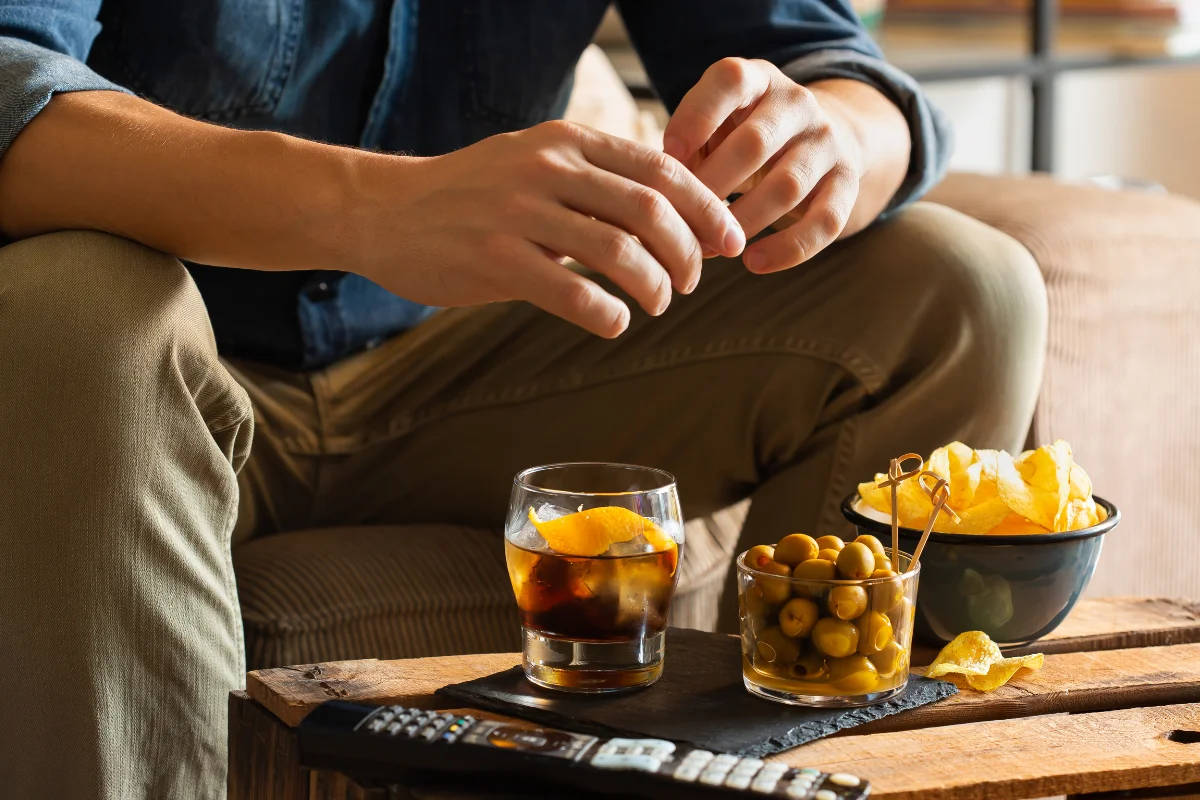

Barcelona’s vermouth culture confuses first-time visitors because it doesn’t behave like a drink order. Nobody says “I’ll have a vermouth.” They say fem vermut — “let’s do the vermouth.” The verb is the tell: it describes a ritual, not a beverage. You’re not ordering something; you’re committing to a midday hour somewhere between noon and two, standing at a marble bar with a glass of something amber, bitter and cold.
The ritual has its own geography. Poble Sec has the oldest bars. Gràcia has the most neighbourhood-authentic version. The Eixample has the most contemporary take. Each is a different experience, and none is wrong — they’re just different answers to the same question.
What is vermouth in Barcelona and where should you try it? Vermouth (vermut) in Barcelona is a pre-lunch aperitivo ritual served noon–2pm, especially on weekends. Draft red vermouth with soda, ice and orange is the standard; paired with olives, anchovies or canned seafood. Key bars: Quimet & Quimet (Poble Sec), Bar Electricitat (Barceloneta, est. 1908), Vermuteria del Tano (Gràcia). Price: €2.50–4.50 at traditional bars. €4–7 at specialist spots.
Quick Decision
- Want the most famous bar in the city → Quimet & Quimet, Poble Sec — arrive before 1pm or face a 20-min queue
- Want the oldest bar → Bar Electricitat, Barceloneta — open since 1908, vermouth straight from the barrel, Russian salad with crab
- Want 100+ vermouth references → Las Vermudas, Gràcia — Spain and Europe’s full spectrum, workshops available
- Want contemporary terrace, no queue → Morro Fi, Eixample — minimal design, house-brand bottled vermouth, sunny terrace
- Want neighbourhood bar with no tourists → Bodega Quimet, Gràcia — local clientele, barrel vermouth, honest prices
- Want history + Gothic Quarter location → El Xampanyet, El Born — house vermouth and cava, medieval street setting
Why Catalan Vermouth Tastes Different
The base is local white wine — Xarel·lo or Parellada from the Penedès — fortified with grape spirit to 13–22% ABV. From there, each producer builds their own botanical mix: wormwood as the backbone, plus cinnamon, clove, citrus peel, medicinal roots. Perucchi, the oldest Catalan producer (Badalona, 1876), uses 50 botanicals. Yzaguirre, with 130 years of production in Reus, ages its Premium and Reserva ranges in oak.
The four styles you’ll find at the bar:
Red (rojo/negre) — the standard. Mahogany colour, sweet-bitter profile with cinnamon and liquorice. Served with orange and an anchovy-stuffed olive. The draft version at most traditional bodegas is red.
White (blanc) — pale yellow, more citric and floral. Pairs with fresh shellfish and artichokes; ask for lemon instead of orange. Less common at traditional bars, more available at specialist spots.
Rosé (rosat) — the newest style. Light, fruity, red berry notes. Best found at places like Vermuteria Puigmartí in Gràcia. Increasingly available but not standard everywhere.
Reserva — amber, oak, dried fruit, cocoa. The most complex category. Yzaguirre Reserva and Perucchi Gran Reserva are the easiest references to find in Barcelona. Order this when you want to understand where the category can go.
One thing that is rarely spelled out: the soda siphon is not optional. The carbonation opens the botanical aromas and balances the residual sugar from the fortified wine. Vermouth without soda is heavier, sweeter and harder to sustain through an hour of midday drinking. If the bar doesn’t add soda automatically, ask.
How many bars are actually open at vermouth hour
The ritual has an hour, but not every bodega keeps it. The same opening-hours logic runs through what is open on Sunday and Monday across the city. Barcelona’s establishment census lists 101 vermouth bars and bodegas inside the city, and only 29 publish opening hours. Of those, 23 are open at 1pm on Saturday, 17 on Sunday and 13 on Monday.
Five open at that hour all seven days: Bodega la Palma on Carrer de la Palma de Sant Just, running 12 to 5 and 7 to midnight; Bodega 1900 at Carrer de Tamarit 91, 1pm to 10:30pm; Bodega Salvat at Carrer d’Andalusia 2, which starts at 9am; Bodega Iturre at Carrer de Sardenya 361; and Bodega Joan at Carrer del Rosselló 164, the longest day of the group.
A small set keeps midday for the weekend only and opens evenings during the week: La Bodegueta de Sants, shut until 6:30pm from Monday to Friday; Vermut i força al canut at Carrer del Vallespir 48, open 12 to 4 on Saturday and Sunday; and El Villa at Carrer de Martínez de la Rosa 27. Turn up on a Tuesday at one and the shutter is down.
Four never do the midday shift at all despite the name: Bodega Oliva in el Gòtic opens 5pm to 11pm, Bodega Berlanga at Carrer de Ferlandina 39 runs 6pm to 2:30am, and Bodega La Tinaja at Carrer de l’Esparteria 9 opens 7pm to midnight. They are night bodegas, closer to the nightlife bars guide than to vermouth hour.
None of the 101 publishes a price list and only eleven have a website, so the cost is asked at the counter, which is also where you confirm whether they are doing midday that day. If the plan carries on, the best tapas in the city pick it up, and the one-day food route builds the rest of the day around it.
Where each one is
The forty on the map are unevenly spread. Sants holds eight and la Vila de Gràcia five, almost half of the total between them, followed by el Poble-sec, l’Antiga Esquerra de l’Eixample, el Gòtic and el Clot with two each.
The five that open at midday every day of the week sit far apart from one another: Bodega la Palma in el Gòtic, Bodega 1900 in Sant Antoni, Bodega Salvat in Sants, Bodega Iturre in el Camp d’en Grassot and Bodega Joan in l’Antiga Esquerra. No single area guarantees a weekday vermouth two streets away.
How to read the map before you go
- Green means any day. Five bodegas, and they are the only ones that work without checking first.
- Amber means some days. Seventeen of them, and Monday is the day that most often falls outside.
- Dark means never at midday. Four bodegas whose name says vermouth and whose hours say evening only.
- Blue means unknown. Fourteen publish no hours at all, more than a third of the map.
- Sants and Gràcia are the dense areas. Thirteen of the forty between them, so a wrong door costs a short walk rather than a metro ride.
- No one publishes prices. Eleven of the city’s 101 bodegas have a website and none lists what a vermouth costs.
The Neighbourhood Logic
Barcelona’s vermouth geography isn’t arbitrary. Each neighbourhood has a different relationship with the ritual — and understanding which one fits what you’re looking for saves a wasted trip.
Poble Sec — The Highest Density
Poble Sec is where the modern Barcelona vermouth ritual crystallised into its current form. Carrer Blai and the streets around it have a concentration of bodegas and vermuterías that has no equivalent anywhere else in the city.
Quimet & Quimet (Poeta Cabanyes 25) is the name that comes up first in every conversation, and for good reason. Family-run since 1914, the space is around 30 square metres with no tables and no chairs. You stand, glass in hand, surrounded by shelves of tins and bottles reaching the ceiling. The draft vermouth is excellent; the montaditos — small open-faced toasts with combinations that exist nowhere else — are the real reason regulars keep coming back. The anchovy-with-truffle honey version is the one to order.
Timing is non-negotiable here. Arrive before 1pm or before 8pm for the evening session. After those windows, the queue to get through the door can run to 20 minutes. Closed in August.
Bar Electricitat (Sant Carles 15, Barceloneta) is technically in the adjacent neighbourhood, but it belongs in the same historical category. Open since 1908 and declared part of Catalonia’s architectural heritage, the vermouth comes straight from the barrel. The Russian salad with crab is what most regulars order alongside it.
Gràcia — The Most Authentic Neighbourhood Version
In Gràcia, vermouth isn’t a trend — it’s been a Saturday habit since before anyone called it a habit. The people drinking here on Sunday mornings have been doing it at the same bar for thirty years.
Vermuteria del Tano (Torrent de les Flors 74) is one of the last century-old bars to keep the original marble bar, wooden benches and barrels on the wall. The vermouth is bulk-poured, the canned seafood is the classics, and the atmosphere matches the décor precisely. No loud music, no cocktail menu, no gin and tonic list. If you want to understand what the ritual looked like before it became fashionable, this is the reference point.
Las Vermudas (Torrent de l’Olla 161) operates on entirely different logic: over 100 vermouth references from across Spain and Europe, a menu organised by origin, and regular production workshops. They call themselves the “Embassy of Vermouth.” For anyone who wants to understand the drink as a category — not just consume it — this is the best starting point in the city.
Bodega Quimet (Vic 23) is the antidote to vermouth tourism. Small local bar, neighbourhood clientele, bodega prices. No Instagram presence, no waiting list, no creative montaditos. Just good vermouth at an honest price.
Eixample — The Contemporary Take
The Eixample came to vermouth culture later than Poble Sec or Gràcia, but it arrived with a clear aesthetic and a younger audience.
Morro Fi (Consell de Cent 604) is probably the single establishment that did the most to establish vermouth as a quality product in the last decade. It started as a food blog, became a bar with its own brand, and now sells its bottled vermouth in shops across the city. The terrace fills fast on sunny days — arrive by noon.
Senyor Vermut (Provença 85) offers 40 catalogued varieties with classic Catalan tapas. The patatas bravas have their own following. Bar Calders (Parlament 25, Sant Antoni) sits at the edge of the Eixample in what’s now one of the most active food and drink streets in the city — pedestrianised, neighbourhood-feeling, with a good selection and terrace.
El Born and Gothic Quarter — Historical Context
El Xampanyet (Montcada 22) is the most-repeated name in the neighbourhood, on the most-photographed medieval street in Barcelona. House vermouth and cava, pickled tapas, atmosphere that hasn’t changed in decades. Closed Mondays.
El Chigre 1769 (Flassaders 24) offers a different angle — Catalan-Asturian fusion, natural ciders alongside vermouth, market cooking. For anyone who wants more than the classic experience without leaving El Born.
What to Order With It
The most common mistake is treating vermouth as a standalone drink. The ritual includes food — not as a complement, but as part of the structure.
The gilda (guindilla pepper + olive + anchovy, skewered together) is the most efficient pairing: the pepper’s acidity and the anchovy’s umami clean the palate between sips, balancing the sweetness of the red vermouth. It’s the most widespread aperitivo across Spanish vermouth culture for a reason.
Canned seafood — mussels in escabeche, cockles, razor clams — brings direct salinity that neutralises the residual sugar of the fortified wine. Quality makes a significant difference here: a mediocre cockle from a generic tin disrupts the pairing; a good one completes it. Ask what brand of conservas the bar uses — the serious places care about this.
Patatas chips with Salsa Espinaler — the condiment of vinegar and red pepper created by the Espinaler taberna in 1896 — is the most informal and most specifically Barcelonian format of all. The move of dipping the chip directly into the small bottle is older than any food trend.
For white vermouth: artichokes, piquillo peppers, fresh cheese, raw shellfish. The citric acidity of the white handles delicacy better than the sweeter, more robust red.
The Brands Worth Knowing
| Brand | Origin | Style | Where to find it |
|---|---|---|---|
| Perucchi | Badalona, 1876 | 50 botanicals, elegant, complex | Specialist bars, high-end cocktail bars |
| Yzaguirre | Reus, 130+ years | Best sweet-bitter balance in Catalan production; oak-aged Reserva | Most traditional bars, specialist spots |
| Miró | Reus | Soft herbal profile, most accessible | Draft at many bodegas |
| Casa Mariol | Batea, Terra Alta | Bold design, serious product, key driver of the vermouth revival | Specialist bars, shops |
| Antich | Barcelona, 1850 | First vermouth born in Barcelona, Mediterranean character | Classic bodegas circuit |
| El Bandarra | Terra Alta | Young brand, contemporary positioning | Modern bars and terraces |
Draft vs. bottled: these are genuinely different products. Draft vermouth is typically softer, designed for sustained drinking over an hour or two. Bottled vermouth has more botanical character, more density, more presence. Neither is better — they serve different moments.
What the standard vermouth round leaves out
Vermouth is usually explained in general terms, as a fortified wine with botanicals, and left there. Three things get lost that way:
The timing within the day matters as much as the bar. Sundays are better than Saturdays. On Saturday, more people, more turnover, more rush. On Sunday the ritual slows down — locals take longer, bars have less rotation, conversations last further into the afternoon. If you have the choice, Sunday between 12:00 and 14:00 is the canonical experience.
The bulk-wine bodega is not a picturesque relic. In neighbourhoods like El Clot and Sant Martí, places like Bodega Sopena have been refilling glass bottles for local residents for decades. The vermouth they pour from barrel has no label, but it has thirty years of palate behind it. These aren’t tourist destinations — and that’s precisely the point.
The soda question separates locals from visitors. At a good traditional bar, soda is automatic. At a mediocre one, it’s skipped. If the server doesn’t add soda, ask for the sifón separately. It changes the drink.
For the broader picture of Barcelona’s food and drink scene, the best tapas bars in Barcelona covers the full aperitivo landscape, and the best wine bars in Barcelona goes deeper into the natural wine scene that’s developed alongside vermouth culture in the same neighbourhoods.
Is It Worth It?
Yes — it’s one of the most affordable and culturally specific things you can do in Barcelona.
A round of vermouth with gildas at a traditional bar costs €5–8 per person. The same hour at a tourist-facing tapas bar in the Gothic Quarter costs three times that and delivers a fraction of the experience. The ritual is accessible, the bars are genuinely historic, and the midday-as-social-time logic is something you don’t get to observe anywhere else in the same way.
When it’s less worth it: going to Quimet & Quimet after 1pm on a Saturday without knowing what you’re walking into. The bar is worth the queue — but the queue without context is just a frustrating wait. When it’s most worth it: a Sunday in Gràcia or Poble Sec, before 1pm, with no fixed plans for the afternoon.
Best Strategy
- 1 hour, central location → El Xampanyet in El Born (house vermouth + gilda, Gothic Quarter atmosphere, no long queue before 1pm)
- Half day, want the full ritual → Poble Sec circuit: Quimet & Quimet before 1pm → walk to Bar Electricitat in Barceloneta for second round → lunch nearby
- Full vermouth deep-dive → Gràcia loop: Vermuteria del Tano (classic) → Las Vermudas (specialist, 100+ references) → Bodega Quimet (neighbourhood closer). Three bars, three angles, one neighbourhood.
- Contemporary + terrace → Eixample: Morro Fi (noon, before the terrace fills) → Bar Calders in Sant Antoni for a second round in the afternoon sun
Mistakes to Avoid
-
Arriving at Quimet & Quimet after 1pm on a weekend. The queue is real and the bar has a hard capacity. The window is 12:00–13:00 or the early evening session. Outside those windows, move on to another bar and come back another day. It’s worth it — but not worth an hour of waiting on the street.
-
Ordering without soda at a traditional bar. If the server doesn’t add the sifón automatically, ask for it. “Con sifón, por favor.” The carbonation is structural — not a preference.
-
Going to a vermouth bar expecting a cocktail menu. The classic bodegas serve vermouth, beer and sometimes cava. Nothing else. Asking for a gin and tonic or a glass of natural wine at Vermuteria del Tano will produce a polite but firm no.
-
Eating a full meal beforehand. The ritual works because you’re slightly hungry. The gilda, the cockles and the chips are calibrated for a pre-lunch appetite. A full stomach removes the function from the food pairing and makes the vermouth heavier than it should be.
-
Skipping the canned seafood. Every guide mentions the gilda and the montaditos. Almost none of them explain that the quality of the conservas — the brand of mussels, the origin of the anchovies — is what separates a serious vermutería from a mediocre one. Ask. The good bars know exactly where their tins come from.
-
Treating white vermouth as a secondary option. Red is the default, but white vermouth with artichokes or fresh shellfish is a genuinely different and excellent pairing. If you see white on draft, order it at least once.
Who Is This For?
- First-time visitors to Barcelona → Start with El Xampanyet (El Born) or Morro Fi (Eixample). Both are accessible, historically grounded and easy to reach from the main tourist circuit. Use the Barcelona first-time visitor guide to build the day around it.
- Food and drink enthusiasts → Las Vermudas in Gràcia for the 100+ reference catalogue and workshops. Pair with the best restaurants in Barcelona for a full food-focused day.
- Budget travellers → Bodega Quimet (Gràcia) or Bar Electricitat (Barceloneta). Both offer barrel vermouth at €2.50–3.50 — the best value in the city. The Barcelona travel budget guide has more on eating and drinking affordably by neighbourhood.
- Repeat visitors who’ve done the standard circuit → Skip Quimet & Quimet this time. Go to Bar Electricitat on a Sunday morning, then walk the Barceloneta waterfront. Or find a bulk-wine bodega in El Clot or Sant Martí and sit at the bar with the regulars.
- Anyone building a food tour of the city → The vermouth ritual pairs naturally with the best tapas bars guide and the best food markets in Barcelona for a full midday circuit.
Frequently asked questions about vermouth in Barcelona
What time is vermouth served in Barcelona?
The canonical window is noon to 2pm, before lunch. On weekends it often extends to 3pm without anyone considering it late. Many traditional bars only open during this window on weekdays — check hours before going.
How much does vermouth cost in Barcelona?
€2.50–4.50 at neighbourhood bodegas. €4–7 at specialist bars with large catalogues. Tourist-area bars can exceed €8. The price difference between a traditional bodega and a tourist-facing bar is significant — and the quality usually isn’t.
What’s the difference between draft vermouth and bottled vermouth?
Draft vermouth is typically softer and designed for sustained drinking over an hour or two. Bottled vermouth has more botanical intensity and complexity. Neither is better — they’re designed for different moments. The bulk-barrel vermouth at traditional bodegas is often in a different category from anything with a label.
Does Quimet & Quimet have seats?
No. It’s a standing bar with capacity for around 30–40 people. Arriving before 1pm avoids queuing. It closes in August and is not open every day — check hours before making the trip specifically for this bar.
What Catalan vermouth brands should I look for?
Perucchi (Badalona, 1876), Yzaguirre and Miró (both from Reus), Casa Mariol (Terra Alta), Antich (Barcelona, 1850) and El Bandarra are the main Catalan producers. Yzaguirre Reserva and Perucchi Gran Reserva are the most complex expressions and worth ordering at least once.
Are there vermouth festivals in Barcelona?
Vermut & Soul runs in spring (May) and autumn (October) at the Port Olímpic — tastings, jazz and swing music, workshops. Va de Vermut is a more technical trade fair oriented toward producers and industry professionals.
The ritual has survived industrialisation, the Civil War, the tourist boom, and the craft cocktail wave. Every decade, someone declares it finished. Every Sunday at noon, the bars fill again.