
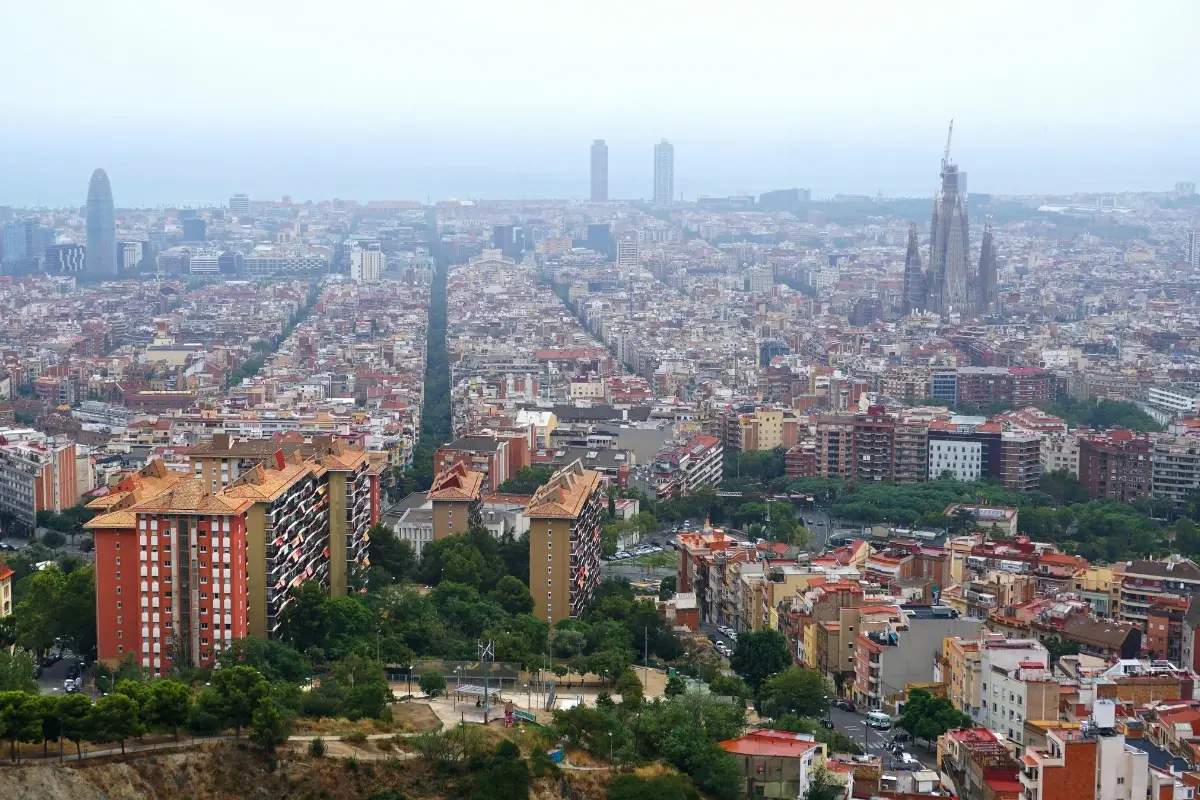

Barcelona has 73 officially designated neighborhoods. The question of which is the best is the wrong question because the Gothic Quarter and Poblenou are not competing for the same visitor, and choosing one over the other without knowing why is how people end up in the wrong place at the wrong hour. The correct question is what you are looking for, and which neighborhood holds it in its most concentrated form. What follows answers that across nine neighborhoods, each with the specific argument for visiting it, the honest trade-offs, and the one data point that decides the visit.
What are the best neighborhoods to visit in Barcelona? Gothic Quarter and El Born for medieval history and first visits. Eixample for Modernista architecture and central logistics. Gràcia for authentic neighborhood life. La Barceloneta for beach and seafood. El Raval for art institutions and cultural diversity. Poblenou for creative scene and uncrowded beaches. Sant Antoni for specialty coffee, brunch and the Sunday book market. Poble Sec for pintxos, theatre and Montjuïc access.
Quick decision by what you want
The neighborhood that fits depends on the traveler profile, the constraints, and the moment of the trip. Eight scenarios cover most decision patterns.
- First time in Barcelona, want the monuments → Gothic Quarter and El Born in the same day — both fit within 1 km²
- Architecture focus → Eixample — Sagrada Família, Casa Batlló and Sant Pau all connected on foot
- Authentic neighborhood atmosphere → Gràcia — independent municipality until 1897, still functions like one
- Beach and seafood at the center → La Barceloneta — 18th century fishing village structure, oldest seafood restaurants
- Art institutions and unconventional energy → El Raval — MACBA, CCCB, Palau Güell within 800 metres
- Creative scene, beaches without crowds → Poblenou — Bogatell and Mar Bella beaches, 15 min from El Born
- Specialty coffee and Sunday book market → Sant Antoni — fastest-changing neighborhood, Sunday market 8:00-14:30
- Budget gastronomy and Montjuïc access → Poble Sec — Carrer de Blai pintxos at 1-3 euros each, 400 m of pedestrian street
Gothic Quarter, two thousand years of urban accumulation
The Gothic Quarter is the oldest part of Barcelona and the most visited. It is also the most misunderstood because what looks like a medieval quarter is a stratified accumulation of Roman, medieval, 19th-century and 20th-century urban decisions layered on top of each other. According to urban historians at the Museu d’Història de Barcelona, the neighborhood condenses more than 2,000 years of continuous architectural superposition within a radius of under 800 metres, a density without equivalent in any other Barcelona zone.
The Roman layer is the most overlooked. The Temple of Augustus at Carrer del Paradís 10 holds four Corinthian columns 9 metres high from the 1st century BC with free entry, and most tourists walk past the door without entering. The MUHBA (Museu d’Història de Barcelona) under the Plaça del Rei preserves 4,000 square metres of 1st-century city visible from elevated walkways including streets, workshops, a garum factory and a wine production facility, with adult tickets at 7 euros and free admission first Sundays of the month. The medieval layer includes the Cathedral with its 13-goose cloister, the Plaça del Rei with the Palau Reial Major, and the Plaça de Sant Felip Neri whose church walls still carry shrapnel marks from the 1938 bombing that killed 42 people, mostly children sheltering inside.
The honest trade-off: pickpocketing around the Cathedral and Plaça Sant Jaume is documented and consistent. Evening noise on the central streets is significant. Arriving before 10:00 transforms the experience because the medieval alleys at low traffic are a fundamentally different place than the same streets at 14:00 in August. The Gothic Quarter walking route sequences the Roman and medieval layers in the order that makes the superposition legible.
El Born, medieval scale with 21st century energy
El Born was the commercial heart of medieval Barcelona. The Basílica de Santa Maria del Mar built between 1329 and 1384 by the harbor workers’ guild without a principal architect is the most structurally coherent Gothic building in the city, with three nearly equal naves, no lateral chapels and Catalan Gothic at its most honest. A 5-euro extended ticket grants architectural detail access including terrace climbs that the free standard entry does not cover.
The Born CCM under the 19th-century iron market building preserves the street plan of the neighborhood demolished by Bourbon troops in 1714 to build the Ciutadella. The elevated walkway view is free. What separates El Born from the Gothic Quarter is energy rather than history. The Gothic Quarter has institutional weight (City Hall, Generalitat, Cathedral). El Born has neighborhood momentum with independent boutiques, the Museu Picasso (free Thursdays from 16:00 and first Sundays of the month), cocktail bars with genuine ambition, and the Carrer de Montcada with its sequence of 15th-century Gothic palaces. The honest trade-off: the Passeig del Born and adjacent streets price-premium and tourist-facing, and quality improves one block inward from the main promenade. The El Born walking route maps the palace sequence and the quieter inner streets.
Eixample, the neighborhood designed for bourgeois ambition
The Eixample was not built but planned. Ildefons Cerdà’s 1859 grid of uniform-width streets with 45-degree chamfered corners had explicit social goals: sun, ventilation and equity. The chamfers were designed to create visibility at intersections for safety and to make street furniture of each corner legible from three directions simultaneously. The Modernista architecture layer came afterward as the industrial bourgeoisie commissioned buildings along the new grid between 1880 and 1925. The result is the highest concentration of Art Nouveau architecture in the world per square kilometre according to UNESCO heritage designations.
The Block of Discord at Passeig de Gràcia 35-43 holds three buildings by three different Modernista architects within 100 metres: Casa Lleó i Morera (Domènech i Montaner, 35), Casa Amatller (Puig i Cadafalch, 41) and Casa Batlló (Antoni Gaudí, 43). The Recinte Modernista de Sant Pau with its 18 UNESCO-listed pavilions sits 10 minutes on foot from the Sagrada Família and receives a fraction of the Sagrada Família’s visitor volume with comparable architectural quality. The neighborhood has 267,000 residents, making it the most populated in Barcelona, and the best public transport logistics in the city. The right side of Passeig de Gràcia (Dreta) holds the monuments and luxury accommodation. The left side (Esquerra) is more residential with the Gaixample (Barcelona’s LGBTQ+ social centre) and streets like Carrer d’Enric Granados, semi-pedestrianised with gallery terraces. The Eixample neighborhood guide breaks down the Dreta and Esquerra split in full.
Gràcia, the municipality that still acts like one
Gràcia was forcibly annexed by Barcelona in 1897 alongside Sants, Les Corts and other surrounding towns. The annexation merged the street numbers and the tax base but not the identity. The street grid of Gràcia does not follow the Eixample’s logic because it was already built when Cerdà designed his expansion: organic, irregular, predating the grid by decades. The plazas function as collective living rooms with Plaça del Sol for evening gatherings, Plaça de la Virreina for quieter afternoons, and Plaça del Diamant for anyone who has read Mercè Rodoreda’s 1962 novel of the same name.
The Casa Vicens on Carrer de les Carolines 24 is Gaudí’s first major commission (1883-1885) with Oriental and Mudéjar influences, geometric ceramic patterns, and none of the organic curves of his mature work. Entry costs 18 euros and the building receives a fraction of the visitors of any other Gaudí building, but is the most architecturally revealing for understanding how his formal language developed. According to travel planners specialising in Modernista architecture, Casa Vicens is the single most pedagogically valuable Gaudí site for anyone studying his career arc. The Festa Major de Gràcia during the week of August 15-21 is the most participatory neighborhood festival in Barcelona, with streets decorated entirely by resident associations using volunteer labour and recycled materials. The Gràcia neighborhood guide covers the plaza culture and the market in depth.
La Barceloneta, the fishing village that survived tourism
La Barceloneta was built in 1753 to house the residents displaced when Felipe V ordered the demolition of the Ribera neighborhood to build the Ciutadella fortress after the 1714 military defeat. The characteristic grid of narrow streets with balconies and laundry lines is the fishing village scale that has survived decades of tourism pressure. The beach in front of the neighborhood is the most central and most crowded in the city. The beaches further north (Nova Icària, Bogatell, Mar Bella in Poblenou) are wider and quieter with the same Mediterranean water.
The seafood restaurants concentrated in and around the neighborhood (rice dishes, fideuà, suquet de peix, shellfish) represent the most consistent concentration of quality marine cuisine in the centre of Barcelona. Five establishments cover the full local spectrum: La Cova Fumada (documented bomba origin in 1944, Carrer del Baluard 56), La Bombeta (own version for 40 years), Can Solé (seafood restaurant since 1903), Can Ganassa (broader Mediterranean cuisine) and 7 Portes (Catalan reference since 1836). The honest trade-off: prices reflect the location and the tourist-to-local ratio in establishments directly facing the beach is high. The Barceloneta complete guide covers the military engineering origin and the beach comparison in full.
El Raval, the neighborhood that survived three demolition attempts
Barcelona attempted to demolish El Raval three times: through 19th-century hygienist urban renewal, through Franco-era slum clearance, and through the 1990s MACBA-anchored regeneration that displaced significant portions of the existing community while adding cultural institutions. The neighborhood survived all three in different forms. Today it holds the MACBA (Museu d’Art Contemporani), the CCCB (Centre de Cultura Contemporània), the Filmoteca de Catalunya, the Palau Güell (Gaudí’s first major building, 1886-1890), and the oldest continuously operating bar in Barcelona (Bar Marsella, since 1820).
El Raval has two distinct zones. The northern area around the MACBA has a younger creative profile and the best concentration of specialty coffee in the old city. The southern area is more multicultural with Pakistani, Filipino and Moroccan communities alongside working-class Catalan residents from multiple generations. According to municipal safety sources, the southern Raval has documented night-time concerns with pickpocketing and petty fraud. Daytime visits and the northern Raval around the MACBA are consistently straightforward. The Barcelona safety guide covers the zone differences and the time-of-day patterns in full detail.
Poblenou, what Las Ramblas would look like if nobody had found it
The Rambla del Poblenou runs approximately 1 km from the Gran Via to the sea. It has the same tree-lined central format as Las Ramblas and none of the tourist infrastructure. Bars with regulars who have been coming for years, a casino that has been the neighborhood’s cultural centre since the late 19th century, and the rhythmic coexistence of longtime industrial-era residents with the creative professionals who arrived with the 22@ tech district conversion from 2000 onward.
The beaches directly adjacent (Bogatell, Mar Bella, Nova Mar Bella) receive significantly lower visitor density than La Barceloneta while offering the same Mediterranean water and comparable service levels. Mar Bella holds the city’s official naturism zone, and Bogatell is the reference beach for water sports with SUP and kayak schools operating in season. Metro L4 connects El Born to Poblenou in 7 minutes, so the perception of distance is a function of the tourist map rather than actual travel time. For visitors who want genuine distance from the tourist circuit without sacrificing urban density or metro connectivity, Poblenou is the most coherent choice in the eastern cluster. The Poblenou neighborhood guide covers the 22@ conversion and the beach options in detail.
Sant Antoni and Poble Sec, the budget and gastronomy neighborhoods
Sant Antoni is administratively part of the Eixample but has built a distinct identity in under a decade. The catalyst was the rehabilitation of the Mercat de Sant Antoni, a 19th-century iron-structure market building whose renovation between 2007 and 2018 uncovered sections of the medieval city wall and a Roman funerary road in the lower level, and triggered the pedestrianisation of surrounding streets into a superilla (superblock). The Sunday book market around the market perimeter (8:00-14:30 every Sunday) is one of the largest in Europe for secondhand books, comics, vinyl and collectibles.
Poble Sec escaped mass tourist development partly through geography because it sits at the foot of Montjuïc, outside the central axis of the old city and the Eixample. The result is a neighborhood with lower prices, more local atmosphere and a gastronomy scene that competes with any area in the city. Carrer de Blai holds Barcelona’s densest concentration of pintxos bars, Basque-style tapas at 1-3 euros per piece on a 400-metre pedestrian street. The format is standing and itinerant: order, eat at the bar, move to the next place. Weekday evenings have better space than weekend nights. Avinguda del Paral·lel concentrates historic theatres including the Condal and the Apolo (a reference concert venue), making Poble Sec the city’s theatre district. The funicular to Montjuïc departs from Paral·lel metro station (L2 and L3) on the same metro ticket. The Sant Antoni neighborhood guide and the Poble Sec guide cover both in depth.
Comparison table of the nine neighborhoods
The table summarises the key decision points for visitors with limited time or a specific budget profile. Each cell holds a concrete trade-off rather than a generic description.
| Neighborhood | Best for | Honest trade-off | Metro | Tourist density |
|---|---|---|---|---|
| Gothic Quarter | First visit, Roman/medieval history | Pickpocketing, noise, crowds | L3 Liceu, L4 Jaume I | Very high |
| El Born | Art, gastronomy, atmosphere | Tourist pricing on main promenade | L4 Barceloneta, Jaume I | High |
| Eixample | Modernisme, central base | Expensive accommodation | Multiple lines | Medium-high |
| Gràcia | Neighborhood life, plazas | No major monuments | L3 Fontana, Diagonal | Medium |
| La Barceloneta | Beach, seafood | Summer crowds, tourist pricing | L4 Barceloneta | Very high in summer |
| El Raval | Contemporary art, diversity | South Raval night concerns | L3 Liceu, L2 Sant Antoni | Medium |
| Poblenou | Creative scene, quiet beaches | 15 min from historic centre | L4 Poblenou | Low |
| Sant Antoni | Coffee, Sunday market, brunch | No major monuments | L2 Sant Antoni | Medium-low |
| Poble Sec | Budget tapas, Montjuïc | Further from centre | L2/L3 Paral·lel | Low |
Las Ramblas is a street, not a neighbourhood
Las Ramblas gets treated as a neighbourhood and it is not one. It is a 1.3-kilometre boulevard that runs along the border between the Gothic Quarter and El Raval, with a tourist profile that has lost its connection to either neighborhood. Choosing accommodation on Las Ramblas is choosing the noisiest possible location with the highest pickpocketing concentration in the city. Local residents have not lived on Las Ramblas in significant numbers since the 1990s.
The second observation rarely surfaced: Gràcia is not a Park Güell transit zone, even though most visitors enter only to pass through to the park. The neighborhood deserves a dedicated afternoon for the plaza culture, the Mercat de l’Abaceria and Casa Vicens, which forms a coherent half-day cluster. The third: Poblenou’s beaches outperform La Barceloneta in summer for visitors who tolerate a 7-minute metro ride. Bogatell and Mar Bella consistently report lower density and equivalent water quality. According to coastal management figures from the Ajuntament de Barcelona, July and August beach satisfaction scores favour the Poblenou strip over La Barceloneta by a meaningful margin.
Who this guide is for
Different traveler profiles need different neighborhood priorities. Five profiles cover most decision patterns.
- First-time visitor with 2-3 days — Gothic Quarter plus El Born day 1, Eixample day 2. The Barcelona first-time visitor guide builds the geographic sequence
- Architecture enthusiast — Eixample as base for the Modernista circuit, with a half day in Gràcia for Casa Vicens
- Repeat visitor who knows the monuments — Gràcia for the plaza culture, Poblenou for industrial heritage and beaches, Sant Antoni for the Sunday market
- Budget-conscious traveler — Poble Sec for accommodation (lower prices, Montjuïc access, Carrer de Blai for meals) or Sant Antoni (strong café culture, Sunday market, reasonable rates)
- Digital nomad staying 1-4 weeks — Sant Antoni or Poblenou, both with high specialty coffee density, quieter streets than the old city, and 15-minute metro access
Best strategy by available time
Three scenarios cover most useful itineraries through the Barcelona neighborhoods, designed around how visitors actually move through the city rather than a generic checklist.
- Half day (4 hours) → Gothic Quarter and El Born together, since they share boundaries and conceptually link medieval Barcelona without requiring transport between them
- Full day (8 hours) → Gothic Quarter and El Born in the morning, Eixample in the afternoon with one Modernista interior visit (Casa Batlló or Casa Vicens, not both)
- Three days minimum → Day 1 historic core (Gothic plus Born), day 2 Eixample with Modernista circuit, day 3 La Barceloneta plus Gràcia or Poblenou depending on weather
The best things to see in Barcelona guide sequences these neighborhoods in the optimal order for typical first-time itineraries.
Mistakes to avoid
Five mistakes appear with consistent frequency in over-budget or under-satisfying Barcelona visits. All are avoidable with minimal advance planning.
- Booking accommodation on Las Ramblas thinking it is the neighborhood — Las Ramblas is a tourist boulevard with the highest pickpocketing concentration and constant noise until 3:00. Eixample, El Born or Sant Antoni offer better sleep with equivalent metro access
- Treating Gràcia as a transit zone to Park Güell — most visitors enter Gràcia only on their way to the park. The neighborhood deserves an afternoon on its own terms with the plazas, the Mercat de l’Abaceria and Casa Vicens
- Going to La Barceloneta beaches only in July and August — October through May, the beach and the neighborhood return to their normal character. Seafood restaurants have better availability with comparable quality
- Dismissing Poblenou as too far — Metro L4 from El Born to Poblenou takes 7 minutes. The perception of distance is a function of the tourist map, not actual travel time
- Choosing a budget hotel in the southern Raval without checking the exact street — El Raval contains perfectly safe zones and zones with documented night concerns. The difference is measured in metres rather than kilometres
A sixth less visible mistake: underestimating noise levels in El Born at night, especially on weekends. The narrow streets amplify terrace noise, and tourist apartments near the Passeig del Born have the worst reported rest scores in the city.
Barcelona neighborhoods in 2026
In 2026 Barcelona is operating under the strictest tourism regulation framework in its recent history, with visible effects across neighborhoods. Since 1 April 2026 the tourist tax combines the regional rate set by the Generalitat with a municipal surcharge of 5 euros per person per night that applies in Barcelona on top of the regional amount, regardless of accommodation type. In practice a guest in a 5-star hotel now pays 12 euros per person per night, a 4-star hotel 8.40 euros, and a licensed tourist apartment 9.50 euros (4.50 regional plus the 5 municipal surcharge). The municipal surcharge is scheduled to rise 1 euro per year to a ceiling of 8 euros in 2029, which would push the top hotel band toward 15 euros per night. Municipal restrictions on tourist apartments have reduced informal accommodation supply by approximately 15 percent versus 2024 according to Ajuntament figures, with the most visible effect in La Barceloneta, Gothic Quarter and El Born.
The year coincides with Barcelona as UNESCO World Capital of Architecture and the centenary of Gaudí’s death on 10 June 1926. Official guided tours through the Eixample have tripled in demand compared to recent years, and the Sagrada Família reaches its final height of 172.5 metres with the completion of the Tower of Jesus Christ. Hotel prices in the central neighborhoods have risen between 8 and 12 percent over the previous year according to official sources from the Gremi d’Hotels, with the strongest effect on Eixample Dreta, El Born and La Barceloneta. The best time to visit Barcelona guide remains critical because the combination of the centenary and peak season multiplies demand in the central weeks of the year.
Frequently asked questions about Barcelona neighborhoods
What are the best neighborhoods to visit in Barcelona?
Gothic Quarter and El Born for medieval history and first visits. Eixample for Modernista architecture and central logistics. Gràcia for authentic neighborhood life. La Barceloneta for beach and seafood. El Raval for art institutions and cultural diversity. Poblenou for creative scene and uncrowded beaches. Sant Antoni for specialty coffee and the Sunday book market. Poble Sec for pintxos and Montjuïc access.
Which neighborhood is best for first-time visitors to Barcelona?
Eixample Dreta between Passeig de Gràcia and Sagrada Família is the most balanced option at 110-180 euros per night. Public transport reaches all tourist points within 15 minutes, the streets are quiet at night, and Modernista architecture sits within walking distance. El Born is the higher-budget alternative with historic atmosphere, and Sant Antoni works for tighter budgets with authentic neighborhood life.
Is the Gothic Quarter safe for tourists in Barcelona?
Yes during the day with standard precautions. Pickpocketing is documented and persistent around the Cathedral, Plaça Sant Jaume and Las Ramblas, with bag at the front and phone secured at all times. The inner streets are safe at any hour except very late night. South Raval after 1:00 has specific warnings and should not be walked alone. Local police maintain constant presence in central tourist zones.
How many days do I need to see Barcelona’s main neighborhoods?
Three days cover the essentials with enough time. Day 1 Gothic Quarter and El Born together due to their adjacency. Day 2 Eixample with the full Modernista route including Casa Batlló and Sagrada Família. Day 3 La Barceloneta in the morning plus Gràcia in the afternoon or Poblenou for uncrowded beaches. A week allows adding El Raval, Sant Antoni and Poble Sec with depth and calm.
Which is the most authentic neighborhood in Barcelona?
Gràcia comes closest to authentic neighborhood life with active plazas throughout the day, an operating Mercat de l’Abaceria, strong residents’ associations, and the Festa Major of August 15-21 built entirely by neighbors. It was an independent municipality until 1897. Poble Sec and Sant Antoni follow with similar profiles but less international recognition. Tourist zones like Gothic Quarter and Born have historic character but visitor-adapted infrastructure.
Is it worth staying in La Barceloneta?
Only in May, June, September and October when tourist pressure is manageable. In July and August the neighborhood operates at saturation with inflated prices, constant noise, and municipal restrictions on tourist apartments. The area has real maritime character and direct beach access, but summer turns it into a transit zone rather than a calm base. For similar budgets, Eixample delivers better rest quality.
For the complementary decisions
For the practical side of choosing where to sleep rather than where to visit, the best neighborhoods to stay in Barcelona guide covers accommodation logic by budget, noise level and proximity to main circuits. For the daily budget side, the Barcelona travel budget by traveler type integrates real prices from each neighborhood into the full-day cost calculation. For the zone-by-zone safety profile with verifiable data, the safety guide linked above details the critical time windows and the specific streets where extra caution applies.
Choosing the right neighborhood is choosing the right Barcelona, because the city has too many layers for any single zone to deliver everything a visitor came for.