
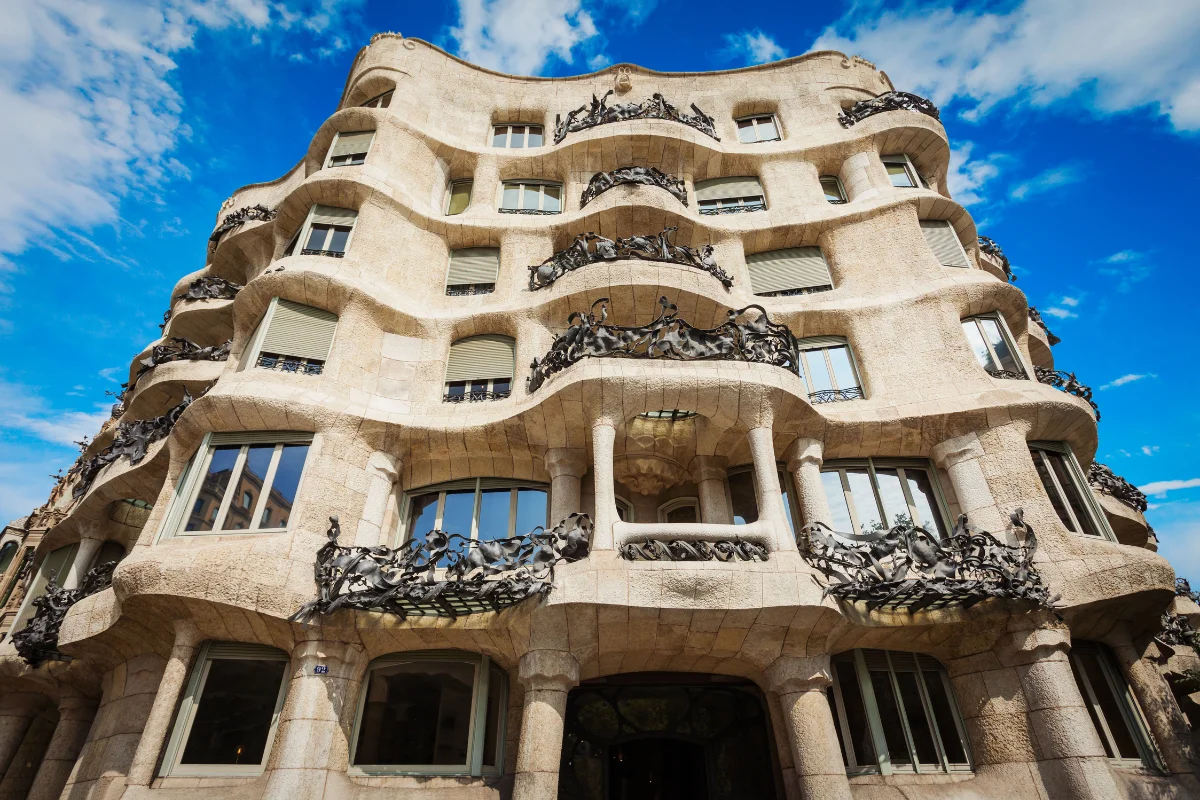

La Pedrera has no load-bearing interior walls. Every partition inside the building is non-structural — it can be removed, relocated, or added without affecting the building’s stability. Gaudí achieved this in 1906 with a pillar system that made the floors entirely free to configure. Le Corbusier included this principle in his Five Points of a New Architecture in 1927 and called it a revolutionary concept. Gaudí applied it two decades earlier without publishing a manifesto.
That gap — between what was built in Barcelona in 1906 and what the architectural establishment formalized in 1927 — is the core argument for taking La Pedrera seriously beyond its visual impact. The building listed as UNESCO World Heritage in 1984 is not just unusual-looking. It solved problems that the rest of architecture hadn’t acknowledged yet.
The Commission That Became a Manifesto
Pere Milà and Roser Segimon bought a 1,835 m² corner plot on Passeig de Gràcia in 1905 with a clear brief: main residence plus rental income. Segimon’s fortune came from her first husband — an indiano, a Catalan who had made money in the Americas and was 38 years older than her. Choosing Gaudí wasn’t arbitrary: he had just completed Casa Batlló, visible from the same street.
What the Milàs expected as a status showcase, Gaudí delivered as systematic transgression. The construction that began February 2, 1906 accumulated three simultaneous conflicts: with the city council, which identified height and facade alignment violations; with the press, which caricatured the building as a “Easter cake” and a rough quarry; and with the owners themselves, who rejected the religious sculpture planned for the building’s crown. The tension ended in court: Gaudí won a lawsuit against Roser Segimon for 105,000 pesetas in unpaid fees — which he immediately donated to a convent — while the city council imposed a 100,000 peseta fine that was only resolved in 1909, when the Eixample Commission certified the building’s monumental value.
The Structural System — The Free Plan in Practice
What’s inside La Pedrera and is it worth visiting? A pillar structure that eliminates load-bearing walls and creates free-plan floors throughout. Two interior courtyards — one circular (90 m²), one elliptical — that carry natural light to every apartment. An attic with 270 catenary brick arches. A sculptural rooftop with 30 chimneys, 6 staircase exits (badalots), and 2 ventilation towers. Entry from €25 (standard daytime). Rooftop alone justifies the visit.
What the Free Plan Actually Means
The structural system uses stone pillars from the Garraf massif, solid brick, and iron profiles supporting metal beam floors with Catalan vault infill. The pillars carry all vertical load. The interior partitions are non-structural divisions — they can be removed, moved, or added without compromising stability.
That solution — today called “free plan” — didn’t exist in Barcelona residential architecture in 1906. The facade works on the same principle: it carries no weight. Over 6,000 stone blocks are attached to the metal structure via anchors, allowing the facade to undulate independently. That structural freedom produces the silhouette the press compared to a quarry.
| Component | Material | Function |
|---|---|---|
| Pillars | Garraf stone, brick, iron | Full vertical load |
| Floor slabs | Metal beams, Catalan vault | Horizontal load transfer |
| Facade | Garraf, Vilafranca, Ulldecona limestone | Curtain wall, non-load-bearing |
| Balconies | Forged iron from recycled scrap | Exterior enclosure |
| Courtyard structure | Concentric bicycle-wheel beams | 12-meter span without intermediate supports |
The basement contained the first underground garage in a residential building on Passeig de Gràcia — helical ramps, cast-iron columns, maximum maneuvering space. In 1906, cars in Barcelona were a rarity. The building already anticipated their use.
Quick Decision — How to Use Your Visit
- 45 minutes → attic and rooftop only. These are the spaces with no equivalent elsewhere in Barcelona.
- 90 minutes → add the period apartment on the fourth floor to understand the contrast between bourgeois domestic life and radical structure.
- Full visit → take the stairs rather than the elevator between floors — the relationship between the ground level, courtyards, and vertical circulation reads better through movement.
- Symbolism focus → rooftop with audioguide. Without context, the inscriptions and chimney forms read as decoration rather than program.
- Fewest visitors in the attic → first session of the morning. Lateral light makes the height variations between the 270 arches legible — without it, the variation disappears.
The Facade — Three Stones and 32 Unique Balconies
The stone selection for the facade was structural and geographic, not aesthetic. Gaudí chose three limestone types with different resistance properties: Garraf stone (30km from Barcelona) for the lower sections and higher-load elements; Vilafranca del Penedès stone (50km) for the main undulating volume; Ulldecona stone from Tarragona for window frames and ornamental details.
The 32 forged-iron balconies are individual pieces — each different from the others. Gaudí executed them using recycled scrap metal, bars, and chains, under direct supervision at the Badia brothers’ workshop. The abstract forms suggest marine algae, cliff vegetation, or shipwreck debris. Technical detail invisible from street level: the drainage outlets are positioned below the balcony floor surface, maintaining the visual reading of the facade without water stains marking the stone below.
The Two Courtyards — The Building’s Luminous Heart
The courtyards at La Pedrera are not the narrow ventilation shafts of the standard Eixample residential building. They are monumental spaces: the Passeig de Gràcia courtyard is circular with a 90 m² floor area; the Provença street courtyard is elliptical. Together they organize all vertical circulation and guarantee direct natural light and ventilation to every apartment, including interior-facing ones.
Gaudí solved the structural span using concentric beams tensioned by radii — the logic of a bicycle wheel — allowing 12-meter diameters to be covered without intermediate supports.
The interior facades were decorated under the direction of symbolist painter Aleix Clapés between 1909 and 1911. The circular courtyard (popularly called the Pati de les Flors) depicts the loves of Vertumnus and Pomona — Roman deities of vegetable metamorphosis — from Book XIV of Ovid’s Metamorphoses. The elliptical courtyard (Pati de les Mariposes) includes scenes from the Trojan War representing the deadly sins of anger and gluttony. Ovid’s presence is not decorative: philosopher Josep Maria Carandell identified the Metamorphoses as the symbolic thread running through the entire building — the shifting, sinuous character of its forms reflecting the idea of continuous transformation.
The Attic — 270 Arches Gaudí Calculated with Chains
The attic is the building’s most technically advanced space and the least recognized as such. Gaudí needed to support the rooftop — with all its sculptural elements and foot traffic — without adding weight to the structure below. The solution: 270 catenary brick arches of varying heights that work exclusively in compression, without buttresses or lateral supports.
The catenary form — the curve a chain describes when suspended from both ends under gravity — generates, when inverted, the most structurally efficient arch possible: every point transmits load directly to the supports without bending or tensile forces. Gaudí determined these forms using funicular models: he suspended chains with weights in an inverted scale model and observed the resulting curve. He placed a mirror beneath the model to visualize the actual arch form before building it. The calculation was physical, not algebraic — gravity designed the structure.
The visual effect of 270 linked arches reads as the interior of a whale skeleton, which is not accidental — it’s a direct consequence of hyperbolic geometry. Originally it functioned as a communal laundry, storage, and thermal insulation chamber. Today it houses the only Gaudí interpretation center in Barcelona.
The Rooftop — Technical System Turned Landscape
The rooftop has 30 chimneys in clusters, 6 badalots (staircase exits), and 2 ventilation towers. Gaudí conceived them as technical infrastructure — smoke extraction, ventilation, stair access — and executed them formally as a sculptural ensemble.
Badalots: the six staircase exits reach seven meters in height, covered in trencadís of ceramic, marble, and stone. Their helical forms have been interpreted as representations of natural forces: earth, water, fire, air. They are the largest and structurally most prominent elements on the roof.
Chimneys: the 30 groups follow an interior path dictated by smoke aerodynamics — they rotate on their axis to improve draft — and an exterior finish in lime and gypsum mortar. One single group is covered in trencadís of dark green cava bottle fragments — the only use of color in the ensemble. Their forms, suggesting helmeted warriors, reportedly inspired George Lucas’s designs for the Imperial stormtrooper helmets in Star Wars. The same motif was adopted for the statuettes of the Gaudí Awards given annually by the Catalan Film Academy.
The singular arch: there is a white trencadís arch on the rooftop walkway designed with mathematical precision to frame the silhouette of the Sagrada Família from the promenade. It is not an accidental alignment — it’s a deliberate architectural dialogue between Gaudí’s two major unfinished works.
The Star Wars connection, with the specifics
Beyond the rooftop chimneys, the detail worth carrying is the Star Wars connection, which can be pinned down specifically.
George Lucas’s production designers for the original Star Wars trilogy used photographs and architectural drawings of La Pedrera’s rooftop as reference material for the Imperial stormtrooper helmet design. The helical form, visor shape, and surface articulation of the warrior-chimneys are directly traceable in the production sketches. This isn’t a rumor: the Gaudí Awards statuettes — given annually by the Catalan Film Academy — reproduce the chimney form precisely because the connection between Catalan architecture and the film’s visual language is considered culturally significant enough to institutionalize.
Is La Pedrera Worth the Entry Price?
Yes, specifically for the attic and rooftop. These two spaces have no equivalent elsewhere in Barcelona or in Europe — the catenary attic is structurally unprecedented in residential architecture of its era, and the rooftop is a functional technical installation that operates as a public landscape. The period apartment adds domestic context; the courtyards are visible from the street to some extent.
When it’s NOT worth it: if you’re only going for the exterior facade, you can see it completely from the street at no cost. The Passeig de Gràcia sidewalk view — including the undulating stone and the balconies — is free. Entry buys you the interior, which is genuinely different, but the facade argument alone doesn’t justify the ticket.
Mistakes to Avoid
- Going in August at midday: La Pedrera has almost no shaded exterior areas and the rooftop can be extremely hot. Morning visits in summer are significantly more comfortable.
- Skipping the attic for the rooftop: most visitors go directly to the rooftop and skip the attic entirely. The attic is the more architecturally significant space — the rooftop is spectacular, but the attic is where the structural argument lives.
- Using the elevator only: the staircase shows how the pillar structure works in relation to the courtyard and the floor plates. The elevator bypasses the spatial logic of the building entirely.
- Missing the courtyard murals: they’re in the central circulation areas and are easy to walk past without looking up. Carandell’s Ovid identification changes how the entire building reads.
- Not looking for the Sagrada Família arch: it’s on the rooftop walkway and most visitors pass it without realizing it was designed as a frame. Face southeast from the promenade and look for the white trencadís arch.
FAQ
How long does it take to visit La Pedrera?
90 minutes to two hours for the period apartment, attic, and rooftop at a comfortable pace. The minimum itinerary — attic and rooftop only — takes 45–60 minutes. The nighttime experience (La Pedrera Night Experience) focuses on the rooftop with projected light and image based on Gaudí’s life and work.
What’s the difference between the daytime and nighttime visit?
The daytime visit includes the period apartment, attic, and rooftop. The nighttime visit concentrates on the rooftop with light projection on the sculptural elements. The daytime visit allows you to understand the full building; the nighttime offers an aesthetic reading focused on the roof surface.
Why does La Pedrera have no right angles?
Gaudí applied ruled geometry — hyperbolic paraboloids, hyperboloids — rather than Euclidean geometry. These doubly-curved surfaces are structurally more efficient than flat planes because they distribute loads continuously. The absence of right angles is not an aesthetic gesture: it’s the visible consequence of a structural decision.
Why was the Virgin sculpture never installed on the corner?
The anticlerical violence of the Setmana Tràgica (Tragic Week) of July 1909 frightened Pere Milà. He refused to install a prominent religious symbol on such a visible building on Passeig de Gràcia. Sculptor Carles Mani had already executed the plaster model. The sculpture was never installed and the corner remained architecturally complete but symbolically unfinished.
What are the catenary arches in the attic and why are they significant?
The catenary is the curve a chain describes when suspended from both ends under gravity. Inverted, it generates the most stable arch possible: it works only in compression, without bending forces, and requires no buttresses. Gaudí calculated all 270 arches through physical funicular models with weights and a mirror, determining the exact form of each arch empirically. The result is a light structure that carries the full load of the rooftop above.
What’s the connection between La Pedrera and Star Wars?
George Lucas’s production design team used La Pedrera’s rooftop chimney forms as reference material for the Imperial stormtrooper helmet design. The helical shape, visor articulation, and surface treatment are traceable in the production sketches. The Catalan Film Academy institutionalized the connection by using the chimney form for the Gaudí Awards statuettes.
La Pedrera is not just the last civil work of Gaudí’s career. It’s the building where every technical solution he had explored for decades — the catenary arch, the free plan, the non-load-bearing facade, the trencadís — functions simultaneously in a single volume. What the Barcelona press of the early 20th century read as a shapeless quarry is, a century later, the most complete argument that architectural modernity didn’t begin in the Bauhaus.
To complete the Gaudí architectural sequence: the Gaudí route in Barcelona organizes his works in chronological order of construction. The Sagrada Família inside guide develops the structural solutions Gaudí refined during the last twelve years of his life. And Casa Batlló shows the same naturalist logic applied to the facade of an existing building just a few years before La Pedrera.