
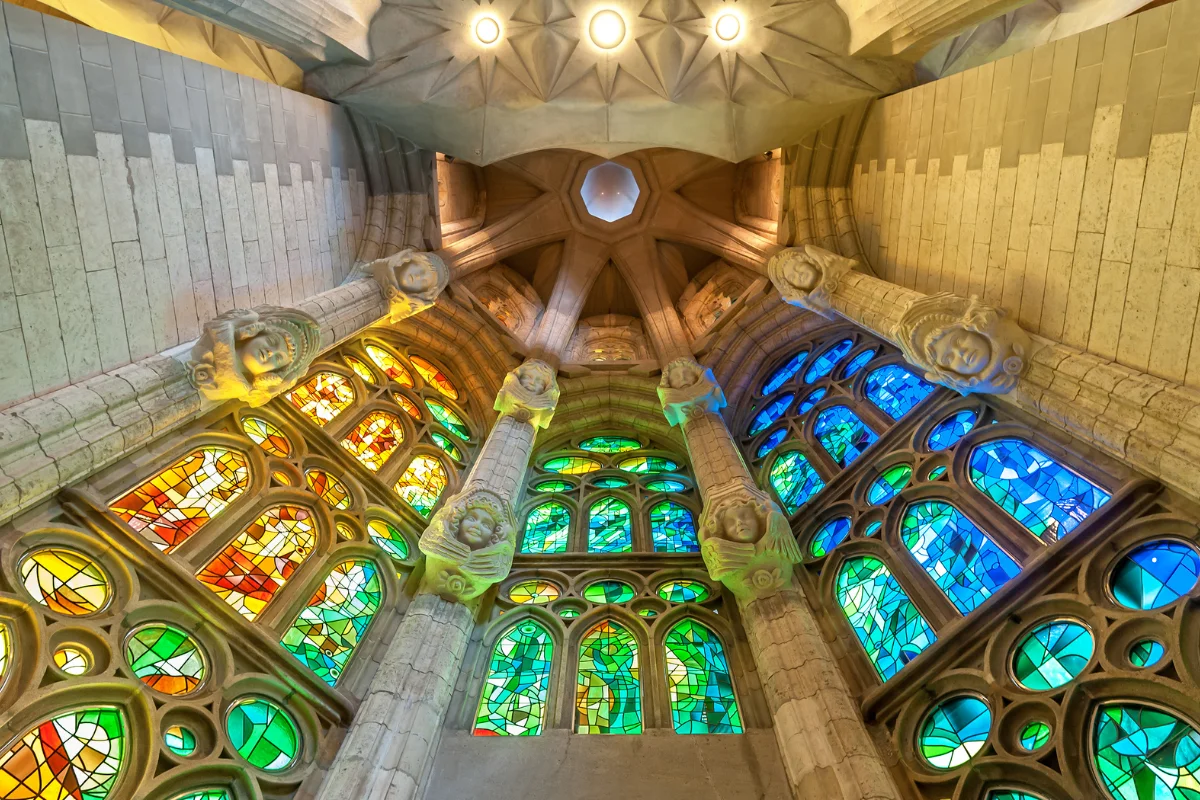

The Sagrada Família’s interior does not resemble any other cathedral in the world, and the claim is not promotional. Columns branch like trees up to 45 metres, the stained glass shifts from cold morning light to warm afternoon light along a deliberate east-west solar axis, and the central nave was given acoustics specifically designed for choral music. The building is not decorative architecture, it is a coherent structural and symbolic argument built in stone, and most visitors process it as beautiful without grasping why it is constructed the way it is. Understanding the system before walking in turns a 90-minute visit into something genuinely different.
The architectural argument hidden in plain sight
Antoni Gaudí took over the Sagrada Família in 1883 at age 31 and worked on it until his death in 1926, dedicating the last 12 years of his life exclusively to the project. He lived in the crypt during his final months and designed a modular construction system that allowed the work to continue without a single central mind, because he knew he would not see it finished. Today 14 of the 18 planned towers are complete and four chief architects have succeeded him at the head of the project.
The basilica was consecrated by Benedict XVI in 2010 and declared a UNESCO World Heritage Site from 2005 (the earlier crypt was listed separately in 1984). With approximately 4.5 million visitors per year it ranks as Spain’s second most visited monument. According to heritage architects who specialise in long-cycle construction projects, the Sagrada Família is the only major religious building in history designed to be physically incomprehensible to any single generation of builders.
What do you actually see inside the Sagrada Família? A central nave 45 metres high with columns that branch like trees, east stained glass in cold tones (blues, greens, pale yellows) and west stained glass in warm tones (reds, oranges, intense yellows) that shift the interior light along the day, an apse with the main altar under a 5-metre liturgical lamp suspended at 75 metres, and optional access to Apostle towers between 100 and 112 metres. The Hour of Silence between 9:00 and 10:00 is the least-crowded window of the day.
Is it worth visiting the Sagrada Família inside
Yes, for almost any traveller, but the verdict comes with three honest qualifications. The interior is genuinely unique in religious architecture and the column-light system rewards anyone willing to spend 90 minutes understanding it. According to experts in modernist architecture, the Sagrada Família is the only operating example worldwide of a building whose structural logic, symbolic system and optical experience were designed as one integrated argument.
It is not worth it for travellers who refuse to book online in advance and arrive expecting same-day taquilla access in medium or high season — they will queue, fail, and ruin a half day. It is not worth the tower supplement for visitors with mobility issues or claustrophobia, because the descent staircase is steep, narrow and has no alternative. And it is not worth visiting between 11:00 and 16:00 in July or August unless that is the only available window, because crowd density at that time obscures the architectural reading the building was designed to allow.
Before you arrive, the four operational rules
Four logistical rules separate a smooth visit from frustration at the entrance. According to staff and certified guides who handle daily groups at the temple, these four points account for around 90 percent of avoidable problems at the gate.
- Timed-entry online booking is mandatory — same-day taquilla tickets sell out before 10:00 in medium and high season. Reservation at sagradafamilia.org is the only reliable access method, ideally 3 to 4 weeks ahead in peak periods
- Large bags rejected at security — X-ray scanners do not admit travel backpacks or cabin luggage. There is no cloakroom on-site or in the immediate vicinity, so storage must happen before reaching the basilica
- Hour of Silence runs 9:00 to 10:00 — absolute silence enforced and headphones mandatory for any audio device. It is the least-crowded window and the only one without amplified tour groups
- Ticket time window is plus or minus 15 minutes — outside this margin the ticket is not valid for that day. The entrance scanners enforce it strictly
The column system, engineering disguised as forest
Gaudí did not design conventional vertical columns because traditional Gothic cathedrals require external flying buttresses to counter lateral structural forces. His solution was to incline and branch the columns the way trees distribute load through their branches without needing external support. The result is that the Sagrada Família nave has no visible buttresses from inside — the space reads as clean, open and vertical.
The structure combines three geometric forms Gaudí calculated manually using suspended funicular models, a technique that inverts gravity to design the optimal curves: hyperboloid (the ceiling), paraboloid (the column branches) and helicoid (the stair-spirals in the towers). Columns rise from the floor in dark granite, reach the branching nodes where they split into lighter secondary elements, and terminate in the ceiling hyperboloids at 45 metres.
Four column types exist according to structural position and the load each level carries: black basalt in the most external columns, grey granite in the intermediate ones, Montjuïc stone in the interior, and red porphyry from Iran in the columns supporting the crossing. The colour and hardness increase toward the structural centre because the more load a column carries, the harder the stone needs to be. The porphyry at the crossing is among the most compression-resistant masonry materials available in architectural stoneworking.
The stained glass as a temporal device
The stained glass of the Sagrada Família is not liturgical decoration but the symbolic orientation system of the building. Gaudí designed the windows so light would shift along the day following the solar axis east to west, and the interior atmosphere would transform between 9:00 and 18:00 without anything material changing.
Nativity Facade windows (east, morning light) use cold tones — blues, greens and pale yellows. Morning light enters and bathes the nave in colours evoking dawn, new life and birth. The best window to photograph this effect is between 9:00 and 11:00.
Passion Facade windows (west, afternoon light) use warm tones — reds, oranges and intense yellows. Afternoon light enters and transforms the interior into an atmosphere of fire and dusk. The best window to experience this is between 16:00 and 18:00.
The symbolic axis is deliberate and complete: the visitor’s path east to west follows the cycle from birth to death, from hope to redemption. It is architecture meant to be read as a sacred text in which light forms part of the narrative. The windows were designed by Joan Vila-Grau and installed in phases over decades. Those in the apse and central nave are complete. The Glory Facade windows (south-facing, the principal entrance, still under construction) remain to be installed.
The two completed facades, Nativity against Passion
The Sagrada Família will have three facades when complete. Two are finished and visitable from inside: the Nativity (the only one Gaudí saw completed) and the Passion (posthumous, designed by Subirachs). The third, the Glory Facade, will be the main entrance and remains under construction. The two completed are aesthetically and emotionally opposite, and that opposition is deliberate.
| Feature | Nativity Facade | Passion Facade |
|---|---|---|
| Orientation | Northeast | Southwest |
| Construction period | 1894-1930 | 1986-2005 |
| Architect/sculptor | Antoni Gaudí | Josep Maria Subirachs |
| Sculptural style | Naturalistic, ornamental | Angular, expressionist |
| Narrative | Birth and infancy of Jesus | Passion, death, resurrection |
| Associated interior light | Cold, morning | Warm, afternoon |
| Most photographed item | Cypress with white dove | Magic square summing to 33 |
| Porticos | Hope, Charity, Faith | Chronological bottom-to-top |
| Historic controversy | None | Style opposite to Gaudí |
Nativity Facade
The only facade Gaudí saw completed in his lifetime was finished in 1930, four years after his death. Facing northeast, it narrates the birth and infancy of Jesus Christ across three vertical porticos: Hope (left), Charity (centre), Faith (right). The sculpture is naturalistic and detailed, with flowers, animals and individualised human faces. Gaudí made plaster casts of real people from the neighbourhood for secondary characters, a technique documented by his collaborators that no contemporary religious architect employed.
The profusion of elements means each visit reveals new details: a tortoise at a column base, bees on the capitals, a pelican feeding its young as a Eucharistic symbol. The central portico of Charity carries the genealogical tree of Christ climbing a column to the Annunciation scene at the top. The cypress at the apex with a Greek cross and a white dove is the most photographed exterior element and a visual code for immortality common in Catalan tradition.
Passion Facade
Designed by Josep Maria Subirachs and completed between 1986 and 2005, it faces southwest and narrates the Passion, Death and Resurrection of Christ in chronological order from bottom to top and left to right, the same way a book is read. The style is angular and expressionist, completely opposite to the naturalism of Gaudí’s facade. Subirachs deliberately chose an aesthetic that generated controversy from the first day: near-schematic human figures, stone cut at right angles, none of the organic exuberance of the eastern side.
The magic square on the facade is a 4x4 matrix of 16 numbers where any combination of four sums to 33, the age of Christ at death, and represents one of the few non-conventional magic squares used in religious architecture. The inclined columns supporting the portal are calculated to look as if they are about to collapse but are structurally stable, a visual perception trick Subirachs used to make the facade transmit drama before any sculpture is read.
The towers and what you see from each one
The Sagrada Família has 18 towers in the complete project, one of the highest figures in European religious architecture. Twelve correspond to the Apostles (four per facade), four to the Evangelists, one to the Virgin Mary and the last to Jesus Christ. As of now, 17 of the 18 are complete or in final phase, with the Jesus tower being the last piece of the assembly. According to the Sagrada Família construction council, this distribution mirrors theological hierarchy: base, middle, apex.
Nativity Tower (100 metres) — access from the northeast facade with views over the Eixample grid, the Recinte Modernista de Sant Pau in the middle distance and the Mediterranean on clear days. Morning light illuminates the facade sculpture from above, offering an aerial perspective on the porticos impossible from street level.
Passion Tower (112 metres) — access from the southwest facade with views toward the city centre and Tibidabo in the distance. Warm afternoon light is the best timing. From here you see the nave crossing and the central tower at eye level.
Tower selection is not made when buying the basic ticket — the ticket type determines which tower. No ticket covers both: you go up either the Nativity or the Passion tower. The tower supplement is 10 euros over basic entry, 36 euros against 26. Physical constraint: access is by elevator up and stairs down, with steep gradient and confined space. Not suitable for visitors with mobility issues or claustrophobia. For the broader plan in the area, the Gaudí route across Barcelona sequences the Sagrada Família with the other major UNESCO sites in optimal order.
The apse and the 5-metre lamp
The apse sits at the northern end of the nave, the furthest point from the Glory Facade. The main altar lies here — a stone table beneath a 5-metre diameter liturgical lamp suspended from the crossing vault at 75 metres. The lamp is shaped as a cluster of grapes and wheat ears, the Eucharistic symbols of bread and wine, and its cabling was one of the most complex engineering challenges of the final construction phase because it must absorb the natural oscillation of the roof at that altitude.
From the altar, looking south toward the Glory Facade, the entire nave reads in sequence: branching columns in perspective, stained glass in the distance, and the crossing vault keystone at 75 metres above. This is the viewpoint from which Gaudí’s architectural intention is most completely legible, and the position experts in sacred architecture recommend for capturing the temple’s total argument in a single glance.
The Jesus tower and the 172.5-metre decision
The central Jesus tower stands at 172.5 metres, deliberately below the 173 metres of Montjuïc hill. Gaudí established in his writings that no human work should surpass the creation of nature, and the minimal difference between the two figures is an explicit architectural statement, not aesthetic modesty. The basilica complete will measure 90 metres long by 60 metres wide with capacity for 9000 people, equivalent to the seating of a large theatre.
With its completion, the pyramidal silhouette Gaudí conceived stands complete for the first time in 144 years of construction: Apostle towers form the base, Evangelist towers the middle body, the Virgin Mary tower the neck, and the Jesus tower the apex. The four-armed cross at the summit acts as the focal point visible from Tibidabo, Montjuïc, the airport and multiple secondary viewpoints in the city. The best things to see in Barcelona guide places the silhouette as the unmistakable visual marker of the city skyline for the next century.
Tickets, slots and the Hour of Silence
Tickets are purchased exclusively at sagradafamilia.org. Buying through third-party platforms (Civitatis, GetYourGuide, Viator) typically adds a 10-20 percent commission over the official rate without real additional benefit beyond free cancellation in some cases. The audio guide app is included in every option, so what separates one price from another is the live guide and the tower lift.
| Ticket type | Price | Includes |
|---|---|---|
| Basilica | 26 € | Access + audio guide app |
| Basilica with guided tour | 30 € | Access + live guide |
| Basilica with towers | 36 € | Access + lift up one of the two towers |
| Guided tour and towers | 40 € | Access + live guide + one tower |
| Over-65s | 21-32 € | Depending on the option chosen |
| Under-30s and students | 24-38 € | Depending on the option chosen |
| Children under 11 | Free | Full access with accompanying adult |
| Visitors with a disability | Free | Full access |
Between 9:00 and 10:00 absolute silence is enforced inside and headphones are mandatory for any audio device — audio guide, phone, group tour earpieces. It is the only window of the day without amplified tour groups and the lowest crowd density of the daily cycle. The ambient difference with any other window is large enough that many visitors consider the Hour of Silence a distinct experience of the same building. For photographers, it is the only window allowing clean interior frames without people crossing the plane. The slot is only guaranteed with a 9:00 timed-entry reservation. The Barcelona travel budget by traveler type factors the ticket cost into the full first-day estimate.
The stone, the glass and the facade that is not the front door
The columns branch like trees, and the four stone types are load-bearing data — the darker and harder the stone, the more structural force it carries. Understanding this makes the column system readable as engineering, not just aesthetics. The stained glass works the same way: it is a clock and a calendar built into the building’s orientation, and the east-morning and west-afternoon shift was the primary driver of the colour decisions.
The Passion Facade carries its own argument. Subirachs’s angular, expressionist style was genuinely controversial when installed in the 1980s, and the contrast with Gaudí’s naturalism is intentional — it reflects the theological contrast between the joy of the Nativity and the weight of the Passion. The Glory Facade is the actual principal entrance facing south on Carrer de Mallorca but remains under construction. What visitors access today is the Nativity or Passion side, not the architectural front door. The Eixample neighbourhood guide places the Sagrada Família in the grid context where its scale becomes properly readable.
Best strategy by available time
How to approach the visit depends entirely on how much time is on the clock. Three useful scenarios cover most cases.
- 2 hours, first visit → Basic ticket with audio guide at the 9:00 slot (Hour of Silence). Start at the Nativity Facade exterior, enter through the Passion Facade, move slowly through the nave reading the column material gradation, reach the altar and look back south, finish at the apse and Christmas Facade area before exiting
- Half day with towers → 9:00 entry → 30 minutes in the basilica before it fills → tower elevator (Nativity for morning light on the Eixample, Passion for the central tower perspective) → descent by stairs → return to the basilica for the apse and altar. Exit by 11:30 before the main tourist wave
- Full architecture day → Morning at the Sagrada Família (9:00 entry) → walk through the Eixample grid to Casa Batlló (pre-booked afternoon entry). Two phases of Gaudí’s career, same neighbourhood, the evolution of his formal language visible across 20 years
Mistakes to avoid
Five mistakes appear with such frequency that temple staff list them as the most common consultations at the desk. All are avoidable with minimal advance planning.
- Arriving with a travel bag or cabin luggage — security X-ray scanners reject it. There is no on-site storage. This is the most common avoidable problem at the entrance
- Confusing the Passion Facade with the main entrance — the Passion Facade (facing Avinguda de Gaudí, metro L2/L5 access) is the standard visitor entry but not the architectural main entrance. The Glory Facade is the principal one, still under construction
- Arriving Saturday without reservation expecting taquilla access — same-day tickets sell out before 10:00 in medium and high season. Online timed-entry is the only reliable method for a specific date
- Not reading the time slot on the ticket — the entry window is plus or minus 15 minutes from the reserved time. Outside that margin the ticket is not valid for that day
- Buying through third-party platforms expecting it to be cheaper — sagradafamilia.org has the lowest prices. Third-party platforms add commission without real additional benefit
- Underestimating the tower descent staircase — the gradient is steep and the space confined. Visitors with mobility issues or claustrophobia should avoid the tower ticket altogether
Sagrada Família in 2026, the closing chapter
In 2026 the Sagrada Família enters its final phase coinciding with the centenary of Gaudí’s death on 10 June 1926 and with Barcelona being designated World Capital of Architecture by UNESCO. The Jesus tower culminates at 172.5 metres with the four-armed cross at the summit, making the temple one of the tallest religious buildings in Europe. The Nativity and Passion Facades have stood complete for decades, while the Glory Facade (principal, south-facing) remains under construction with no official public completion date.
The centenary events include dedicated exhibitions inside the temple, institutional ceremonies with Vatican attendance, and an expansion of visitor services to absorb predicted demand growth. Ticket prices rose between 5 and 8 percent over 2025 according to official patronage sources, and the timed-entry distribution has tightened to spread the flow across the day. For visitors who want to see the temple in its most symbolic year, the Recinte Modernista de Sant Pau ten minutes north completes the same architectural moment with the only other UNESCO Catalan Art Nouveau site in the immediate area.
The magic square on the Passion facade adds up to 33 rather than the 34 a normal one would, and it cheats elegantly to manage it: more of that in the Sagrada Família secrets guide.
Frequently asked questions about the Sagrada Família inside
What do you actually see inside the Sagrada Família?
A central nave 45 metres high with columns that branch like trees, east stained glass in cold tones (Nativity, dawn) and west stained glass in warm tones (Passion, dusk), an apse with the main altar under a 5-metre liturgical lamp, and tower access up to 112 metres. The Hour of Silence between 9:00 and 10:00 is the least-crowded window with mandatory headphones.
How long does it take to visit the Sagrada Família inside?
Between 90 minutes and 2.5 hours depending on ticket type. Basic basilica visit takes 90 minutes. With tower access and full route through the apse, 2 to 2.5 hours. The Hour of Silence (9:00-10:00) is the calmest window and the only one without organised tour groups operating with amplification.
How much does it cost to visit the Sagrada Família?
Basic entry costs 26 euros with the audio guide app included. A live guided tour is 30 euros, access with a tower lift is 36 euros, and the two combined are 40 euros. No ticket covers both towers: the lift goes up one of them. Over-65s pay 21 euros for basic entry and under-30s pay 24 euros. Children under 11 free. Online booking at sagradafamilia.org with 3-4 weeks advance is essential in high season.
What is the difference between the Nativity and Passion Towers?
The Nativity Tower (northeast, 100 m) offers views over the Eixample grid and the Mediterranean, best in morning light. The Passion Tower (southwest, 112 m) offers views toward the city centre and Tibidabo, best in warm afternoon light. Both descend by narrow, steep stairs with no alternative route.
What is the Hour of Silence at the Sagrada Família?
Between 9:00 and 10:00 absolute silence is enforced inside and headphones are mandatory for any audio device. It is the least-crowded window of the day and the only one without organised groups with amplification. Requires a 9:00 timed-entry ticket and is considered the optimal slot for photography without crowds.
When will the Sagrada Família be finished?
The central Jesus tower of 172.5 metres is the final major structural element, scheduled to coincide with the centenary of Gaudí’s death in 2026. With its completion, 14 of the 18 planned towers stand complete. The Glory Facade remains under construction with no official public completion date.
No other building in the world has been under construction for 144 years exactly as its architect imagined it, and it is still not finished.