
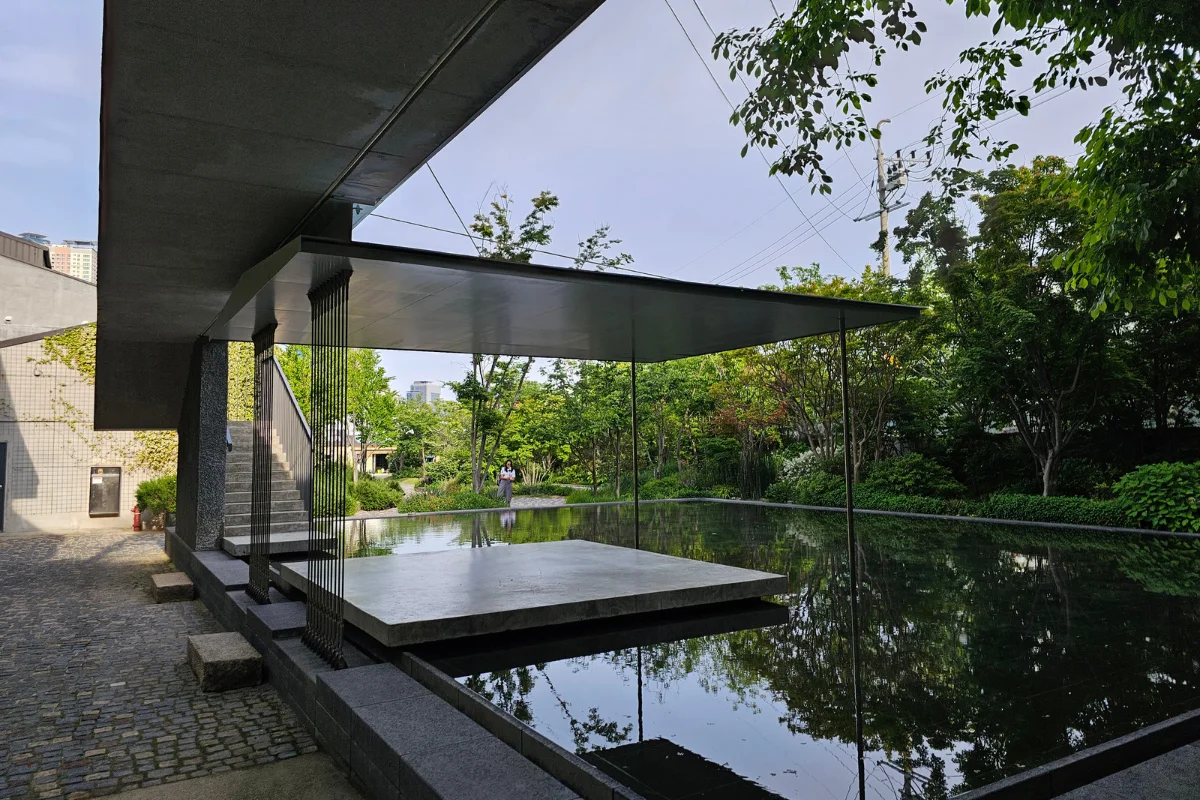

The most influential building of the 20th century was out of existence for 56 years. The German Pavilion for the 1929 International Exhibition in Barcelona was constructed, disassembled the following year — the steel sold by weight — and spent the next half-century circulating exclusively in black-and-white photographs. In those photographs, without human scale or color, architects around the world projected their own version of the space. Every open-plan apartment, every glass facade, every office building without interior partitions carries an echo of the pavilion. It was reconstructed in 1986. What you visit today is that reconstruction, not the 1929 original. The debate about whether that matters remains open.
The Pavilion That Showed Nothing
The pavilion had no conventional functional program. It was not a residence, not a museum, not an exhibition of industrial products. Ludwig Mies van der Rohe and Lilly Reich designed it as a Repräsentationsraum — a representation space — whose sole intended use was to host the official reception of Spain’s King Alfonso XIII and Queen Victoria Eugenia by the authorities of the Weimar Republic. Once that ceremony was complete, the building stood open for eight months to be walked through. Then it was gone.
The absence of content was the declaration. In a universal exhibition where every other pavilion displayed industrial products, art, or technology, the German entry displayed nothing. The building was the exhibit. That decision — exhibiting space itself as object — changed how architects conceive what they build.
The Silenced Authorship — Lilly Reich
For decades, the architectural canon attributed the pavilion’s credit almost exclusively to Mies. Contemporary scholarship has corrected that with specific documentation: Lilly Reich was appointed artistic director of the entire German section of the 1929 Exhibition. Her command of textile materials, exhibition spaces, and color use is not secondary in the pavilion — it is constitutive.
The red velvet curtain and black carpet visible in the historic photographs are not decoration: together with the golden onyx, they form the colors of the German flag. That code is Reich’s. The “luminous glass wall” — which generates an ethereal interior light — is a technique Reich had previously explored in her display case designs for the textile industry.
Reich’s erasure was compounded by her remaining in Nazi Germany during the Second World War while Mies emigrated to Chicago. It was Reich who catalogued, packed, and protected Mies’s archive to save it from Allied bombing. Without that work, the 1986 reconstruction would have been impossible for lack of documentation. The Fundació Mies van der Rohe acknowledged this debt by creating the Lilly Reich Fellowship for Equality in Architecture.
Is the Mies van der Rohe Pavilion worth visiting in Barcelona? Yes, for a specific reason: it is the spatial argument for why modern architecture looks the way it does, available as a physical experience for €12. The onyx wall, the reflecting pools, and the eight-pillar structure that eliminated load-bearing walls are all present and walkable. Visits take 45–90 minutes. Open Tue–Sun 10:00–20:00 (last entry 19:30). On Montjuïc, 15 minutes on foot from the MNAC.
The Structural System — Eight Pillars That Liberated Architecture
The pavilion’s constructive system is radical in its simplicity: eight cruciform steel pillars support the flat roof. Eight pillars. That is all that carries the ceiling. The walls — of marble, of onyx, of glass — load nothing. They are autonomous planes that define spatial flows without enclosing volumes.
This separation of structure from enclosure — which Mies called free plan — had been explored by Le Corbusier, but the pavilion takes it to its most radical consequence: if the wall carries no weight, it can be anywhere, adopt any material, have any thickness. The pavilion’s partitions don’t reach the ceiling. Spaces communicate above the wall planes, creating a continuity that makes the floor plan, viewed from above, read as an abstract composition of rectangles that never fully close.
The building is raised on a 1.30-meter travertine podium that isolates it from ground level. That elevation — seemingly small — produces a significant perceptual effect: from inside, the exterior ground disappears. Only walls, water, and sky.
The Invisible Grid
The pavilion appears asymmetric and spontaneous. It isn’t. The architects who reconstructed it identified a base grid of 1.09 × 1.09 meters organizing the stone paving pattern, the pillar positions, and the edge of each glass plane. Every stone joint coincides with a pillar axis or an enclosure boundary. The apparent freedom is the result of exhaustive mathematical control.
The Materials — Four Stones and the Onyx That Measures Space
| Material | Origin | Perceptual function |
|---|---|---|
| Roman travertine | Tivoli, Italy | Podium unity, classical historical connection |
| Green marble (Alps) | Austria | Reflectivity, depth in the pools |
| Ancient green marble | Greece | Chromatic contrast with travertine |
| Golden onyx | Atlas, Morocco/Algeria | Translucency, light wall, central piece |
| Steel | — | Stainless in 1986 (nickel-plated in 1929) |
| Glass | — | Smoked, translucent, green — boundary dissolution |
Mies personally selected the golden onyx block in a Hamburg warehouse. Onyx is semi-precious and translucent — when light passes through it, the natural vein acts as an abstract painting in motion. The height of this wall (3.10 meters) determined the total height of the building. In the 1986 reconstruction, a similar vein was located in Algeria — the current stone is perceptibly more reddish than the original.
The marble veins are opened symmetrically using the bookmatching process: two slabs cut from the same block face each other as a mirror, creating bilateral organic patterns. It is the building’s only ornamentation. No moldings, no reliefs, no applied motifs. The nature of the stone is the decoration.
Why the black-and-white photographs did the work
Beyond the onyx wall and the reflecting pools, the part that explains its reach is why the black-and-white photographs amplified the influence beyond what a visitable building would have achieved.
Between 1930 and 1986, the pavilion existed only in photographs — all in black and white, without human scale, without color. Those images circulated in architecture textbooks and journals for decades. In 1947, the MoMA in New York used a pavilion photograph as the cover of the catalog for Mies’s first major retrospective. The physical absence allowed each architect to project their own interpretation of the space onto those images, amplifying the influence beyond what any visitable building could have achieved. The photographs, by eliminating color, created a more austere and more “pure” image of the building than the original actually was. The real pavilion — with its red velvet, gold onyx, and reflecting pools of dark water — is far more sensory and less cerebral than the black-and-white canon suggests.
The Barcelona Chair — The Most Copied Furniture of the Modern Movement
Mies and Reich designed the Barcelona Chair specifically for the pavilion, to provide seating for the Spanish royals during the official reception. Mies described it as a “throne” — an object of prestige, not daily use. Its design takes the form of the sella curulis — the folding chair of Roman magistrates — and translates it into two curved steel profiles crossing in an X supporting a leather seat.
The original 1929 version was chrome steel with ivory pigskin upholstery. In the 1950s, Mies refined the design with Knoll so the frame was a single seamless piece of stainless steel. Each current-version chair requires 40 individually cut and hand-stitched leather panels. It is the most ubiquitous object of 20th-century interior design, and one of the few cases where the provenance is completely traceable: it was born in this building, for this ceremony, for these specific people.
During the inauguration ceremony, Alfonso XIII and Victoria Eugenia did not sit in them.
The Philosophical Debate — What Are You Visiting?
What exists since 1986 is not the 1929 pavilion. It is a scientific reconstruction based on archival research in Berlin, New York, and Chicago, executed by Ignasi de Solà-Morales, Cristian Cirici, and Fernando Ramos. Technical differences are documented: the original roof was a lightweight steel-and-plaster frame; the reconstruction uses reinforced concrete for durability. The original pillars were nickel-plated; the current ones are stainless steel to resist Barcelona’s saline atmosphere.
Rem Koolhaas argued that resurrecting the building “killed its aura” — that the pavilion’s power resided in its absence and its existence as pure idea. Philosopher Cristina Arribas described “an uncanny sense of deception” at visiting something presented as original that isn’t. On the other hand, the reconstruction allows the physical experience of a space that for 56 years existed only in black-and-white photographs — photographs that, by eliminating color, created a more austere image of the building than the original ever was.
Quick Decision
- First visit, no context → Enter from the travertine podium, stand in front of the onyx wall until the light changes, find the small pool with Kolbe’s sculpture — those three moments are the pavilion
- Understanding the history → Arrive at opening on a weekday; the low attendance of morning allows the space to be read before tour groups with audioguides arrive
- Photography → Mid-morning with direct lateral light on the onyx — the vein illuminates differently than in all the archive photographs
- Combined with Montjuïc → The pavilion is 15 minutes on foot from the MNAC — a route covering two centuries of architectural ambition in under two hours
- For someone with no prior interest in architecture → Lead with the paradox: the most influential building of the 20th century spent 56 years out of existence — that always generates curiosity before the building itself
Is It Worth It?
Yes, specifically for the spatial argument. The onyx wall, the pillar logic, and the way space flows between planes that don’t meet — these are things that can only be understood through the body moving through the space. No photograph captures the proportional relationship between the travertine podium height and the walls above. No description explains why the interior feels much larger than the floor plan suggests.
When it’s NOT worth it: if you’re expecting a conventional museum visit with labeled artworks and narrative rooms. The pavilion has one room, no permanent text panels, and no objects to look at beyond the building itself. It is entirely an architectural experience — which is either everything or nothing depending on what you came for.
Mistakes to Avoid
- Going only for the exterior: the onyx wall and the pool dynamics are only accessible from inside. The exterior view from the street gives you the travertine podium and nothing else.
- Staying less than 30 minutes: the light through the onyx changes continuously. A 20-minute visit sees one version of the space. A 60-minute visit sees four or five.
- Skipping the small rear pool: the Kolbe sculpture in the smaller rear courtyard — Dawn (Alba) — is the only figurative element and the only human-scale reference in the building. It’s also the most reflective pool, where the marble and the figure multiply into an unstable boundary between the building and its image.
- Treating it as a photo stop: the building was designed to be experienced through movement, not documentation. The sequence of entering, crossing through the open-plan space, reaching the onyx wall, and finding the rear courtyard is an architectural argument. Walking through it twice in opposite directions produces a different experience both times.
FAQ
Why was the original pavilion dismantled in 1930?
It was built as a temporary structure for the 1929 International Exhibition with a limited budget and no intention of permanence. When the exhibition closed, the building was disassembled and its materials — especially the steel — were sold. Nobody anticipated that an eight-month building would become the central reference of the Modern Movement.
What are the main differences between the 1929 original and the 1986 reconstruction?
The roof: the original used lightweight steel and plaster; the current version uses reinforced concrete. The pillars: originally nickel-plated steel, now stainless steel to resist the coastal environment. The building incorporates drainage, waterproofing, electrical lighting, and heating that the original temporary structure didn’t have. The golden onyx from the Atlas Mountains was replaced with a similar vein from Algeria, slightly more reddish in tone.
How long does a visit take?
Between 45 minutes and 90 minutes. It is a small space — under 2,000 m² — but time extends depending on attention given to the materials, the reflections, and the changing light. Quick visits miss the onyx illuminated by lateral light and the figure multiplication in the pools, which are the core of the experience.
What is the Barcelona Chair and why is it everywhere?
A piece of furniture designed by Mies and Reich for the 1929 pavilion, conceived as seating for the Spanish monarchs during the reception ceremony. Its form references the Roman sella curulis. Currently produced by Knoll in stainless steel and leather, it is the most reproduced piece of modern design in the world and appears in hotel lobbies, law office waiting rooms, and corporate headquarters across the globe. Its provenance is one of the few in modern design that is completely traceable.
Why did the pavilion influence architecture so much if almost nobody could visit it?
Between 1930 and 1986, it only existed in photographs. Those images circulated in architecture textbooks and journals for decades. The physical absence allowed each architect to project their own interpretation onto the images, amplifying influence beyond what any visitable building achieves. The photographs — by eliminating color and scale — also created a purer, more cerebral image of the building than the original actually was, which made it easier to extract principles from.
The pavilion is the only building in history that exercised its maximum influence while not existing. They reconstructed it so we could visit it. Now it exists, and far fewer people visit it than should. That paradox is not an accident of tourism — it is the nature of the building: it has always been more powerful as an idea than as a presence.
The pavilion is part of the natural Montjuïc circuit alongside the MNAC, the Fundació Joan Miró, and the Montjuïc Castle. For the architectural contrast within the same 1929 period, the Barcelona Modernisme route maps the Domènech i Montaner and Gaudí buildings that represent the opposite pole of what modernity could mean in the same city and the same year.