
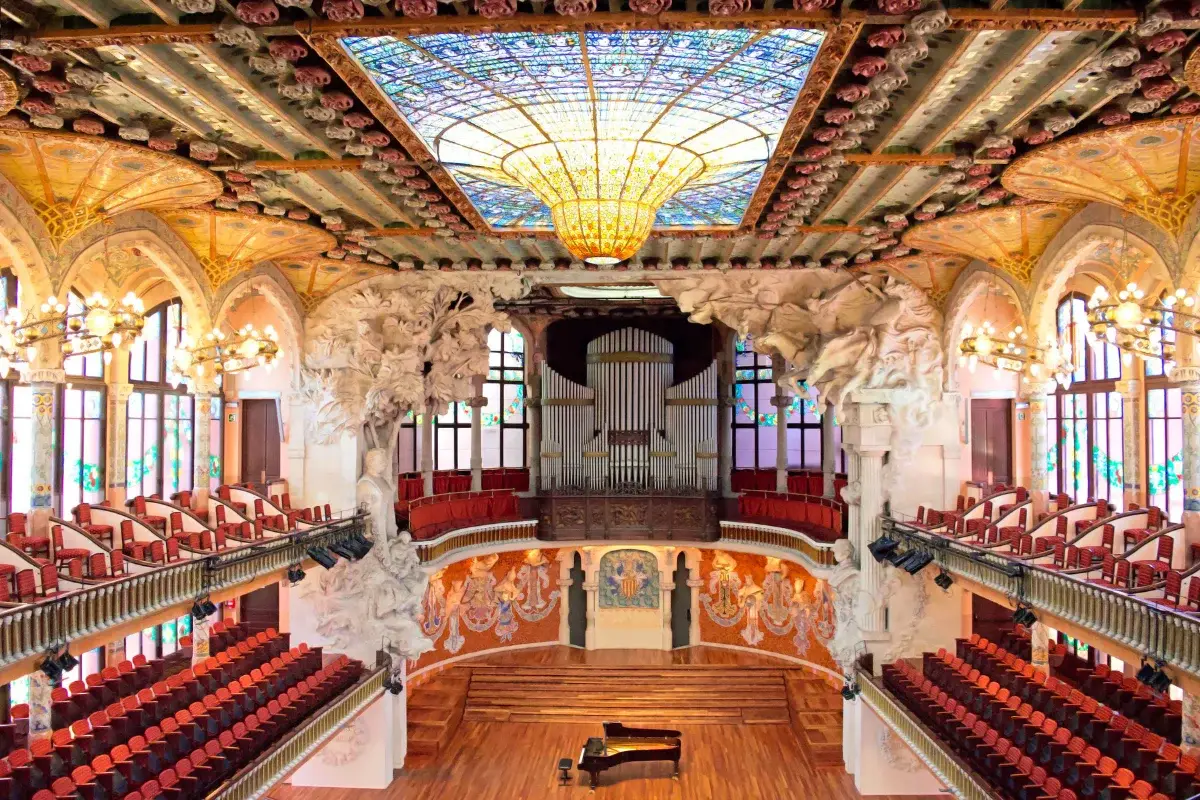

The Palau de la Música Catalana is a working concert hall that has been active since 1908, designed by Lluís Domènech i Montaner for the Orfeó Català choral society, and listed as UNESCO World Heritage since 1997. It is also one of the most genuinely misunderstood buildings in Barcelona: visitors frequently choose the wrong ticket type, arrive at the wrong hour for the skylight light, or attend a concert without understanding that the experience of the full hall — seats occupied, the choir’s acoustic resonance in a space literally built for it — is fundamentally different from the daytime visit.
This guide resolves the three decisions before you arrive.
Five Ticket Types — What Each Actually Includes
Standard Guided Visit (€22): the 50-minute guided tour covers the rehearsal room of the Orfeó Català, the Lluís Millet Hall with access to the double-colonnade balcony, the Concert Hall, and the Foyer with a professional guide. Some schedules include access to the stage, depending on that day’s programming. Languages: Catalan, Spanish, English, French, Italian, German, Chinese. English tours depart at 10:00 and 15:00; French at 11:00 and 14:00; Catalan at 12:00.
Free Visit with Audioguide (€20–24): entry every 30 minutes from 09:00 to 15:30. Mobile app available in 9 languages including Korean and Japanese — making this the most complete option for Asian visitors. Same duration as the guided visit, without a live guide or group.
Esència Palau (€30): sensory visit adding olfactory, auditory, and tactile stimuli to the standard route. Seasonal availability — check the calendar before purchasing.
“Las Mujeres del Palau” Visit: thematic route focused on the female stories of the building, from the stage muses to the Girls’ Choir. Combines history, architecture, and gender perspective.
Palau Premium (from €120): access to spaces not included in any other visit — technical areas, dressing rooms, restricted zones — with a private guide in exclusivity.
| Format | Price | Duration | Best for | Main limitation |
|---|---|---|---|---|
| Guided visit | €22 | 50 min | First visit, historical context | Fixed schedule by language |
| Audioguide free | €20–24 | 50 min | Independent visitors | No live explanation |
| Esència Palau | €30 | 50 min | Sensory experience | Seasonal availability |
| Women of the Palau | Consult | 50 min | Cultural and gender perspective | n/a |
| Palau Premium | From €120 | Variable | Professionals, serious curiosity | Price and availability |
| Palau + Sant Pau Pack | €32 | Two visits | Full Domènech i Montaner | Independent management at each site |
Applicable discounts: 20% for certain card holders and collectives. Some discounts apply only at the box office, not online. Online purchase avoids the €2 per-ticket handling fee charged at the box office.
The Architecture — Four Spaces That Justify the Entry
The Inverted Skylight
Designed by Antoni Rigalt, the skylight is a glass dome that sinks toward the interior of the hall. The design uses yellow tones at the center to represent the sun and blues at the perimeter to simulate sky. Around the central nucleus: 40 female faces representing the original women’s choir of the Orfeó. It is the most photographed element of the building and the one that changes most dramatically by hour of day. Between 09:00 and 11:00, direct sunlight hits the lateral stained-glass windows and projects colored reflections across the stalls.
The 18 Stage Muses — The One Without an Instrument
Carved in relief in the upper section and in mosaic on the lower by Eusebi Arnau and Lluís Bru, the figures hold instruments from different musical traditions. Seventeen of the eighteen hold an instrument. One does not. She represents choral singing — the reason the building exists. It is the detail that guides are asked about most frequently and that almost no conventional source mentions as a point of interest.
The Lluís Millet Hall
Double-height rest salon with floral stained glass windows and a double-colonnade balcony in multicolor trencadís ceramic. It is the most photographed space from the exterior — the ceramic columns are the most reproduced motif in Modernisme architecture guides. Access from the colonnade balcony gives a direct lateral view of the Concert Hall that the interior visit does not.
The Foyer and Rehearsal Room
The Foyer preserves original mosaic ticket booths integrated into red brick and green-glazed ceramic columns. The Rehearsal Room — semicircular, below the main stage — is where the Orfeó Català still rehearses today. The acoustics here are intimate and different from the main hall. The Foyer’s curved stair and the street-level view of the rehearsal room are only accessible with a ticket.
How much does it cost to visit Palau de la Música Catalana? Standard guided visit €22, 50 minutes. Reduced €16 for over-65 and under-35. Free under-10. Groups of 15+ from €18 per person. Audioguide without live guide €20–24 (9 languages including Korean and Japanese). Online purchase avoids the €2 box office handling fee. The Palau + Recinte Modernista de Sant Pau combined pack costs €32.
Quick Decision
- First-time visitor, 1 hour available → Guided visit at 09:00 — the skylight light is lateral and direct, photography is best, fewer people
- For architectural depth → Palau Premium from €120 — access to technical areas, dressing rooms, restricted spaces with a private guide
- Traveling with children 5–10 → Family visit with workshop — the route includes a creative activity, under-10 enter free
- Independent, self-paced → Free visit with audioguide at €20 — access every 30 minutes from 09:00, 9 languages including Korean and Japanese
- Complete musical experience → Morning guided visit + afternoon or evening concert — the Palau 100 and Palau Cambra cycles have tickets from €20
- Group or institutional visit → Combined Pack with Recinte Modernista de Sant Pau for €32 — both major Domènech i Montaner works in one day
Concerts — The Experience the Daytime Visit Doesn’t Replicate
The Palau runs its own programming divided into thematic cycles.
Palau 100: the flagship symphonic cycle. Draws ensembles including the Bavarian Philharmonic, the London Symphony Orchestra, and the Dresden Staatskapelle. Tickets for headline concerts sell out weeks in advance.
Palau Òpera: opera in concert format, focused on Baroque and Classical repertoire — Handel, Gluck, Mozart — with specialist period-practice performers.
Palau Bach and Palau Cambra: chamber music and specific Bach repertoire cycles, with more intimate formats and more accessible prices than the symphonic cycle.
Organ at the Palau: recitals of the grand organ presiding over the Concert Hall. These are the concerts that best exploit the building’s specific acoustics — the metal structure acts as a resonance box and the organ fills the space without amplification.
Family Concerts: Sundays at 10:15, designed for children 5–10. The only concerts where a different noise level is accepted.
Tickets at palaumusica.cat. The best cycles sell out weeks in advance — the season programming is published cycle by cycle.
The acoustics and their particularities: the glass walls that make the Palau unique in Europe are not soundproofed. This means reverberation works differently than in a concrete concert hall, and occasionally exterior sounds can filter through during performances. It is an inherent feature of the design, not a construction defect.
How the hall’s structure shapes what you hear
Beyond the skylight and the stained glass, the part that explains the building is the relationship between the hall’s structure and its acoustic behaviour.
The Palau’s acoustic properties come from a structural choice that was not made for acoustic reasons: the metal structure and glass walls produce a resonance profile unlike any other concert hall in Europe. Orchestras that perform here regularly note that the hall responds differently to string sections than to brass — the glass reflects high frequencies while the metal structure holds low-frequency resonance. This is why choral music, for which the hall was designed, sounds particularly natural here: the Orfeó’s warm mid-range vocal frequencies interact with the structure in a way that was intuited rather than calculated by Domènech i Montaner.
The practical implication: if you attend only one concert at the Palau, a choral program or the organ recitals will use the building’s acoustic character more fully than a full orchestral program.
Practical Information
Box office hours: Mon–Sat 08:30–21:00; Sun and holidays 08:30–15:30.
Photography: permitted in visit zones. Morning hours between 09:00 and 11:00 are recommended — sunlight hits the lateral stained glass in that window. In August, hours extend to 20:00, allowing late-afternoon light through the skylight.
What is not permitted: food or drinks in the hall, large bags (no cloakroom), tripods, and wedding photo sessions without prior written authorization.
Important limitation: the Palau is an active concert hall. Visits may be cancelled or modified due to technical rehearsals without refund rights under current terms. Confirm the visit the day before if a concert is programmed.
Gastronomy without entry: the Cafè Palau in the Foyer is open Tue–Thu 18:00–00:30, Fri–Sat 12:30–16:00 and 18:00–00:30, Sun 12:30–16:00. The Pizzicato Gastrobar on the first floor offers weekend menus for around €25. Both spaces allow experiencing Domènech i Montaner’s architecture without buying a collection ticket.
Metro: Urquinaona (lines L1 and L4). Five minutes on foot from Plaça de Catalunya.
Can you visit the Palau without booking in advance?
Yes, but it’s not recommended in high season. Capacity per session is limited and English-language guided visits — the most in demand — frequently sell out before noon. Online purchase also avoids the €2 per-ticket handling fee charged at the box office.
Is it worth combining a daytime visit with an evening concert?
Yes, if planned well. A morning visit (09:00–10:30) and an afternoon or evening concert is the combination that makes the most of the trip. The difference between seeing the empty hall during the visit and seeing it full during a concert is sufficient to justify both costs. Palau Cambra and Organ at the Palau cycles have more accessible entry prices than Palau 100 and are a good first introduction to the building’s repertoire.
Best seats for a concert?
Depends on the repertoire. For symphony orchestra, the amphitheater (mezzanine) offers the most balanced sound mix and a visual perspective that includes the skylight. For piano recitals, rows D–E of the stalls on the left side allow seeing the performer’s hand technique. For choirs and organ, the rear rows of the amphitheater give the best sound mix in the building.
The visit explains the building’s container. The concert demonstrates what it’s for. If the itinerary allows only one, the guided morning visit resolves the architectural argument. If it allows two, the combination of empty hall in the morning and full hall in the evening is one of the most coherent ways to understand why Domènech i Montaner built what he built and who he built it for.
For the full Domènech i Montaner context: the Recinte Modernista de Sant Pau is the architect’s other major Barcelona work — the combined pack at €32 covers both in one day. For the Gaudí buildings that represent the contrasting Modernisme approach, the Gaudí route in Barcelona organizes the sequence. And for the El Born neighborhood that surrounds the Palau, the guide covers the medieval streets, markets, and waterfront within walking distance.