
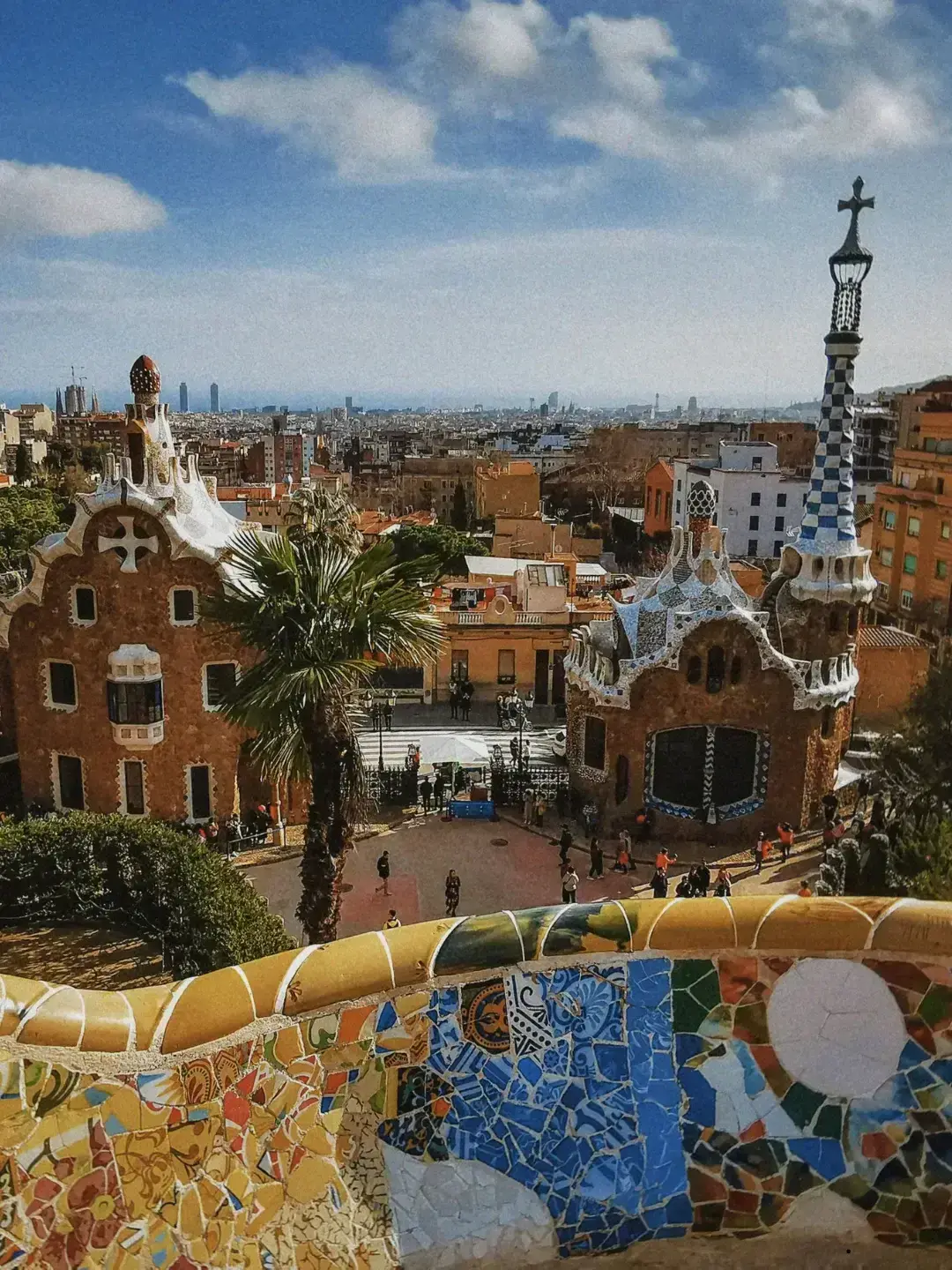

Most first-timers arrive at Park Güell expecting a park and meet something stranger: the infrastructure of a city that was never built. Gaudí drew it between 1900 and 1914 as a private housing estate of 60 plots for wealthy families, and exactly two sold, one of them to Gaudí himself. The bankrupt project passed to the city and opened as a public park in 1926, the year he died. Read that before you go and the whole place stops being a garden and starts being the ghost of a neighbourhood.
What you actually pay for, and what you don’t
Park Güell is two parks under one name, and confusing them is the single most expensive mistake a visitor makes. The Monumental Zone (12 hectares of Gaudí’s mosaics, dragon staircase, and serpentine bench) is ticketed at €18 and capped at 1,400 visitors an hour. The forest zone (pine woods, gardens, hillside colonnades, and the best viewpoint in the park) is free and unticketed. Get the two mixed up and you either pay for something you didn’t need or miss the photograph you came for.
Quick decision by what you want
- First-time visitor → Monumental Zone ticket, first slot of the day — 1.5 hours covers the highlights before crowds peak
- On a tight budget → Free forest zone and Three Crosses viewpoint only — no ticket, better panorama than the paid terrace
- Coming for photography → First entry (9:30am) or after 5pm — the south-east-facing bench catches flat, harsh light at midday
- Interested in Gaudí the man → Add the Casa Museu Gaudí, separate ticket — the interior reveals more than the architecture does
- Travelling with reduced mobility → Bus 24 to the Carretera del Carmel gate; the main terrace is accessible, the viaducts are not
- Visiting April to October → Book 1 to 2 weeks ahead — timed slots sell out several days early
The failure behind the mosaics
The Monumental Zone was designed as a luxury housing estate, and it went bankrupt as one. Eusebi Güell had seen English garden suburbs like Port Sunlight and Bournville, and he wanted the same for Barcelona’s upper class: villas with gardens, shared services and sea views, away from the industrial density of the centre. He commissioned Gaudí to build the shared infrastructure for 60 plots.
The location killed it. The Carmel hillside sat too far from the centre with no direct transport, while the bourgeoisie stayed perfectly content on the Passeig de Gràcia. Only two plots sold. Güell died in 1918, the city bought the land in 1922, and what Gaudí had built as roads, a market hall, and a communal terrace opened as a park four years later. This is why the place feels like a stage set rather than a district, since everything you walk through was built for residents who never came. The dragon staircase, the Hypostyle Hall, and the terrace all belong to the same failed real-estate logic that shaped Barcelona’s best-known sights.
The Hypostyle Hall and the water system beneath it
Known as the hall of columns, this is a flat-roofed structure held up by 86 Doric columns, each 6 metres tall. The classical Greek reference is deliberate, a case of Gaudí rebuilding an ancient order in concrete and ceramic. But the clever part is invisible from below. The ceiling’s 45 domes, decorated in trencadís, are a combined ventilation and drainage system: they collect rainwater from the terrace above, filter it, and channel it to an underground cistern holding 12 million litres.
In 1900 the park was self-sufficient in water. According to official data from the site, most visitors walk through looking up at the mosaics without realising they are standing above one of the most sophisticated rainwater systems of its era. The hall’s roof doubles as the floor of the terrace above, a piece of Gaudí logic where no element serves a single purpose, the same thinking that runs through his work on the Sagrada Família interior.
The ticket is €18, online only, not €10 at the gate
A €10 ticket bought at the gate is the version still circulating. Neither half is true. The adult ticket is €18, the reduced rate €13.50 for children 7 to 12 and over-65s, and under-7s enter free. Crucially, there is no box office on-site, and the park sells tickets online only, in advance. Turn up without one in high season and the staff will send you to the website while your afternoon evaporates.
The system runs on timed slots with a 30-minute grace window: a 9:30am booking lets you enter until 10:00am, after which the slot is forfeited even with a valid ticket. Third-party resellers charge 15 to 20% more for the same entry. Travel experts consistently recommend booking directly at parkguell.barcelona and treating any “buy on arrival” advice as out of date. Building the real cost of the visit into a wider daily budget by traveller type avoids the sticker shock at the gate.
The free viewpoint that beats the paid terrace
The Three Crosses hill, the Turó de les Tres Creus, is the highest point in the park, it is free, and its 360-degree panorama outdoes the ticketed terrace in scope. Almost no tourists reach it because they turn back at the Monumental Zone exit, but it sits 15 minutes uphill and the view is clean in every direction: Sagrada Família, the sea, Tibidabo, and the Pyrenees on clear days.
According to travel experts, the free zone is not a consolation prize for anyone short on money or time. The Lavanderes Gallery, a semi-covered stone colonnade in the northern section, is empty of tourists mid-morning, and the viaduct paths run through the same free area. Sunrise sits around 07:10 in June and 08:15 in December, and it can only be caught from the free zone, since the Monumental Zone doesn’t open until 9:30am. If this quieter side of the city appeals, the guide to Barcelona’s hidden places points to more of it.
Is Park Güell worth it?
Yes for the Monumental Zone, with realistic expectations about scale. The dragon, the bench, and the Hypostyle Hall are extraordinary, and trencadís at this scale exists nowhere else. But the ticketed area is compact, just 12 hectares, and in peak season it feels dense even with timed entry. You’ll spend 45 to 90 minutes in a small space designed for residential use, not tourist flow.
When it is not worth the ticket: if your budget is tight and you’ve already visited Casa Batlló or another Gaudí interior, the free zone plus the Three Crosses viewpoint delivers real value at zero cost. The forest paths and summit views are a different, quieter experience, and arguably closer to how Gaudí meant the park to be used. The honest verdict depends on whether you want the specific icons or the broader hillside.
Mistakes to avoid
- Booking a midday slot. the terrace faces south-east and takes full sun from 11am to 4pm in summer; the mosaic reflects heat. First entry or late afternoon are far more comfortable.
- Skipping the free zone. the Three Crosses viewpoint is 15 minutes uphill from the Monumental exit and beats the paid terrace for panorama. Most visitors never learn it exists.
- Expecting a ticket desk. there is no box office on-site in any season. Book online before you leave your accommodation.
- Driving up. the streets around the park are narrow, one-way, and heavily ticketed; the two car parks on Carrer d’Olot fill by 9:30am in summer and cost €3.50 an hour.
- Underestimating the climb. the park sits at 160 metres; the final 15 to 20 minute ascent from the metro punishes anyone in flip-flops or midday July heat.
- Treating the Casa Museu Gaudí as skippable. for anyone interested in Gaudí beyond the architecture, the house is the most personal record of how he lived.
The Casa Museu Gaudí, an ascetic in a flamboyant park
Gaudí bought one of the two sold plots and had his closest collaborator, Francesc Berenguer, build the house. He lived there from 1906 to 1925, a year before his death. It is now the Casa Museu Gaudí, entered on a separate ticket, and it reopened after a period closed for restoration. Inside are furniture he designed, including the oak armchair originally made for the Palau Güell, and original documentation of his life.
The revealing thing is the house itself. The architect of the most extravagant buildings of his era lived with near-monastic austerity, in few rooms, with functional furniture and an oratory. When a tram struck him in 1926, his clothing was so worn that nobody recognised him, and he was first taken to a paupers’ hospital. The gap between the house he lived in and the buildings he designed is the most illuminating thing in the park for anyone who wants Gaudí the person rather than the brand. It reframes the polished tourist icon the way visiting Casa Vicens, his first major house, reframes his early career.
Getting there, hours and key facts
The park sits at 160 metres in the Gràcia district, and no metro line reaches the gate, so the final approach is the part nobody warns you about. Metro L3 (Lesseps or Vallcarca) leaves a 15 to 20 minute uphill walk; Vallcarca is shorter but steeper, Lesseps longer but gradual. Bus 24 from Passeig de Gràcia drops directly at the Carretera del Carmel gate beside the Monumental Zone, the easiest option with children or reduced mobility. From central Barcelona, a taxi to Carretera del Carmel runs €12 to €18.
Opening hours shift by season: summer runs 9:00am to 7:30pm, and quieter months close around 5:30pm, always with timed entry. Check the exact day on the official site before travelling, as the calendar changes several times a year. To line the visit up with the right month, the guide to the best time to visit Barcelona helps, and the Gràcia neighbourhood guide covers the squares and markets below the park that justify a half day more.
| Element | Data |
|---|---|
| Total area | 20 hectares (12 monumental + 8 forest) |
| Construction | 1900–1914 |
| Opened to public | 1926 |
| UNESCO listing | 1984 |
| Hypostyle columns | 86 Doric, 6 m tall |
| Bench length | 110 metres |
| Cistern capacity | 12 million litres |
| Plots planned / sold | 60 / 2 |
| Monumental Zone cap | 1,400 visitors per hour |
| Altitude | 160 metres |
Park Güell in 2026, lit UNESCO blue
With Barcelona serving as World Capital of Architecture in 2026, Park Güell has joined the celebration by lighting its entrance pavilions, dragon staircase, and Hypostyle Hall in blue, the colour of UNESCO, for the first time. It is a recent development older sources won’t mention, worth knowing if your visit overlaps with the year’s programming.
The practical detail that matters year-round: the Monumental Zone runs on capped hourly slots, so a visit during a major event window needs earlier booking than usual. For a fuller day on the hill, pair the park with the free forest zone at opening and the secret viewpoints of Barcelona scattered across the surrounding ridge.
Frequently Asked Questions
How much is a Park Güell ticket and can I buy one at the gate?
The Monumental Zone costs €18 for adults, €13.50 for children aged 7 to 12 and visitors over 65, and is free for under-7s. There is no box office on-site, and tickets are sold online only, in advance. The surrounding forest zone is free and needs no ticket.
What is the difference between the paid and free areas of Park Güell?
The Monumental Zone (12 hectares, ticketed) holds the dragon staircase, Hypostyle Hall, terrace bench and viaducts that Gaudí designed as shared infrastructure. The forest zone (8 hectares, free) is everything else, including the Casa Museu Gaudí and the Three Crosses viewpoint.
Is the free zone of Park Güell worth visiting without a ticket?
Yes, strongly. The Three Crosses viewpoint at the summit is free and offers a 360-degree panorama over Barcelona that the ticketed terrace does not match in scope. Budget travellers can have a complete experience without paying, though the walk uphill is real.
How far in advance should I book Park Güell tickets?
In high season (April to October) book 1 to 2 weeks ahead, as popular time slots sell out several days early. In low season 2 to 3 days is usually enough. Booking at parkguell.barcelona is the only guaranteed method, since there is no ticket desk at the park.
How do I get to Park Güell and is there a lot of walking?
Metro L3 (Lesseps or Vallcarca) leaves a 15 to 20 minute uphill walk. Bus 24 from Passeig de Gràcia drops you at the Carretera del Carmel gate beside the Monumental Zone, the easiest option. The park sits at 160 metres altitude, so the final climb is steep in summer heat.
Why did Gaudí’s original housing project fail?
Of 60 planned plots only 2 sold. The Carmel hillside was too far from the centre with no direct transport, and Barcelona’s wealthy preferred the Eixample. Güell died in 1918, the city bought the land in 1922, and it opened as a public park in 1926.
Park Güell is not a park Gaudí decorated, but a neighbourhood nobody moved into, inherited by a city that turned failure into art.