
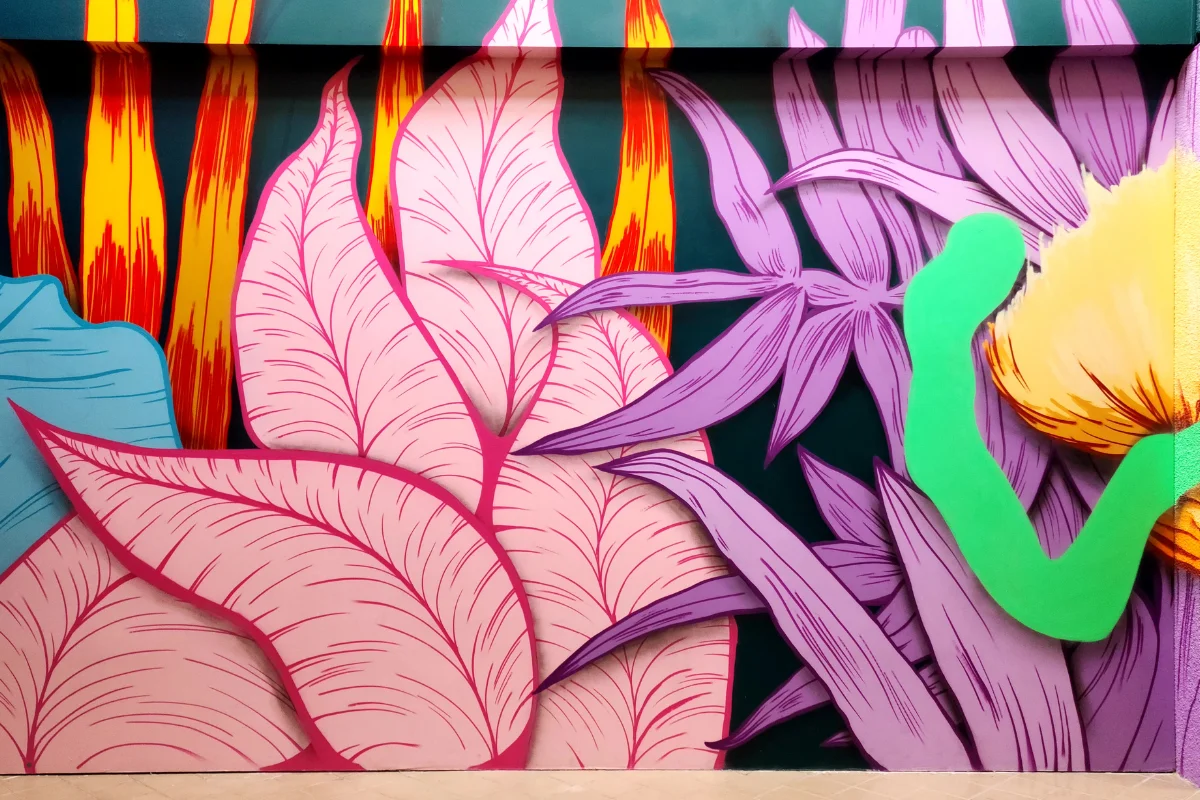

Poblenou was Spain’s largest industrial district in the 19th century. Today the same blocks that held the factories contain over 12,000 technology and creative companies. The walking route of about 5km starts at Jean Nouvel’s Torre Glòries, passes through La Escocesa — a 19th-century Scottish textile factory with 21 active artist studios — runs the length of Carrer de Pere IV with its constantly changing murals, and ends on the Rambla del Poblenou. Most murals on the route are ephemeral: they change as buildings are renovated or demolished. Every visit is a different route. Metro L1, Glòries stop.
Torre Glòries and the Disseny Hub — The Route’s Threshold
Torre Glòries (Jean Nouvel, 2005) has 144 meters and 4,500 glass panels of different colors that at night illuminate in programmed LED sequences. From the outside it’s the clearest visual marker of the boundary between the Eixample grid and the 22@ district. For the full Poblenou guide including daily life, gastronomy, and the neighborhood’s non-creative-district side, the neighborhood article covers what this route doesn’t.
The Disseny Hub Barcelona (Plaça de les Glòries) is the city’s design museum, with collections of fashion, decorative arts, industrial design, and graphic design. Free Sundays from 15:00. Regular hours: Tuesday–Sunday 10:00–20:00. General entry: €6. The building’s terraces have free access and a direct visual axis to Torre Glòries and the park.
At 200 meters: Parc del Centre del Poblenou, also designed by Jean Nouvel in 2008, with perimeter walls covered in Mediterranean plants and a forged-iron gate with Gaudí references. On adjacent building facades: Escif’s Classical Column mural — one of the first serious urban artists in the Barcelona circuit.
Time: 30–45 minutes.
Quick Decision — Route Options
- 2 hours without detours → Torre Glòries exterior + Carrer de Pere IV murals + coffee on the Rambla del Poblenou — the route’s core without entering buildings
- Best single mural on the route → Fer Llenya by Gonzalo Borondo at the corner of Lope de Vega and Pallars — monumental format, Expressionist castellers, surviving since 2015
- For architecture → Media-TIC by Enric Ruiz-Geli on Carrer de Roc Boronat — ETFE bubble facade that regulates temperature and light, the 22@’s most innovative building
- First weekend of the month → Palo Alto Market in the former Ramón Gal factory — the most complete design and craft market in the area in an industrial setting
- Most moving mural → portrait of Neus Català on Passeig del Taulat by Roc Blackblock — concentration camp survivor, painted with photographic detail
- Connecting to the beach → the Rambla del Poblenou meets the Barceloneta — the Barceloneta guide picks up the coastal route from there
Carrer de Pere IV — The Street Art Backbone
Carrer de Pere IV is the route’s main axis, running through Poblenou from northwest to southeast along the former railway track alignment. The facades of factories in process of conversion are the neighborhood’s most active canvas.
Key fact before starting: many of these murals are temporary. Facades of buildings pending demolition or renovation change their appearance in months. The Open Walls Conference has brought international artists to paint legally on these walls for years — names who have worked here include Axel Void, Miss Van, Sixe Paredes, Sam3, and Roc Blackblock. What you see on the next visit will not be the same as this one.
At the corner of Lope de Vega and Pallars: Fer Llenya by Gonzalo Borondo, one of the largest-format murals in the neighborhood. Castellers in a pinya formation with Expressionist brushwork and dripping colors. Painted during the 2015 Open Walls Conference and still standing — notable durability for this type of work.
Time along this axis: 30–40 minutes.
La Escocesa — 21 Artist Studios in a 19th-Century Factory
La Escocesa (Carrer de Pere IV, 345) is a former textile factory built by Scottish investors in the 19th century that has functioned as an artistic creation center since the early 2000s. It has 21 studios for local and international artists, selected by public tender and renewed every two years.
Interior access depends on programming — during festivals, open-door days, and the Poblenou Open Day (a Saturday in May, 11:00–22:00, over 60 free activities) the space is visitable. The exterior is always open: the walls carry murals by Miss Van and Zosen Bandido among others.
What doesn’t appear in any tourist guide: La Escocesa has Fàbrica de Creació certification from Barcelona City Council, which gives it access to public funding and requires it to maintain a percentage of activities open to the neighborhood. It is the only model of this type in Poblenou that remains managed entirely by the artists who work in it.
Time: 15 minutes exterior, longer if open for a visit.
The Wallspot system behind the legal murals
Beyond the rotating murals on Carrer de Pere IV and the Open Walls Conference, the mechanism worth understanding is the Wallspot system that makes the legal rotation possible.
The Wallspot platform manages several walls in the neighborhood as legal rotational urban art spaces. Artists apply for a wall, paint it, and free it for the next artist. There’s no squatting, no legal conflict, and no static collection — the walls are designed to change. This is different from commissioned murals (which are permanent until the building changes) and from illegal pieces (which risk removal). Wallspot created a third category: legal, temporary, community-managed.
The practical implication for visitors: the walls managed by Wallspot near the ConnectHort community garden on Selva de Mar/Perú change faster than anywhere else on the route. Pieces that were there six months ago may be entirely different now. That’s a feature, not a bug — it’s the only genuinely living street art circuit in Barcelona.
Selva de Mar and the ConnectHort Murals
At the northern end of the route, the Selva de Mar and Perú intersection concentrates some of the largest murals in the neighborhood. A hyperrealist portrait of musician Pau Donés that appeared here made this corner a reference point for tribute muralism in Barcelona.
At the entrance to the ConnectHort community garden (same streets): a mural sequence by different artists — pomegranates by Taneli Stenberg, a snake by Mr Sid, a girl with birds by Maya Jevans, a child picking strawberries by Monstro. The community garden functions as a resident-managed space — the contrast between active urban farming and large-scale murals is one of the most distinctive compositions in the neighborhood.
Time: 15 minutes.
On the other side of the city the climb replaces the grid: pintxos on Carrer Blai, cactus gardens and the 180-degree panorama from the Mirador de l’Alcalde make up the Poble-sec and Montjuïc walking route.
The Rambla del Poblenou — Closing the Route
The Rambla del Poblenou is the neighborhood’s central promenade — the axis that separates historic Poblenou from the industrial section. Terraces, specialty coffee (Nomad Coffee, Federal Café), the Casino de l’Aliança with its 1904 Modernista facade, and neighborhood life that hasn’t changed pace.
Tío Che has been the neighborhood ice cream shop since 1912. On the same Rambla, Modernista building architecture that nobody signposts — looking at the facades of the lower-numbered buildings is enough to find details that appear in no organized tour.
The Poblenou Cemetery is the unexpected and most poetic close to the route: high-quality Novecentista sculpture, the Beso de la Muerte (Death kissing a young person), and — on the rear wall of the cemetery along Passatge de la Llacuna — murals by Hyuro. The only place in Barcelona where contemporary street art literally surrounds 19th-century funerary heritage. Free. Opens 8:00–18:00.
Practical Notes
- Duration: 3–4 hours at an easy pace. With Disseny Hub visit and lunch on the Rambla, plan 5 hours
- Best light: early morning (09:00–10:00) for lateral light on the murals; sunset for light between factory chimneys
- Murals change: some referenced in photography online may no longer exist — this is the nature of street art in Poblenou
- Disseny Hub: free Sundays from 15:00
- Can Framis: museum of Catalan painting from the 15th–18th century in a converted 18th-century factory — Tuesday–Saturday 11:00–18:00, Sunday 11:00–14:00, €10
- By bike: the route is perfectly cyclable — on a bike the Selva de Mar murals can be added without significant extra effort
Poblenou doesn’t have a street art museum because the whole neighborhood is the museum. Every facade that changes, every factory being rehabilitated, every vacant lot waiting for its next use is part of the same transformation process that has been running for twenty-five years. The route you do today won’t be the same in six months, and that instability is exactly what makes it interesting.
To extend the day: the Poblenou nightlife guide covers the bars and clubs that transform the neighborhood after 22:00. For the 22@’s relationship to the broader Barcelona architectural picture, the Barcelona Modernisme route places the contemporary district in the city’s long transformation timeline. And to connect this route with the beach, the Barceloneta guide is 10 minutes on foot from the Rambla del Poblenou.