
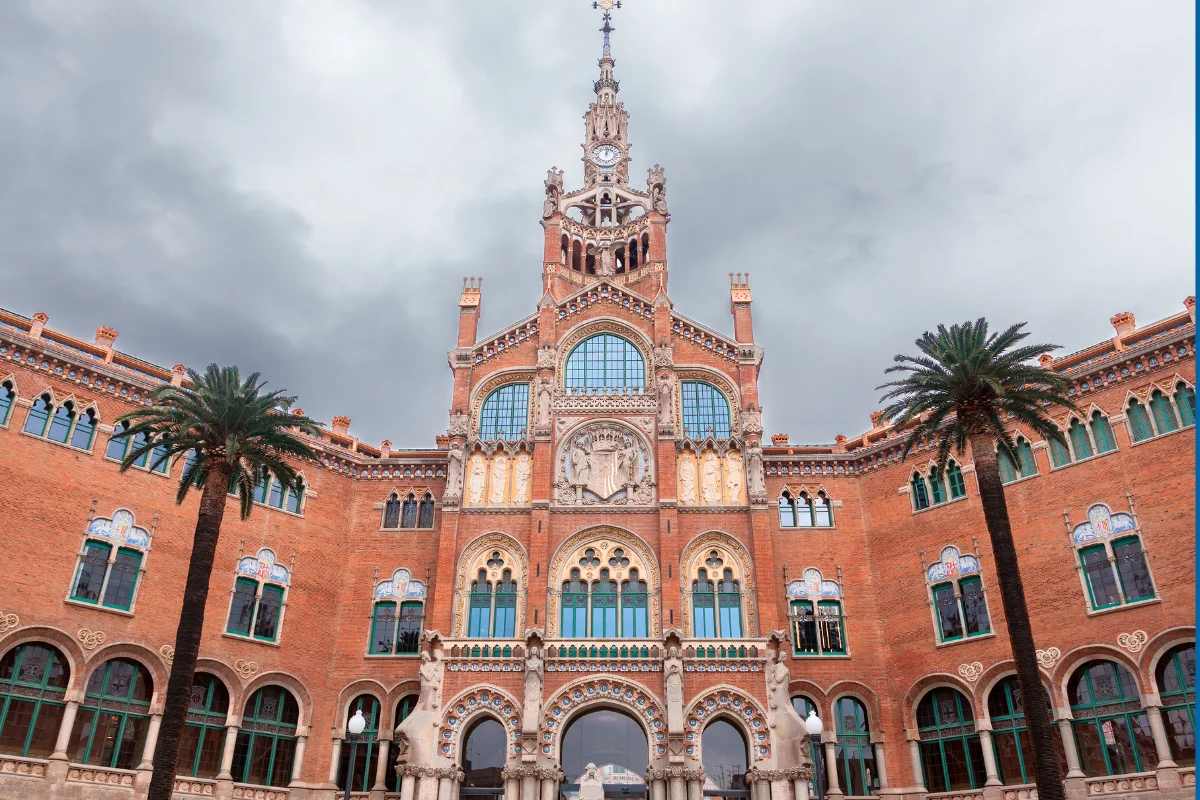

The Recinte Modernista de Sant Pau sits at a 45-degree angle to the surrounding Eixample grid. That rotation was the project’s most calculated decision. Lluís Domènech i Montaner studied over 200 hospitals in Europe before beginning the design, and rotating the entire complex was the only way to guarantee maximum solar exposure in all pavilions throughout the day — essential for ultraviolet sterilization at a time when bacteriology was only beginning to document its principles. Everything else in the building — the ceramics, the mosaics, the underground tunnel network, the separation of patients by medical specialty — follows from that first structural decision.
It is the largest Art Nouveau complex in the world, UNESCO World Heritage since 1997, and one of the few buildings in Barcelona where a single archival fact — the axis points directly toward the Sagrada Família — represents an architectural argument rather than a coincidence.
The Hospital Barcelona Could Never Build Inside Its Walls
The Hospital de la Santa Creu had been operating in the Raval since 1401, born from the merger of six medieval hospitals under King Martín el Humano. For five centuries it was the only major medical center in Barcelona — the same place Cervantes received treatment after the Battle of Lepanto and where Antoni Gaudí died after being struck by a tram.
But by the 19th century, industrialization had made the Raval one of the densest and most contaminated neighborhoods in Europe. The medieval building could not apply the advances of bacteriology and hygiene: without ventilation, without light, without separation of infectious diseases, mortality was unacceptable. The expansion of the city through Cerdà’s Eixample plan opened new territory — but moving the hospital required financing the public institution didn’t have.
The catalyst was Pau Gil i Serra, a Barcelona banker living in Paris. His will left 3,060,000 pesetas with precise instructions: build a hospital for Barcelona’s poor under the patronage of Saint Paul, applying the most advanced principles of hygiene and medicine. The merger of Gil’s legacy with the centuries-old institution created the Hospital de la Santa Creu i Sant Pau and gave Domènech i Montaner an unprecedented commission.
The 45-Degree Rotation — The Decision Nobody Else Made
The site chosen for the new hospital covered the equivalent of nine Eixample blocks in the Guinardó district — a 300×300 meter square. Any conventional architect would have aligned the building with Cerdà’s grid. Domènech i Montaner rotated it 45 degrees.
The reasons were simultaneously technical and political. Technically, the north-south orientation guaranteed that the main facades of each pavilion received direct sunlight for the maximum number of hours per day — a key requirement for the natural UV sterilization that bacteriology of the era was beginning to document. The natural slope of the terrain, combined with the rotation, created constant air currents that evacuated the stagnant air associated with medieval hospitals.
Politically, the rotation was a silent protest against the orthogonal monotony of Cerdà’s grid, which Domènech considered an urbanistic model insufficient for real public health needs. The hospital didn’t just face a different direction from the Eixample — it faced directly toward the Sagrada Família, establishing the symbolic axis of the Avinguda de Gaudí that connects the two major works of the rival architects of Catalan Modernisme.
The practical result of that diagonal orientation: from the Administration Pavilion windows, the Sagrada Família towers are perfectly framed on the horizon. Domènech designed it that way. It was an architectural message, not a coincidence.
Is the Recinte Modernista de Sant Pau worth visiting in Barcelona? Yes — it’s the most architecturally coherent hospital complex ever built, with 27 pavilions, gardens, underground tunnels, and an iconographic program where every surface was designed as a therapeutic agent. UNESCO World Heritage since 1997. Entry €15–18. Open Tue–Sun, hours vary by season. 15 minutes on foot from the Sagrada Família via Avinguda de Gaudí.
The Pavilions — A Medical City Organized by Specialty
The original plan contemplated 48 buildings. 27 were built. The complex was organized on a logic that the 19th century was only beginning to formalize: separation of infectious from non-infectious diseases, of male from female patients, of medical staff circulation from patient movement. Each quadrant of the site had a specific function.
Two 50-meter diagonal avenues divided the enclosure into four sectors. The underground tunnel network — more than one kilometer total — allowed the transfer of supplies, stretchers, and personnel without interfering with the gardens or patients’ rest. The gardens were not a decorative luxury: planted with orange trees, lime trees, and medicinal plants — rosemary, sage, lavender — whose effect on air quality was documentable by contemporary science.
The Administration Pavilion
The most ornamented piece in the complex acts as an institutional altarpiece. The clock tower reaches 62 meters and serves as a visual reference from the Eixample. Inside: 16 mosaics by Mario Maragliano on designs by Francesc Labarta narrating the hospital’s history from 1401 to the 20th century. There is one empty space in the interior — a panel that was never installed due to disagreement between patrons about whom to dedicate it to. It’s the only unfinished element of the iconographic program, and no conventional guide mentions it.
The pavilion also houses the Historical Archive of the Hospital, one of the oldest documentary funds in Europe with records from the 15th to 20th century. It served as a film location for “Perfume: The Story of a Murderer” and “The Passenger.”
The Operating Theatre
Designed to maximize natural light before reliable electric surgical illumination was generally available. Three north-facing apses with large glazed walls and ceilings provided constant, cold, shadowless light — most suitable for surgical work. The interior was tiled in white and blue ceramics easy to clean and resistant to bacterial accumulation: a hygienic measure that also proved aesthetically coherent with the complex’s chromatic language.
The Sant Rafael Pavilion
Restored to recreate a patient ward from the 1920s, with ten original beds, period radiators, and a day room where patients received visitors. The direct visual connection with the exterior gardens was part of the therapeutic protocol — the “garden aromas” was not a literary metaphor but a recognized component of the recovery plan.
Art in Service of Healing — The Decoration That Wasn’t Decoration
Domènech i Montaner believed that a bedridden patient staring at a plain ceiling for weeks experienced mental fatigue that slowed recovery. That conviction — which today has backing in research on therapeutic environments — determined that every surface in the complex was treated as an opportunity to positively stimulate the patient.
Sculptors Eusebi Arnau and Pau Gargallo executed reliefs and statues representing moral virtues — compassion, hope, sacrifice — alongside a dense animal symbolic program: dragons for protection, peacocks for rebirth, owls for wisdom, and pelicans feeding their young with their own blood, symbol of ultimate sacrifice and charity. The floral motifs functioned as “substitute nature” for those unable to go out to the gardens.
In 1913, Barcelona City Council awarded the hospital the prize for the year’s best building with an unusual citation: each individual building within the complex was, on its own, deserving of an independent award. The Council awarded Domènech i Montaner the institution’s Gold Medal. It was his third prize from the city government — the first two had been for Casa Lleó i Morera and the Palau de la Música Catalana.
The ceramics were a hygiene decision, not a decorative one
Beyond the rotation of the pavilions and the iconography, the detail worth knowing is what the ceramics were doing hygienically.
The curved, glazed ceramic surfaces covering virtually every exterior and many interior surfaces were not a stylistic preference — they were the most hygienic surface treatment available in 1902 for a medical facility. Bacteria cannot easily colonize curved surfaces because there are no corners for accumulation. Glazed finishes are non-porous and withstand the aggressive cleaning protocols hospitals require. The trencadís mosaic technique, which Domènech shared with Gaudí, creates a surface profile that water and detergent clean more effectively than flat paint.
The building’s beauty was engineered from the inside out: the forms that appear ornamental were chosen because they were medically functional first. That inversion — beauty as a consequence of hygiene rather than in spite of it — is what makes Sant Pau architecturally unique among all Moderniste buildings.
From Hospital to Knowledge Campus
In 2009, the last patients transferred to the new hospital complex built northeast of the historic enclosure. The resulting restoration ran until 2014 and recovered 29,517 m² of buildings and 31,052 m² of gardens with a €100 million investment.
The restoration includes a geothermal system with nearly 400 wells over 100 meters deep — the largest in southern Europe — that maintains the enclosure’s climate without visible radiators or ducts that would compromise the integrity of the mosaics and ceramics. Lighting is 100% wireless via Lutron technology, to avoid drilling historic walls for new installations. The complex has earned six LEED certifications — extraordinary for 20th-century heritage.
Today the enclosure houses the WHO office for health systems financing, UN-Habitat’s urban resilience program, the European Forest Institute, Casa Àsia, and the United Nations University (UNU-GCM). The same institution born as a hospital for Barcelona’s poor now houses the organizations that think about health and cities at global scale.
Practical Information
High season (April–October): Mon–Sat 9:30–19:00; Sun and holidays 9:30–15:00. Low season (November–March): Mon–Sat 9:30–17:00; Sun and holidays 9:30–15:00. Box office closes 30 minutes before site closure.
Entry: €15–18 depending on season and sales channel. Guided visit: €20–21. Audioguide: approximately €4. Free days: April 23 (Sant Jordi), September 24 (La Mercè), Night of Museums.
Combined Pack with Palau de la Música: €32 — both major Domènech i Montaner works in one day, connected by Avinguda de Gaudí in 15 minutes on foot.
Access: Carrer de Sant Antoni Maria Claret, 167. Metro L5, Sant Pau-Dos de Maig stop. 12 minutes on foot from the Palau de la Música Catalana via Avinguda de Gaudí. 15 minutes on foot from the Sagrada Família.
Visit duration: minimum 90 minutes for the main pavilions and gardens. Two hours for the tunnels and Sant Salvador Pavilion exhibition at a comfortable pace.
FAQ
Why is the complex rotated 45 degrees from the Eixample grid?
Domènech i Montaner rotated it to maximize natural solar exposure in all pavilions for the maximum number of daily hours — essential for UV sterilization before chemical antiseptics were widely available. The terrain slope and orientation also facilitated cross-ventilation, clearing the stagnant air associated with medieval hospitals.
What’s the difference between Domènech i Montaner’s work and his son Pere Domènech i Roura’s later additions?
The first phase (1902–1913, 13 pavilions) shows the father’s full Modernisme: exuberant in ceramic, mosaic, sculpture, and symbolism. The second phase (1920–1930, 6 pavilions), executed by Pere after his father’s death in 1923, presents more moderate and restrained Modernisme with less ornamentation and more contained lines. The difference is perceptible moving through the enclosure from north to south.
What are the underground tunnels for?
The tunnels connect all pavilions below the gardens and allowed transfer of supplies, stretchers, and staff without disturbing patients’ rest and walking spaces. Over one kilometer long, tiled in white ceramics for easy cleaning, they were a key logistical element of the “garden city hospital” model. Today they form part of the visit circuit.
Is it worth combining with the Sagrada Família in the same day?
Yes — they’re connected by Avinguda de Gaudí in 15 minutes on foot. The architectural contrast is the best argument: same city, same period of urban ambition, opposite aesthetic principles. Domènech’s ornament serves hygiene; Gaudí’s serves theology. Understanding one makes the other more legible.
Why is Sant Pau considered the most beautiful hospital in the world?
It’s not an official title but a conclusion from comparing the architectural ambition of the commission with the results executed. Most historically significant hospitals are functional with some decorative elements added. Sant Pau inverts that order: it starts from a philosophy where beauty is an active therapeutic agent, and constructs medical functionality within that aesthetic framework. The scale of the result — 27 pavilions, gardens, tunnels, complete iconography — has no equivalent anywhere.
What happened to the patients and the active hospital?
The last patients transferred to the new hospital complex in 2009. The historic enclosure underwent comprehensive restoration until 2014 and is now a cultural heritage site, UNESCO World Heritage campus housing international organizations including UN-Habitat and the WHO’s health financing office.
Sant Pau is not the most beautiful hospital in the world because of its materials or its craftsmen’s skill — though both are extraordinary. It’s the most beautiful because it was the only one built from the conviction that beauty was not a luxury added to medicine but an active component of healing. That hypothesis, stated in 1902 with brick, ceramic, and medicinal plant gardens, is now the subject of therapeutic architecture research. Domènech i Montaner arrived a century early.
The Barcelona Modernisme route organizes Sant Pau alongside the other major works of the period in a timed itinerary. The combined Palau de la Música + Sant Pau pack at €32 covers both Domènech i Montaner masterworks; the Palau de la Música visit guide covers the tickets and concert options. And for the Gaudí architectural comparison, the Sagrada Família inside guide develops the structural solutions at the other end of Avinguda de Gaudí.