
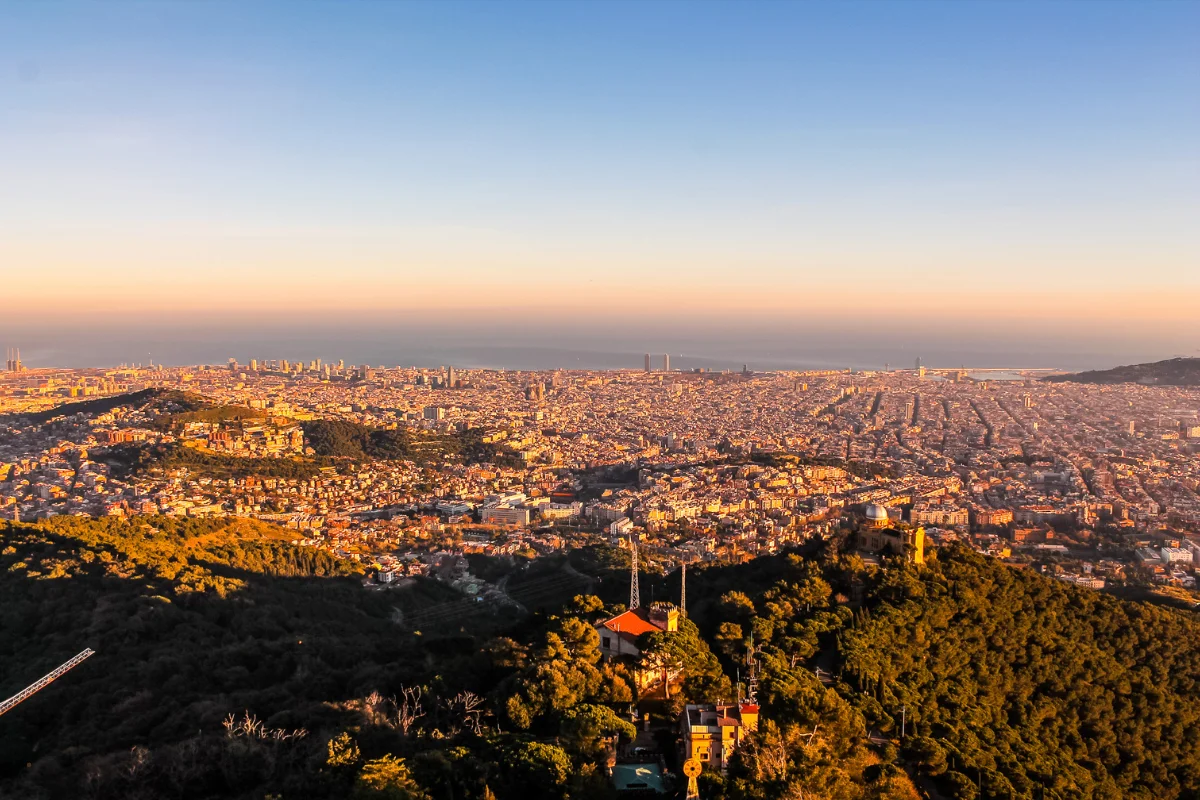

Sarrià was the last municipality in the Barcelona metropolitan area to lose its independence. The annexation happened on November 4, 1921, by royal decree — and it was not well received. Residents had been resisting the process for over two decades while Gràcia, Sants, and Les Corts were absorbed in 1897. That late resistance explains why Sarrià retained something the other absorbed neighborhoods lost long ago: a village-scale street plan, squares that function as actual squares, a neighborhood market with fourth-generation stallholders, and a social logic that doesn’t feel like any other part of Barcelona.
Sarrià residents still say “I’m going down to Barcelona” when they mean the city center. The FGC commuter train from Sarrià station to Plaça de Catalunya takes twelve minutes.
Getting There and Where to Start
The FGC lines S1 and S2 stop at Sarrià station, placed directly in the village core — not on the periphery. It’s faster from the center than Metro L3 (also a Sarrià stop). The practical choice: FGC from Plaça de Catalunya, 12 minutes, walk out the station and you’re on Carrer Major.
Start at Plaça de Sarrià, presided over by the 18th-century parish church of Sant Vicenç, built over medieval foundations. The square functions as the village living room: terrace tables with long-term residents, unhurried pace at all hours. Sitting here for twenty minutes before starting the walk is the fastest way to understand what separates Sarrià from the rest of Barcelona.
From the square, Carrer Major runs south in a straight line along the route of the old path connecting Barcelona to Sarrià. The buildings here are the oldest in the core. Shops that have carried the same name for decades, bakeries with period shopfronts, bars where clients know each other. It’s the walk that explains why Sarrià doesn’t feel like a neighborhood of the Eixample — because it never was.
What is Sarrià and why is it different from other Barcelona neighborhoods? Sarrià was an independent municipality until 1921 and retains a village structure — a Carrer Major, village squares, a traditional market (open since 1911), and a pace distinct from central Barcelona. It’s in the upper city, 12 minutes by FGC from Plaça de Catalunya. Torre Bellesguard (Gaudí, 1900–1909) is here. So is the entrance to Collserola Natural Park. No major queues, no organized tours.
Quick Decision
- 2 hours → Plaça de Sarrià + Carrer Major + Mercat de Sarrià + Foix pastry shop + Bar Tomàs — the complete village core
- Half day → Add Parc de l’Oreneta and the upper viewpoint — immediate nature without leaving the district
- For the least-visited Gaudí → Torre Bellesguard, advance booking required — 15 minutes on foot from the square, no queue
- With young children → Parc de l’Oreneta with the steam miniature train on weekends — the only steam miniature railway in Barcelona
- Best photograph of the area → Carrer Major on a weekday morning, oblique light on the facades — no tourists, no cars
- Combining with Tibidabo → the sequence Sarrià village → Parc de l’Oreneta → Tramvia Blau → Tibidabo funicular is a complete half-day itinerary going uphill
The Market, Foix and Bar Tomàs — The Three Village Staples
Mercat de Sarrià has been open since 1911. Designed by architects Arnau Calvet and Marcel·lí Coquillat with a pyramidal brick facade and 22 stained glass panels that flood the interior with natural light. Some stalls are run by families in their fourth generation. Visiting on a weekday morning before noon is the most direct way to see the Sarrià that doesn’t appear in tourist guides.
Pastelería Foix has been on Carrer Major for over 125 years. The founder was the father of poet J.V. Foix, who grew up between the counter and the oven before becoming one of the central figures of 20th-century Catalan poetry. The marrons glacés and croissants are the most ordered items; the history behind the shopfront makes them more interesting.
Bar Tomàs, also on Carrer Major, has the reputation for the most acclaimed patatas bravas in Barcelona. Fried in olive oil, spicy alioli sauce, irregular cut. No more sophisticated secret than that. No pretension. Weekend queues are the norm. Going on a weekday at lunchtime avoids the wait.
Torre Bellesguard — The Gaudí Almost Nobody Visits
Torre Bellesguard sits on the Collserola hillside at the northern limit of Sarrià. It’s a work by Antoni Gaudí built between 1900 and 1909 on the ruins of the castle of King Martín I the Humane — the last king of the Catalan-Aragonese dynasty — a place that in 1408 served as the royal and papal seat. The name means “beautiful view,” which describes the panoramas that reach 70 kilometers of coastline.
Bellesguard is radically different from the rest of Gaudí’s work: predominantly straight forms, a neo-Gothic language that dialogues with the medieval remains under the building’s foundation. It uses stone from the Collserola hillside itself. The stained glass produces a distinctive interior light. The garden is calm and accessible.
Open Tuesday–Sunday 10:00–15:00. Advance booking required. The visit covers the building and gardens. It’s 15 minutes on foot from Plaça de Sarrià heading up Carrer Bellesguard, or 5 minutes by taxi from the FGC stop. Combined with a morning in the old village core and an afternoon at Parc de l’Oreneta, the circuit is complete without needing to go back to the city center.
For those completing the Gaudí architectural sequence, the Gaudí route in Barcelona places Bellesguard in the chronological context of the complete body of work — it’s one of the least-visited and most conceptually coherent pieces.
Parc de l’Oreneta and the Collserola Access
Parc de l’Oreneta occupies the grounds of two former private estates at the boundary between Sarrià’s urban core and the Collserola range. Forest paths, play areas, zip lines, a viewpoint at the upper level with city views. The most singular feature: a steam miniature train that has been running a 635-meter circuit since 1981, with 11 locomotives and three wagons. Operates on weekends and public holidays.
The park is the most accessible entry point to Collserola Natural Park from Sarrià. From the upper section, trails lead toward Vallvidrera and toward the Carretera de les Aigües — a nearly 10-kilometer nearly flat path running along the Collserola hillside with panoramic city views. The original use was as a water distribution conduit from the mountains — that’s the name’s origin. Today it’s the preferred circuit for cyclists and runners from the upper city.
Why the 1921 annexation still shapes Sarrià
Beyond Carrer Major and Bar Tomàs, the fact that explains the neighbourhood is the annexation of 1921 and what it did to its character.
When Gràcia, Sants, and Les Corts were absorbed in 1897, they lost their independent administrative structures and were immediately subject to Barcelona’s urban development pressure. New buildings, street widening, infrastructure imposed from outside. Sarrià resisted for an additional 24 years — long enough that the village fabric remained largely intact before absorption.
The result is visible today: Sarrià has building-height limits that don’t apply to the Eixample, a street network that follows medieval logic rather than the Cerdà grid, and a resident association culture that successfully resists large-scale development in the historic core. The village character is not a heritage performance — it’s the consequence of political resistance that lasted longer than anywhere else in the metropolitan area.
Tibidabo From Sarrià — The Natural Extension
Sarrià is the most comfortable starting point for the Tibidabo–Collserola axis. The Tramvia Blau (Blue Tram) has been operating since 1901, departing from Plaça Kennedy — fifteen minutes on foot from Plaça de Sarrià — to the base of the funicular that climbs to the summit. From the top: 360-degree coastal views, the Temple Expiatori del Sagrat Cor, and the Museu d’Autòmates with one of the best-preserved automata collections in Europe.
If the plan includes Tibidabo, the most efficient sequence is: morning in the Sarrià village core (market, Foix, Carrer Major), stop at Parc de l’Oreneta, afternoon at Tibidabo. The Tibidabo Barcelona guide covers access details, prices, and amusement park hours.
The Sarrià resident who says “I’m going down to Barcelona” is not being ironic or nostalgic. They’re accurately describing the perception of someone who inhabits a space with its own pace, its own scale, and its own character built over a thousand years. The 1921 annexation changed the map. What it couldn’t change is what makes Sarrià still recognizable as a village a century later.
For the context of other Barcelona neighborhoods with distinct identities: the best neighborhoods to visit in Barcelona positions Sarrià relative to Gràcia, El Born, and Poblenou. For the Gràcia neighborhood that shares a similar village-origin story but experienced absorption 24 years earlier, the comparison is instructive. And for the broader Barcelona outdoor picture, hiking near Barcelona covers Collserola routes accessible from the Sarrià access points.