
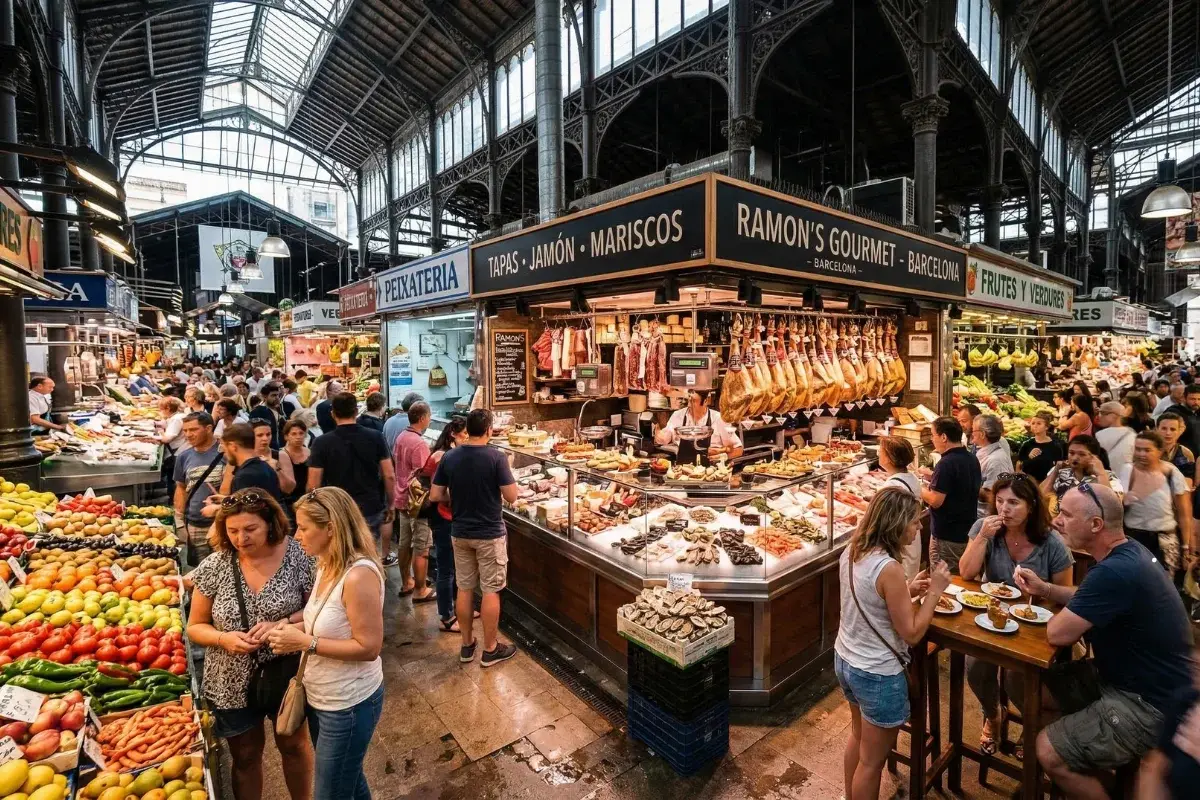

This guide is based on real visits to Barcelona’s main food markets — including checking prices, talking to vendors, and eating at the bars inside. The goal is simple: tell you which market is worth your time, when to go, and what to order when you get there.
Barcelona has over 40 municipal food markets. Some receive millions of tourists a year. Others are where residents buy Tuesday’s fish. The best ones manage both. The gap between them — in price, atmosphere, and what you’ll actually find — is wider than most travel guides suggest.
The single most useful thing to know before visiting any Barcelona food market: La Boquería before 10am and La Boquería after 11am are functionally different experiences. The same applies to nearly every market on this list. Timing is the variable that determines whether you get a market or a tourist attraction.
Quick Answer: Best Food Markets in Barcelona Most famous (go early): La Boquería, Las Ramblas (300+ stalls, Bar Pinotxo from 6:30am). Best local atmosphere: El Ninot, Eixample (surgeons eat here, no tourist markup). Best architecture: Santa Caterina, Born (Miralles ceramic roof, free medieval archaeology below). Best neighbourhood market: Mercat de la Llibertat, Gràcia (direct from the fishing dock). Best upscale: Mercat de Galvany, Sarrià (game, imported cheese, zero tourists). Best flowers 24 hours: Mercat de la Concepció, Eixample.
Quick Picks
- Best breakfast in a market → Bar Pinotxo, La Boquería (from 6:30am, closes when food runs out)
- Best market for price vs quality → El Ninot (salmon at €17/kg vs €23/kg at Sant Antoni)
- Best architecture → Santa Caterina (325,000 ceramic tiles, free archaeology underneath)
- Best for locals, zero tourists → Mercat de Galvany (Sarrià) or El Ninot (Eixample)
- Best modern food hall → Time Out Market (Maremagnum, Port Vell, chef-driven, open late)
- Best Sunday market food → Palo Market Fest (Poblenou, first weekend monthly, food trucks + music)
Quick Decision: Which Food Market Is Right for You?
- Want the iconic Barcelona market experience → La Boquería, but before 10:00 — Bar Pinotxo or El Quim for breakfast
- Want the market where residents actually shop → El Ninot (Eixample) — no tourist markup, real produce prices
- Want architecture + food + free archaeology → Santa Caterina (Born) — all three in one visit
- Want the best upscale neighbourhood market → Mercat de Galvany (Sarrià) — game, charcuterie, imported cheese
- Want a modern food hall, not a traditional market → Time Out Market (Maremagnum) — chef-driven, open late
- Want a market in Gràcia → Mercat de la Llibertat — fish direct from the dock, authentic neighbourhood feel
- Want flowers at 3am → Mercat de la Concepció, Eixample (the only 24-hour florist in the city)
Who Is This For?
- First-time visitors → La Boquería (before 10am) + Santa Caterina as a combined morning — both in the old city, 15 minutes apart on foot
- Food-focused travellers → El Ninot for honest pricing and quality; Bar Pinotxo at La Boquería for breakfast; Santa Caterina for a sit-down lunch at Cuines
- Architecture interested → Santa Caterina (Enric Miralles + Benedetta Tagliabue); Sant Antoni (1882, recently renovated for €80M with medieval wall discovery)
- Local experience seekers → El Ninot, Mercat de Galvany, or Mercat de la Llibertat — none of these appear in standard tourist itineraries
- Budget travellers → El Ninot has the best price-to-quality ratio of any central market
La Boquería — The Most Visited Market in the World (and When It’s Still Worth It)
Mercat de Sant Josep de la Boqueria receives 10.3 million visitors per year. It is the most photographed market in Barcelona and one of the most visited in the world. That volume has direct consequences on what you’ll find depending on where you stand.
The honest picture: the stalls near the Las Ramblas entrance are oriented almost exclusively toward tourists — pre-cut fruit cups, colourful smoothies, prices above market rate. They’re not dishonest, but they’re not the reason to visit.
The interior is different. The market’s traditional produce section — meat, fish, vegetables — maintains real market function, partly because the Barcelona city council approved a regulation limiting ready-to-eat and pre-packaged food to 50% of each stall’s offering. That rule took time to enforce but has stabilised the market’s composition.
The real reason to go: the bars.
Bar Pinotxo — on the right immediately inside the main entrance — has been the reference breakfast bar for market workers and chefs for decades. Opens at 6:30. Serves esmorzars de forquilla (fork breakfasts): chickpeas with black pudding, tripe, cap i pota, fried eggs with cuttlefish. Closes when the food runs out, not at a fixed hour. Arrive by 9:00.
El Quim de la Boqueria works with the day’s market produce in more contemporary preparations: eggs with foie, mushroom scramble, anchovies from La Escala. The most-photographed dish is the fried eggs with baby squid.
When to go: 8:00–10:30. Before 11:00, the market functions as a market — fresh produce, local clients, real prices. After midday it’s a tourist attraction.
For what to eat beyond the market, the best tapas in Barcelona guide covers the bars near La Boquería that operate on the same daily-produce logic.
Sant Antoni — The Most Transformed Market in the City
Mercat de Sant Antoni opened in 1882 — a cast iron and glass building at the edge of the Eixample and the Sant Antoni neighbourhood. The comprehensive renovation took over ten years and cost €80 million. The result goes beyond aesthetics: Sant Antoni is the only market in Spain aligned with the European Commission’s 2030 energy plan, with integrated geothermal systems. It received Mitsubishi Electric’s Three Diamonds award for energy efficiency.
The X-shaped floor plan allows three simultaneous uses: fresh food market, Encants section with second-hand clothing and accessories, and the Sunday collectibles market that occupies the exterior canopy area each Sunday morning.
The gastronomy: Sant Antoni has high product quality — and high prices to match. Salmon at €23/kg compared to €17/kg at El Ninot. Designer fruit stalls at prices that can be double La Boquería’s equivalent. What you’re buying here is selected product, careful presentation, and a neighbourhood atmosphere that many Barcelonese prefer to the Las Ramblas chaos.
Important for visitors: the food market is closed on Sundays. The Sunday market is books, comics, vinyl, and collectibles at the exterior perimeter — a completely different visit. The best markets in Barcelona guide covers the Sunday market in detail.
When to go: weekday mornings for produce. Sundays only if you want the collectibles market (8:30–14:30, exterior only).
Santa Caterina — Architecture, Archaeology, and the Most Photogenic Roof
Mercat de Santa Caterina in El Born is the oldest covered market in Barcelona, built in 1845 on the site of a demolished medieval convent. Completely renovated in 2005 by architect Enric Miralles — who died before seeing it completed. Benedetta Tagliabue finished the project.
The roof: 325,000 ceramic hexagonal tiles in 67 distinct tones representing an aerial view of a market fruit table, using the trencadís technique associated with Gaudí. One of the most photographed architectural elements in Barcelona after the Gaudí buildings.
What sits under the stalls: the foundations of the original 13th-century Dominican convent and earlier medieval occupation remains, preserved and free to visit through the MUHBA (Museu d’Història de Barcelona). Visitors walk over medieval stratigraphy while buying bread. The archaeology space is open during market hours at no extra cost.
Gastronomy: Cuines Santa Caterina inside the market has open kitchen, communal tables, and a menu combining Mediterranean and Asian influences using the day’s produce. More relaxed than La Boquería, more neighbourhood-oriented, better for a sit-down meal without rushing.
When to go: any weekday morning. Located in El Born — natural to combine with the Picasso Museum or the Palau de la Música. The best streets in Barcelona walking guide maps the Born neighbourhood around Santa Caterina.
El Ninot — Where Barcelonese Actually Eat
Mercat del Ninot is in the Eixample Esquerra on Carrer de Mallorca, a few minutes from Hospital Clínic. Recently renovated with 48 fresh food stalls, 33 other product stalls, and around 12 bars and restaurants. It consistently appears on lists of favourite markets among Barcelonese who live in the centre and want quality without tourist markup.
The price comparison: salmon at €17/kg (vs €23/kg at Sant Antoni), quality langostinos below boutique market prices, a charcuterie and cheese selection that competes with any specialist shop in the Eixample.
La Taverna del Ninot inside the market is where Hospital Clínic surgeons eat lunch: daily market menu, produce from the stalls, reasonable prices. The kind of restaurant that exists because it has a captive clientele of people who know what quality looks like.
Completely outside the mass tourist circuit — which for many visitors is exactly the reason to go.
When to go: Monday–Friday 8:00–21:00, Saturday mornings. Quietest and most interesting on weekday lunchtimes.
Mercat de la Concepció — Flowers at Any Hour
Also by Rovira i Trias, 1888. Known locally as “the flower market” for the florists on the perimeter operating 24 hours a day, 365 days a year. It is the only point in Barcelona where flowers can be purchased at any hour of the night — a practical detail that matters for late-night events, hotel arrivals, and impulse decisions at 3am.
Fresh produce market inside, floral market on the exterior perimeter around the clock. Located in the Eixample Dreta, two blocks from Passeig de Gràcia. The most useful market in the city for a very specific need that no other market addresses.
Metro L4 Girona. The best flower shops in Barcelona guide covers the specialist florists in the same area for daytime purchases.
Mercat de la Llibertat and Galvany — The Neighbourhood References
Mercat de la Llibertat is the reference market in Gràcia — designed by Francesc Berenguer (direct Gaudí collaborator) in 1888, Modernista iron and brick, renovated in 2009 with original decorative elements preserved. Fish arrives direct from the llotja (fishing dock). Bar Joan Noi inside the market is known for fish and shellfish cooked to order. Real neighbourhood pricing, genuine local atmosphere, no tourist pressure.
Mercat de Galvany in the upper Eixample is considered the most selective market in the city: exposed brick architecture, gourmet stalls, game counter, hand-carved jamón, imported cheeses. High-purchasing-power neighbourhood clientele. The market that answers where do people in Diagonal-area Barcelona actually shop — and the answer that doesn’t appear in tourist guides.
Modern Food Halls and Event Markets
Time Out Market Barcelona occupies the second floor of Maremagnum in Port Vell, with direct sea views. 5,250 m², 14–15 kitchens from award-winning and emerging chefs, several bars, a delicatessen shop. No raw produce — 100% prepared food. The proposition is eating well in a modern environment with significant style variety in one space. Open daily, restaurant service extending into the evening.
Palo Market Fest in Poblenou runs the first weekend of each month in a renovated factory. Food trucks with author-driven cooking, independent designers, live music. Young and local audience, fewer tourists than any fixed central market. Format is closer to festival than market — worth planning around if the date aligns. The best flea markets in Barcelona guide covers the full Palo Market schedule.
Is It Worth It?
La Boquería before 10am: Yes — Bar Pinotxo alone justifies the visit. After 11am, it depends on your tolerance for tourist density.
Santa Caterina: Yes, unconditionally. The Miralles roof, the free archaeology, and Cuines Santa Caterina make it the most layered market visit in the city. Rarely crowded to the point of discomfort.
El Ninot: Yes — the best price-to-quality ratio of any central market and the most honest answer to where do people in Barcelona actually eat at market prices.
Sant Antoni: Yes, but know what day you’re going. Food market on weekdays. Collectibles on Sundays. Arriving on Sunday expecting fresh produce means finding none.
Time Out Market: Depends. It’s a food hall, not a market — good for variety and modern cooking, not for produce shopping or the traditional market experience.
Market Comparison
| Market | Neighbourhood | Best for | Tourist level | Best time |
|---|---|---|---|---|
| La Boquería | Las Ramblas | Breakfast bars | Very high | 8:00–10:30 |
| Sant Antoni | Sant Antoni | Premium produce (weekdays) | Medium | Weekday mornings |
| Santa Caterina | Born | Architecture + archaeology + lunch | Medium-low | Any weekday morning |
| El Ninot | Eixample Esquerra | Honest prices, quality fish | Very low | Weekday lunch |
| La Concepció | Eixample Dreta | Flowers 24h | Low | Any hour |
| La Llibertat | Gràcia | Fresh fish, neighbourhood feel | Very low | Weekday morning |
| Galvany | Upper Eixample | Upscale produce, no tourists | Very low | Weekday morning |
| Time Out Market | Port Vell | Modern food hall, chef cooking | High | Midday–evening |
Note on Mondays: fish at any market on Monday is not at its freshest — boats don’t go out on Sundays. For the best seafood selection, go Tuesday through Friday.
Three unwritten rules of a Barcelona market
Don’t touch the produce. A strict cultural norm across all Barcelona markets. Point to what you want and the vendor handles it. This applies equally to locals and visitors — it’s not a tourist rule.
Cash is still king in the informal stalls. Fixed markets accept cards reliably. In Els Encants, at the Sant Antoni Sunday market, and at Palo Market, cash facilitates negotiation and some smaller stalls accept nothing else.
The entrance prices are not the real prices. At La Boquería especially: stalls near the Las Ramblas entrance charge tourist-area prices. Five metres further in, the same product can cost 30–50% less. Walk the full market before buying anything.
Mistakes to Avoid
- Going to La Boquería after 11:00 expecting an authentic market. After that hour, tour group density makes movement difficult and prices reflect the tourist traffic. The 8:00–10:30 window is the only time it operates as a real market.
- Going to Sant Antoni on Sunday expecting fresh produce. The food stalls are closed on Sundays. What’s open is the exterior collectibles and books market. These are two completely different visits in the same building.
- Skipping the free archaeology at Santa Caterina. The MUHBA space under the market stalls is open during market hours at zero cost. Most visitors don’t know it exists. It takes 10 minutes and is one of the most unusual market inclusions in Europe.
- Comparing La Boquería and El Ninot prices without adjusting for location. El Ninot’s lower prices reflect lower real estate costs in the Eixample Esquerra, not lower quality. The fish sourcing is equivalent; the markup for proximity to Las Ramblas is not.
- Buying at the front of La Boquería. The stalls facing the Las Ramblas entrance are uniformly higher-priced than identical product ten metres inside. A full walk-through before purchasing takes three minutes and saves money.
Best Strategy by Time Available
Got 2 hours: La Boquería at 8:30 (Bar Pinotxo breakfast, chickpeas or eggs with squid) → walk 15 minutes to Santa Caterina (roof + free archaeology + produce browse). Two markets, completely different experiences, one old-city morning.
Half-day: Santa Caterina (morning, produce + Cuines for lunch) → El Ninot (afternoon browse, see price difference vs Sant Antoni). Old city to Eixample by metro in 10 minutes.
Full experience: Monday/Wednesday/Friday: Els Encants auction at 8:00 (live auction, free) → La Boquería at 9:30 (Bar Pinotxo) → Santa Caterina at 11:00 → Cuines Santa Caterina for lunch. Full day across three distinct market formats.
1-Day Food Market Plan:
- 8:30: La Boquería — Bar Pinotxo (chickpeas with black pudding, or fried eggs with baby squid). Arrive early, no queue.
- 10:00: Walk to Santa Caterina — roof, free archaeology, produce browse (15 min walk through El Born)
- 12:00: Cuines Santa Caterina — lunch with market produce, Mediterranean-Asian menu, no rush
- 14:30: Metro to El Ninot — browse the Eixample’s best local market, compare prices with what you saw at La Boquería
- 16:00: Coffee nearby — specialty coffee Barcelona has options in the Eixample Esquerra
Frequently Asked Questions
What time does La Boquería open in Barcelona?
La Boquería opens Monday to Saturday at 8:00 and closes at 20:30. Closed Sundays. Bar Pinotxo opens from 6:30 and closes when the food runs out — usually before midday. The best window for an authentic market experience is 8:00–10:30.
Which is the least touristy food market in Barcelona?
Mercat del Ninot (Eixample Esquerra) and Mercat de Galvany (upper Eixample) have almost exclusively local clientele among central markets. Mercat de la Llibertat in Gràcia also has a fully neighbourhood atmosphere.
Does Sant Antoni market open on Sundays?
The interior food market is closed on Sundays. What opens on Sundays is the exterior collectibles market — books, comics, vinyl, trading cards — that surrounds the building perimeter from approximately 9:00 to 14:30.
Where is the Time Out Market in Barcelona?
Second floor of Maremagnum shopping centre at Moll d’Espanya, Port Vell. Metro: Drassanes (L3) or Barceloneta (L4). Open daily with restaurant service running into the evening.
Can you eat inside Mercat de Santa Caterina?
Yes. Cuines Santa Caterina inside the market has an open kitchen, communal tables, and a menu combining Mediterranean and Asian cuisine using the day’s market produce. More relaxed than La Boquería for a seated meal, with better atmosphere for eating without rushing.
What is the cheapest food market in Barcelona?
El Ninot in the Eixample Esquerra consistently has the best price-to-quality ratio among central markets. Salmon at €17/kg, quality shellfish below boutique market prices. No tourist markup because almost no tourists go there.
Final Insight
The gap between Barcelona’s tourist-facing markets and its neighbourhood markets is larger than in almost any other major European city — partly because La Boquería’s fame is so concentrated. El Ninot and La Llibertat deliver equivalent or better produce at significantly lower prices, in spaces that feel like what La Boquería felt like forty years ago. Both are central, both are accessible, and both require nothing more than knowing they exist.
Buying loose food here works the other way round from the English sense of bulk: a granel means exactly the amount you need, which is why the zero-waste and bulk shops guide starts by sorting the two.
Continue the Food Route
Markets are where Barcelona’s restaurant kitchens start each morning. The best restaurants in Barcelona guide covers the chefs who shop at these markets daily — useful context for planning a food-focused day that moves from market to restaurant.
For the broader picture of eating in the city, the Barcelona travel budget guide compares market eating costs against restaurant dining at different levels — including the market bars, which are consistently the best-value eating option in the city.
And if you’re combining market visits with neighbourhood exploration, the best Barcelona walking streets guide maps the route connecting La Boquería, Santa Caterina, and Sant Antoni in a single old-city morning.