
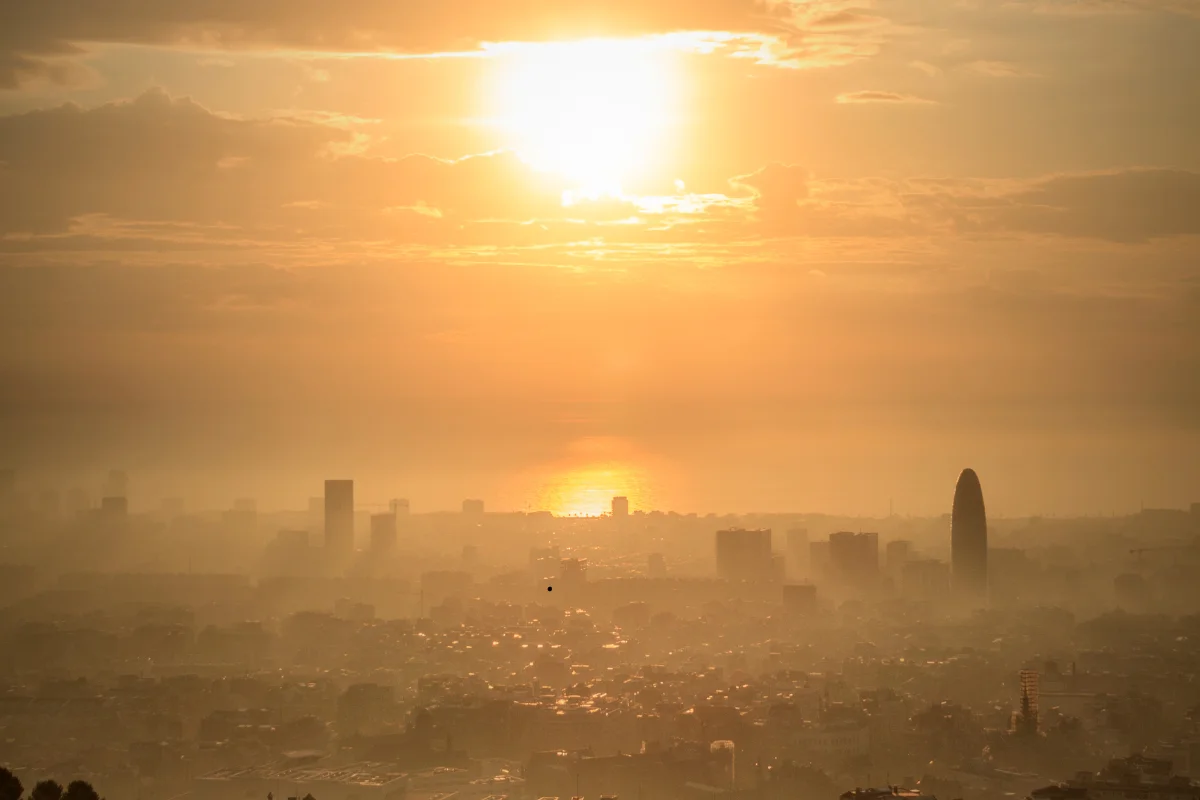

Barcelona faces east. The city runs along the Mediterranean coast with the Collserola ridge behind it, which means that from almost any elevated point, the sun rises directly over the sea. That geographic fact makes sunrises here remarkably consistent — but it doesn’t solve the access problem. The best viewpoints have opening times, ticket requirements, or logistical barriers that most sunrise guides completely ignore.
This is a timing guide, not just a location list. The difference between a great sunrise and arriving to find a locked gate depends on knowing exactly when each spot is actually open.
The Búnkers del Carmel: the access gap nobody mentions
The Turó de la Rovira — the hilltop site universally known as “the Búnkers” — is the most-photographed sunrise spot in Barcelona. The anti-aircraft bunker ruins give it a raw, textural quality that no other viewpoint has. The 360° panorama is real: you can see the Sagrada Família, the Collserola ridge, the full coastline, and the port simultaneously.
The problem: the fenced archaeological site opens at 9:00. In summer, sunrise is around 6:30. You’d be waiting two and a half hours outside the gate.
What time does the Búnkers del Carmel open? The fenced archaeological zone opens at 9:00 year-round (closing at 19:30 May–October, 17:30 November–April). For summer sunrises, this means the official site is inaccessible. The adjacent hillsides of Parc del Carmel are open 24 hours with nearly identical views and no access restrictions.
The actual solution: The open parkland surrounding the fenced site stays accessible around the clock. You won’t be inside the concrete bunker structures, but the elevation and sightlines are essentially the same. Getting there before 6:00 on weekdays avoids both the gate problem and the crowds. On summer weekends, the area around the bunkers draws people coming from nightclubs until 5:00–6:00 AM — if you want quiet, Tuesday or Wednesday is the move.
Getting there without daytime transport: Metro L4 to Joanic or L5 to El Carmel, then 20 minutes on foot uphill. Bus 86, 92 or V17 in daytime. Before 5:30 AM, the NitBus N15 runs through the area, or taxi.
Quick Decision — Pick Your Sunrise Spot
- Want the widest city panorama → Búnkers del Carmel adjacent hillsides — open 24h, 360° views, arrive before 9:00 to beat the gate; midweek is far quieter than weekends
- Want sea-facing sunrise with zero effort → Barceloneta or Mar Bella beach — flat, open 24h, sun rises directly over the Mediterranean horizon, NitBus N8 or N28 runs through the night
- Want a completely unknown Montjuïc spot → Mirador del Migdia — open 24h, south-facing, overlooks the port and Hotel W silhouette, no crowds at any hour
- Want the highest point in the city → Tibidabo terrace (512m) — exterior accessible without hours, but public transport doesn’t run early enough; taxi or private car required before 7:00
- Want Gaudí in the frame → Park Güell free upper zone (Mirador de Joan Sales) — no ticket required, no set hours; in winter the sun rises directly behind the Sagrada Família towers
- Want an urban maritime sunrise → Port Vell — masts and rigging against an orange sky, open 24h, flat walk from the Gothic Quarter, best on overcast mornings when light bands form low on the horizon
Mirador del Migdia: the best sunrise spot nobody talks about
The Mirador del Migdia sits on Montjuïc’s south face, pointing directly at the sea. It’s open around the clock. The sun rises over the port, and the Hotel W building — Ricardo Bofill’s sail-shaped tower — cuts a clean silhouette against the pre-dawn sky as cruise ships come in.
What makes Migdia different from every other Montjuïc viewpoint: the surrounding pine forest absorbs most of the city noise, and there are merenderos (outdoor bar-restaurants) nearby that open early enough for a post-sunrise coffee. It doesn’t appear in most tourist circuits, which is precisely why it works.
The Montjuïc cable car doesn’t start running until 10:00 or 10:15 in high season — far too late for sunrise. Pre-dawn access: take the NitBus N0 to Plaça Espanya, then walk up the Montjuïc road, or drive. The Funicular from Paral·lel metro opens around 7:15.
Barceloneta and Mar Bella: the easiest option
No hill climbing. No timing calculations. The sun rises directly over the Mediterranean from every point on Barcelona’s beach strip, and the entire coastline is open 24 hours.
Barceloneta is the most central and the most active at night — on summer weekends, the area draws clubbers until 6:00 or 7:00 AM, which can disrupt the atmosphere if you’re looking for calm. Mar Bella (further northeast, near Poblenou) is quieter at all hours. The jetty at Mar Bella allows compositions without port infrastructure in the foreground.
Nova Icária is the best compromise: more sheltered than Barceloneta, less far than Mar Bella, and usually empty before 7:00 AM.
Park Güell’s free zone: the winter sunrise secret
Park Güell has two distinct sections. The paid monumental zone (ticket required, opens 9:30 for tourists) gets all the attention. But the free upper park — including the Mirador de Joan Sales and surrounding terraces — has no posted opening hours and can be accessed at any time.
From the free zone in winter (roughly November through February), the sun rises directly behind the Sagrada Família towers. The geometry only works during those months — the lower winter sun trajectory creates an alignment that disappears in spring. It’s one of the most visually specific things Barcelona offers at dawn.
Residents of the surrounding neighborhoods (El Carmel, La Salut) have a Passi Verd that allows entry to the monumental zone at any hour, but for visitors, the free upper area covers the best sightlines without any ticket.
What is actually accessible before 07:00
A sunrise viewpoint is only useful if you can reach it in the dark. What matters is which of these are accessible before 07:00.
The real practical gap: the NitBus does not accept Hola Barcelona cards or T-Casual cards (the standard tourist transport passes). It requires a separate ticket (€2.55 single, purchased on the bus). Tourists planning to use their pass at 5:30 AM to reach the Búnkers will find it doesn’t work.
The second gap: temperature differential. At the Búnkers (265m), Tibidabo (512m) and on exposed Montjuïc terraces, the temperature in summer is 4–6°C lower than at street level in the city, with consistent wind. June mornings at the Búnkers feel like October in terms of layering requirements.
The third gap: “blue hour” is not sunrise. The 20–30 minutes before the sun clears the horizon — when the sky goes from dark blue to violet to gold — is photographically more interesting than the moment of sunrise itself. Being positioned and ready 25 minutes before the listed sunrise time is what makes the difference.
Tibidabo at 512m: the cloud layer option
The Tibidabo terrace in front of the church’s exterior is accessible without tickets or operating hours. At 512 meters, it’s the highest public point in the city.
The specific phenomenon that makes it worth the logistics: in winter months, Barcelona’s urban valley frequently fills with low fog while Tibidabo sits above it. The “sea of clouds” effect — city invisible below, sun hitting the cloud layer from above — is something none of the lower viewpoints can offer.
The logistics problem: The first FGC train (L7 to Avinguda del Tibidabo) runs around 5:00 AM, but the Tramvia Blau and the Funicular de Cuca de Llum don’t start until approximately 7:15. For summer sunrises, this means taxi or private vehicle is the only practical option.
Mistakes to Avoid
- Showing up at the Búnkers gate at 6:30 in summer — you’ll wait two hours outside. Use the adjacent open parkland or pick a different spot entirely
- Buying a transport day pass and expecting it to work on the NitBus — it doesn’t. The NitBus requires a separate single ticket
- Bringing only a wide-angle lens — a telephoto is needed to compress the Sagrada Família against the sunrise sky from the Búnkers or Park Güell. Wide angle captures the city spread, not the architectural detail
- Going on a summer weekend — the Búnkers area has a dual-use problem on Friday and Saturday nights: sunrise-chasers and club-goers arriving from opposite ends of the night create a crowded, noisy atmosphere. Weekday mornings are categorically different
- Underestimating the climb time — from El Carmel metro to the Búnkers is 20 minutes at a normal pace; in the dark on an unfamiliar path, add 10 minutes and bring a phone flashlight
- Skipping weather research — Barcelona’s best sunrises happen with partial cloud cover, not perfectly clear skies. A completely cloudless morning produces a clean but flat sunrise; scattered clouds create the color bands. Checking a forecast the night before is worth it
Practical Timing by Sunrise Time
| Season | Sunrise | Best Arrival | Transport Option |
|---|---|---|---|
| June–August | ~6:20–6:45 | 5:45 AM | NitBus (ticket €2.55) |
| March–May / Sept–Oct | ~6:45–7:30 | 6:15 AM | NitBus or first Metro (opens 5:00) |
| November–February | ~8:00–8:20 | 7:30 AM | Metro L4/L5, Bus 86 or 92 |
In winter, the Búnkers site is actually open before sunrise — making it the only season when the fenced zone and the timing work together.
FAQ
Can you visit the Búnkers at night?
The fenced archaeological site closes at 17:30–19:30 depending on season. The surrounding parkland (Parc del Carmel) remains open throughout the night. In practice, most people who go for sunrise access the hilltop via the open park rather than the gated site.
Is there a fee to watch sunrise from any of these spots?
No. All sunrise viewpoints mentioned here are free. Park Güell’s free upper zone has no ticket or entry fee. The beaches are public. The Mirador del Migdia and the Búnkers’ adjacent parkland are open public spaces. The only costs are transport (NitBus €2.55, Metro with T-Casual or single ticket) and optional food or coffee afterwards.
What’s the best spot if you only have one chance?
For summer visits, the Mirador del Migdia offers the best combination of sea views, 24-hour access, and no crowds — without the uncertainty of the Búnkers gate timing. For winter visits, the Búnkers’ free adjacent hillside with the city-plus-sea panorama is unmatched, and the site is properly open before sunrise.
Does cloud cover ruin Barcelona sunrises?
Not necessarily. Partial cloud cover — particularly low cloud banks over the sea — creates the most dramatic light conditions: color bands at the horizon, golden-orange reflections on building facades. Completely overcast mornings do flatten the light, but light fog can create atmospheric depth, especially from elevated spots looking down at the city.
How long does the good light last after sunrise?
The “golden hour” after sunrise lasts roughly 45–60 minutes before the light becomes flat and harsh. The 20 minutes before sunrise (blue hour) through the first 30 minutes after are the most photogenic window. Planning to stay 90 minutes total at the chosen spot covers the full quality light range.
The right spot depends entirely on timing and what you want in the frame. For sea-focused composition with zero logistical complexity, the beaches win. For urban panorama with historical texture, the Búnkers’ surrounding parkland is the answer — arrive before the gate opens and you’ll have the hilltop to yourself. For something that almost no visitor sees, the Mirador del Migdia at first light is Barcelona without the crowd, facing the Mediterranean, with nothing between you and the horizon.
For more secret viewpoints across the city at different times of day, and for planning the full Barcelona first-time visit around the best light conditions, both resources cover what the standard tourist circuit doesn’t.