
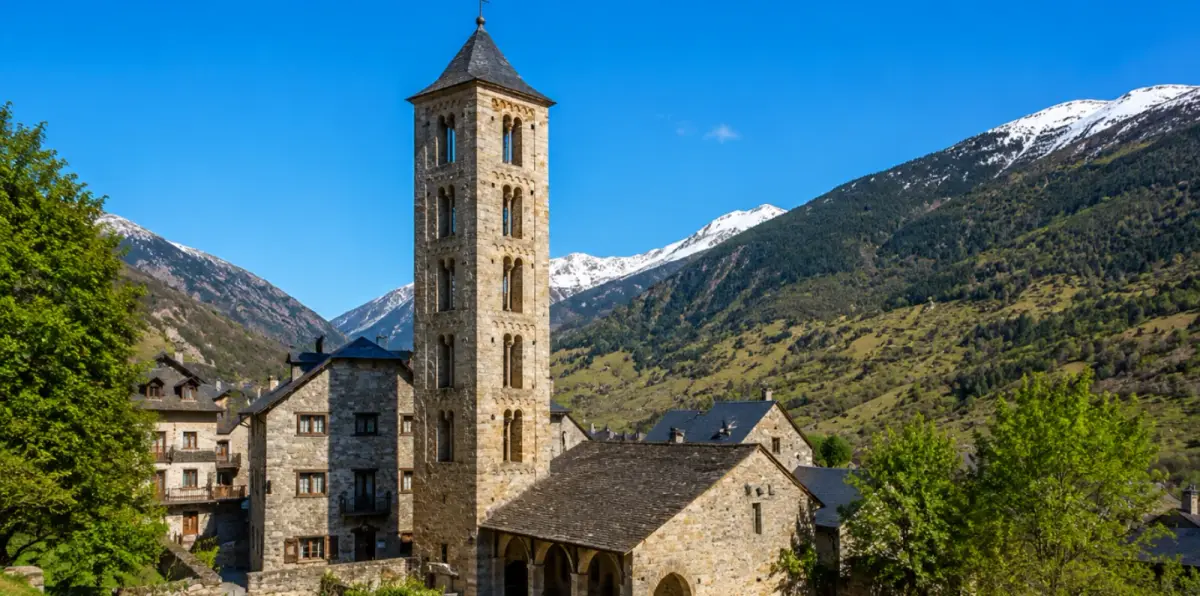

Arrive in the Vall de Boí expecting a quiet mountain valley and you find, tower after tower, 9 of the densest-packed Romanesque churches in Europe. Spread across eight small stone villages, they share a single UNESCO World Heritage listing, and beyond the last of them the road climbs into Catalonia’s only national park. You rarely have to choose here between art and mountains. Here’s how to see both without rushing.
The essentials in 30 seconds
- ✅ 9 Romanesque churches (8 churches and 1 hermitage), UNESCO World Heritage
- ✅ The star: Sant Climent de Taüll (six-storey tower and video mapping)
- ✅ Gateway to Aigüestortes, Catalonia’s only national park
- ✅ Easy base at Barruera; spa at Caldes de Boí; skiing at Boí Taüll
- 🎟️ Combined church ticket; book ahead in high season
- 🚗 About 3 h 30 to 4 h from Barcelona; 1-2 days for the Romanesque
What is there to see in the Vall de Boí? Its treasure is the set of 9 Lombard Romanesque churches (eight churches and one hermitage) listed as UNESCO World Heritage, spread among stone villages like Taüll, Boí, Erill la Vall and Durro. The one not to miss is Sant Climent de Taüll. The valley is also the gateway to the Aigüestortes national park, with high-mountain lakes, and has a spa at Caldes de Boí and skiing at Boí Taüll. It’s about 3 h 30 from Barcelona.
The nine Romanesque churches
They are why the valley is known worldwide. Nine Lombard churches built between the 11th and 12th centuries form a single UNESCO World Heritage site, and according to experts it is the largest concentration of the style in Europe, with slender tower bell towers that once doubled as lookouts. The star is Sant Climent de Taüll, with its six-storey tower and the video mapping that recreates the Pantocrator (the original is in the MNAC in Barcelona); its full guide is in what to see in Taüll.
Beyond Taüll, the highlights are Sant Joan de Boí, with its fantastical bestiary paintings; Santa Eulàlia de Erill la Vall, with the Descent from the Cross sculptures; and Sant Feliu de Barruera. Everything is run from the Centre del Romànic in Erill la Vall, and visited with a combined ticket. Experts recommend booking it online in high season; if you go inside only one, make it Sant Climent.
Aigüestortes, the national park
The other half of the valley is pure nature. The Vall de Boí is one of the gateways to the Aigüestortes i Estany de Sant Maurici national park, Catalonia’s only one, famous for its 200-plus glacial lakes, wooden boardwalks and peaks above 3,000 metres. To protect the setting, car access is regulated: from Boí, a shared 4x4 taxi service climbs to the Aigüestortes area for around 10 euros return.
The walking alternative is the Ruta de la Nutria, about 7 kilometres, a gradual, easy climb ideal for families up to the Aigüestortes plain. There are options for every level, from flat strolls beside the lakes to high-mountain treks like the Carros de Foc, for experts only and lasting several days.
The valley’s villages, from Taüll to Durro
The charm isn’t only in the churches but in the eight stone villages around them. Taüll (about 1,500 m) is the most famous and touristy. Boí is the starting point for Aigüestortes. Erill la Vall hosts the Centre del Romànic and one of the finest towers. Barruera, with more services, is the best base to sleep. And Durro, considered one of the prettiest villages in Spain, has in the Sant Quirc hermitage a natural viewpoint over the whole valley.
To these add tiny, often overlooked hamlets like Cardet, Cóll and Llesp, with their own Romanesque parish churches. Driving between them takes little time, as they sit close together, which makes it easy to link several churches and viewpoints in a single day.
Skiing, spa and other plans
The valley works all year. In winter, the Boí Taüll resort is the highest in Catalonia, at close to 2,000 metres, heights that tend to guarantee good snow for skiing and snowshoeing. And in any season, the Caldes de Boí spa, with dozens of thermal springs at different temperatures, is the perfect reward after a mountain day.
If you travel in summer, catching the Falles del Pirineu (the night-time torch descents, listed as UNESCO Intangible Heritage) adds a one-off plan. Between churches, lakes, snow and hot springs, the Vall de Boí is one of those places that change completely with the season.
Half a day, one day and two days
The valley bends to the time you have. In half a day you can do a quick Romanesque loop: Taüll (Sant Climent and Santa Maria), Boí and Erill la Vall, three of the finest churches, with the Centre del Romànic in between. In one full day, add the entrance to the Aigüestortes national park with an easy walk like the Ruta de la Nutria, about 7 kilometres. And in two days you cover it all without rushing: the 9 churches, a mountain day in the park and an afternoon at the Caldes de Boí spa.
Experts recommend at least two days if you want to combine heritage and nature at ease, as the villages are close together but the church visits and mountain routes add up to more time than they seem. For more ideas, the hiking near Barcelona guide has routes for every level.
The Vall de Boí with kids and when it snows
It’s an easy valley for families. The Sant Climent video mapping grabs children’s attention, the 4x4 taxi access to Aigüestortes avoids the long walks, and flat lakeside strolls like the Nutria route suit any age. The Caldes de Boí spa rounds off the day with a relaxing soak.
On snow, the Boí Taüll resort, inside the valley, is the highest in Catalonia, at close to 2,000 metres, heights that tend to give it good snow. It usually opens from December to April depending on the year. So the Vall de Boí works all year: Romanesque and hiking in the warmer months, skiing in winter.
Parking, where to eat and where to sleep
The practical bit: to enter Aigüestortes, you leave the car in the Boí car park and take the shared 4x4 taxi, around 10 euros return; in the villages you park at the entrance of each one, all pedestrian or narrow-laned. From there the visits are on foot.
For food, the valley’s restaurants serve mountain fare, with stews, meats and local cured products; book ahead on long weekends and in ski season. To sleep, Barruera is the most practical base for services and central position, though Taüll and Boí also have characterful accommodation, ideal for enjoying the villages once the day walkers leave.
Getting there and how many days
From Barcelona it’s about 3 h 30 to 4 h by car via the A-2 to Lleida and then mountain roads, so the Vall de Boí calls for a weekend at least. There’s no direct train; the car-free option is the high-speed train to Lleida and then a taxi or rental. This is the quick reference.
| Church | Village | Highlight |
|---|---|---|
| Sant Climent | Taüll | Six-storey tower, Pantocrator mapping |
| Santa Maria | Taüll | Free, Epiphany murals |
| Sant Joan | Boí | Fantastical bestiary paintings |
| Santa Eulàlia | Erill la Vall | Descent from the Cross sculptures |
| Sant Feliu | Barruera | Handy village base |
| La Nativitat | Durro | Large church, Sant Quirc viewpoint |
For dates, summer and early autumn are best for the park, in line with the best time to visit Barcelona; winter is for snow. And to price the trip, the Barcelona travel budget helps with the car, sleeping and eating.
Common questions
What is there to see in the Vall de Boí?
Its nine UNESCO World Heritage Romanesque churches, starting with Sant Climent and Santa Maria de Taüll and continuing with Sant Joan de Boí, Santa Eulàlia de Erill la Vall, Sant Feliu de Barruera and la Nativitat de Durro. On top of that are the valley’s stone villages and the entrance to the Aigüestortes national park, with hikes between high-mountain lakes.
How many Romanesque churches does the Vall de Boí have?
Nine, forming a single UNESCO World Heritage site: eight churches (Sant Climent and Santa Maria de Taüll, Sant Joan de Boí, Santa Eulàlia de Erill la Vall, Sant Feliu de Barruera, la Nativitat de Durro, Santa Maria de Cardet and l’Assumpció de Cóll) and the hermitage of Sant Quirc de Durro. It is the largest concentration of Lombard Romanesque in Europe.
How many days do you need for the Vall de Boí?
One or two days cover the Romanesque route well, visiting the churches and villages. If you want to add the Aigüestortes national park, set aside at least one more day for the hikes. Barruera makes a good base to sleep, as it has services and sits centrally among the other villages.
How do you reach the Aigüestortes national park from the Vall de Boí?
The park has an access from the valley at Boí, where a shared 4x4 taxi service climbs to the Aigüestortes area for around 10 euros return. The walking alternative is the Ruta de la Nutria, about 7 kilometres, which climbs gradually to the Aigüestortes plain. There is also an access from the Cavallers reservoir.
Can you ski in the Vall de Boí?
Yes. The Boí Taüll resort, inside the valley, is the highest in Catalonia, at close to 2,000 metres, which tends to give it good snow. In winter you can pair skiing with visits to the villages and, after the mountain days, relax at the Caldes de Boí spa.
Can you visit the Vall de Boí with kids?
Yes, it’s an easy valley for families. The Sant Climent video mapping grabs children’s attention, the 4x4 taxi access to Aigüestortes avoids long walks, and there are flat lakeside strolls like the Ruta de la Nutria that suit any age. The Caldes de Boí spa makes a good end to the day.
Where do you park and sleep in the Vall de Boí?
To enter Aigüestortes, you leave the car in the Boí car park and take the shared 4x4 taxi; in the villages you park at the entrance of each one. To sleep, Barruera is the most practical base for services and central position, though Taüll and Boí also have characterful accommodation for enjoying the villages without the daytime crowds.
The Vall de Boí is the most monumental stretch of the route through the prettiest villages in the Catalan Pyrenees, and its star village has its own guide in what to see in Taüll. If you carry on into the Val d’Aran, the villages of Arties and Vielha link Romanesque and skiing. For more ideas, villages near Barcelona and weekend getaways from Barcelona round out the trip.
The Vall de Boí packs Europe’s finest mountain Romanesque and a national park into a few kilometres: heritage and nature without choosing.