
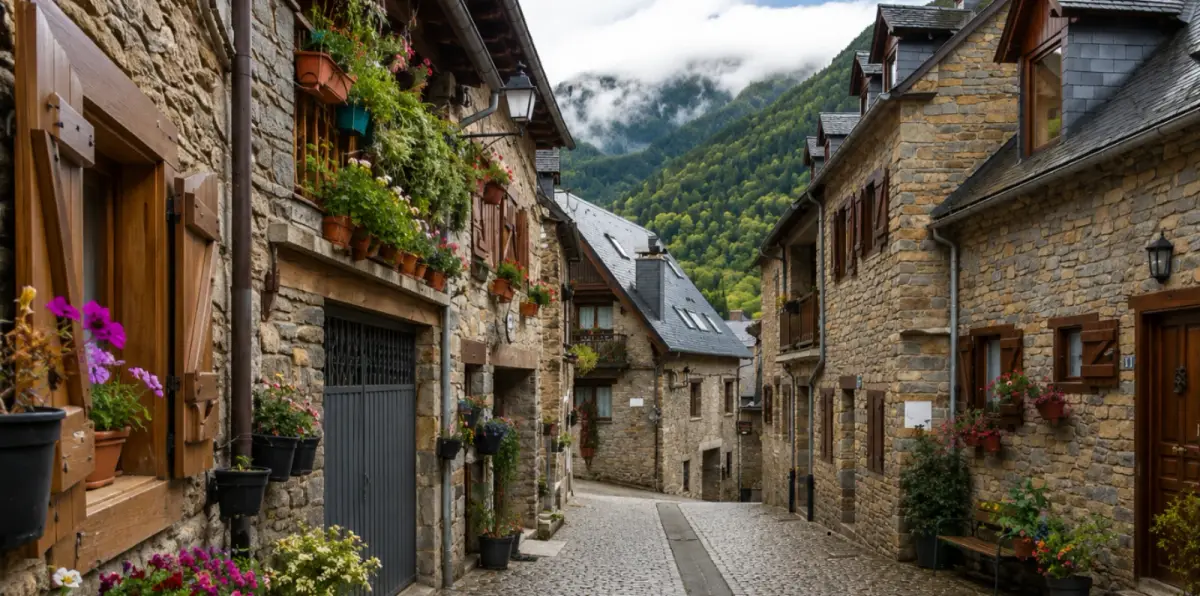

Inside Vielha’s main church, a 12th-century wooden Christ known as the Crist de Mijaran has drawn pilgrims and art lovers for generations. It’s the standout of a town that, unlike the postcard villages around it, works as a real Aranese capital, about 4 h from Barcelona and busy year-round. Let’s start with the essentials.
The essentials in 30 seconds
- ✅ Church of Sant Miquèu with the Crist de Mijaran, a 12th-century carving
- ✅ Old town by the river Nere and the Museu dera Val d’Aran
- ✅ The best base for skiing at Baqueira Beret (about 15 km away)
- ✅ Starting point for summer trails across the valley
- 🍲 Aranese cooking: olla aranesa and a pintxos route
- 🚗 About 4 h from Barcelona; a capital with every service
What is there to do in Vielha? The essentials are walking its old town by the river Nere, seeing the church of Sant Miquèu with the Crist de Mijaran (a 12th-century carving), and touring the Museu dera Val d’Aran. As the valley’s capital, it’s the best base for skiing at Baqueira Beret and for mountain trails in summer, with good Aranese food. It’s about 4 h from Barcelona.
Sant Miquèu and the Crist de Mijaran
Vielha’s central monument is the church of Sant Miquèu, late Romanesque with Gothic elements added centuries later. Its great treasure, and reason to visit, is the Crist de Mijaran, a polychrome wood carving over 900 years old, from the 12th century, considered one of the most valuable works of Aranese art. Seeing it inside the church, right in the old town, is a stop no one should skip.
The church stands beside the Carrer Major, the artery of the old town, worth strolling as you cross the bridges over the river Nere. It’s a compact, lively centre, with terraces and shops, where the mountain feel mixes with the bustle of a valley capital.
The old town and its museums
Vielha keeps heritage that goes beyond its churches. The main one is the Museu dera Val d’Aran, housed in a 17th-century fortified house, which covers the history, language and traditions of the valley; among its pieces is the Armari des Sies Claus, the six-key cabinet where the Aranese government’s documents were kept. According to official data, it is the reference museum for understanding the region’s identity.
A few steps away, the Fabrica dera Lan, a former wool factory with 19th-century machinery, shows the valley’s industrial past. And for bad-weather days or family trips, the Palai de Gèu is the largest sports complex in the area, with an ice rink, pool, climbing wall and padel under one roof.
A base for skiing and summer mountains
In winter, Vielha is the best base for skiing at Baqueira Beret, about 15 kilometres away, with the valley’s biggest concentration of accommodation, equipment rental and restaurants for skiers. Experts recommend sleeping here and heading up to the slopes each day if you want comfort and atmosphere.
In summer, skiing gives way to hiking. From Vielha you quickly reach high-mountain spots like the Saut deth Pish, a spectacular waterfall; the Artiga de Lin, a glacial valley of meadows and woods; or the Circ de Colomèrs, with one of the densest sets of lakes in the Pyrenees. They’re why the capital makes a comfortable base camp for both faces of the mountain.
Half a day and a full day in Vielha
Half a day covers the essentials of the capital. A comfortable 2-hour walk follows the Carrer Major, crosses the bridges over the river Nere, steps into Sant Miquèu to see the Crist de Mijaran, and ends at the Museu dera Val d’Aran; if you have time left, the pintxos route through the old town is the best finish.
For a full day, Vielha is the gateway to the high mountains. In summer, from the capital you quickly reach the Artiga de Lin, a glacial valley of meadows and woods, or the Circ de Colomèrs, with its many lakes. Experts recommend setting off early and checking the restricted 4x4 access to some of these spots in high season. For more ideas, the hiking near Barcelona guide has routes for every level.
Vielha with kids and when it snows
As the capital, Vielha is the valley’s most practical option for families. The Palai de Gèu, with an ice rink, pool and indoor climbing wall, rescues any bad-weather day, and the flat walk beside the river Nere is easy with a pushchair. In summer, gentle excursions to the Artiga de Lin suit all ages.
On snow, the Val d’Aran has one of the longest seasons in the Pyrenees. It usually snows from late autumn, and Baqueira Beret, about 15 kilometres away, typically opens from December to April depending on the year. So Vielha works all year: a ski base in winter and a mountain camp in summer.
Parking, where to eat and where to sleep
The practical bit first: Vielha has several car parks, some underground, near the old town, more convenient than looking for a street space, especially in ski season. From there the centre is under 10 minutes on foot.
For food, the old town has the valley’s best choice: Aranese restaurants serving the olla aranesa and a popular pintxos route; book ahead in high season. To sleep, Vielha offers the widest range of accommodation in the area, from hotels to apartments, which makes it the most comfortable base for anyone who wants services close by without relying on the car every night.
Getting there and nearby villages
Getting here takes about 4 hours by car from Barcelona through the Vielha tunnel, so the capital calls for a weekend. There’s no direct train. As the valley’s central hub, it’s also the best point for visiting the villages around it. This is the quick reference.
| See or do | Why |
|---|---|
| Sant Miquèu church | The Crist de Mijaran, a 12th-century carving |
| Museu dera Val d’Aran | Valley history in a fortified house |
| Baqueira Beret | Skiing, about 15 km away |
| Old-town pintxos route | Best food scene in the valley |
Just a step away are Arties, 7 kilometres off, with its thermal baths and Romanesque church; Salardú, with its church of Sant Andreu; and Bagergue, one of the highest and prettiest villages in the Val d’Aran, some 15 minutes away. In a weekend there’s time to pair the capital with two or three of them. For dates, the best time to visit Barcelona helps, and to price the trip, the Barcelona travel budget is a useful reference.
Common questions
What is there to do in Vielha?
The essentials are walking its old town by the river Nere, visiting the church of Sant Miquèu with the Crist de Mijaran, and touring the Museu dera Val d’Aran. As the valley’s capital, it’s the best base for skiing at Baqueira Beret in winter and for mountain trails in summer. The pintxos route through the old town is another highly recommended plan.
What is there to see in Vielha’s church of Sant Miquèu?
Sant Miquèu is a late Romanesque church with Gothic elements, and its great treasure is the Crist de Mijaran, a valuable 12th-century polychrome wood carving. It is one of the central sights of Vielha’s old town, along with a walk down the Carrer Major and over the bridges on the river Nere.
How far is Vielha from Barcelona?
Vielha is about 4 hours by car from Barcelona, in the far north-west of the Pyrenees, in the Val d’Aran (Lleida). Given the distance, it works better as a weekend break. It is the valley’s capital and has every service, which makes it the most comfortable base for getting around the area and for skiing.
Is Vielha a good base for skiing?
Yes, it’s the best base in the valley. The Baqueira Beret resort is about 15 kilometres away, and Vielha concentrates the accommodation, equipment rental and restaurants aimed at skiers. In summer, it swaps skiing for hiking to spots like the Saut deth Pish, the Artiga de Lin or the Circ de Colomèrs.
What museums are there in Vielha?
The main one is the Museu dera Val d’Aran, housed in a 17th-century fortified house, which covers the history and traditions of the valley. You can also visit the Fabrica dera Lan, a former wool factory that testifies to Aranese industry, and the Palai de Gèu, the large sports complex with an ice rink and pool.
Where do you park in Vielha?
Vielha has several car parks, some underground, near the old town, more convenient than looking for a street space, especially in ski season. From there the centre is a few minutes on foot. As the valley’s capital, it has more spaces and services than the small villages around it.
Can you visit Vielha with kids?
Yes, it’s the valley’s most practical option for families. The Palai de Gèu, with an ice rink, pool and indoor climbing wall, rescues bad-weather days, and the flat walk beside the river Nere is easy with children. In summer, gentle excursions to the Artiga de Lin suit all ages.
What villages are near Vielha?
Very close are Arties, about 7 kilometres away, with its open-air thermal baths; Salardú, with its church of Sant Andreu; and Bagergue, one of the highest and prettiest villages in the Val d’Aran, some 15 minutes away. Vielha is the ideal base for pairing the capital with two or three of these villages in a weekend.
Vielha is the gateway to the Val d’Aran on the route through the prettiest villages in the Catalan Pyrenees, and its essential neighbour is Arties, 7 km away. If you’ve come for the Romanesque, it links with the Vall de Boí and Taüll, about 2 hours away. For more ideas, villages near Barcelona and weekend getaways from Barcelona round out the trip.
Vielha isn’t a postcard village but the living capital of the Val d’Aran: the easiest base for skiing and exploring the valley.