
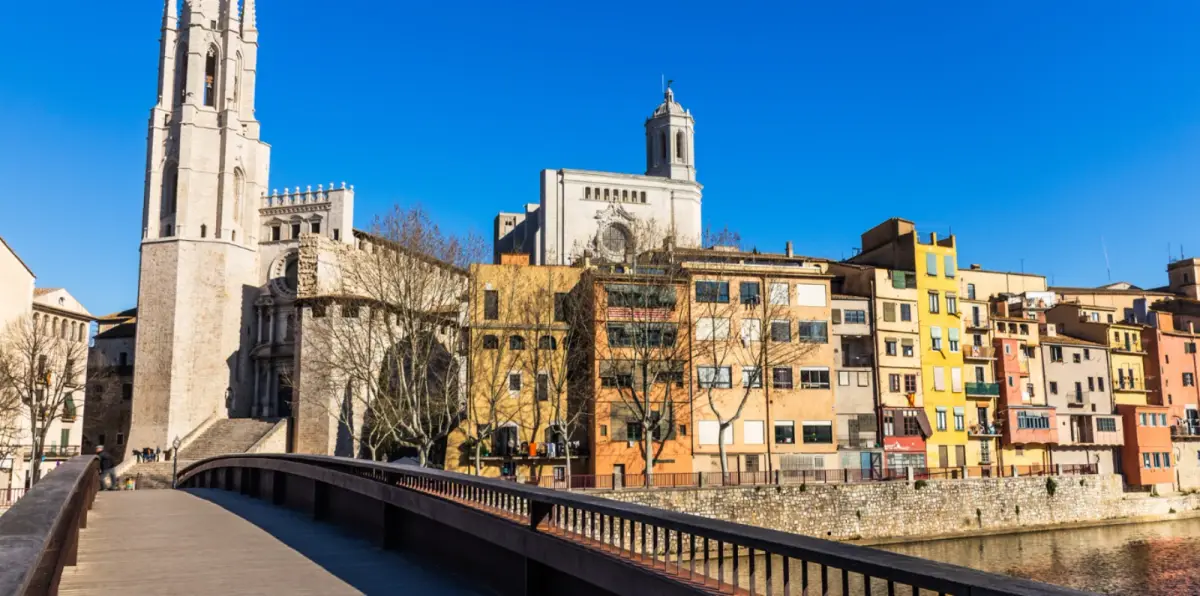

Some of Catalonia’s best escapes are a 38-minute train ride; others are a four-hour drive that only makes sense across two full days. Before choosing a region, the practical question for a weekend is how much time you actually have. Catalonia splits into coast, stone villages, high mountains and wine country, and each one asks for a different number of nights.
What is the best weekend getaway from Barcelona? It depends how long you have. For a single day, Girona is 38 minutes by high-speed train, Sitges 36 minutes by Rodalies, and Montserrat about 1h 15 by the R5 plus rack railway. For two nights, the Costa Brava and the Pyrenees open up, where Vall de Boí holds 9 UNESCO-listed Romanesque churches a four-hour drive away.
Quick decision by how much time you have
- Half a day and no car → Girona — 38 min by high-speed train from Sants, medieval core at the station
- One easy day in the mountains → Montserrat — R5 plus rack railway, about 1h 15, no car needed
- One night by the sea → Costa Brava, Begur or Calella — Camí de Ronda coves, easier with a car
- One night in a stone village → Besalú or Peratallada — 12th-century Romanesque bridge, walkable old town
- Two full days in the high Pyrenees → Vall de Boí — 9 UNESCO churches, a four-hour drive
- A wine day → Sant Sadurní in Penedès — cellars 45 min away by train; Priorat needs a car
The Costa Brava, the postcard coast
The Costa Brava is the most-searched escape and the hardest to do without a car. Cadaqués has no train station and depends on a direct bus of 2h 45 from Estació del Nord, with only four or five departures a day. It is the coast’s most iconic village, with a whitewashed old town, the Dalí house-museum at Portlligat, and Cap de Creus, the easternmost point of the Iberian Peninsula, a natural park since 1998.
The most photogenic stretch sits to the south, between Begur and Palafrugell, where coves like Aiguablava string together along the Camí de Ronda coastal path. Calella de Palafrugell keeps its fishermen’s houses at the water’s edge. Moving between small coves rewards a car, since public transport along this stretch is slow. For a single base with a castle and sea walls, Tossa de Mar is the easiest entry to the coast, and the Costa Brava from Barcelona guide and the Cadaqués guide map each stop.
The Pyrenees and Vall de Boí, a two-day trip
The Catalan Pyrenees deliver the most dramatic weekend and the worst fit for an improvised one. Vall de Boí, in the Alta Ribagorça, holds 9 Romanesque churches inscribed by UNESCO on 30 November 2000, led by Sant Climent de Taüll, where a video-mapping projection recreates the apse’s original frescoes. It sits about a four-hour drive from Barcelona with no rail link, so it needs two full days for the journey to pay off.
Next door, Aigüestortes i Estany de Sant Maurici National Park packs more than 200 lakes and peaks of 3,000 metres, with 4x4 taxis from Boí for the higher trails. This is genuine high mountain, best in summer and built for slow days, not a quick hit. According to travel planners, anyone treating it as a casual Saturday trip ends up spending more time driving than walking.
Easy mountain escapes, from Montserrat to Montseny
For mountains without the distance, Montserrat is the most efficient escape and the only one comfortably done car-free. You reach it on the R5 from Plaça Espanya and climb by rack railway or cable car, around 1h 15 to the monastery. From the top, the Sant Joan funicular opens ridge walks and viewpoints over the serrated rock, and it works as a there-and-back day.
Further north, Montseny has been a Biosphere Reserve since 1978 and gathers three European biomes in one massif, with beech woods that turn gold in autumn. Sant Llorenç del Munt is the day-hiker’s favourite, and Siurana, perched on a Tarragona cliff, adds climbing and long sunsets. The Montserrat from Barcelona guide lays out the full plan for the sacred mountain.
Medieval villages and wine country
For a weekend of stone and cellars, inland Girona and Penedès cover both. Besalú centres on a fortified 12th-century Romanesque bridge over the Fluvià and a miqvé, the Jewish ritual bath, one of few preserved in Europe. Peratallada, about 30 minutes away, is among the best-kept walled villages, with a moat cut into the rock. Pals adds a clock tower and rice-field views, and in autumn Rupit turns photogenic with its stone houses and hanging bridge.
For wine, Sant Sadurní d’Anoia is the cava capital, 45 minutes away on the R4, with cellars a short walk from the station and weekend tours. Priorat, with its slate llicorella soils and intense, internationally prized reds, needs a car to move between scattered wineries. The best villages near Barcelona and the Besalú guide cover the stone side, while the Penedès day trip handles the wine.
How many nights each getaway needs
The single most useful planning fact is that travel time, not the destination’s fame, sets the right number of nights. Girona works as a 38-minute day trip, while Vall de Boí needs two full days for a four-hour drive to make sense. Official data on Renfe shows around 25 daily trains to Girona, so frequency never forces the decision on the car-free routes.
| Region | Time from Barcelona | Ideal nights | Best season |
|---|---|---|---|
| Girona | 38 min by AVE | 1 | Spring, autumn |
| Costa Brava (Begur, Calella) | 1h 30-2h by car | 1-2 | May to September |
| Medieval villages (Besalú) | 1h 30 by car or bus | 1 | Spring, autumn |
| Montserrat | 1h 15 by R5 plus rack railway | 0-1 | Year-round |
| Vall de Boí (Pyrenees) | ~4h by car | 2 | Summer |
| Penedès and Priorat | 45 min to Sant Sadurní by train | 1 | Spring, autumn |
| Ebro Delta | ~2h by car or train | 1-2 | Spring, autumn |
Basing yourself in one sub-region beats hopping between them. Girona makes a strong base for the medieval villages and the southern coast within an hour; Sant Sadurní or Vilafranca anchor the wine country; and Taüll or Boí put you inside the Pyrenees for the church circuit and the national park. The car-free single-day options are gathered in the Barcelona train day trips guide.
Mistakes visitors make
The costliest mistake is treating four-hour destinations as a Saturday-morning escape. Vall de Boí and Aigüestortes need two full days and a car, because a same-day round trip adds roughly 8 hours of driving that swallows the plan. For those, the right call is to book a night rather than force the day.
A second trap is counting on the train for the cove-hopping Costa Brava. Public transport between small villages is slow, and without a car you end up tied to one spot. The third is ignoring the season: the Pyrenees shine in summer, villages and wine in spring and autumn, and the coast loses half its appeal off-season. Anyone pricing the trip first should check the Barcelona budget and daily costs guide.
When to go and what a weekend costs in 2026
For 2026, getaway platforms list rural and coastal stays across a wide band, from about €55 a night inland to over €200 for experience hotels in peak season, with a typical weekend running €200 to €400 per person depending on the area. Inland and villages come in cheaper than the coast, which climbs fast between June and September.
The sweet spot for most destinations is spring, March to June, and autumn, September to October, when the weather holds and prices drop below summer. For high mountain, summer remains the only comfortable window. The best time to visit the Barcelona area breaks down the seasons in more detail.
Common questions about weekend getaways
What is the best weekend getaway from Barcelona without a car?
Girona, 38 minutes by high-speed train from Sants, with its medieval core right at the station. Sitges follows at about 36 minutes on the R2, and Montserrat takes roughly 1h 15 combining the R5 with the rack railway. All three work car-free.
Which getaway from Barcelona can you do in a single day?
The ones on a nearby train line. Girona in 38 minutes, Sitges in 36, Tarragona in about an hour and Sant Sadurní in 45 minutes all work as a day trip. The Costa Brava coves and the Pyrenees need an overnight stay.
How many days do you need for Vall de Boí?
Two full days. Vall de Boí sits about a four-hour drive from Barcelona and holds 9 UNESCO-listed Romanesque churches. A same-day round trip wastes the journey, so it is better to sleep nearby and give the church circuit a full day.
The best escape is not the farthest or most famous, but the one that fits your nights and how you plan to get there.