
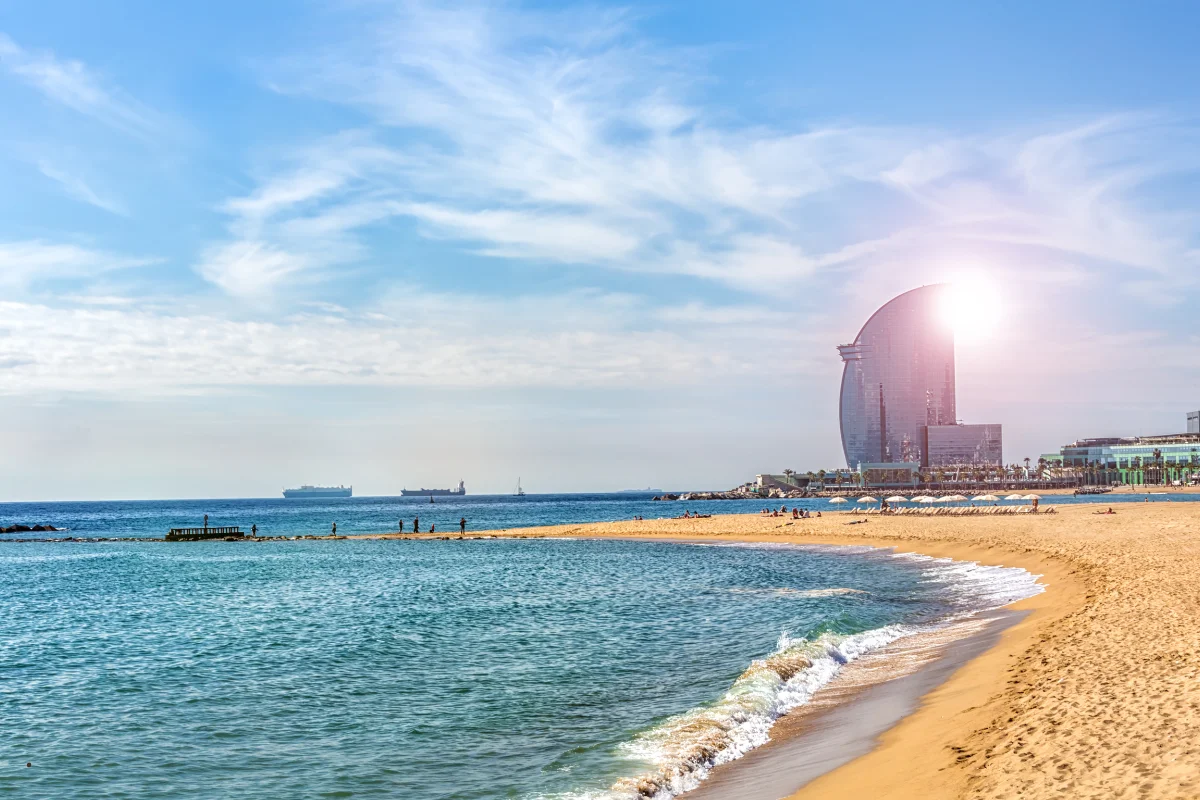

Every beach in Barcelona was built. Not “developed” in the sense of adding infrastructure to a natural beach — built from scratch, on top of a closed coastline, in a construction program that ran parallel to the 1992 Olympic Games preparation. Before that project, the sea was physically inaccessible to most of the city: a continuous barrier of railway tracks, industrial buildings and the remnants of the Somorrostro shantytown separated the urban fabric from the water.
The Somorrostro was not a small settlement. At its peak, 40,000 people lived in makeshift structures directly on the sand — the largest informal urban settlement in mid-20th-century Spain. The city demolished it in 1966 and left the coastline in industrial use until the Olympic urban transformation buried the rail lines, cleaned the contaminated soil and deposited millions of cubic meters of sand to create beaches that had never previously existed.
Understanding this origin doesn’t diminish the beaches. It makes them legible. They behave like engineered infrastructure because they are: the sand is topped up with 30,000 cubic meters of imported material per year to compensate for constant erosion. The water quality is managed through active monitoring by the Catalan Water Agency. The services — lifeguards, showers, accessibility ramps — were designed in from the beginning. What you’re swimming at is a municipal amenity, not a geographic accident.
The beaches are not interchangeable
A list ordered south to north with generic ratings hides the point: the beaches are not interchangeable. They have substantially different water quality profiles (the southern beaches are more vulnerable to storm drainage events), different social characters (Mar Bella’s nudist zone and LGBTQ+ scene are a deliberate community formation, not a side note), and different practical situations depending on what day and time you arrive.
The Barceloneta beach on a Tuesday morning in October is a different place than on a Saturday afternoon in August. The Zona de Banys del Fòrum has no sand and is the only facility in Europe where a wheelchair user can enter the Mediterranean directly without assistance from another person. Bogatell receives the “Excellent” water quality rating most consistently. None of these facts appear with any prominence in the standard guide format.
This guide is organized by character, not by position on the coastline.
How many beaches does Barcelona have? Ten urban beaches covering 4.2 kilometers of coastline. From south to north: Sant Sebastià, Sant Miquel, Barceloneta, Somorrostro, Nova Icària, Bogatell, Mar Bella, Nova Mar Bella, Llevant, and the Zona de Banys del Fòrum. All are free, all accessible via Metro L4. Full services (lifeguards, showers, accessible equipment) operate from approximately May 24 to September 11, 10:30–19:30.
The Character Guide: Which Beach For What
For Families With Young Children → Nova Icària
Nova Icària sits inside the protective arc created by the Port Olímpic breakwater. The result is the calmest water on the Barcelona coastline — wave heights that would be acceptable anywhere else are further attenuated here. For children who are learning to swim or who are uncomfortable with open water movement, Nova Icària is the practical choice.
The beach has a children’s playground adjacent to the sand, an accessible boardwalk suitable for prams and wheelchairs, and the connected Port Olímpic marina — which gives the family plan a natural lunch extension without leaving the area.
The towers that define this section of the skyline (Hotel Arts and the Mapfre tower) are immediately recognizable from here. The Frank Gehry gold fish sculpture on the terrace of the Hotel Arts is visible from the beach and best photographed from the west in late afternoon light.
Metro: L4 to Ciutadella-Vila Olímpica.
For Water Quality → Bogatell
The Bogatell beach has 650 meters of length — the longest individual beach on the Barcelona coastline — and consistently receives the “Excelent” (top tier) classification from the Agència Catalana de l’Aigua’s monitoring program. The beach is far enough from the storm drainage outfalls near the Barceloneta to avoid the temporary quality drops that affect the southern stretches after heavy rain.
The sports infrastructure is the most complete of any Barcelona beach: permanent volleyball nets, table tennis tables, a beach football pitch, and the calisthenics equipment that most of the city’s outdoor gyms replicated later. The Guingueta de l’Escribà — the beachside operation of the Escribà pastry dynasty — is the only chiringuito on the Barcelona coastline that genuinely advances the gastronomic argument for staying on the beach rather than going elsewhere for food.
Bogatell is also the most accessible beach in the northern cluster, with wide boardwalks, adaptive equipment and monitored assisted bathing. The Poblenou neighborhood guide covers the creative district that sits directly behind this beach — an obvious combination for a half-day that starts with a swim and continues into the neighborhood.
Metro: L4 to Llacuna or Poblenou, 10–15 minutes’ walk.
For the LGBTQ+ Scene and Nudism → Mar Bella
Mar Bella has the official nudist zone of the Barcelona coastline — an established, marked and serviced area that has functioned as such since the early years after the Olympic beach construction. The adjacent beach bars (BeGay and Chiringuito Mar Bella in particular) are the most explicitly LGBTQ+-oriented on the coastline, a social geography that developed organically rather than by municipal design.
The Base Nàutica Municipal is located here — the only facility on the Barcelona beaches offering kayak, dinghy sailing, windsurfing and paddleboard rental with instruction. When the wind picks up from the northeast (a frequency that increases from October to March), Mar Bella receives the most surfable conditions on the central Barcelona coastline — modest, but consistent.
The beach runs from the Poblenou district into the beginning of the Llevant area, positioning it between the creative district neighborhood to the west and the quieter, newer Llevant strip to the east. Both the Poblenou guide and the adjacent neighborhood context are relevant for understanding the area’s social character.
Metro: L4 to Poblenou or Selva de Mar.
For Quiet and Authenticity → Nova Mar Bella
Nova Mar Bella is the beach that residents of the Sant Martí district use when they want to avoid the density of Bogatell and Mar Bella. It has lower service density (fewer chiringuitos, less sports infrastructure) and consequently lower visitor volume. It’s the beach most likely to have usable space on a summer Saturday without arriving before 9:00.
Architecturally it’s the most carefully considered of the Barcelona beaches — the Ajuntament has used it as a reference for thoughtful coastal design — with seating, shade structures and transitions from urban to beach that work better than the more heavily used alternatives.
The beach is also the most vulnerable to storm erosion on the northern cluster, having required emergency sand replenishment after several recent winter storm sequences. The natural sediment dynamics of the coastline move sand northward along the shore; the beaches at the northern end of the system gain what the southern ones lose until engineering intervention rebalances the distribution.
Metro: L4 to Selva de Mar, 12 minutes’ walk.
For Maximum Centrality (With Honest Trade-offs) → La Barceloneta
The Barceloneta beach is 422 meters long, directly connected to the Barceloneta neighborhood, and the closest beach to the historic city center. It is also, in August, the most intensely crowded stretch of sand on the Iberian Mediterranean coast per square meter. Arriving after 10:00 on any weekend between late June and early September means competing for space with an estimated 100,000+ people across the full beach day.
The water quality at the Barceloneta is the most variable of any Barcelona beach. The storm drainage system in this section of the coast combines surface runoff and sewage in the same pipe when rainfall overwhelms capacity — a “combined sewer overflow” event. After heavy rain, bacteria levels spike and the red flag goes up. The event typically clears within 24–48 hours. The ACA monitors in real time; check the flag status and the agency’s app before entering.
The historical context of the Barceloneta neighborhood — built in the 18th century to house the population displaced from the Ribera district when Felipe V ordered it demolished to build the Ciutadella fortress — is explained in the Barceloneta neighborhood guide. The beach, the neighborhood and the maritime history form a single coherent visit that most beach guides separate artificially.
Metro: L4 to Barceloneta.
For History and Scale → Sant Sebastià
Sant Sebastià is the oldest and largest of the Barcelona beaches — nearly 700 meters of sand anchored by the W Hotel sail at its southern end and the Club Natació Barcelona (one of the city’s oldest sports clubs) at its northern boundary. The coexistence of club members who have been swimming at this beach for decades and hotel guests who arrived yesterday defines the social register of Sant Sebastià in a way that no other beach replicates.
The Bastian Beach club installed within the Club Natació premises offers VIP access from €300 per sunbed, with cabana packages reaching €3,000 for groups — the most explicit stratification of any facility on the Barcelona coastline. The public beach immediately adjacent is, as always, free.
Sant Sebastià has the most consistent assisted swimming program of any Barcelona beach, with trained staff and amphibious wheelchairs operating 11:00–14:00 daily during peak season. The combination of size, service level and the W Hotel’s visual anchor makes it the beach with the most cinematic silhouette — the sail visible from the cable car arriving from Montjuïc is the most reproduced image of the Barcelona seafront.
Metro: L4 to Barceloneta, 15 minutes’ walk south.
For Something Completely Different → Zona de Banys del Fòrum
The Banys del Fòrum is not a beach. It has no sand. It is a 375-meter enclosed saltwater pool created by extending breakwaters into the Mediterranean to trap and calm a section of sea. The bottom is smooth, the depth is controlled and predictable, and the entry options include conventional steps and ramps plus the hydraulic-lift system — the only installation of its kind in Europe — that allows direct water entry for wheelchair users who cannot use conventional access points.
The practical argument for the Banys del Fòrum: if you want to swim in Mediterranean water without competing for sand space, without risk of wave interference with young children, and with the most complete accessibility infrastructure on the Barcelona coast, this is the answer. It is also the least crowded facility in this guide, consistently, because most visitors to Barcelona’s beaches don’t know it exists.
Adjacent to the Parc del Fòrum and the Museu Blau — making it the natural complement to a Poblenou or Fòrum-area day — and directly served by Metro L4 and the Tram T4.
The Rules That Apply to Every Beach
No smoking: the no-smoking rule applies across all Barcelona beach sand, from the start of the season to the end. Terrace areas of chiringuitos are regulated separately and may permit smoking in some conditions.
Water quality flags: green (swimming permitted), yellow (variable conditions, caution), red (swimming prohibited). The red flag most commonly appears after heavy rainfall events affecting the Barceloneta and Somorrostro sections. Duration: typically 24–48 hours after the triggering event.
Dogs: permitted only in the designated zone at Platja de Llevant during swimming season (30 May to 13 September 2026, 10:30–19:30, maximum 100 dogs). Outside swimming season, dogs can access all Barcelona beaches without zone restrictions, except during Easter week. The full dog beach guide for the province is the dog beaches near Barcelona guide.
Service season: full services (lifeguards at 10:30–19:30, showers, accessible equipment, beach bars) run from approximately May 24 to September 11. During shoulder season (April–May and September–October), lifeguard hours reduce to approximately 10:30–18:30. All beaches are accessible year-round, but outside service season there is no lifeguard coverage.
Getting to the Beaches
Metro L4 (yellow line) is the single most efficient connection to the entire Barcelona beach strip. The relevant stops in sequence from south to north:
- Barceloneta → Platja de Sant Sebastià, Sant Miquel, Barceloneta
- Ciutadella-Vila Olímpica → Somorrostro, Nova Icària
- Llacuna → Bogatell
- Poblenou → Bogatell, Mar Bella
- Selva de Mar → Mar Bella, Nova Mar Bella
- El Maresme-Fòrum → Llevant, Zona de Banys del Fòrum
Maximum walk from any of these stops to the sand: 15 minutes. The Passeig Marítim cycling path runs the full 4.2 kilometers parallel to the coast. Bicing (the city’s public bicycle system) has stations adjacent to every beach entrance. The T4 Tram line covers the seafront from Ciutadella to the Fòrum and is included in the standard transport ticket.
Comparison Table
| Beach | Length | Best For | Water Quality | Dog Access | Distinctive Feature |
|---|---|---|---|---|---|
| Sant Sebastià | ~700m | History, sports clubs | Good | No | W Hotel sail, oldest club |
| Barceloneta | 422m | Centrality, atmosphere | Variable (post-rain) | No | Most central, most crowded |
| Nova Icària | ~400m | Families, calm water | Good | No | Most protected water |
| Bogatell | 650m | Sports, water quality | Excellent | No | Longest beach, best water |
| Mar Bella | ~500m | Nudism, LGBTQ+, nautical | Good | No | Nudist zone, sailing school |
| Nova Mar Bella | ~300m | Tranquility, residents | Good | No | Least crowded of northern set |
| Llevant | ~400m | Quiet, dogs in season | Good | Yes (30 May-13 Sep, zone) | Only dog beach in city |
| Banys del Fòrum | 375m | No-sand swimming, accessibility | Controlled | No | Hydraulic wheelchair entry, no waves |
Is Barcelona Worth Visiting for the Beaches?
Depends — on what you’re comparing them to.
If the benchmark is the Costa Brava or the Costa Daurada — natural rocky coves, clearer water, pine forest access — Barcelona’s beaches don’t compete. They’re urban beaches with urban water quality and urban crowds. The Barceloneta in August is the Mediterranean equivalent of a busy public park.
If the benchmark is other major European cities — London, Paris, Berlin — Barcelona’s beaches are extraordinary: accessible by metro, free, with full services and actually swimmable Mediterranean water in the middle of a city of 1.6 million.
When they’re not worth it: arriving at the Barceloneta or Somorrostro without checking the water quality flag after a storm, arriving at any beach between 11:00 and 14:00 in August without a very specific plan for space, or treating all ten beaches as interchangeable when they demonstrably are not.
Are all Barcelona beaches free to use?
Yes. All ten Barcelona beaches are completely free. The chiringuito terraces charge for food and drink. VIP beach clubs within some beach areas (like the Bastian Beach at Club Natació Sant Sebastià) charge premium prices. The beach itself is always public access.
Which Barcelona beach has the clearest water?
Bogatell and Nova Icària most consistently receive the Agència Catalana de l’Aigua’s “Excellent” water classification. The Barceloneta and Somorrostro stretches are most vulnerable to post-storm quality drops due to combined sewer overflow events. Check the real-time ACA app before swimming after rain.
Can you swim at Barcelona beaches year-round?
Physically yes — the beaches are open 365 days. The Mediterranean sea temperature around Barcelona reaches its minimum of approximately 13°C in February and maximum of 25–27°C in August. Full lifeguard coverage runs May 24 to September 11. Outside that window, swimming is at your own risk without lifeguard presence.
What is the Zona de Banys del Fòrum?
A 375-meter enclosed saltwater pool at the northern end of the Barcelona coastline, adjacent to the Parc del Fòrum. It has no sand — it’s a calm-water swimming area created by breakwaters. Its hydraulic-lift entry system makes it the only marine swimming facility in Europe with direct water access for wheelchair users requiring mechanical assistance.
Is Barcelona’s sand natural or artificial?
Entirely artificial. All of Barcelona’s beaches were created from scratch for the 1992 Olympic Games, on ground previously occupied by factories, railway lines and informal settlements. The city imports approximately 30,000 cubic meters of sand per year to compensate for ongoing coastal erosion, using material from urban construction excavations.
Where is the nudist beach in Barcelona?
Mar Bella beach has the official designated nudist zone of the Barcelona coastline — marked, established and with its own services. It’s the only officially sanctioned nudist area on the 4.2-kilometer beach strip. Accessible via Metro L4 to Poblenou or Selva de Mar.
Final Insight
The Somorrostro that gave its name to a stretch of Barcelona beach was a community of 40,000 people without running water, sewage or legal tenure, living on sand where the beach is now. The Olympic transformation that replaced it with a public beach is consistently cited as one of the most successful urban regeneration projects of the late 20th century. Both things are true simultaneously: the beach is a successful piece of urban infrastructure, and the name it carries is the only memorial to the neighborhood that was erased to build it. Walking the Somorrostro strip knowing that context is a different experience from walking it as just another section of sand.
For the quieter end of the same coast, the nudist beaches near Barcelona guide covers the twelve naturist options and the one official city beach among them, which is also the narrowest at 42 metres.
For planning the Barcelona seafront as part of a larger visit, the Barcelona complete travel guide places the coast within the full geographic logic of the city. And for the neighborhoods that connect directly to the beach — the historic maritime district and the converted industrial creative quarter — the Barceloneta guide and the Poblenou guide cover what’s worth seeing immediately behind the sand.