
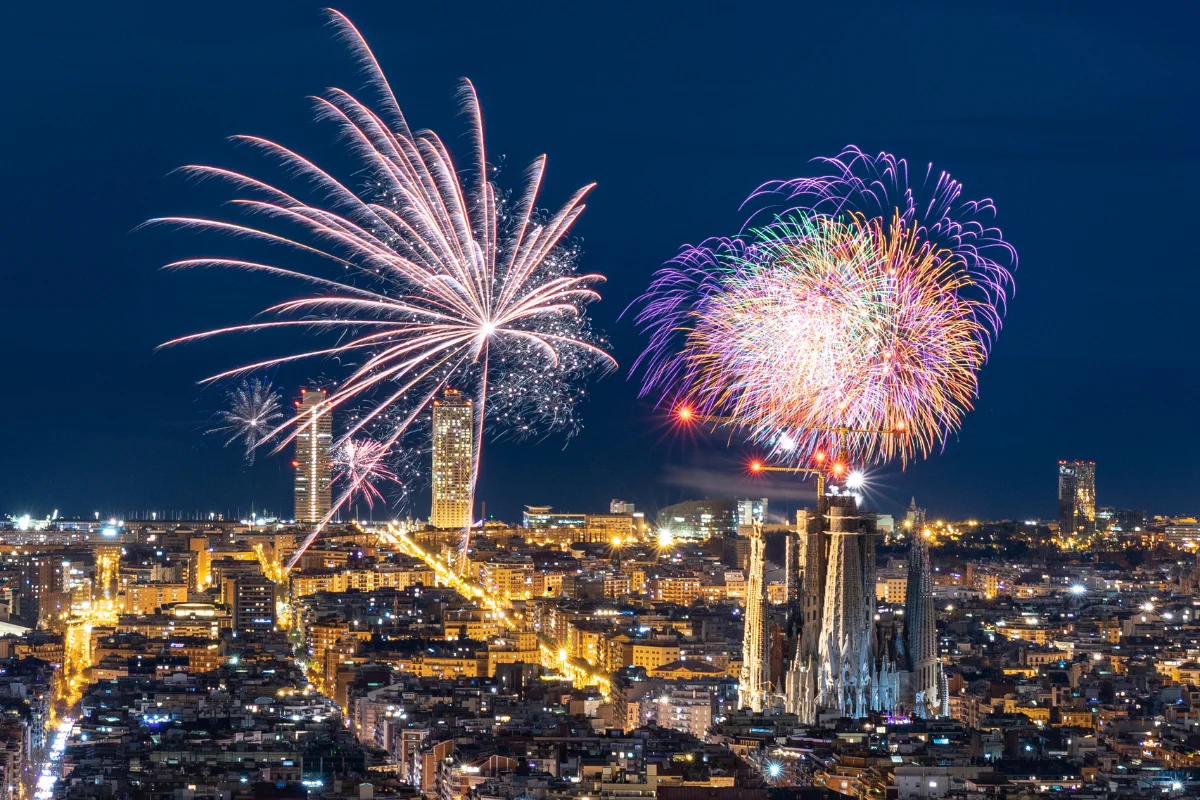

Barcelona’s Christmas season doesn’t work like other European capitals. There’s no central Christmas market with mulled wine, no single square that becomes the focal point for the whole city. What exists instead is a network of separate fairs across multiple neighborhoods, 126 kilometers of designer lighting installations commissioned from independent studios, and two Catalan traditions — the Tió de Nadal and the Caganer — that have no equivalent anywhere else in the world.
The season officially begins November 22 when the lights switch on at 18:30 on Passeig de Gràcia and runs through January 6 when the Three Kings parade ends at the Montjuïc Magic Fountain. That’s six weeks, two “Christmas Eves” (December 24 and January 5), and a public holiday on December 26 that only exists in Catalonia.
The Christmas Markets: What Each One Actually Is
Barcelona has six or seven active Christmas markets running simultaneously in December. They are not interchangeable. Each one has a different product focus, crowd level, and reason to visit.
What are the best Christmas markets in Barcelona? Fira de Santa Llúcia (Cathedral, since 1786) is the oldest and most culturally specific — Catalan nativity figures, Tió de Nadal, Caganer figurines. Nadal al Port Vell (Moll de la Fusta) is the largest by area (27,000 m²) with a 65m Ferris wheel and harbor light shows. Fira de la Sagrada Família is the quietest and most neighborhood-oriented. None of them serve mulled wine or follow the Central European model.
Fira de Santa Llúcia — the oldest and most Catalan
Running since 1786, this is the market to start with, and for good reason: it’s the only place in the city where you can buy the full range of Catalan Christmas objects — pessebre (nativity) figures, the Caganer in its hundreds of versions, the Tió de Nadal in every size, natural moss for the nativity scene, and traditional instruments for carol singing.
What it doesn’t have: almost no food stalls, no alcohol, no entertainment. It is a shopping market, not an experience market. Arriving on a weekday before December 15 gives you the full selection without the weekend pressure of the final week.
Dates: November 28 to December 23, 10:00–21:00 daily. Location: Avinguda de la Catedral.
Nadal al Port Vell — the largest by scale
The harbor market at Moll de la Fusta covers 27,000 m² and is the only one open through January 6. It has wooden stalls, a 65-meter Ferris wheel with illuminated harbor views, historic boats from the Maritime Museum decorated for Christmas, and LED light shows reflected on the water.
This is not primarily a shopping market. It’s an entertainment destination — go for the atmosphere and the light shows, not for culturally specific products.
Dates: November 28 to January 6, 11:00–21:30.
Fira de la Sagrada Família — the neighborhood option
The market around the Plaça de la Sagrada Família is significantly less crowded than either of the above. The scale is smaller, the clientele is local (Eixample residents rather than tourists), and the products lean toward Christmas trees, artisanal food, and local crafts. The view of the illuminated Sagrada Família behind the market stalls is one of the visually strongest combinations in the city during winter.
Dates: November 28 to December 23.
Fira de Reis de la Gran Via — for January 5
Specialized in toys and last-minute gifts for Three Kings Day (January 6). Runs December 15 to January 6. Barcelona families traditionally come on the night of January 5, after the Three Kings parade, to eat churros with chocolate at the stalls that stay open late.
Market Comparison
| Market | Dates | Best for | Crowd level | Food/drinks |
|---|---|---|---|---|
| Fira de Santa Llúcia | Nov 28–Dec 23 | Catalan traditions, nativity figures | High weekends, low weekdays | Minimal |
| Nadal al Port Vell | Nov 28–Jan 6 | Atmosphere, Ferris wheel, light shows | Moderate | Yes |
| Sagrada Família | Nov 28–Dec 23 | Quiet shopping, neighborhood vibe | Low | Some |
| Fira de Reis (Gran Via) | Dec 15–Jan 6 | Children’s gifts, Three Kings night | Moderate | Churros on Jan 5 |
| Els Llums de Sant Pau | Nov 20–Jan 11 | Light installation, modernist heritage | Timed entry | No |
Quick Decision — What Kind of Barcelona Christmas Are You Looking For?
- Want the most historically rooted market → Fira de Santa Llúcia (Cathedral) — 1786, specialist Catalan items, best on weekdays before Dec 15
- Want lights and atmosphere without paying entry → Passeig de Gràcia and Via Laietana at dusk — lights on from 17:30, Via Laietana has 20 arches and 175 digital floral motifs with typographic “ho ho ho” integrated into the design
- Want the best ticketed light experience in the city → Els Llums de Sant Pau — €12–22, timed entry 18:00–23:00, UNESCO modernist architecture as backdrop, book weeks in advance for December weekends
- Want a harbor atmosphere with entertainment → Nadal al Port Vell — 65m Ferris wheel, open until January 6, good for families
- Want to understand Catalan Christmas traditions specifically → Start at the Fira de Santa Llúcia to buy or observe the Caganer and Tió, then visit the Gothic Quarter for chocolate and churros
- Want to see the Three Kings arrive → Moll de la Fusta at 16:00 on January 5 — the Kings disembark from the historic schooner Santa Eulàlia; the parade starts at 18:00 from Avinguda Marquès de la Argentera
The Catalan Traditions Nobody Else Has
The Tió de Nadal: the log that gives gifts
The Tió de Nadal (“Christmas Log”) is a hollow log with a painted face, little legs, a red hat (barretina), and a blanket. It arrives in Catalan homes in early December. Children have to feed it every day — scraps of fruit, bread crusts — starting December 8. The premise: the more it eats, the more it will produce.
On December 24, children beat the log with sticks while singing a traditional song (“Caga, tió, ametlles i torró…”) and lift the blanket to find sweets, nougat, and small gifts underneath. The origin is pre-Christian: the log burned at the winter solstice to provide heat and light, its ashes later used to fertilize fields. The ritualized version for children emerged over centuries of overlap between agrarian cycles and the Christian calendar.
The Fira de Santa Llúcia sells logs in every size. The market also has a Giant Tió installation where children can participate in the ritual and receive candy.
The Caganer: the figure nobody outside Catalonia expects
The Caganer (literally “the defecator”) is a small figurine of a squatting peasant that is placed hidden somewhere in the nativity scene, away from the main figures. It has existed since the 18th century. Its symbolic function is fertility: by “fertilizing” the ground of the nativity, it guarantees health, prosperity, and good harvests for the coming year.
In the modern version, the Caganer has evolved into political and social satire. Every December, new editions appear caricaturing current footballers, politicians, and public figures. The stalls at Fira de Santa Llúcia can have hundreds of versions. Finding the most recent or most unexpected version is part of the visit.
The theological logic behind the Caganer
The Tió and the Caganer are easy to file away as quirky. The more interesting layer is the theological logic behind the Caganer: placing a defecating figure in the nativity scene was not considered disrespectful in Catalan tradition because it represented the cycle of life — birth, growth, decomposition, renewal. The sacred and the earthy occupied the same space. That coexistence is very specifically Catalan, not Spanish, and it’s one of the clearest markers of how differently Christmas functions here culturally.
The Lights: 126km of Designer Installations
The Christmas light switch-on happens November 22 at 18:30 on Passeig de Gràcia. The budget for the city’s lighting program is €3.8 million, with different design studios commissioned for each major street — not repeating patterns, but independent creative projects per avenue.
Key installations this season:
- Via Laietana: 20 arches and 175 digital floral motifs, designed by Esther Pujol and Marta Cerdà, with “ho ho ho” typographically integrated into the floral design
- Passeig de Gràcia: updated large-scale star design with light cascades that interact with the Gaudí facades
- Plaça de Catalunya: ARTEC installation using 2,025 dichroic elements that catch natural light during the day and project moving reflections at night
Operating hours: Sunday–Thursday 17:30–01:00, Friday–Saturday and special dates (December 24, 25, 31 and January 5) until 02:00.
The best walking route for the lights: Passeig de Gràcia from Diagonal to Plaça Catalunya (passing Casa Batlló and La Pedrera), then Via Laietana down to the Gothic Quarter. On rainy evenings — common in December — the light reflects off wet stone in a way that makes the architecture look completely different from dry conditions.
Els Llums de Sant Pau: the Best Ticketed Experience
The Recinte Modernista de Sant Pau — the largest modernist hospital complex in the world, designed by Lluís Domènech i Montaner, and now a UNESCO World Heritage Site — transforms November 20 through January 11 into an outdoor light garden.
18 light and technology installations are integrated into the pavilions, gardens, and covered corridors of the complex. The design respects the building’s original concept as a “therapeutic garden”: the installations use the architecture as backdrop rather than covering it.
Access: timed entry in 30-minute slots, 18:00–23:00. Tickets: €12–22 depending on type. Advance booking is essential — December weekend slots sell out weeks ahead. The Recinte Modernista is worth visiting during the day as well, outside the Christmas installation season.
The Food: Two Dishes That Explain Catalan Christmas
December 25 — Escudella i Carn d’Olla: The central Christmas meal is a two-course broth: first a clear soup with galets (large snail-shaped pasta), then the slow-cooked meats and vegetables served separately. The defining element is the pilota — a large spiced meatball made from pork and veal. Almost every Catalan family eats this on December 25, regardless of economic background.
December 26 — Canelons de Sant Esteve: December 26 is a public holiday in Catalonia called Sant Esteve — it does not exist as a holiday anywhere else in Spain. The traditional dish is Catalan canelons, made from the leftover meat of the December 25 carn d’olla, slow-roasted (not sautéed, which is the Italian method), minced, filled into pasta tubes, and baked under béchamel. The roasting method gives the filling a completely different texture and flavor from any Italian version. The tradition consolidated in the late 19th century as a way to use the previous day’s leftovers without waste — today it’s considered the benchmark of Catalan home cooking.
For the chocolate and churros tradition of December evenings, historic spots like La Pallaresa and Granja Viader in the Gothic Quarter are the reference points — the chocolate here is thicker than elsewhere in Spain.
Three Kings: January 5–6
In Barcelona (and throughout Spain), January 6 is the main gift-giving day — more central than December 25 for most families. The eve, January 5, is when the Three Kings arrive in the city.
The arrival: the Kings come by sea, disembarking from the historic schooner Santa Eulàlia at the Portal de la Pau at 16:00. The mayor of Barcelona performs a formal welcome ceremony, presenting the traditional bread, salt, and the symbolic Keys to the City. The parade begins at 18:00 from Avinguda Marquès de la Argentera and ends at the Montjuïc Magic Fountain around 21:10.
Best viewing positions: the Gran Via stretch and the area around Plaça Espanya for the final section. Accessible viewing areas for reduced mobility visitors are positioned at Moll de la Fusta (for the arrival) and Plaça Espanya with Av. Paral·lel.
January 6 morning: children open their gifts. Adults traditionally eat tortell de Reis — a ring-shaped pastry with candied fruit that hides a small figurine and a dried bean. Finding the figurine means you’re crowned king or queen; finding the bean means you pay for next year’s tortell.
Mistakes to Avoid
- Assuming there’s a main Christmas market — Barcelona’s fairs are scattered across different neighborhoods with different purposes. Going to one expecting the experience of another will disappoint. Check what each market specializes in before going
- Booking Els Llums de Sant Pau for a December Saturday without advance planning — timed slots sell out weeks ahead. Book as soon as you know your dates
- Arriving at Fira de Santa Llúcia on December 21–23 — the final week is extremely crowded and many of the best items (specific Caganer editions, handmade Tió sizes) are already gone. First two weeks of December are better
- Expecting December 26 to be a normal shopping day — Sant Esteve is a public holiday in Catalonia. Most shops, markets, and many restaurants are closed
- Missing the New Year countdown context — the Montjuïc Magic Fountain event on December 31 (pyrotechnics + 500 drone show) starts filling from 23:00. The metro runs overnight on New Year’s Eve specifically to manage the crowd
Best Strategy by Duration
One day in December: lights walk on Passeig de Gràcia from 17:30 → Fira de Santa Llúcia for the Caganer and Tió → chocolate at La Pallaresa or Granja Viader in the Gothic Quarter.
Two days: add Els Llums de Sant Pau (pre-booked evening slot) + Nadal al Port Vell for the harbor atmosphere + Sagrada Família market if you want a quieter shopping option.
January 5–6 visit: arrive in the afternoon of January 5 for the Three Kings disembarkation at the harbor (16:00) → position for the parade route → January 6 morning for the city after-parade atmosphere.
Barcelona’s Christmas season is not designed for visitors who want the Central European market experience — and that’s precisely its value. The city doesn’t perform Christmas for tourism; it performs it for itself, with traditions that are centuries older than the region’s modern tourist infrastructure. The Caganer has been in Catalan nativity scenes since the 1700s. The Fira de Santa Llúcia has been setting up in front of the Cathedral since before the French Revolution. Those aren’t selling points — they’re just what December has always looked like here.
For planning the full Barcelona visit around the Christmas period, the Barcelona travel budget guide covers seasonal pricing. For walking routes that connect the Gothic Quarter markets with the Born neighborhood, the Barcelona best walking streets guide maps the most direct paths between the main December landmarks.