

This guide is based on real visits across Barcelona’s main museums — including checking current prices, free-access windows, queue realities, and what each museum actually delivers that justifies the entry cost. The goal is to help you choose which museums are worth your time, when to go, and whether any of the passes save you real money.
Not every museum in Barcelona deserves the same amount of time or the same type of visit. Some justify three hours of serious attention. Others are done in 90 minutes or visited specifically for a single work. The difference matters for planning — and for not spending €40 on entry fees for experiences that needed 45 minutes.
The most useful thing to know first: Barcelona’s museum passes can save 40–50% on individual entry prices. But they only make financial sense if you visit three or more of the included museums. This guide tells you exactly when each pass is and isn’t worth it.
Quick Answer: Best Museums in Barcelona Best for art history: MNAC (world’s largest Romanesque mural collection, €12, free Saturdays from 15:00). Best for a single artist’s story: Picasso Museum (his Barcelona training years, all 58 Las Meninas, €13 — book online or queue 60+ minutes). Best modern art foundation: Fundació Joan Miró (14,000 works in a Sert building, €14). Best contemporary art: MACBA (from 1950s to now, €12, iconic skate plaza outside). Best archaeology: MUHBA (walk over Roman Barcino under the Plaça del Rei, €7). Most unexpected: CosmoCaixa (1,000m² Amazon rainforest with live caimans, €6).
Quick Picks
- Best museum for international visitors → Picasso Museum (specific story, manageable size, book ahead)
- Best for serious art lovers → MNAC (world-unique Romanesque collection + Catalan Modernisme)
- Best for families → CosmoCaixa (live Amazon ecosystem, under-16s free)
- Best architecture + art combo → Fundació Joan Miró (Sert building designed for the collection)
- Best under-the-radar museum → MUHBA (Roman Barcelona under your feet, almost no queues)
- Best pass value → Articket €38 (covers 6 museums, fast-track at Picasso where it matters most)
Quick Decision: Which Museum Should You Visit?
- First time in Barcelona, limited time → Picasso Museum (specific, digestible, unforgettable if you understand what you’re seeing)
- Want world-class art you can’t see anywhere else → MNAC (12th-century Romanesque murals in their original apse layouts — unique globally)
- Want contemporary and conceptual art → MACBA (1950s to now, changing exhibitions, iconic plaza)
- Want to walk through ancient history physically → MUHBA (Plaça del Rei, Roman ruins at floor level, suspended walkways)
- Visiting with children → CosmoCaixa (Amazon rainforest with live caimans, under-16s free, €6 adults)
- Want to see three or more museums → Buy the Articket (€38, 12-month validity, fast-track at all six)
Who Is This For?
- First-time visitors → Picasso Museum + MNAC terrace (€2) or MACBA plaza (free) as a combined day
- Art-focused travellers → Articket covering MNAC + Fundació Miró + Picasso Museum + Fundació Tàpies
- Budget visitors → MUHBA (free Sundays from 15:00), MNAC (free Saturdays from 15:00), Picasso (free Thursday evenings 18:00–21:00)
- Families with children → CosmoCaixa (€6 adults, free under 16, 1,000m² Amazon ecosystem)
- Architecture interested → MNAC (Palau Nacional 1929), Fundació Miró (Sert rationalism), MACBA (Richard Meier)
Picasso Museum — Not the Museum Most People Expect
The Picasso Museum in Barcelona is not a general Picasso museum. It is specifically about his formation — the Barcelona years between 1895 and 1904, when he was between 14 and 23 years old, and the subsequent period when the city remained his visual reference point.
Visitors expecting the Guernica or mature Cubism leave disappointed. Visitors who understand they’re seeing the Picasso who learned to draw academically — and then deliberately broke every rule — leave with a completely different reading of everything he made afterward. The academic portraits, the early figure studies, the teenage paintings that are better than most adult painters ever produce: these are works you cannot see anywhere else in the world.
The museum occupies five interconnected medieval palaces on Carrer de Montcada in El Born — 13th-century Gothic courtyards that form part of the experience. The architecture is as significant as the collection.
The central work: the Las Meninas series — 58 reinterpretations that Picasso painted in 1957 in Cannes after months studying Velázquez’s painting. All 58 are here. There is no other place in the world where the complete series can be seen.
Critical access information: in high season, queues without prior booking exceed 60 minutes. Online booking with a timed entry slot is effectively mandatory. The Articket includes fast-track access — no queue — and the Picasso Museum is where that benefit makes the biggest practical difference of all six included museums.
Pricing: €13 general. Free first Sunday of the month + Thursdays 18:00–21:00.
📍 Carrer de Montcada 15–23, El Born. For the neighbourhood context, the best Barcelona walking streets guide covers El Born — the Picasso Museum, Santa Maria del Mar, and Santa Caterina market are all within a 10-minute walk.
MNAC — Frescoes That Travelled 150km from the Pyrenees
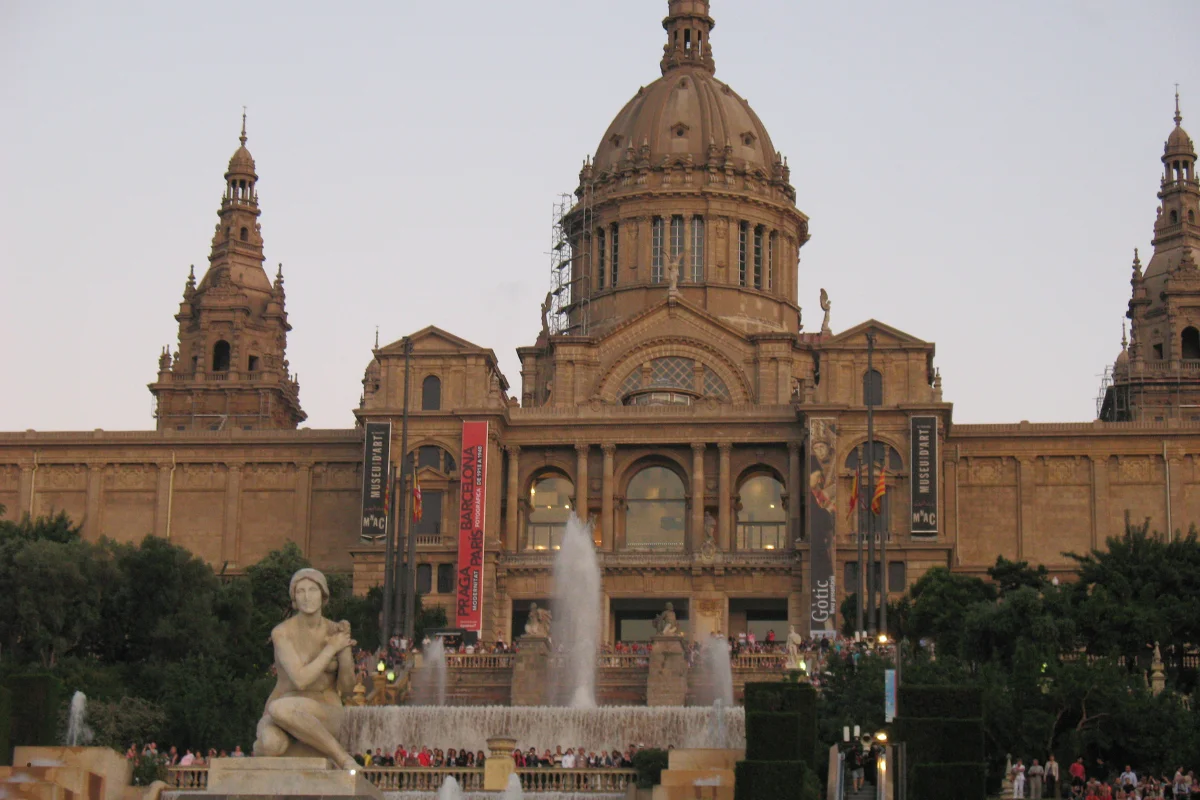
The Museu Nacional d’Art de Catalunya holds the world’s largest collection of Romanesque mural painting. This is not a marketing claim — it is a structural fact that explains why the museum exists and why it has no equivalent anywhere.
Between the late 19th and early 20th centuries, the Romanesque frescoes of Catalan Pyrenean churches were deteriorating without possibility of in-situ restoration. The solution was technically extraordinary: the frescoes were removed from the walls using a consolidation technique involving cloth and plaster, transported to Barcelona, and installed in purpose-built apsidal rooms that replicate the original church spaces. The apses at MNAC are architectural reconstructions of those Pyrenean churches, housing the actual 12th-century frescoes.
The result: you can see the Romanesque murals of Sant Climent de Taüll — including the Maiestas Domini apse, painted around 1123 — in the same spatial arrangement they had in the mountain church, 150 kilometres from where they were created.
Beyond the Romanesque, MNAC covers a thousand years of Catalan art: Gothic, Renaissance, Baroque, and Catalan Modernisme. The Modernisme collection — Ramon Casas, Santiago Rusiñol, period posters and applied arts — is the most complete available in any public museum.
The terrace: the Palau Nacional’s exterior mirador terraces offer one of the best panoramic views of the Montjuïc-Eixample-sea axis in the city, accessible with museum entry. The €2 terrace-only option (without museum access) is worth knowing about — covered in the Montjuïc Barcelona guide.
Pricing: €12 general. Free Saturdays from 15:00 and first Sunday of the month.
📍 Palau Nacional, Parc de Montjuïc. Metro Espanya (L1/L3) + escalators.
Fundació Joan Miró — The Building Designed for the Collection
The Fundació Joan Miró building was designed by Josep Lluís Sert — Miró’s personal friend and one of the most important architects of Catalan rationalism — so that Mediterranean light would enter in a controlled way and illuminate the works without damaging them. This is not a museum installed in an existing building: the building and the collection were conceived together.
With over 14,000 works — paintings, sculptures, textiles, ceramics, drawings, and prints — it is the most complete archive of Miró’s work available to the public. The permanent collection covers his entire trajectory from early figurative work through his period of maximum symbolic synthesis, when his paintings reduced to primary colours, lines, and forms that function almost as ideograms.
The sculpture terrace has views over Montjuïc and the Mediterranean — the space where the integration of work, architecture, and landscape is most evident.
Pricing: €14 general. Included in the Articket.
📍 Parc de Montjuïc s/n. Funicular from Metro Paral·lel (L2/L3).
MACBA — The Museum and Its Plaza
The MACBA in El Raval has two parts that function independently: the museum and the exterior plaza.
The MACBA plaza — designed by Richard Meier alongside the building in 1995 — is the most iconic skate spot in Barcelona and one of the most recognised in the world. The combination of smooth pavement, ramps, and stairs with rationalist geometry made it a skater destination before the museum opened. The plaza is entirely public and free.
The museum covers art from the mid-20th century to the present, with emphasis on conceptual art, experimental practices, and Catalan and international artists who worked outside the dominant mainstream. Temporary exhibitions define the museum’s character more than the permanent collection — checking the current programme before visiting is worth the two minutes.
The Richard Meier white glass-and-aluminium facade creates intense light contrasts with the Raval surroundings at certain times of day — one of the most worked photographic framings in the neighbourhood.
Pricing: €12 general. Free first Saturday of the month. Included in the Articket and Barcelona Card.
📍 Plaça dels Àngels 1, El Raval. For the neighbourhood context, the El Raval guide covers the cultural institutions surrounding the MACBA — the CCCB, Filmoteca, and Biblioteca de Catalunya are all within 300 metres.
MUHBA — Walking Over Roman Barcino
The Museu d’Història de Barcelona has its main site beneath the Plaça del Rei in the Gothic Quarter. The entrance descends below medieval plaza level to the ruins of Barcino — the Roman colony founded in the 1st century BC — walked through on suspended walkways over the excavation.
What you see is not a display of extracted objects: it is the original spaces with their functions preserved. A garum factory — the fermented fish sauce that was one of Barcino’s main export products — with production vats still in position. Laundries. Wine cellars. Thermal baths. The 4th-century BC urban grid at actual scale, with 4 metres of visible stratigraphy between the Roman floor level and the medieval above.
The Saló del Tinell (medieval throne room built over the excavation) and the Chapel of Santa Àgata complete the circuit. The MUHBA has multiple sites across the city, but the Plaça del Rei site has the highest density of visible archaeology.
Pricing: €7 general. Free first Sunday of the month and Sundays from 15:00.
📍 Plaça del Rei s/n, Gothic Quarter.
CosmoCaixa — The Museum That Doesn’t Feel Like a Museum
CosmoCaixa is technically a science museum, but that category doesn’t prepare you for what’s inside. The Bosc Inundat (Flooded Forest) is a 1,000-square-metre recreation of the Amazon rainforest with live fauna — caimans, anacondas, arapaima fish, birds — in a space with controlled humidity and temperature. It is not an aquarium or a zoo: it is an ecosystem installation with vegetation, soil, water, and animals integrated in a continuous environment.
The rest of the museum has interactive science logic — physics experiments, geology, palaeontology, a planetarium — but the Flooded Forest is the element with no equivalent in any other museum in Europe.
For families with children, it is the museum with the highest experience density per square metre in the city. For adults without children, the Flooded Forest alone justifies the journey to the upper city.
Pricing: €6 adults. Free under 16. Located in Sarrià-Sant Gervasi.
📍 Carrer d’Isaac Newton 26, Sarrià. FGC Avinguda del Tibidabo.
Moco Museum — Pop Art and Street Art in El Born
The Moco Museum opened in Barcelona in 2021 and quickly became the museum with the highest demand among 25–40 year old visitors. The permanent collection includes Banksy works unavailable in any other museum, alongside Warhol, Basquiat, Haring, Kusama, and contemporary digital artists.
The immersive installations are the Moco’s differentiator: visitors enter the works rather than observe them from outside. The format is closer to experience than to study.
Located three minutes from the Picasso Museum in El Born, making the two a natural morning-of-museums combination.
Pricing: from €18. Not included in the Articket or Barcelona Card.
📍 Carrer de Provença 22, El Born.
Museum Passes — When They Actually Save Money
Articket — €38, 12-Month Validity
Covers six museums: MNAC, MACBA, CCCB, Picasso Museum, Fundació Joan Miró, and Fundació Antoni Tàpies. Includes fast-track access at all — the most relevant benefit is at the Picasso Museum, where queues without advance booking exceed 60 minutes in high season.
Savings vs individual tickets: approximately 45%. The 12-month validity makes it useful even for residents visiting in multiple sessions. For any visitor planning three or more of the six included museums in a single trip, the Articket is the most efficient option.
When it’s NOT worth it: if you’re visiting only one or two museums, or if you’re going during free-access windows (Saturday afternoons at MNAC, Thursday evenings at Picasso), the savings evaporate.
Barcelona Card — From €57, 72/96/120-Hour Validity
Includes unlimited public transport (metro, bus, FGC, tram, airport train) plus free access to the same six museums as the Articket. For anyone who needs to move frequently by public transport and visit multiple museums, the Barcelona Card absorbs the Articket’s value and makes it redundant.
What it doesn’t include: Sagrada Família and Park Güell are only discounts (approximately €7 each), not free. For a Gaudí-focused visit, the Barcelona Card is not the most efficient pass.
Free Access Windows — No Pass Needed
| Museum | Free access |
|---|---|
| Picasso Museum | First Sunday monthly + Thursdays 18:00–21:00 |
| MNAC | First Sunday monthly + Saturdays from 15:00 |
| MACBA | First Saturday monthly |
| Fundació Joan Miró | First Sunday monthly |
| MUHBA | First Sunday monthly + Sundays from 15:00 |
| CosmoCaixa | First Sunday monthly |
Strategy: if your trip includes one or two Sundays, the first Sunday of the month unlocks most museums for free simultaneously. Building the itinerary around that date can eliminate the need for any pass at all.
Is It Worth It?
Picasso Museum: Yes — specifically for what it shows about how Picasso learned before he revolutionised. The Las Meninas series alone is a reason to visit that doesn’t exist anywhere else. Book online or buy the Articket to avoid the queue reality.
MNAC: Yes — the Romanesque collection is globally unique and would be worth visiting even if the rest of the museum didn’t exist. The €2 terrace-only access is one of the best-value options in the city if the full museum isn’t the priority.
Fundació Miró: Yes — if modern art is your focus. The building-collection integration is the kind of thing architecture and art enthusiasts understand immediately. Less compelling if Miró isn’t already interesting to you.
MACBA: Depends. The plaza alone is worth seeing. The museum’s value depends heavily on the current temporary exhibition — checking the programme before buying is worth it.
MUHBA: Yes — and it’s consistently underrated. Walking over Roman ruins at street level in a 2,000-year-old city is an experience that’s easy to take for granted until you’re standing there. Almost no queues, reasonable price.
CosmoCaixa: Yes — the Flooded Forest is genuinely unlike anything else in the city. More so for families, but the Amazon ecosystem doesn’t require children to justify the visit.
Mistakes to Avoid
- Going to the Picasso Museum without booking online. In high season, queue times exceed 60 minutes. The online booking with a timed entry slot costs the same as the door price. There is no reason not to book.
- Buying the Articket if you’re only visiting one or two museums. The maths only work from three museums upward. For one museum, buy the individual ticket. For two, it depends on which two.
- Going to the MNAC for the Gaudí connection. The MNAC doesn’t have Gaudí — it has Romanesque frescoes, Gothic altarpieces, and Catalan Modernisme (Casas, Rusiñol). Gaudí architecture is at Casa Batlló, Casa Vicens, and the Sagrada Família.
- Skipping the MUHBA because it sounds dry. “Museum of History” undersells it considerably. Walking over Roman ruins through suspended walkways in the basement of the Gothic Quarter is one of the most unusual experiences available in any European city.
- Not using the MNAC Saturday free window. Free access from 15:00 every Saturday is the most useful recurring free window in Barcelona’s museum calendar. It’s not well-publicised — most visitors pay full price because they don’t know about it.
- Treating CosmoCaixa as only for children. The Flooded Forest is a 1,000m² live Amazon ecosystem. It doesn’t require children to be worth visiting.
The Picasso Museum is not a general overview
The Picasso Museum is not a general Picasso overview. It is specifically about his formation in Barcelona and the Las Meninas series. Framing it correctly changes whether the visit makes sense for any given visitor.
They don’t flag the queue reality at the Picasso Museum. Sixty minutes in a queue in summer is not a footnote — it’s the difference between a good morning and a wasted one. This belongs in the first sentence of any Picasso Museum recommendation.
They don’t distinguish between Articket and Barcelona Card. Both cover the same six museums. The Barcelona Card adds transport. Recommending one without the context of the other — or without the transport calculation — produces expensive decisions.
Best Strategy by Time and Budget
Got 2–3 hours: Picasso Museum (booked online, 90 minutes inside) → MUHBA if afternoon (free from 15:00 on Sundays). Both in El Born, 5 minutes on foot between them.
Half-day: MNAC on a Saturday after 15:00 (free) → Fundació Miró (on the same Montjuïc hill, 15 min walk). The Montjuïc complete guide maps the routing between them.
Full-day museum programme: Morning: Picasso Museum (booked, El Born). Afternoon: MACBA + CCCB (El Raval, 5 min metro from El Born). Evening: MNAC terrace (€2, from Plaça d’Espanya, Font Màgica if the schedule aligns).
1-Day Museum Plan:
- 9:30: Picasso Museum — pre-booked, timed entry. 90 minutes for the full collection including Las Meninas (60 minutes minimum).
- 11:30: Walk to MUHBA, Plaça del Rei (10 min on foot). 45 minutes over the Roman excavation.
- 13:00: Lunch in El Born — the best tapas in Barcelona guide covers Bar del Pla and Cal Pep, both within 5 minutes.
- 15:00: Metro to Plaça d’Espanya → MNAC (free from 15:00 on Saturdays). 2 hours inside + terrace.
- 18:00: Font Màgica (free, if Thursday–Saturday and in season) from the MNAC steps.
Frequently Asked Questions
What is the most visited museum in Barcelona?
The FC Barcelona Museum / Camp Nou Experience leads on total entry numbers. Among art and culture museums, the Picasso Museum is first, followed by Fundació Joan Miró and MNAC. The Moco Museum has the highest relative demand for a recently opened institution.
Is the Articket worth it in Barcelona?
Yes — if you visit three or more of the six included museums. Savings are approximately 45% versus individual tickets. The 12-month validity allows multiple visits. Fast-track at the Picasso Museum, where queues without booking exceed 60 minutes in high season, is the most tangible benefit.
When are Barcelona museums free?
Most public museums are free on the first Sunday of the month. MNAC is free Saturdays from 15:00. MUHBA is free Sundays from 15:00. Picasso Museum is free Thursdays 18:00–21:00. See the full table above.
How many museums can you see in one day in Barcelona?
Two museums with adequate time for each — 90 minutes to 3 hours per museum depending on size. Three is possible if combining one large museum (MNAC, Picasso) with two compact ones (Tàpies, CCCB). More than three in a single day doesn’t allow quality visits to any of them.
Is CosmoCaixa only for children?
No. The 1,000m² Flooded Forest with live Amazon fauna is an installation with no equivalent in Europe that justifies the visit regardless of age. The complete museum also has interactive physics, geology, and a planetarium. For adults without children, the Flooded Forest is the primary argument.
Which museums are NOT included in the Articket or Barcelona Card?
Moco Museum, Sagrada Família, Park Güell, Casa Batlló, La Pedrera, CosmoCaixa, and the FC Barcelona Museum are not included in either pass. For Gaudí sites, the 3 Houses Combo Pass (Casa Batlló + La Pedrera + Casa Vicens) is the most efficient option.
Final Insight
The Picasso Museum and the MNAC answer the question what makes Barcelona’s museum landscape different from other major European cities more precisely than any other combination. The Romanesque collection at MNAC exists because a generation of Catalan scholars decided that 12th-century mountain frescoes were worth physically removing and transporting to preserve them. The Picasso Museum exists because Barcelona is where Picasso learned to paint — and that origin story is more interesting than the mature work most people already know.
Continue the Cultural Route
For the full Montjuïc context — including the MNAC, Fundació Miró, and access routes — the Montjuïc Barcelona complete guide maps the hill as a full day with pricing and timing for each site.
For the El Born neighbourhood that surrounds the Picasso Museum — including El Raval and the MACBA — the best art galleries in Barcelona guide covers the commercial gallery scene that operates in parallel with the public institutions.
And for planning the budget across museums, transport, and food, the Barcelona travel budget guide has the full cost breakdown for a cultural-focus visit at different spending levels.