
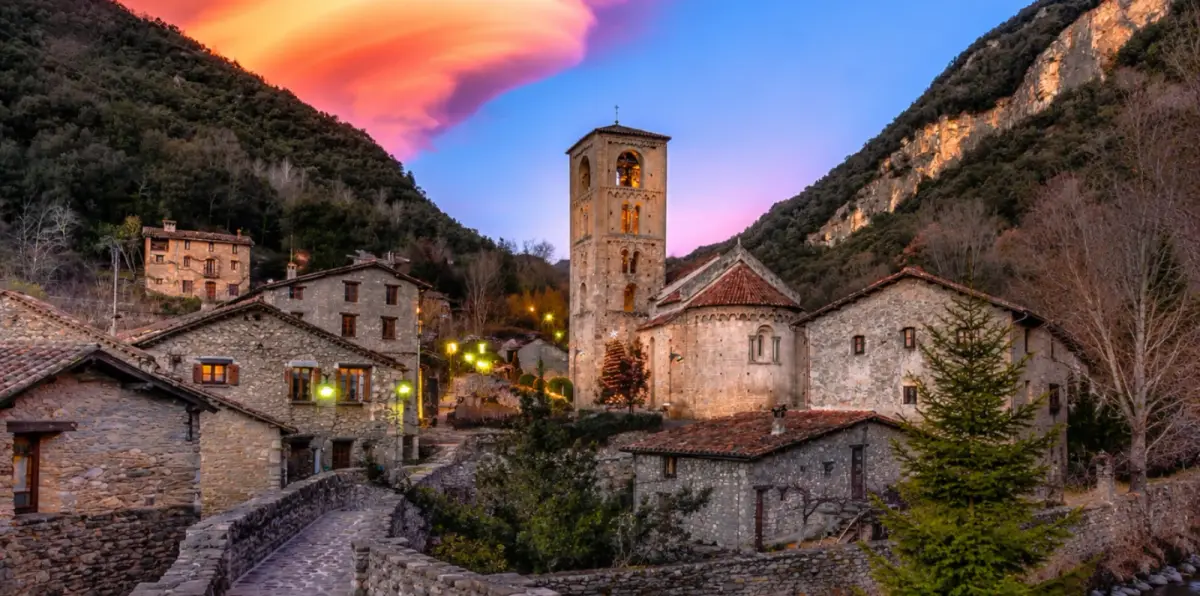

Getting to Beget takes about 2 h 45 from Barcelona and a stretch of narrow mountain road, and that effort is exactly what has kept it unspoiled. Hidden in a valley of the Alta Garrotxa, this stone hamlet keeps its cobbled lanes, a Romanesque church with a little-known treasure inside and a medieval feel that’s rare so close to the coast. The real reward isn’t the drive but the quiet at the end of it. Here’s what to see and how to plan the visit.
The essentials in 30 seconds
- ✅ Romanesque church of Sant Cristòfol, with a 22-metre bell tower
- ✅ The Majestat de Beget: a wooden carving nearly 2 metres tall, inside
- ✅ Two medieval stone bridges over the river Llierca
- ✅ Stone houses and cobbled streets; walkable in under 1 hour
- 🚗 About 2 h 45 from Barcelona; narrow road in from Camprodon
- 🅿️ Free parking at the entrance; arrive before 11 at weekends
What is there to see in Beget? The essentials are its 12th-century Romanesque church of Sant Cristòfol, with a 22-metre bell tower holding the Majestat de Beget inside, a wooden carving nearly two metres tall. Outside, its two medieval stone bridges over the river Llierca are the most photographed image. The village, all stone houses and cobbled streets, takes under an hour to walk. It’s about 2 h 45 from Barcelona.
Sant Cristòfol and the Majestat de Beget
It’s the heart of the village and its main reason to visit. Sant Cristòfol is a Romanesque church documented from the 12th century, whose tower bell tower, some 22 metres tall and four storeys high, rises over the houses and can be seen from around the valley. According to experts, it is one of the best-preserved examples of rural Romanesque in the area.
Inside it holds its most valuable piece: the Majestat de Beget, a polychrome wooden carving nearly two metres tall depicting Christ, one of the landmark works of Catalan Romanesque. Its story adds feeling to the visit, because the villagers hid it during the Civil War to save it from the flames. Seeing it in place, in the dim light of the church, is the best reason to step inside.
The medieval bridges and the stone village
If there’s one image of Beget, it’s its two medieval stone bridges over the river Llierca, which connect the different parts of the core and make the most photographed scene. Around them, the village is a weave of rubble-stone houses with timber frames and windows, cobbled streets and corners that invite you to slow down.
There are no grand monuments beyond the church and the bridges, and that’s exactly the appeal: here the plan is to wander without hurry, take photos and take in the quiet, especially in the late afternoon when the day walkers leave. With fewer than 30 residents and no souvenir shops, Beget keeps a rural feel that’s hard to find this close to the coast. According to official data, the whole core is protected as a national cultural asset.
Half a morning in Beget and the river pools
You can see all of Beget in under 1 hour, so the ideal visit is a quiet morning. A natural route starts at the church of Sant Cristòfol, with the Majestat de Beget inside, drops to the two medieval bridges over the river Llierca, the classic photo, and gets pleasantly lost in the cobbled lanes. That’s the essentials covered.
In summer there’s a bonus: the pools of the Beget stream are a good spot for a cold-water dip after the walk, and short routes through the Alta Garrotxa, like the circular one to Rocabruna, let you stretch the morning. Experts recommend arriving early, as the car park at the entrance fills up at weekends.
Beget with kids and how to combine the visit
Beget is an easy, safe village for children: no traffic, the river running through, and very short distances. The summer pools and the stone bridges tend to go down well, and with no compulsory long walks it works for all ages.
As the village takes a morning to see, the best plan is to combine it. Under 40 minutes away is Camprodon, with its Pont Nou and its biscuits, and under an hour, Queralbs and the Vall de Núria. A day through the Ripollès and the Alta Garrotxa is enough for Beget plus one or two nearby villages at an unhurried pace. For more ideas, the hiking near Barcelona guide has routes for every level.
Getting to Beget and what to know
This is the part to plan. Beget is in the Alta Garrotxa but belongs to Camprodon (Ripollès), and it’s reached by narrow, winding roads: from Camprodon it’s about 17 kilometres and 30-40 minutes, and it can also be reached from Oix. The core is pedestrian, with free parking at the entrance. This is the quick reference.
| Good to know | Beget |
|---|---|
| Where | Alta Garrotxa (belongs to Camprodon, Ripollès) |
| Residents | Fewer than 30 |
| From Barcelona | ≈2 h 45 by car |
| Parking | Free at the entrance; pedestrian inside |
| Mobile signal | Weak, download the map first |
One practical note: arrive before 11 at weekends to find parking, as the small lot fills fast. To price the break, the Barcelona travel budget is a useful reference, and the best time to visit Barcelona helps you pick dates.
Common questions
What is there to see in Beget?
The essentials are its Romanesque church of Sant Cristòfol, with its 22-metre bell tower and the Majestat de Beget carving inside, and its two medieval stone bridges over the river Llierca, the village’s most photographed image. The rest is wandering slowly through its cobbled streets and stone houses, which takes under an hour.
How do you get to Beget?
Beget is in the Alta Garrotxa and the access is by narrow, winding roads, mainly from Camprodon (about 17 kilometres, 30-40 minutes) or from Oix. There is free parking at the entrance to the village, as the core is pedestrian. At weekends it’s worth arriving before 11 in the morning to find a space.
How far is Beget from Barcelona?
Beget is about 2 hours 45 minutes by car from Barcelona. The distance isn’t huge, but the last kilometres from Camprodon are narrow, slow mountain road, so allow extra time. Administratively it belongs to Camprodon, in the Ripollès, although the landscape is that of the Alta Garrotxa.
What is the Majestat de Beget?
It is a Romanesque carving in polychrome wood, nearly two metres tall, depicting Christ, kept in the church of Sant Cristòfol. It is one of the most valuable pieces of Catalan Romanesque, and the villagers hid it during the Civil War to save it from destruction. Today you can see it inside the church.
Is there hiking near Beget?
Yes. Several routes through the Alta Garrotxa start from Beget, among woods and mountains. One of the best known is the circular route along the old smugglers’ paths to Rocabruna, about 13 kilometres. In summer, the pools of the Beget stream are a good place for a swim after the walk.
Can you visit Beget with kids?
Yes, it’s an easy, safe village for children: no traffic, the river running through, and very short distances. The summer pools and the stone bridges tend to go down well, and with no compulsory long walks it works for all ages. It’s worth arriving early at weekends to park easily at the entrance to the village.
Which villages can you combine Beget with?
As Beget takes a morning to see, the best plan is to combine it. Under 40 minutes away is Camprodon, with its 12th-century Pont Nou and its biscuits, and under an hour, Queralbs and the Vall de Núria. A day through the Ripollès and the Alta Garrotxa is enough for Beget plus one or two nearby villages at an unhurried pace.
Beget is one of the Ripollès stops on the route through the prettiest villages in the Catalan Pyrenees, and it pairs well with Queralbs and the Vall de Núria, under an hour away. It also fits with the medieval villages of inland Catalonia. For more ideas, villages near Barcelona and weekend getaways from Barcelona close the trip.
Beget takes a morning to see and has no souvenir shop, yet few villages in Catalonia keep their medieval feel so completely intact.