
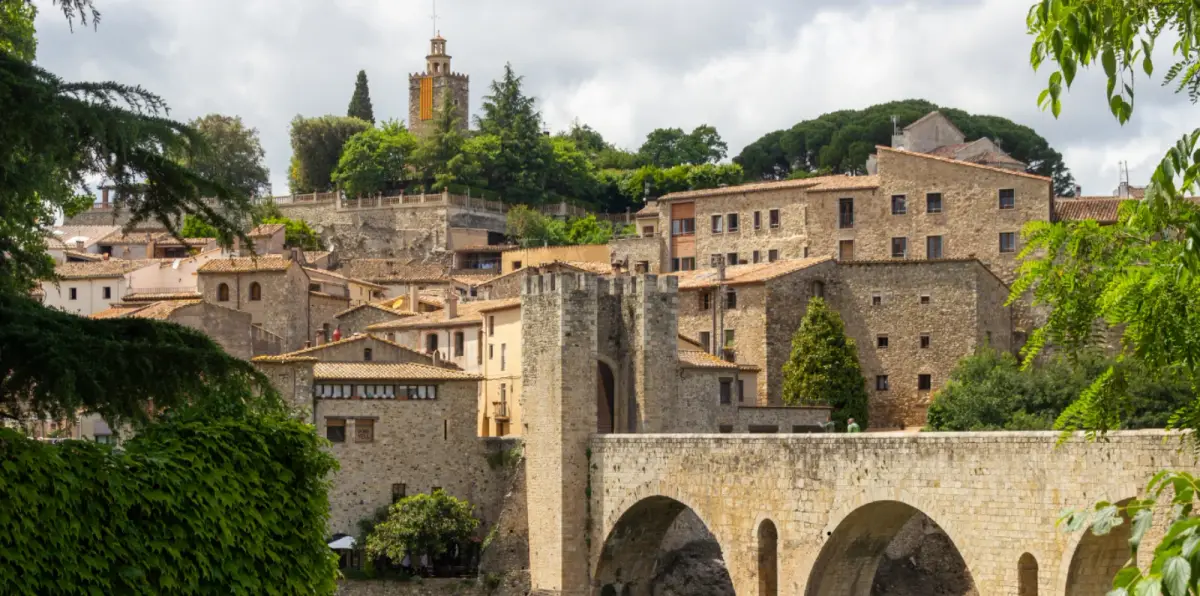

When you walk into a medieval village in inland Catalonia, what you see is not set dressing but thousand-year-old frontier engineering. The adjoining houses forming a sealed ring, the square towers of rough stone, the rows of small arches under the church roofs: every element answers a concrete need of defence, control or survival. Which villages to visit is the easy half. How to read them is the half that turns a pretty walk into a journey you understand.
Where can you see the best medieval architecture near Barcelona? In the inland villages of Catalonia, built between the 9th and 15th centuries on rocky outcrops for defence. Besalú is the quintessential example, with a 12th-century Romanesque bridge; Cardona crowns its castle over a salt valley; Montfalcó Murallat is the purest villa closa, where the houses form the wall. They sit one to two hours from Barcelona, mostly reachable by car.
The Marca Hispànica, why these villages are where they are
Before looking at a single building, it helps to understand the mental map that ordered them. Between the 9th and 11th centuries, inland Catalonia was the Marca Hispànica, a buffer zone between the Carolingian world and Al-Andalus. That frontier condition dictated a way of building geared to survival, where urbanism bent to the topography to guarantee visual control and impregnability. Settlements were raised systematically on rocky outcrops.
The relief was not scenery, it was architecture. A high crag gave control over the roads, a river at its foot served as a natural moat, and a cliff removed an entire flank of attack. That is why the villages most spectacular for their setting, like Rupit on its rock at 845 metres or Castellfollit de la Roca perched on a basalt cliff of some 50 metres, did not choose those positions for the view but for defence. The view, today their main draw, was a side effect of war. To place each village in a day trip, lean on the best villages near Barcelona guide.
The villa closa, when the houses are the wall
Here is the concept that changes how you look at a walled village. According to experts in medieval architecture, the villa closa is a model of collective defence where the houses share party walls and also serve a defensive function built into the outer perimeter. The thick rear walls of the houses form the wall. The village does not have a wall: the village, literally, is the wall, with limited, controlled access points that allowed it to withstand cavalry raids.
The supreme example is Montfalcó Murallat, in the Segarra, at 602 metres above the confluence of the Sió river. Barely fifteen houses joined side by side close the circle without a gap, with a single entrance, the Portal de la Vila Closa, a round arch connecting to the central square where a cistern still stores rainwater. That low density, with around twenty actual residents, has frozen the village in its medieval dimensions forever, because the structure prevents any outward growth. It is an urban fossil that teaches more about medieval defence than any book, the kind of place worth pairing with the first-time visitor guide to Barcelona for a full trip.
A visual glossary for reading these villages
Once you know the vocabulary, you see it everywhere. This is the shorthand for what your eyes are catching.
| Element | What it is | Where to see it |
|---|---|---|
| Villa closa | Houses whose rear walls form the perimeter wall | Montfalcó Murallat |
| Lesenes and blind arches | Vertical bands topped by decorative arches, not windows | Sant Vicenç de Cardona |
| Round arch and barrel vault | Semicircular arch extended into a heavy stone ceiling | Romanesque church interiors |
| Arrow-slit windows | Very narrow openings forced by thick walls | Any Lombard church |
| Square bell tower | Multi-storey tower with paired windows | Pre-Pyrenean villages |
How to read Lombard Romanesque on a wall
The style that defines these churches has an exterior signature you will see everywhere once you know it. According to experts in medieval art, Lombard Romanesque reached Catalonia in the 11th century through the master builders who came from Lombardy, in northern Italy, the so-called magistri comacini. Its great promoter was Abbot Oliba of Ripoll, and its unmistakable trait is the exterior decoration: vertical stone bands projecting from the wall, the lesenes, topped by rows of small blind arches that are not windows but pure relief.
That graphic, rhythmic pattern is the Catalan signature par excellence, completed by square bell towers of several storeys, each with paired windows of two arches split by a slender column. The masterpiece of the style is the church of Sant Vicenç in Cardona castle, begun in 1020 and consecrated around 1040, with a barrel vault on transverse arches and 19 metres of austere height. The near-simultaneous building of Ripoll in 1032, Vic cathedral in 1038 and Cardona in 1040 shows the force with which the style spread inland.
The interior skeleton, why the walls are so thick
What holds up the roof explains everything else about the building. Romanesque solved its ceilings with stone instead of wood to avoid fires, and that change multiplied the weight and defined the rest of the elements, as the 19-metre nave at Cardona shows. The round arch, a perfect semicircle, channels the weight of the stones above to the side pillars; extended in depth, it generates the barrel vault, a heavy continuous curved ceiling reinforced by transverse arches, the building’s ribs.
The consequence shows in the walls. Because the vault pushes the weight sideways and not only down, the walls had to be extremely thick so the building would not split open, which prevented large windows. Hence the arrow-slits, very narrow openings that create dim interiors with strong contrasts of light. That chiaroscuro atmosphere, so photogenic today, was not an aesthetic decision but the only technical answer to a problem of weight. It is the same principle visible in the medieval architecture across these villages, where stone rules over opening.
Besalú, a thousand years layered in stone
The quintessential medieval town condenses this whole history in a single enclosure. Besalú, in the Garrotxa, was capital of an independent county until it joined the County of Barcelona in 1111, and its name comes from the Latin Bisuldunum, fortress between two rivers. Its iconic image is the Pont Vell, the fortified Romanesque bridge of the 12th century over the Fluvià, with its angular layout that served as both crossing and access control to the town.
Inside is a legacy few villages keep. The monastery of Sant Pere, founded in 977 by the count-bishop Miró Bonfill, is the relic of the old Benedictine house, and the Jewish quarter holds a mikvah, a Jewish ritual bath of the 13th century discovered by accident in 1964, one of three preserved on the entire Iberian Peninsula and a listed cultural site. Walking Besalú is reading vertically: the castrum atop the hill, the burg on the slopes, the churches as landmarks of the houses. It is the most complete lesson in medieval urbanism you can get in a day, and it sits within reach of the best things to see in Barcelona.
Cardona, the power of salt turned to stone
Some villages make no sense without the resource that made them rich. Cardona, 90 kilometres from Barcelona, owes its grandeur to the Salt Mountain, a diapir 120 metres tall and visible that gave its lords white gold, a resource essential for preserving food in the Middle Ages. That wealth made the Cardonas kings without a crown, ranked only below the royal house, and financed one of the most sophisticated fortified complexes on the peninsula.
The castle, founded around 886 by Wilfred the Hairy, the same who raised Ripoll, covers some 62,000 square metres over the Cardener valley. It houses the collegiate church of Sant Vicenç, an exponent of early Lombard Romanesque, and the Torre de la Minyona, of the 11th century, wrapped in legend. Its strategic weight peaked in 1714, when it was the last Austracist stronghold to surrender to Bourbon troops, holding out a week longer than Barcelona itself. Today the complex is a Parador, and the visit fits a full-day escape well.
The cliff villages, architecture against the terrain
There is a group of villages where rock is not base but protagonist. Rupit i Pruit, in the Collsacabra, rises at 845 metres on a rocky crag, with stepped streets carved into the bedrock and a suspension bridge over the stream. Unlike pure Romanesque, Rupit stands out for its sturdy stone houses of the 16th and 17th centuries, with heavy wooden balconies, and for its closeness to the Salt de Sallent, one of the tallest waterfalls in Catalonia. There is no car access, so it pays to arrive early before the car park fills.
Peratallada carries the idea in its name: it means cut stone, because the village was sculpted directly into the sandstone rock. It preserves one of the best-kept ensembles of medieval civil architecture in Catalonia, with a triple walled enclosure and a moat dug into the rock that reaches seven or eight metres deep. Both prove that in these villages the stone was not brought in but worked on site, and that direct relationship with the terrain explains their unique texture. To plan the timing of these escapes, the best time to visit Barcelona guide lays out the seasons.
Frequently asked questions about medieval villages in inland Catalonia
What is a villa closa in Catalonia’s medieval villages?
It is a walled core where the thick rear walls of the houses form the defensive perimeter itself. The village does not have a wall; the village is the wall. The supreme example is Montfalcó Murallat, with around 15 adjoining houses closing the circle and a single entrance gate.
How do you recognise Lombard Romanesque in a Catalan village?
By its exterior decoration: vertical stone bands (lesenes) topped by rows of small blind arches that are not windows but relief. Add square bell towers of several storeys with paired windows and semicylindrical apses. The defining work is Sant Vicenç de Cardona, consecrated around 1040.
Why are inland medieval villages built on rocky outcrops?
For frontier defence. Between the 9th and 11th centuries, inland Catalonia was the Marca Hispànica, a buffer zone against Al-Andalus. Settlements were built on rocky crags for visual control and impregnability, turning the natural relief into the first line of defence.
Which is the best-preserved medieval village in inland Catalonia?
Besalú, in the Garrotxa, is the quintessential medieval town, capital of an independent county until it joined the County of Barcelona in 1111. It keeps its 12th-century Romanesque Pont Vell, the monastery of Sant Pere founded in 977, and a 13th-century mikvah, one of three medieval Jewish ritual baths on the Iberian Peninsula.
These villages are not visited but read: every stone and every blind arch is a sentence in a thousand-year-old language.