

Queralbs sits about 2 h from Barcelona, at the point where the mountain road simply stops. This small Ripollès hamlet marks the last stretch of tarmac before the Vall de Núria, and almost everyone treats it as a doorway rather than a destination. That’s a shame, because its Romanesque church earns a stop of its own. Below: the church, the climb to Núria and the practical details.
The essentials in 30 seconds
- ✅ Romanesque church of Sant Jaume, with a six-arch porch and carved capitals
- ✅ It’s the gateway to the Vall de Núria: reached only on foot or by rack railway
- ✅ The old path to Núria: about 7 km through a gorge with waterfalls
- ✅ Last village reachable by car; stone houses and valley views
- 🚗 About 2 h from Barcelona, works as a day trip
- 🚞 The rack railway runs from Queralbs and Ribes de Freser up to Núria (1,964 m)
What is there to see in Queralbs? The essentials are its Romanesque church of Sant Jaume, with a six-arch porch on columns with carved capitals, and its stone core with views over the valley. But Queralbs is above all the gateway to the Vall de Núria (at 1,964 m), reached only on foot or by the historic rack railway. The classic Camí Vell trail starts here. It’s about 2 h from Barcelona.
The church of Sant Jaume and its porch
It’s the village’s monument and worth the first stop. Sant Jaume is a 12th-century Romanesque church, built over an earlier temple documented centuries before, whose most singular feature is outside: a porch with six round arches on columns topped by carved capitals. According to experts, it is one of the finest Romanesque porches in the Pyrenees, and it has given Queralbs a reputation as a privileged balcony over the valley.
Around the church, the village keeps its layout of sloping stone streets, and in the lower part there are remains of the old castle of Queralbs. It’s a small place, walked in a short while, so the village visit is usually the prelude to what almost everyone comes to do: go up to Núria.
Gateway to the Vall de Núria
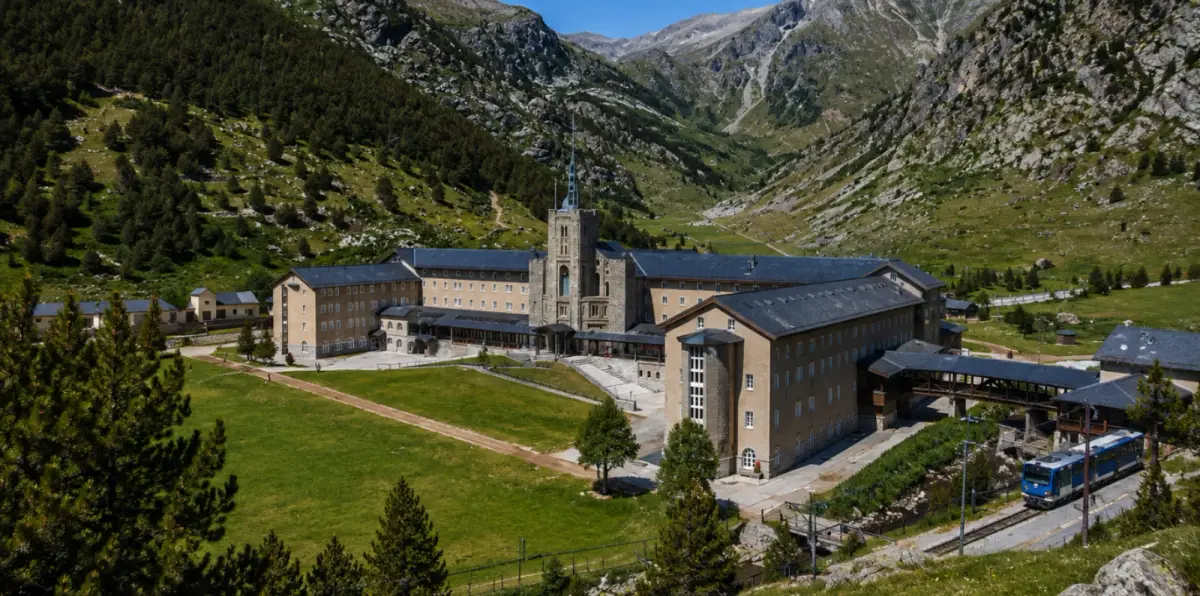
Here is the main reason to come to Queralbs. The village is the last point reachable by car before the Vall de Núria, a high-mountain valley at 1,964 metres with a landmark sanctuary, a lake, woods and trails, plus a small ski station in winter and a family activity park. Núria can’t be reached by private vehicle: you go up only on foot or by the historic rack railway, which leaves from both Queralbs and Ribes de Freser.
That access restriction is exactly what has protected the setting and turned it into a haven of nature. The rack-railway climb, gaining height between mountain walls, is itself one of the Pyrenees’ experiences, and the full valley guide is in the car-free Vall de Núria.
Walking to Núria and the waterfall trails
If you prefer your legs to the train, the Camí Vell from Queralbs to Núria is one of the classic Catalan hikes: about 7 kilometres through a dramatic gorge that passes waterfalls like the Cua de Cavall and the Salt del Sastre. Experts recommend walking up and taking the railway down to spare your knees, and allowing about 3 to 4 hours.
For something shorter, the Salt del Grill route, around 4 kilometres, leads to another pretty waterfall with barely any climb. The whole area belongs to the Capçaleres del Ter i del Freser natural park, with satellite hamlets like Fustanyà, which keeps its own 12th-century Romanesque church.
The Vall de Núria with kids
Queralbs and the Vall de Núria are a plan families enjoy. The easiest way up with children is the rack railway, an adventure in itself, climbing between mountain walls. At the top, in Núria, at 1,964 metres, there’s a lake with rowing boats, a small activity park and flat walks that suit any age, plus a simple ski station in winter.
The Camí Vell on foot, by contrast, is more demanding for its ascent, so with young children it’s usually better kept for the descent or another trip. Experts recommend checking the rack-railway timetable before going up, especially in high season and at weekends. For more ideas, the hiking near Barcelona guide has routes for every level.
Parking, where to eat and where to sleep
The practical bit: in Queralbs you park at the entrance to the village or by the rack-railway station, as the centre has narrow, steep streets. As a small village of fewer than 200 residents, its choice of restaurants is limited; plan for that, and if you go up to Núria there are catering services there.
To sleep, Queralbs has small, characterful places, and a different option is to stay up in the Vall de Núria sanctuary, which works as a mountain hotel: waking in the valley, without the day walkers, is hard to match.
Getting to Queralbs and visiting tips
From Barcelona it’s about 2 hours by car via the C-17 towards Ripoll and Ribes de Freser, so Queralbs does work as a day trip, especially combined with Núria. You can also take the Rodalies train to Ribes de Freser and connect with the rack railway. These are the ways up.
| To Núria from Queralbs | How | Note |
|---|---|---|
| On foot (Camí Vell) | ~7 km, about 3-4 h | Gorge and waterfalls |
| Rack railway | A few minutes | Also runs from Ribes de Freser |
| By car | Not possible | Queralbs is the last road access |
Summer and autumn shine for hiking, in line with the best time to visit Barcelona; winter covers Núria in snow. To price the trip, the Barcelona travel budget is a useful reference.
Common questions
What is there to see in Queralbs?
The essentials are its Romanesque church of Sant Jaume, with a six-arch porch on columns and carved capitals, and its stone core with viewpoints over the Vall de Ribes. As the village is small, the visit is rounded off by going up to the Vall de Núria by rack railway or on foot along the old path, which is the main reason to come this far.
How do you get from Queralbs up to the Vall de Núria?
There are two ways, because Núria can’t be reached by car. The easiest is the rack railway, which leaves from Queralbs and Ribes de Freser and climbs in a few minutes. The finest is on foot along the Camí Vell, about 7 kilometres through a gorge that passes waterfalls like the Cua de Cavall and the Salt del Sastre. Queralbs is the last village reachable by car.
How far is Queralbs from Barcelona?
Queralbs is about 2 hours by car from Barcelona, in the Vall de Ribes, in the Ripollès (Girona). Given the distance, it does work as a day trip, especially combined with the climb up to the Vall de Núria. You can also take the Rodalies train to Ribes de Freser and connect there with the rack railway.
What is special about the church of Sant Jaume in Queralbs?
It is a 12th-century Romanesque church, rebuilt over an earlier one, and its most striking feature is the outer porch, with six round arches on columns topped by carved capitals. According to experts, it is one of the finest Romanesque porches in the Pyrenees, and it has earned the village a reputation as the area’s prettiest balcony.
What hikes are there from Queralbs?
The most classic is the Camí Vell from Queralbs to Núria, about 7 kilometres. For something shorter, the Salt del Grill route, around 4 kilometres, leads to a pretty waterfall. The whole area is part of the Capçaleres del Ter i del Freser natural park, with nearby hamlets like Fustanyà, which has its own Romanesque church.
Can you go up to the Vall de Núria with kids?
Yes, and it’s a plan families enjoy. The easiest way is the rack railway, an adventure in itself. At the top, in Núria, at 1,964 metres, there’s a lake with rowing boats, a small activity park and flat walks that suit any age. The Camí Vell on foot is more demanding for its ascent, so with young children the rack railway is usually the better way up.
Where do you park and sleep in Queralbs?
In Queralbs you park at the entrance to the village or by the rack-railway station, as the centre has narrow, steep streets. As a small village, its choice of restaurants is limited. To sleep there are small, characterful places, and a different option is to stay up in the Vall de Núria sanctuary, which works as a mountain hotel.
Queralbs is one of the Ripollès stops on the route through the prettiest villages in the Catalan Pyrenees, and its natural continuation is the car-free Vall de Núria. It pairs well with medieval Beget, under an hour away. For more ideas, villages near Barcelona and weekend getaways from Barcelona close the trip.
Queralbs takes little time to see, but it’s the perfect start for the Vall de Núria — a stop worth planning into any Pyrenees trip.