
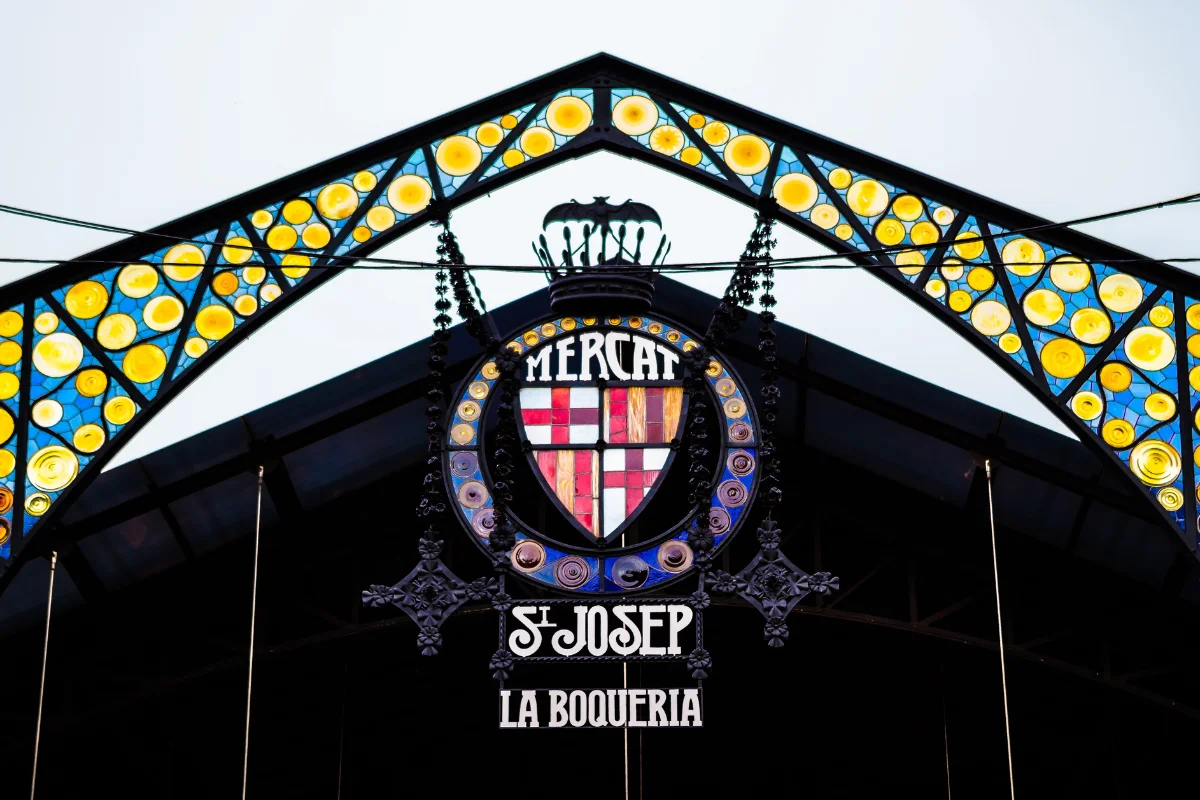

La Boqueria receives 23.2 million visitors a year. The Sagrada Família gets around 4.5 million. That single comparison explains the central tension the market has been managing for over a decade: too much tourism to function as a neighbourhood market, too much history to become a theme park.
The first documented reference to market stalls on this site dates from 1217. The iron roof that gives the building its distinctive silhouette is from 1914. A €12 million renovation launching in summer 2026 — with the market staying open throughout — will address the asbestos in that same roof while reorganising the internal layout. Between those three moments, eight centuries of the city negotiating with its most famous commercial space.
Practical details:
- Address: La Rambla, 91
- Hours: Monday–Saturday 8:00–20:30, closed Sundays
- Entry: free
- Metro: Liceu (L3)
- Size: 2,583 m², over 300 stalls
Why the market is called La Boqueria
The name doesn’t come from any gastronomic metaphor. It comes from boc — goat in Catalan. The Llano de la Boqueria was the site in the 13th century where livestock traders, specifically goat dealers, conducted their transactions outside the city walls. The word survived eight centuries after the goats disappeared.
The formal market structure arrived after a fire. In 1835, during the “Burning of the Convents” — a night of political anti-clerical violence — the Sant Josep convent on La Rambla was burned and demolished. The cleared site was the opportunity the city had been waiting for. On 19 March 1840 — the feast of Saint Joseph — the first stone of the current building was laid according to a design by architect Josep Mas i Vila.
A detail that prefigures the market’s current tensions: in 1802, before a visit by King Charles IV, the city authorities removed all the market stalls to the convent garden next door — purely for aesthetic reasons, so the royal procession would see a clean Rambla. The conflict between Barcelona’s public image and the functioning commercial market is not a product of mass tourism.
The architecture: three layers on the same ground
The iron roof of 1914 — what makes it photogenic and problematic
The visual identity of La Boqueria — the filtered light falling on the stalls, the photogenic interiors — comes almost entirely from the iron canopy installed between 1914 and 1916 by La Maquinista Terrestre y Marítima, under the technical direction of Joan Torras i Guardiola, nicknamed the “Catalan Eiffel” for his structural iron work.
The Art Nouveau entrance arch from La Rambla, designed by Antoni de Falguera in 1913, adds stained glass, municipal heraldry and trencadís tilework. The market sits within the same stylistic timeline as the Barcelona Modernisme route, though almost no architecture guides include it in Modernista itineraries.
The reason the renovation runs in phases: the 1914 roof contains asbestos. Replacing it is one of the central technical challenges of the 2026 renovation — work that has to be managed while the market operates, which is why the project will be done in phases alternating the mountain side and the sea side of the building.
The Gardunya entrance — the Raval side that most visitors miss
The Plaça de la Gardunya — the rear entrance to the market from El Raval — was redesigned by architect Carme Pinós. The intervention added 1,020 m² of market surface and converted what had been a purely logistical loading area into a proper urban facade. Loading operations moved underground.
The result: two entrances of equal dignity. Most tourists arrive from La Rambla and leave from La Rambla. Entering from the Gardunya and walking through toward La Rambla reverses the experience and gives access to the stalls with the least tourist traffic first.
The stalls that define the market’s character
La Boqueria has around 300 stalls. The ones that define its identity are the ones that have been operating for decades or generations.
Menuts Rosa is the most extreme case of continuity: a casquería stall (offal — tripe, trotters, organ meats) run by four generations of women — Sisqueta, Quima, Francisca and Rosa — for 122 years. Sisqueta Grau founded it over a century ago and worked until the day before a surgery at age 72. The stall currently supplies reference restaurants across the city.
Bolets Petràs is the specialist mushroom and wild-product stall. The stall developed the Montseny wasabi in collaboration with the Alicia Foundation — a locally grown wasabi product that emerged from applied research between mountain producers and chefs. It illustrates how the most specialised stalls in La Boqueria function as nodes in the city’s gastronomic R&D network.
El Quim de la Boqueria (stall 582) started in 1987 with 3 metres of counter and 5 stools. It’s now internationally recognised for its fried eggs with baby squid and top-quality anchovies. Around 15 seats, queues start building after 10am.
Direkte Boqueria: 14 m² of chef’s kitchen with 1 Sol from the Guía Repsol, led by chef Arnau Muñío. The most technically ambitious food offer in the market. Advance booking strongly recommended.
Bacallà Carme Gomà: 45+ years of specialisation in salt cod from Iceland. The same specific focus since day one.
Quick decision: what kind of Boqueria visit do you want?
Is La Boqueria worth visiting? Yes — with the right timing. The market has over 300 stalls, an 1840 building with a 1914 iron roof, and some of the most specialised food vendors in Barcelona. Before 10am on weekdays it functions as a real market. After 11am on weekends it’s primarily a tourist experience. Free to enter. Metro Liceu (L3).
- To experience the market the way locals use it → arrive between 8:00 and 10:00, Monday–Friday — full product selection, navigable aisles, real purchasing activity at the counters
- Best counter for breakfast without a long wait → El Quim de la Boqueria (stall 582) before 10am on weekdays; weekend waits can be substantial
- Best fine-dining experience in the market → Direkte Boqueria, 14 m², 1 Sol Repsol — book ahead
- Most unusual product in the market → Bolets Petràs for seasonal mushrooms, Montseny wasabi and items that don’t exist outside the professional supply chain
- Best offal and specialist butchery → Menuts Rosa, 122 years, four generations — tripe, trotters, organ meats supplied to top restaurants
- To avoid the tourist entrance → enter from the Gardunya side (Raval), walk through toward La Rambla — significantly less congested, the same stalls in a different order
- If you’re short on time in Barcelona → yes, worth 45 minutes before 10am; not worth it after 11am on a weekend when it’s at its most crowded
The Bar Pinotxo case and what it revealed
Pinotxo was the most iconic bar in La Boqueria from 1940, built around the figure of Juanito Bayén. After his death, a legal dispute revealed that his nephew had registered the name “Pinotxo” without the family’s knowledge in 2011. The bar was forced to rebrand as El Mític Bar to continue operating under the same family.
The case exposed a structural vulnerability: the symbolic value of the most historic stalls has no legal protection. When a name accumulates decades of international recognition, that value can be captured by someone with access to a trademark registration form.
The same dynamic plays out in transfer prices: the transfer value of a large bar licence in La Boqueria can reach €5.5 million. A reference fishmonger or butcher can reach €3 million. Those prices effectively exclude any new generation of traders who didn’t inherit a position in the market.
The 2026 renovation: what changes and why
The vendors’ association approved the renovation plan with over 90% of votes. The investment is €12 million, works begin summer 2026, and the market will remain open throughout — works proceed in phases.
Four axes of the renovation:
-
Asbestos roof replacement — the most technically complex intervention, extended in time because managing hazardous material in an active space requires careful staging
-
Complete renovation of the fish section — the elliptical central nucleus that integrated the fishmongers in 1911 has refrigeration and drainage infrastructure considered obsolete under current food safety standards
-
Widening of internal aisles — some stalls will be relocated to create a central corridor relieving the main traffic axes. The most contentious element for traders, as it implies loss or displacement of stalls
-
Commercial mix regulation — the plan establishes a minimum of 53.73% traditional commerce (fresh produce, charcuterie, fish, butchery) against a maximum of 46.27% prepared food and takeaway. The goal is to reverse the drift toward tourist consumption that has displaced neighbourhood traders
Technology already deployed: the market has 78 smart sensors measuring visitor flow in real time and detecting congestion before it forms. The first market in Spain with this type of system in operation.
Comparison: La Boqueria vs Barcelona’s other food markets
| Market | Character | Best for | Tourist density | Opening |
|---|---|---|---|---|
| La Boqueria | Historic, iconic, under renovation | Specialist stalls, early mornings | Very high | Mon–Sat |
| Mercat de Santa Caterina | Wavy Miró-tiled roof, neighbourhood feel | Local daily shopping, restaurant supply | Low | Mon–Sat |
| Mercat de Sant Antoni | Renovated 1882 building, book market Sundays | Sunday secondhand books, weekday food | Medium | Mon–Sun |
| Mercat del Born | Gothic quarter, mostly bar and restaurant use | Evening drinks, proximity to El Born | Medium | n/a |
| Mercat de l’Abaceria (Gràcia) | Traditional neighbourhood market | Local food, no tourists | Very low | Mon–Sat |
For the full picture of Barcelona’s food markets, the guide covers all markets by neighbourhood and speciality.
Two recognitions that complicate the picture
Best market in the world, 2024: Food & Wine magazine, with contributions from over 180 international food journalists, named La Boqueria the best food and drink market in the world — ahead of Tokyo’s Tsukiji Outer Market and London’s Borough Market.
UNESCO Intangible Heritage candidacy: presented jointly with the Nishiki market in Kyoto and the San Lorenzo market in Florence. The candidacy doesn’t seek to protect the building — mechanisms for that already exist — but the model: the vendors’ craft, fresh product and the direct relationship between seller and buyer.
The paradox is structural: every international recognition increases the tourist pressure that the 2026 renovation is trying to reduce.
Mistakes to avoid
- Going on a Sunday — the market is closed. It opens Monday to Saturday only
- Arriving after 11am on a weekend — the central aisles become difficult to navigate and product quality at the peak-traffic stalls declines
- Buying from the front stalls along the Rambla entrance — the stalls closest to the entrance have the highest prices and the most tourist-oriented offer; the prices normalise toward the interior
- Treating the fresh juice stalls as a local tradition — the €4–6 juice cups at the entrance are priced for tourists, not for anyone who buys fruit here regularly
- Not booking Direkte Boqueria in advance — 14 seats, high demand, and the format is too specific to risk showing up without a reservation
Is it worth it?
Yes, with conditions. Before 10am on a weekday, La Boqueria is a genuine market — product quality is high, the stalls of Menuts Rosa, Bolets Petràs and the specialist fish counters are the best versions of themselves, and the aisles are navigable. The architecture alone — the 1914 iron roof, the Falguera entrance arch, the elliptical fish nucleus — is worth 20 minutes of attention.
Not worth it if: you arrive at noon on a Saturday expecting to see how Barcelona shops for food. What you’ll see is 23 million annual visitors compressing into the same central aisles. The Mercat de Santa Caterina gives you a better sense of how the city actually feeds itself.
For the broader context of what’s in the neighbourhood, the El Raval guide covers what’s within walking distance. For Barcelona’s best restaurants that source from the market, the guide includes the places where La Boqueria’s raw material reappears on a plate. And for the Gothic Quarter as the next stop after the market, the guide covers the walking route through the historic centre.