
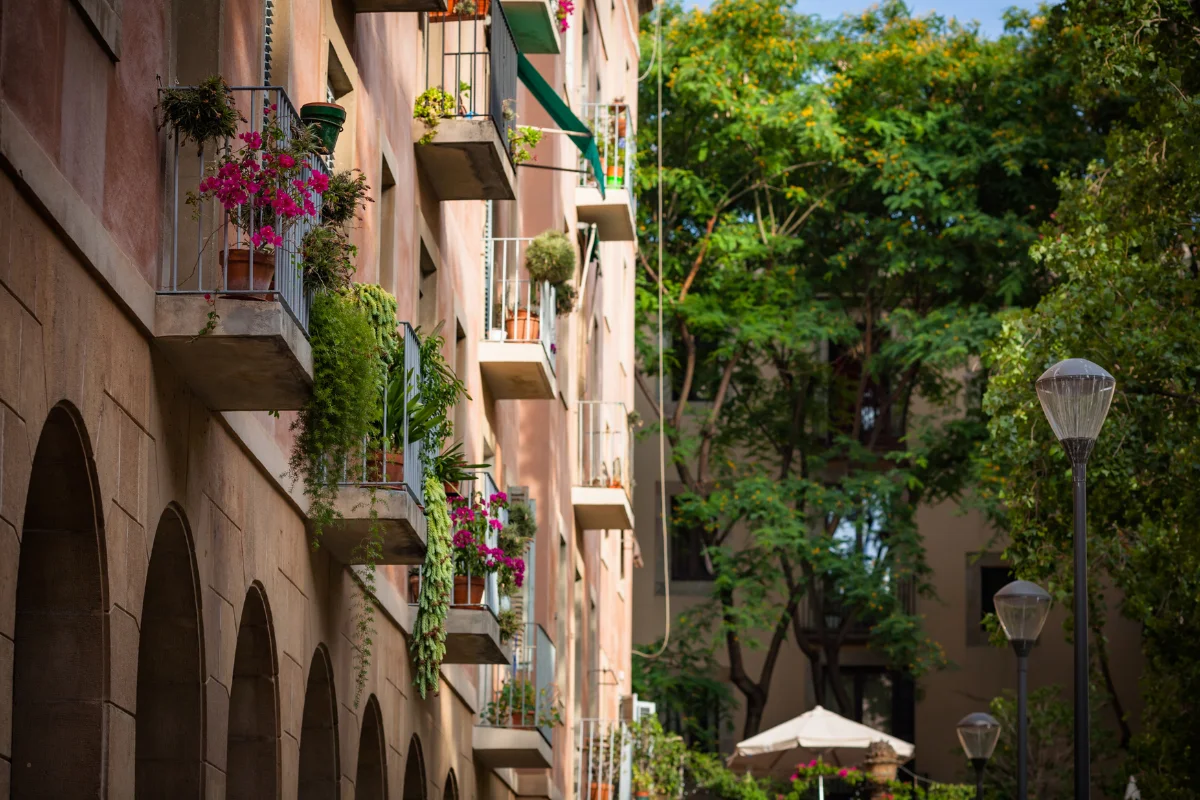

El Raval’s reputation was built in the 1980s, when it was genuinely difficult — a dense working-class neighbourhood with high unemployment, drug problems, and the proximity of the port. That version of El Raval has been described in enough books and films to become permanent mythology. The actual neighbourhood in 2026 has the highest concentration of cultural institutions per square kilometre of any district in Barcelona, a multicultural restaurant scene that no other neighbourhood can replicate, and an energy that the polished tourist-facing versions of El Born and the Gothic Quarter have largely traded away.
The reputation persists. The neighbourhood it’s describing doesn’t quite exist anymore.
The Geography First: What El Raval Actually Is
El Raval is bounded east by Las Ramblas, west by Paral·lel, north by Ronda de Sant Antoni, and south by Passeig de Colom. It’s the section of old Barcelona that remained outside the Eixample grid — the industrial, port-adjacent, densely populated quarter that Cerdà’s 19th-century plan deliberately left behind.
The transformation began with two cultural institutions: the CCCB in 1994 and the MACBA in 1995. Both opened in the same year, in adjacent buildings, and between them they shifted the neighbourhood’s identity more decisively than any urban planning intervention could have. A decade later, successive waves of immigrants from the Maghreb, South Asia, Latin America, and the Philippines gave El Raval the demographic density and cultural complexity that now defines it.
What it is today: a dense, live neighbourhood with real friction and a cultural offer that’s hard to match in any European city centre. What it’s not: the dangerous neighbourhood of the 1980s, or the hipster-gentrified neighbourhood some guides imply.
MACBA: The Museum That Takes Real Risks
Richard Meier’s 1995 building on Plaça dels Àngels is one of the best pieces of contemporary architecture in Barcelona — the contrast between the white rationalist volume and the Gothic church directly behind it is one of the city’s most productive visual collisions.
The permanent collection covers art from the second half of the 20th century, with particular strength in conceptualism, political art, and Spanish and international video art. What distinguishes MACBA from comparable institutions is that its temporary exhibition programme takes genuine risks — it’s not a decorative museum.
Practical: standard entry €15 at the door and €13.50 online, free on the first Sunday of the month and, in summer, from 18:00 to 20:00 Thursday to Saturday. The exterior plaza is one of the few spaces in Barcelona where skateboarding is officially tolerated — it’s been a gathering point for the local skate scene for decades, and that community is as much part of the MACBA experience as anything inside.
For anyone building a broader understanding of Barcelona’s art gallery scene, MACBA is the institutional anchor that makes the rest of the circuit make sense.
CCCB: Fifty Metres Away, Completely Different
The Centre de Cultura Contemporània de Barcelona occupies the former Casa de la Caritat complex from the 17th century, immediately adjacent to MACBA. Unlike its neighbour, the CCCB has no permanent collection. Its exhibitions address city, technology, science, and culture from angles that most cultural institutions avoid.
The inner courtyard — with its mirror wall reflecting the Tibidabo skyline — is one of the most photographed architectural spaces in Barcelona for entirely justified reasons.
Before going: check the current programme at cccb.org. The value varies significantly depending on what’s showing. Some of the best intellectual experiences Barcelona offers happen here; some exhibitions are less compelling. Five minutes of research before visiting makes a real difference.
Filmoteca de Catalunya: Where the Serious Cinephiles Go
In the Plaça de Salvador Seguí, Josep Lluís Mateo’s 2012 building houses the Filmoteca — Barcelona’s cinematheque. The programme runs author cinema, thematic cycles, retrospectives, and classics with genuine curatorial intelligence. Tickets range from €4 to €6.
This is not a tourist resource. It’s where Barcelona residents who take cinema seriously actually go. That’s precisely its value — and it’s the reason the best independent cinemas in Barcelona circuit starts here.
Antic Hospital de la Santa Creu: The Most Underrated Space in El Raval
Founded in 1401, the Hospital de la Santa Creu was Barcelona’s main hospital for centuries. Today it houses the Biblioteca de Catalunya and the Escola Massana. The 15th-century Gothic courtyard is free to enter and open to the public.
It’s one of the best-preserved medieval spaces in the city and one of the least known. Antoni Gaudí died here in 1926, after being struck by a tram and initially brought in unrecognised because his clothing was too deteriorated.
The courtyard alone is worth 20 minutes on any visit to El Raval. Free, always open during library hours, genuinely extraordinary.
La Central del Raval: A Bookshop in an 18th-Century Chapel
The Capella de la Misericòrdia — an 18th-century baroque nave — houses one of the best bookshops in Barcelona. Eighty thousand titles in humanities and foreign languages, an interior garden with an orange tree, and the Bar Decameron for coffee. The full story of Barcelona’s best bookshops runs through this building — it’s the architecturally most remarkable of them all.
Palau Güell: Where Gaudí’s Language Began
At Carrer Nou de la Rambla — technically El Raval — the Palau Güell (1890) is Gaudí’s first major commission and the building where he developed the architectural vocabulary that would culminate in the Sagrada Família and Casa Batlló. The rooftop chimneys directly anticipate Park Güell.
If you’ve visited or plan to visit the later Gaudí buildings, the Palau Güell is the piece that explains the evolution. The first Sundays of the month are free — book in advance. Standard entry: €12.
Who Is This Neighbourhood For?
- Culture-focused visitor who’s done the main circuit → El Raval is the next layer — MACBA, CCCB, Filmoteca, Antic Hospital, La Central. A full day barely scratches it.
- Traveller who wants genuine multicultural food → The Pakistani restaurants on Carrer del Carme and the Moroccan spots near Paral·lel are made for local communities, not tourists. That’s the quality guarantee.
- Architecture enthusiast → Palau Güell + the MACBA building + La Central in the chapel + the Antic Hospital Gothic courtyard. Four architectural registers in one neighbourhood.
- Night owl who prefers local bars over tourist clubs → Carrer de Joaquín Costa and Carrer del Parlament have bars that have served the same clientele for decades. No dress code, no tourist pricing.
- First-time visitor with limited time → Skip El Raval unless you have at least half a day. It rewards slow exploration, not a quick pass-through.
Eating in El Raval Without the Tourist Premium
The practical rule: the further from Las Ramblas, the better the quality-to-price ratio. The tourist restaurant infrastructure clusters around the Rambla perimeter and deteriorates quickly in quality while maintaining high prices.
What actually works:
The Pakistani restaurant cluster around Carrer del Carme serves karahi, biryani, and Punjabi home cooking for local community residents — the quality control mechanism that tourist-facing restaurants don’t have. Prices are significantly lower than equivalent quality anywhere else in the city.
The Moroccan spots in the southern Raval — near Paral·lel — serve tajines, couscous, and pastela made for a residential community. Same dynamic.
For coffee, the third-wave cafés that opened around the MACBA in the last decade serve the neighbourhood’s creative community. Expect no-syrup, no-flavour menus and genuine attention to extraction. The specialty coffee circuit in Barcelona has several El Raval addresses worth adding.
The menú del día around the Mercat de la Boqueria perimeter — not inside the market itself — serves working lunches for neighbourhood residents: €10–14 for three courses, no English menu in the window, no photographs on the walls.
El Raval stopped being up-and-coming in 1994
El Raval’s cultural transformation started in 1994. Describing it as emerging or edgy is thirty years out of date. The MACBA and CCCB are established international institutions. La Central is one of the most important bookshops in Spain. The neighbourhood is not in transition — it’s arrived.
They focus on the safety question without answering it usefully. The honest answer: El Raval is an urban neighbourhood with the problems of any dense city centre in Europe. The southern section below Carrer de Sant Pau has a different character at night, particularly around the Barri Xino zone near the port. During the day and in the cultural district around MACBA and CCCB, there is no meaningful differential risk from other central Barcelona neighbourhoods. The pickpocketing problem belongs to Las Ramblas, not El Raval specifically.
They miss the Sant Antoni connection. The Mercat de Sant Antoni — technically in the Eixample but five minutes from El Raval’s northern border — is the market that El Raval residents actually use. Its Sunday book market is one of the cultural anchors of the entire area.
Mistakes to Avoid
- Going to La Boqueria for a meal — it’s in El Raval’s eastern border but oriented entirely towards tourism. Mercat de Sant Antoni or Santa Caterina for actual food shopping; the menú del día bars behind the market for eating.
- Skipping the Antic Hospital Gothic courtyard — it’s free, it’s extraordinary, and it takes 15 minutes. Almost no standard itinerary includes it.
- Not checking the CCCB programme before visiting — it’s worth the five minutes. The gap between a strong CCCB programme and a weak one is significant.
- Confusing El Raval with Las Ramblas — they share a border. The tourist infrastructure of Las Ramblas (overpriced terraces, pickpocket density, performance artists) does not extend into El Raval proper. One block west of Las Ramblas is a different place.
- Planning El Raval as a quick stop between the Gothic Quarter and El Born — it doesn’t work as a corridor. It works as a destination with its own half-day logic.
Best Strategy
-
2 hours → Antic Hospital Gothic courtyard (free) → MACBA exterior and plaza → walk through La Central del Raval. No entry fees, covers the architectural and cultural register.
-
Half day → MACBA or CCCB (depending on current programme) → La Central del Raval → lunch at a Pakistani restaurant on Carrer del Carme → Filmoteca check for evening programme.
-
Full day → Start at Mercat de Sant Antoni (Sunday book market if weekend) → Antic Hospital → MACBA → CCCB → Palau Güell → dinner in the neighbourhood’s multicultural restaurant zone → evening at a Carrer de Joaquín Costa bar.
El Raval connects directly to the Gothic Quarter across Las Ramblas (5 minutes) and to El Born across Via Laietana (15 minutes on foot). The hidden churches circuit includes Sant Pau del Camp — the oldest Romanesque building in Barcelona, on Carrer de Sant Pau in El Raval’s heart — which is one of the most extraordinary spaces in the neighbourhood and appears in almost no standard guide coverage.
Practical Information
Metro: L3 Liceu (entry via Las Ramblas), L2 Sant Antoni (northern Raval), L3 Paral·lel (southern Raval). The neighbourhood is small enough to walk across in 20 minutes — metro is only needed for arrival and departure.
MACBA: Tue–Sat 11am–7:30pm, Sun 10am–3pm. Closed Tuesdays in some periods — check website. Free from 4pm Sunday.
CCCB: Tue–Sun 11am–8pm. Closed Mondays. Entry varies by exhibition.
Filmoteca: Programme published monthly. Check filmoteca.cat.
Palau Güell: Tue–Sun 10am–8pm (summer), 10am–5:30pm (winter). €12 standard. Free first Sunday of month — book in advance.
Antic Hospital / Biblioteca de Catalunya: Mon–Fri 9am–8pm, Sat 9am–2pm. Courtyard access during library hours.
The neighbourhood that Barcelona spent decades trying to explain away turned out to have the most interesting cultural infrastructure in the city. That’s not a coincidence — it’s what happens when institutions with real ambitions set up in a neighbourhood that doesn’t have the social pressure to be decorative.
Over 53 % of El Raval was born abroad and more than 200 languages are spoken in its streets, which shows up directly on its menus: the El Raval restaurants guide follows that thread.
Frequently Asked Questions
Is El Raval safe to visit?
Yes, during the day and in the cultural district around MACBA and CCCB. The southern section below Carrer de Sant Pau has a different character late at night. The main tourist-facing risk in the area is pickpocketing on Las Ramblas — which borders El Raval but is a distinct environment. Standard urban precautions apply.
What is MACBA and is it worth visiting?
The Museu d’Art Contemporani de Barcelona — a Richard Meier building from 1995 with a strong collection of 20th-century art and a consistently ambitious temporary programme. Worth visiting if you have any interest in contemporary art; free on Sundays from 4pm; €12 otherwise. The exterior plaza is worth visiting regardless.
How long does El Raval take to explore?
Half a day minimum to cover MACBA or CCCB, La Central del Raval, the Antic Hospital courtyard, and lunch. A full day to add Palau Güell, the Filmoteca programme, and the neighbourhood’s restaurant and bar circuit properly.
What’s the difference between El Raval and El Born?
El Born is more homogeneous, more gentrified, with a better-organised tourist circuit and stronger gastronomy aimed at visitors. El Raval is more diverse, more institutionally dense (MACBA, CCCB, Filmoteca), more multicultural in its restaurant offer, and retains more genuine friction. They’re 15 minutes apart on foot and make a logical full-day combination.
Where should I eat in El Raval?
The Pakistani restaurants on and around Carrer del Carme, the Moroccan spots near Paral·lel, and the menú del día bars in the blocks behind La Boqueria. Avoid the restaurant strip immediately adjacent to Las Ramblas — it’s priced for and aimed at tourist pass-through, not for quality.