

The MNAC holds 350,984 works. About 3,200 are on display. The rest is in storage, on deposit, or in the Drawings and Prints Cabinet that almost no visitor enters. The building itself — the Palau Nacional at the top of Montjuïc’s cascading fountains — is visible from half the city. But what’s inside is far less understood than its profile suggests.
Most visitors complete the Romanesque circuit and leave with the impression they’ve seen the museum. They haven’t. They’ve seen one floor of one collection. What they missed: Thyssen works that queue for an hour at the Madrid Thyssen sit here in calm. A Picasso painted at 14 with no line while the Picasso Museum in El Born has one every morning. And 2,500 hand-designed emergency banknotes from Catalan municipalities during the Civil War — arguably the most singular design collection in the building — which almost no one looks at.
The Romanesque Collection — The Most Important in the World
The MNAC’s Romanesque hall is not “the medieval section.” It holds the largest intact collection of Romanesque mural painting anywhere on earth, and it’s here for a specific historical reason: someone had to save it before it disappeared.
In the early 20th century, the absence of heritage legislation in Spain allowed the legal sale of medieval frescoes to foreign collectors. The apse of Santa Maria de Mur arrived too late — it’s now in Boston’s Museum of Fine Arts. The others were saved through a systematic campaign between 1919 and 1923 in which teams from the Junta de Museus applied the strappo technique in Pyrenean churches: wet cloths bonded with organic glue applied directly to the fresco surface, then peeled away once dry, removing only the pigment layer and leaving the bare wall. Immovable art converted into movable object, transported to Barcelona.
At the museum, each fresco was mounted on structures replicating the curvature of the original apse. These are not reproductions — they are the actual paintings on reconstructed supports.
Is the MNAC worth visiting in Barcelona? Yes, specifically for the Romanesque collection (world’s largest of its type), the Thyssen-Bornemisza deposit (Fra Angelico, Canaletto, available in complete calm), and the modern art collection with documented context. Entry €12, valid for two separate visits within the same month. Free Saturdays from 15:00 and first Sunday of every month. The Sala Oval and rooftop terrace are accessible without paying the collection entry.
The Romanesque — Two Works That Require Time
Sant Climent de Taüll is the central piece and the reason the MNAC is a global reference. The Pantocrator — Christ in majesty inscribed in a mandorla with the Tetramorph — uses a geometry and a chromatic range that fascinated Picasso and the Fauvist painters before anyone in Europe had systematized that influence into a theory. Technical analysis of the paint layer reveals aerinite for blue and hematite for red — local pigments — but in some Pyrenean works lapiz lazuli has been detected, indicating these mountain churches were integrated in international trade networks that local history rarely acknowledges.
The Batlló Majesty: a 12th-century walnut carving with original polychromy conserved, representing Christ triumphant in a Byzantine-influenced tunic decorated with circular friezes. The contrast between the wood grain and the color is one of the most direct visual effects in the museum.
Quick Decision — How to Use the MNAC
- 90 minutes → Full Romanesque + Thyssen rooms (Renaissance/Baroque) — highest visual return per time unit in the museum
- Half day → Add the modern art collection; the arc from bohemian Barcelona to Civil War changes how you read everything before it
- Most undervisited works → Thyssen deposit and Cambó Bequest — Fra Angelico and Canaletto with no queue
- With children → Romanesque first, using the Second Canvas app to zoom into the Taüll Pantocrator at ultra-high resolution on a phone
- Lowest entry cost → Saturdays from 15:00 or first Sunday of the month — free full access to all collections
- Rainy day in Barcelona → €12 entry valid for two visits in the same month; use the second visit for the specialized collections
The Thyssen and Cambó — The Rooms Nobody Waits For
The renovation of the Renaissance and Baroque galleries completed in 2018 added 1,313 m² of exhibition space. They are the quietest rooms in the museum and the ones that offer the greatest return per minute of attention.
The Cambó Bequest (donated 1949) was assembled explicitly to fill the chronological gap between Catalonia’s medieval art and its modern art — 50 paintings including a Botticelli, Zurbarán, Rubens, and Goya. Politician Francesc Cambó bought these works knowing Barcelona had nothing to cover that historical stretch.
The Thyssen-Bornemisza deposit adds nearly 1,000 more: Fra Angelico, Lucas Cranach the Elder, Canaletto. These works draw queues every morning at the Thyssen museum in Madrid. Here, the Thyssen rooms at the MNAC are so quiet you can hear your own footsteps. It’s the single most overlooked opportunity in Barcelona for European Old Masters.
Modern Art — The Story Most Visitors Don’t Follow
The modern art collection, renovated in 2014, is the most visited section of the museum and paradoxically the least understood. The issue is expectations: many visitors expect a succession of famous names and instead find a narrative.
The narrative runs from industrial bourgeoisie to disaster: industrial Barcelona, Modernisme as a national identity project, the bohemian scene at Els Quatre Gats, the war and postwar period. 260 artists, over 1,350 works, photography and decorative arts integrated into the same discourse.
Gaudí has over 35 original pieces in a permanent space here: furniture designed for Casa Batlló and La Pedrera, decorative elements, maquettes. The MNAC frames him as a total designer, not just a building facade architect — and that reframing changes how the buildings read.
Santiago Rusiñol and Ramon Casas are the two axes of Modernisme in painting. Rusiñol’s La Morfina (1894) and his Aranjuez garden paintings introduce Symbolism into Catalonia before anyone was using that word. Casas’s street paintings document nightlife and the public with an immediacy that prefigures photojournalism.
The Civil War section includes photographs by Agustí Centelles and Juli González’s sculpture Montserrat Screaming (1940) — a forged iron piece that captures war trauma with a formal economy that no painting of the period matches.
Three Collections Almost Nobody Visits
Photography: approximately 40,000 images covering pictorialism through contemporary photojournalism. The fund includes historic Barcelona studios — Pau Audouard (official photographer of the 1888 Exhibition, with a studio designed specifically for equine photography) — and the work of Català-Roca, whose 1950s street photography transformed documentary language in Spain.
Drawings and Prints Cabinet: 50,000 drawings and 70,000 prints, including a Dürer Saint Anthony (1519), Jacques Callot’s 17th-century war horror documentation, and 200 original Ramón Casas portraits donated by the artist himself in 1909. These portraits constitute a visual encyclopedia of Catalan intellectual and artistic life at the turn of the century that no other collection concentrates. The fragility of paper works under light means they are rarely displayed in the gallery, but the museum’s digital catalog makes them fully accessible.
Numismatic Cabinet of Catalonia: over 155,000 pieces from the 6th century BC to the present. The most singular section: 2,500 banknotes designed and issued by Catalan municipalities during the Civil War, when the banking system collapsed and each town created its own emergency currency. It’s a document of local graphic design and economic history that is completely unique and practically never visited. Also includes 9,000 pieces of Moderniste medallistic art by Josep Llimona, Eusebi Arnau, and Pablo Gargallo.
The Thyssen deposit, and what your ticket actually covers
Beyond the Romanesque collection and the building itself, the detail that changes a visit is the Thyssen deposit and its relationship to what you pay.
At the Thyssen-Bornemisza Museum in Madrid, the same works — Fra Angelico’s Madonna of Humility, Canaletto’s Venice views — are the main draw. The Madrid museum charges €13 for general entry and consistently has morning queues for the most visited rooms. The MNAC charges €12 for entry that includes the Thyssen deposit plus ten centuries of Catalan art. The price difference is negligible; the crowd difference is significant. It’s not that the works are less important in Barcelona — it’s that almost no one knows they’re here.
Eating at the MNAC — Absis Restaurant and Oval Café
The MNAC has two dining spaces accessible without a museum ticket, both managed by Vilaplana Catering — the high-end catering brand of Compass Group.
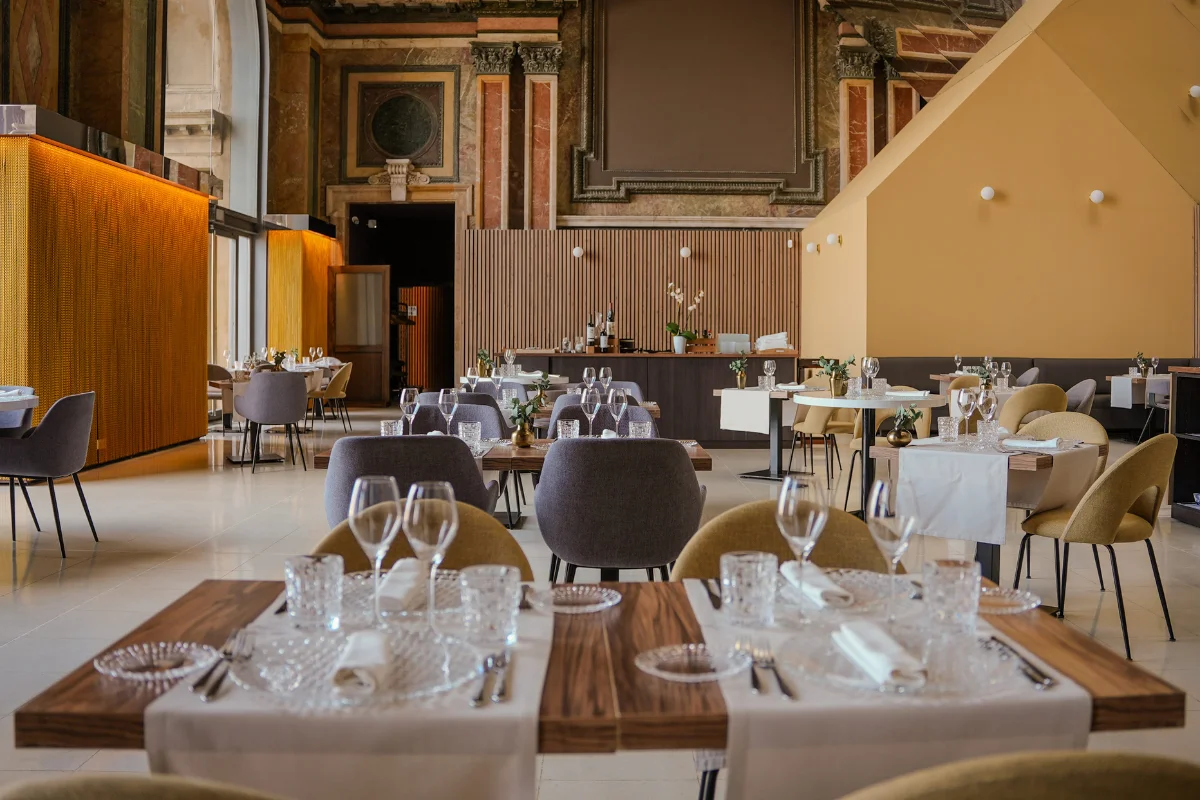
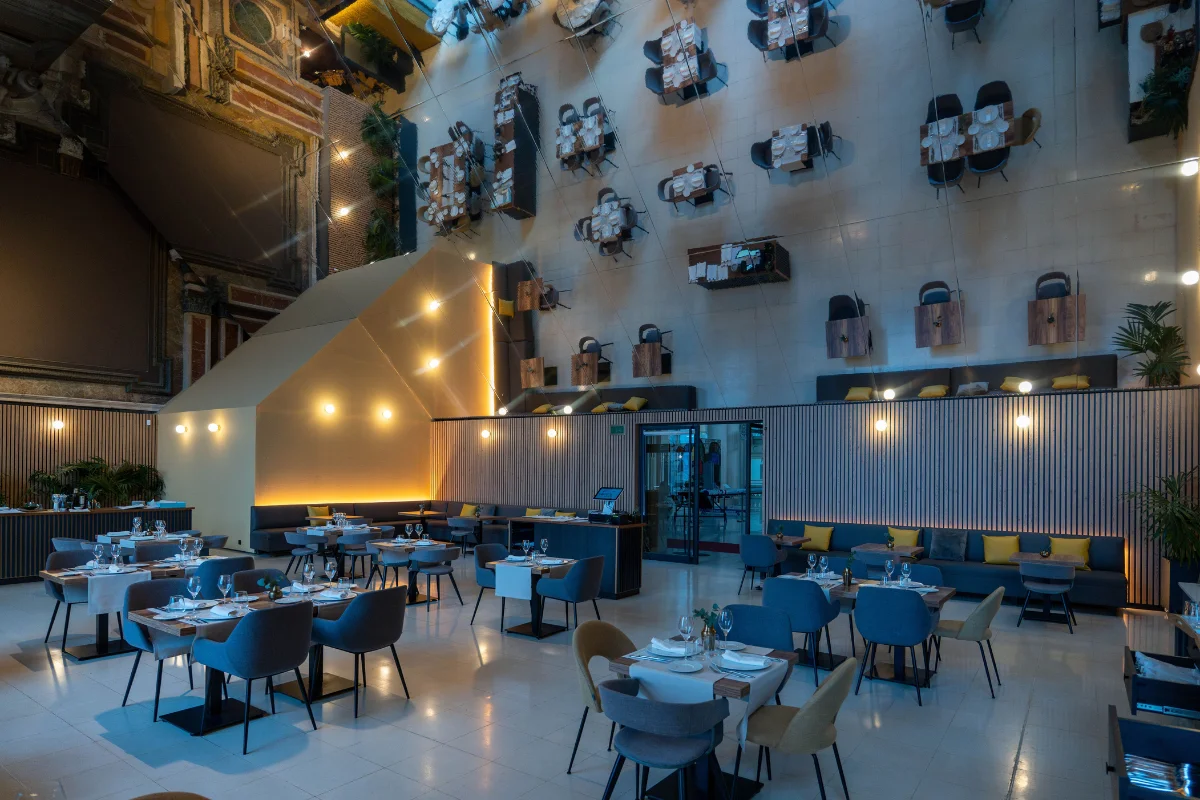 Photo: © Vilaplana Catering en MNAC
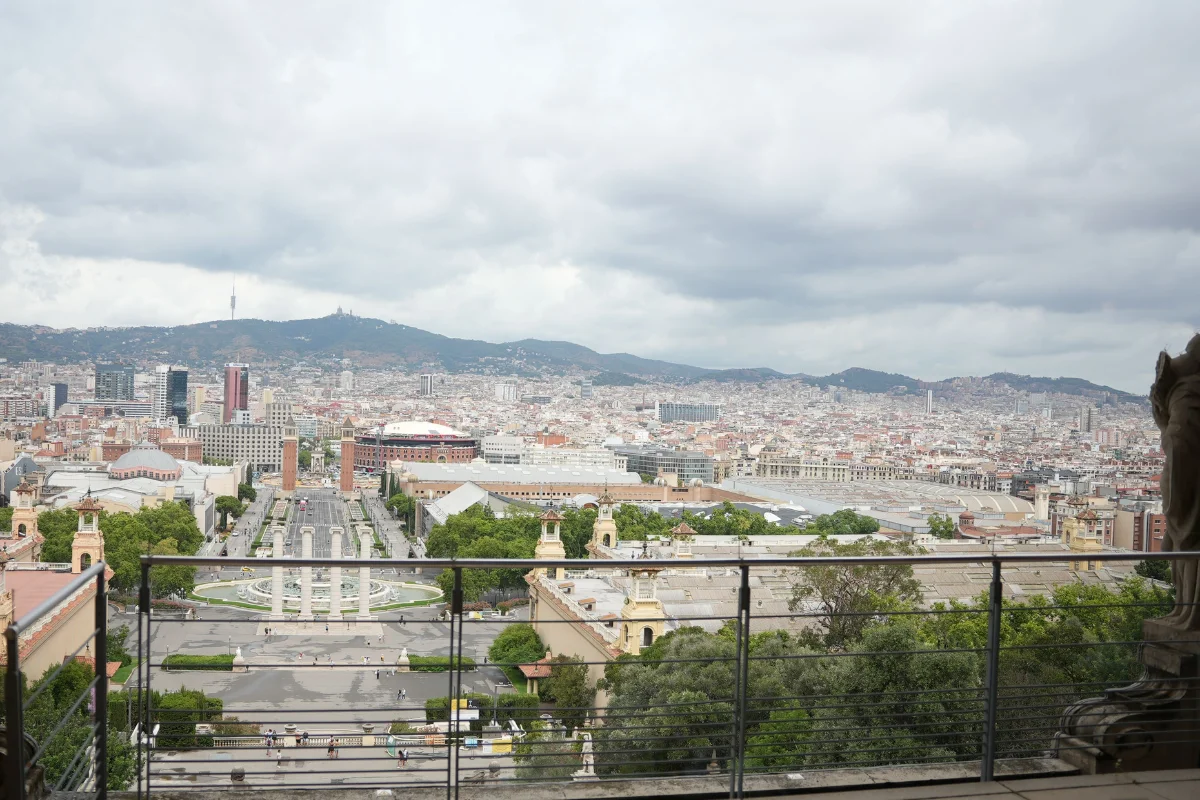
Absis Restaurant is the main space, set in one of the most spectacular rooms of the Palau Nacional with direct views over Barcelona from Montjuïc. The menu is designed by Michelin-starred chef Albert Raurich, combining Catalan proximity cooking with contemporary technique. Spring menu highlights: sea bass with lemon and sott’olio vegetables, Santa Pau beans with clams, rossejats noodles with squid, Iberian pork marinated in paprika and rosemary, and veal fricandó with wild mushrooms. Desserts include Maresme strawberry cake and baked apple with vanilla ice cream.
 Photo: © Vilaplana Catering en MNAC
Reservation recommended, especially on weekends. No museum ticket required.
Oval Café is the more accessible option: a café in the museum’s Sala Oval, open during MNAC hours. The Sala Oval retains the original 1929 frescoes and houses a 34-metre-wide organ — one of the largest in Europe. It also functions as a rest point between gallery sections without leaving the building.
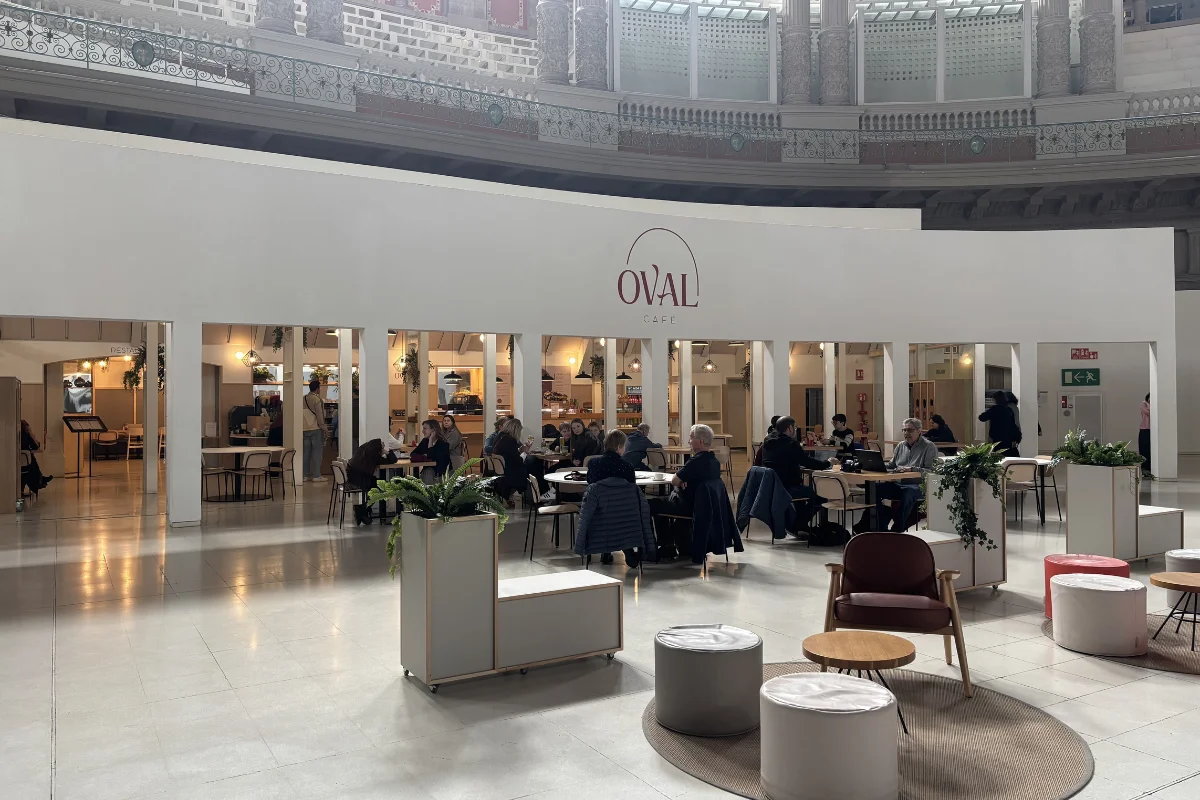 Photo: © Vilaplana Catering en MNAC
Both spaces are open without a museum ticket — you can eat at Absis or have a coffee at the Oval Café without paying the €12 entry.
Practical Information
| Entry | Price | Includes | Notes |
|---|---|---|---|
| General | €12 | All permanent collections, valid 2 visits same month | n/a |
| Basic | €2 | Building + Terraces-Mirador | No collection access |
| Free | €0 | Everything — Sat from 15:00 and first Sun of month | Higher crowds |
| Thyssen deposit | Included in general | ~1,000 works, 13th–20th century | General ticket required |
Winter hours (Oct–Apr): Tue–Sat 10:00–18:00; Sun 10:00–15:00. Summer hours (May–Sep): Tue–Sat 10:00–20:00; Sun 10:00–15:00. Closed Mondays.
Access: Metro L1/L3, Espanya stop. Bus 55 (closest to the Palau Nacional). Escalators from Plaça d’Espanya to the museum entrance. 20 minutes from the Gothic Quarter by metro.
Second Canvas app: allows zooming into works like the Taüll Pantocrator at resolution impossible in the gallery — individual brushstrokes, signatures, textures. Free, especially useful in the Romanesque rooms where conservation lighting is intentionally dim.
Is the MNAC worth it if you’ve already visited the Picasso Museum?
Yes, because they cover different things. The Picasso Museum traces one artist’s full trajectory. The MNAC provides context: the same historical period seen through multiple artists, with urban life, Modernisme, and bohemian Barcelona as the thread. Room 40 at the MNAC also has a Picasso painted at 14 — no queue, no crowd — that complements rather than duplicates what you see in El Born.
When is the MNAC least crowded?
Weekday mornings, especially Tuesday and Wednesday. Saturday free hours from 15:00 concentrate more visitors. First Sundays of the month (also free) are the most crowded days. For the Romanesque with full calm, first hour of Tuesday or Wednesday is the best window.
The MNAC is the only museum in Barcelona where you can see ten centuries of art in a single circuit, sit with Fra Angelico and Canaletto in complete silence, and find a Picasso with no competition for space. The entry price is the same as the Picasso Museum, which covers one artist in one building. The value comparison is not even close.
For the broader Montjuïc context: the Montjuïc Barcelona guide covers the castle, the gardens, and the full hilltop itinerary around the museum. For contemporary art beyond the MNAC, best art galleries Barcelona maps the current commercial and institutional gallery scene. And for hidden museum options with shorter queues and comparable depth, hidden museums Barcelona covers the less-trafficked alternatives.