
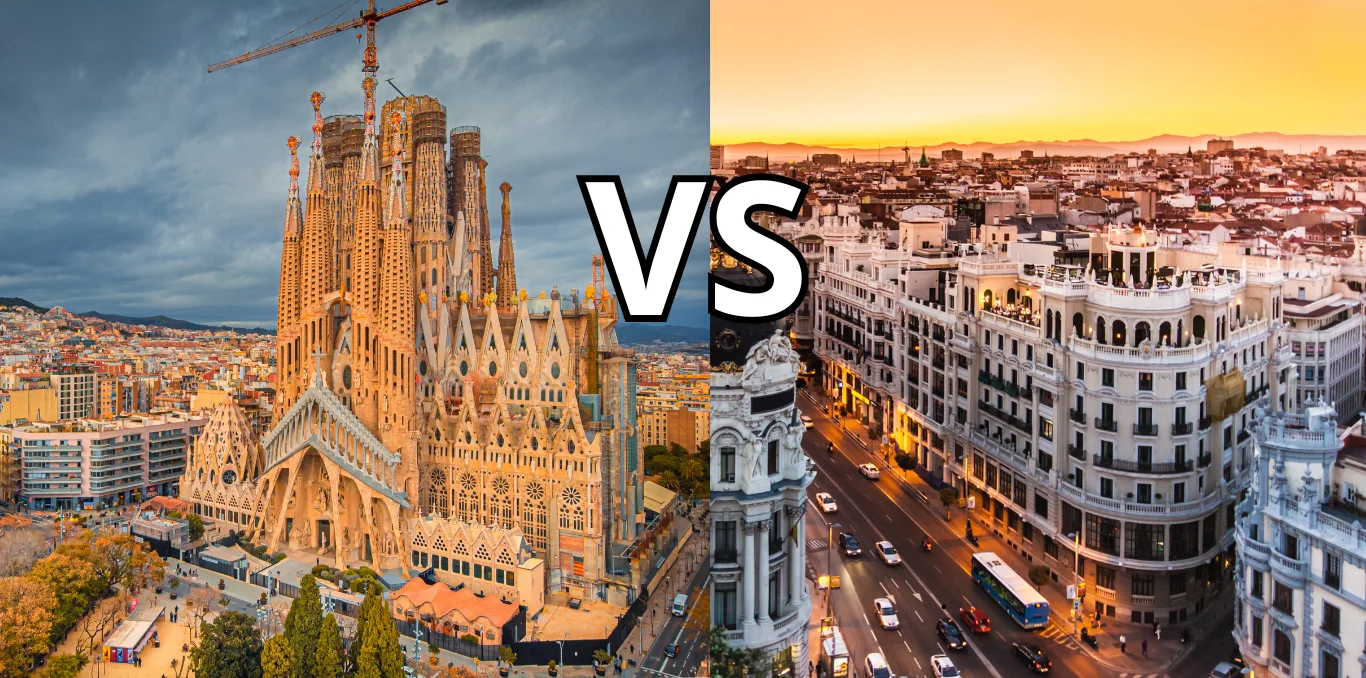

Most first-time visitors to Spain agonize over this, then discover the cities barely compete — they solve different trips. The mistake isn’t picking the “wrong” one; it’s picking the one that doesn’t match what you actually came for.
Barcelona or Madrid, the short answer
For a short first trip, Barcelona packs more icons into less space — Sagrada Família, Gaudí’s works, a medieval old town and a city beach, all walkable or one metro ride apart. Madrid wins on world-class museums, food value, nightlife and price, and makes a better base for historic day trips. Barcelona impresses faster; Madrid rewards the longer you stay.
Quick decision by what you want
- Short first trip, want the icons → Barcelona — Gaudí and beach in a tiny radius
- You’re here for the art → Madrid — the Prado, Reina Sofía and Thyssen within walking distance
- Traveling on a budget → Madrid — roughly 8–20% cheaper on lodging and food
- Want city and sea in one trip → Barcelona — the only one with a beach
- Day trips to historic towns → Madrid — Toledo and Segovia under an hour by train
- Shooting photo/video content → Barcelona — denser run of shoot-ready locations
- Want to feel less swamped by tourists → Madrid — lower tourist saturation per neighborhood
Architecture and first impression
This is Barcelona’s knockout punch. Gaudí’s work — Sagrada Família, Park Güell, Casa Batlló, La Pedrera — exists nowhere else on earth, and Cerdà’s grid-planned Eixample is a one-of-a-kind piece of urban design. The Gothic Quarter folds a medieval maze a few minutes from the sea. Walking the Gaudí route or the Eixample makes the appeal obvious within an hour.
Madrid plays a different game: monumental scale, grand boulevards, the Plaza Mayor, the Royal Palace, the Retiro. It doesn’t seduce with architectural eccentricity but with the poise of an imperial capital. Weaker first photo, more comfortable city to actually live in for a few days.
Museums, where Madrid wins outright
Madrid’s “Golden Triangle” — Prado, Reina Sofía, Thyssen — concentrates some of Europe’s most important painting collections within a few hundred meters. The Prado for old masters, Reina Sofía for Picasso’s Guernica, Thyssen for eight centuries in one building. That density is hard to beat anywhere.
Barcelona counters with the MNAC (the world’s finest Romanesque art collection) and the Miró Foundation — excellent, but not the same accumulated firepower. If museums are your reason for the trip, Madrid is the answer. Compare the MNAC collection and Barcelona’s key museums to see the gap.
Food and nightlife
Madrid’s edge is the menú del día (€12–16), an unbeatable value institution, plus a culture of roasts, jamón and tapeo that runs past midnight in La Latina or Malasaña. Its nightlife is among Europe’s most relentless.
Barcelona brings Mediterranean cooking, seafood, rice dishes and pa amb tomàquet, with a strong restaurant scene by level and characterful night districts. Call it a tie with caveats: Madrid wins on price and hours, Barcelona on seafood and sea-facing terraces.
Cost, the factor people underestimate
Madrid runs roughly 8–20% cheaper than Barcelona on lodging, restaurants and daily spend. According to recent cost-of-living comparisons, over a week that’s €150–300. The structural reason: Barcelona carries heavier tourist pressure, which pushes prices up in peak season and during festivals.
On top of that sits a concrete budget line: Barcelona charges a tourist tax of €3.50 to €7.50 per person per night depending on the category of the accommodation. Madrid’s region levies no such tax. Over several nights, it adds up. The Barcelona daily budget guide breaks down the rest.
Safety, said plainly
Worth stating without drama and without hiding it: according to official crime data, Barcelona records one of the higher crime rates among major Spanish cities, and pickpocketing clusters in very predictable spots — Las Ramblas, the metro, crowded tourist zones. It’s opportunistic theft, not violence, and it’s preventable: zips facing in, nothing in back pockets, attention on packed transport.
Madrid feels safer in everyday tourist use. Neither is dangerous for a sensible visitor, but if you’re carrying camera gear, Barcelona demands more active awareness. The Barcelona safety guide maps it zone by zone.
Comparison table
| Criterion | Barcelona | Madrid |
|---|---|---|
| Iconic architecture | Gaudí, unique modernisme | Monumental classical |
| Art museums | MNAC, Miró (strong) | Prado, Reina Sofía, Thyssen (superior) |
| Beach | Yes, urban | No |
| Daily cost | Higher | 8–20% cheaper |
| Tourist tax | €3.50–7.50/night | None |
| Perceived safety | Concentrated pickpocketing | Higher |
| Day trips | Landscape (sea, mountain) | Historic cities |
| Nightlife | Strong, by district | More intense, runs later |
Best strategy by trip length
- 3–4 days, one city only → Barcelona. Maximum icon-per-day ratio for a first taste of Spain.
- 5–6 days → Split it. The AVE links both in about 2.5 hours. Do 3 in one, 2–3 in the other.
- 7–10 days, want depth → Both, unhurried. Barcelona for architecture, sea and creative districts; Madrid for art, food and a day trip to Toledo or Segovia.
What actually changes in 2026
One time-sensitive argument tilts this year toward Barcelona. The city is World Capital of Architecture, with more than 1,500 events across its ten districts through the year, coinciding with the centenary of Gaudí’s death. The headline: the Sagrada Família reaches its final height with the Tower of Jesus Christ, becoming the tallest church in the world at 172.5 meters — one meter below Montjuïc hill, by deliberate design.
The practical counterweight: expect extreme crowding in Barcelona around June, when the centenary events concentrate. If your trip lands then, book months ahead, or start in Madrid and finish in Barcelona.
Can you do both in one trip?
Yes, and it’s the best move if you have the days. The high-speed AVE connects them in about 2.5 hours, so a 7–10 day trip covers both comfortably. A split that works: 4–5 days in Barcelona for architecture and sea, 3–4 in Madrid for museums, food and a historic day trip.
Which is better for a first trip to Spain?
For a single city on a first visit, Barcelona delivers more immediate payoff — icons, photogenic streets and beach in a small footprint. Madrid rewards the repeat visitor or the longer stay, because its value lives in cultural depth and street rhythm rather than first-postcard impact.
Pick Barcelona if it’s one city and a first trip, especially in 2026, its once-in-a-century year. But the real difference is simpler: one city is seen, the other is lived.