
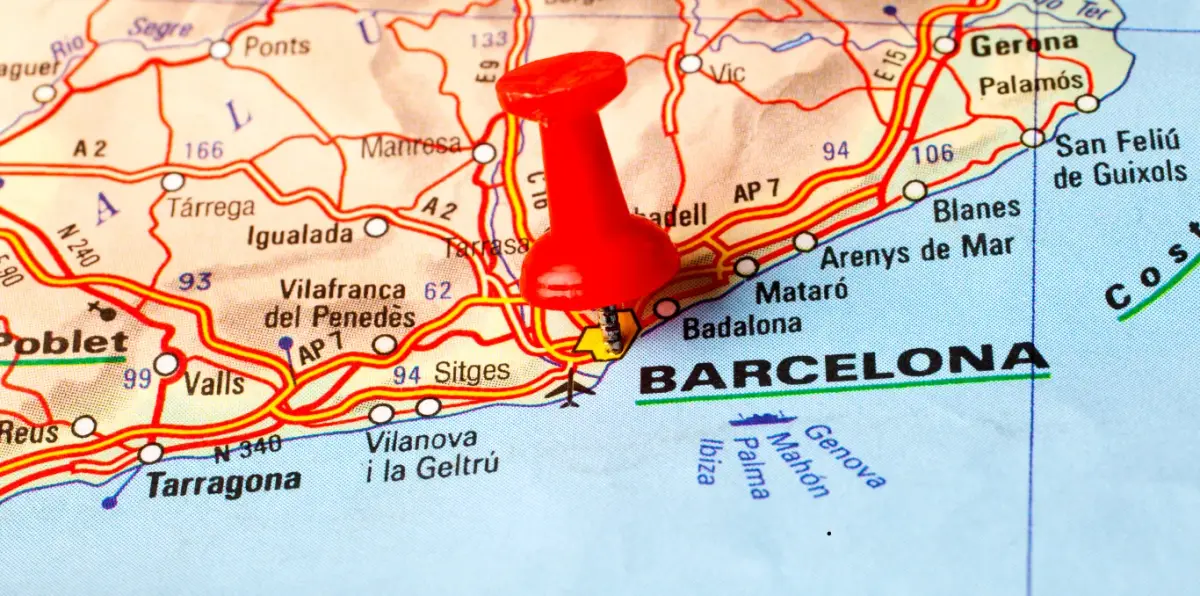

Most visitors arrive expecting Spanish and walk straight into a wall of street signs they can’t read. That’s because Barcelona runs on three languages at once, and the one printed on the metro map isn’t the one you studied for that trip to Madrid.
The three-language reality nobody explains upfront
Barcelona has two co-official languages, Catalan and Spanish, plus enough working English to get a tourist through almost anything. Spanish dominates conversation and tourist service. Catalan dominates everything written: signs, menus in local bars, official notices. English fills the gap in hotels, attractions and central restaurants. You will rarely need more than one of them.
The confusion most English speakers carry is that Catalan is some regional accent of Spanish. It isn’t. Catalan is a separate Romance language, closer to Occitan and French in places than to Spanish, with its own grammar and spelling. Treating it as “broken Spanish” is the fastest way to annoy a local.
| Spanish (Castellano) | Catalan (Català) | English | |
|---|---|---|---|
| Heard in conversation | Everywhere | Local neighborhoods, families | Tourist zones |
| Seen written | Some menus, official docs | Most signage, street names | Tourist menus, museums |
| Will get you through a visit | Yes, completely | Not needed | Mostly, in central areas |
| Locals’ reaction if you try | Neutral, expected | Warm, appreciated | Understood, normal |
Quick decision: which language do you actually need?
- Weekend tourist, central areas → Spanish or English — staff switch to whichever you start in
- Reading the metro and street signs → A few Catalan words (sortida = exit, carrer = street)
- Eating in a non-touristy neighborhood bar → Spanish; the menu may be Catalan-only
- Want warmer interactions → Open with bon dia (Catalan), continue in Spanish or English
- Moving here for work → Depends entirely on sector — see the breakdown below
- Worried about a language barrier → Don’t be; English covers the tourist core
Do they actually speak English in Barcelona?
In the tourist core, yes — more than in most of Spain. Hotel staff, major attractions, central restaurants and younger people in service jobs generally manage English well. Step into a residential neighborhood, an old-school bar or deal with someone over 60, and English thins out fast. Spanish becomes the more reliable fallback there.
This is the question English speakers care about that Spanish-speaking visitors never ask. The honest answer: you can run a normal Barcelona trip in English alone, but a handful of Spanish words removes friction the moment you leave the Gothic Quarter. If it’s your first time in the city or a tight weekend, English plus three polite words is genuinely enough.
What the numbers actually say
Spanish is the habitual language of just over half of Barcelona’s residents, with surveys placing it roughly in the 50–56% range, while Catalan sits around 35–40% depending on the study. Yet over 90% of people understand Catalan and about 80% can speak it — knowledge is near-universal even where daily use is lower.
Here’s the part travel guides never include: the picture flips by area. Among people aged 25–44, habitual Catalan use drops to around 21–22%, and Catalan only outweighs Spanish among residents over 64. By district, only Sarrià-Sant Gervasi, Les Corts and Gràcia have more habitual Catalan speakers than Spanish. So where you stand matters more than any citywide average.
The Catalan you’ll see before you hear it
Even surrounded by spoken Spanish, what you read is overwhelmingly Catalan — metro, buses, street plaques, public buildings. Most of it is decodable once you know a handful of words.
| Catalan | English |
|---|---|
| Sortida | Exit |
| Entrada | Entrance |
| Carrer | Street |
| Plaça | Square |
| Mercat | Market |
| Estació | Station |
| Obert / Tancat | Open / Closed |
If you’re navigating the public transport system or wandering the city’s markets, those seven words clear up most of the confusion.
The one pronunciation rule that fixes four phrases
Learning four phrases is easy; saying them so people understand is not. One rule does most of the work: in central Catalan, an unstressed e is pronounced like a soft a.
That’s why cervesa (beer) sounds closer to “sar-VEH-sa” and Barcelona itself, said locally, softens its first vowel. Knowing this single rule does more for your accent than memorizing a phrasebook.
Phrases that change how you’re treated
You don’t need to study the language. Said on the way in or out, these shift the whole tone:
- Bon dia → Good morning (works into the afternoon too)
- Bona tarda → Good afternoon
- Gràcies / Moltes gràcies → Thank you / Thank you very much
- Si us plau → Please
- Adéu → Goodbye (everyone says it, whatever language they were speaking)
- Bon profit! → Enjoy your meal (locals say it to total strangers who are eating)
And one to sound like you’ve been here a while: Déu n’hi do! — an all-purpose exclamation of surprise or being impressed. No clean translation, but it lands like “wow” or “that’s something.”
The mistake that marks you instantly
Never call the city “Barça.” Barça is the football club, not the city. Locals shorten Barcelona to “Barna” or “BCN.” Getting this wrong flags you as a newcomer faster than any accent ever could. It’s the single most common error English speakers make.
What to do when someone speaks Catalan to you
The usual sequence: you walk in, you’re greeted in Catalan, you reply in Spanish or English, and the conversation switches without anyone blinking. It happens constantly and bothers no one. If you want to ask directly:
“Sorry, I don’t speak Catalan — could we use Spanish or English?”
Almost everyone switches happily. Friction over language exists, usually for identity reasons, but it’s a minority experience against the ordinary rhythm of the city. The reliable move is to open with bon dia, then continue in whatever you’ve got.
Is Catalan worth learning? Only if you’re staying
For a visit: no. For living here, it depends entirely on your sector — and this is where “optional” can quietly become “required.”
| Sector | How much Catalan matters |
|---|---|
| Public administration, education, public health | Effectively required mid-term; certified level expected |
| Local-facing roles (shops, paperwork) | Strongly valued; sets you apart |
| Marketing, design, hospitality | Useful, rarely mandatory |
| International firms, tech, remote work | Barely needed; English and Spanish suffice |
The regulatory trend pushes toward certified Catalan for new public-sector and teaching posts. If your path runs through education, health or administration, assume you’ll eventually need to prove it. The upside: the regional government offers free courses through platforms like Parla.cat (levels A2 to C1), with tens of thousands of places a year.
Why Catalan dominates signage despite lower daily use
It can seem odd that a language habitually spoken by roughly a third of the city owns the street signs, schools and broadcasting. The reason is structural: Catalan is the language of instruction in public schools and the lead language of regional TV and radio, and the administration prioritizes it as the territory’s own language. It’s a living language defended with real pride.
For a visitor, that translates into one thing: any attempt to use it, however small, is received well. You’ll feel that pride sharpest during festivals like Sant Jordi, where the language and its symbols take center stage.
Language is one of the things that separates the two big Spanish city breaks, and the rest — architecture, museums, cost, safety and how to split the days — is weighed up in Barcelona vs Madrid.
FAQ
Do they speak Spanish in Barcelona?
Yes — Spanish is co-official and the habitual language of just over half the city. You can handle an entire trip in Spanish without any issue. The twist is that signage and many local menus are in Catalan, not Spanish.
Is Catalan a dialect of Spanish?
No. Catalan is an independent Romance language with its own grammar, vocabulary and pronunciation. It shares Latin roots with Spanish and overlaps heavily in writing, but it’s also close to French and Italian in many words. Calling it a Spanish dialect is incorrect and locals dislike it.
Can I visit Barcelona speaking only English?
Largely, yes. The tourist core — hotels, major sights, central restaurants — operates comfortably in English. Outside those zones, especially in local bars and with older residents, a few words of Spanish make things smoother. English alone won’t strand you, but it has limits.
Which neighborhoods speak the most Catalan?
Sarrià-Sant Gervasi, Les Corts and Gràcia are the only districts where habitual Catalan speakers outnumber Spanish speakers. The tourist center and much of the metropolitan area lean firmly Spanish in daily conversation.
Do I need Catalan to find a job in Barcelona?
It depends on the sector. Public administration, education and public health effectively require certified Catalan mid-term. Tech, international companies and remote work run fine on English and Spanish. Most other fields treat it as a plus rather than a requirement.
How fast will I pick up Catalan if I move there?
If you already know Spanish, comprehension comes quickly — within months you’ll follow much of spoken Catalan and almost all written Catalan through exposure alone. Speaking it fluently is a separate effort, but understanding arrives fast thanks to the overlap between the two languages.
The language question in Barcelona is rarely about being understood — between Spanish and English, you will be. It’s about which version of the city you get to see. Arrive treating Catalan as an obstacle and you stay a tourist; treat it as the language of a house you’ve been invited into, and the doors open differently.