
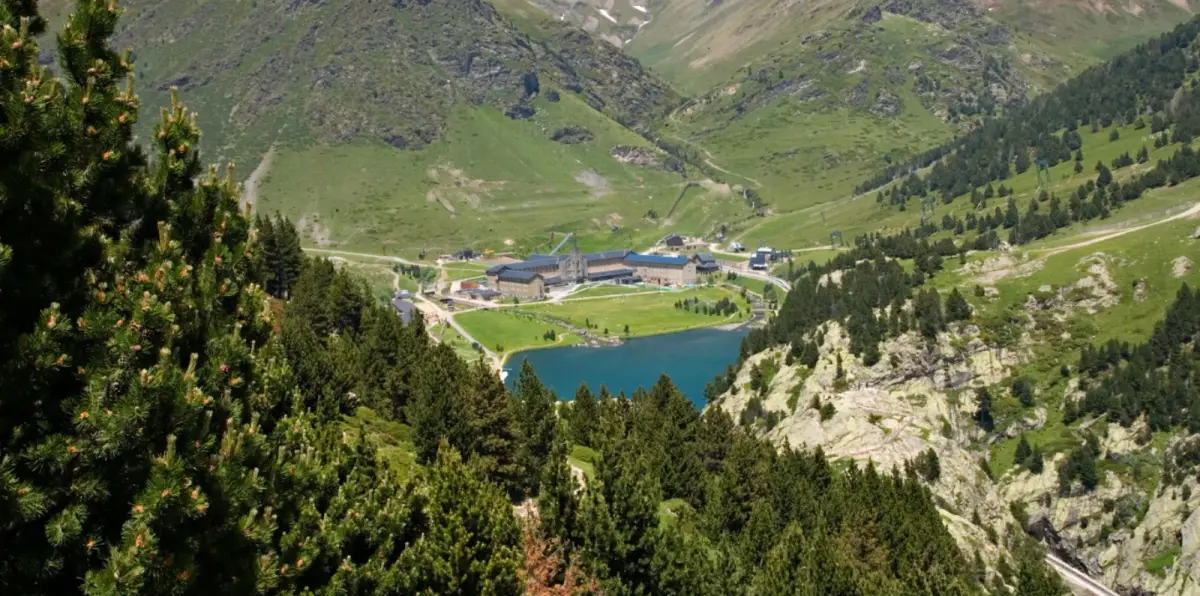

The last stretch to Núria has no asphalt: a small red train hauls you up the mountainside while the road, far below, simply stops at the valley’s edge. Set at 1,964 metres in the Girona Pyrenees, this is one of the few corners of Catalonia where the engine noise never arrives, and that silence is the whole point. Getting there well, though, means knowing two things tourist listings tend to blur: what the train actually costs and where to leave the car.
How do you visit Vall de Núria, the car-free valley? You take the Núria rack railway from Ribes de Freser or Queralbs, where parking is free, or walk up the trails. The return ticket costs €7.50 and includes the cable car, sanctuary and exhibitions. The valley sits at 1,964 metres, opens all year, and combines summer hiking with family skiing in winter.
Quick decision by how you want to go
- From Barcelona without a car → R3 to Ribes de Freser plus rack railway, or the TreNatura combined ticket for around €40.20
- By car with the shortest climb → park at Queralbs, the railway takes 20-25 minutes from there
- For those who want to walk → the Camí Vell from Queralbs, around 7.5 km and 3-4 hours uphill
- Families with small children → railway plus the flat lake walk, 1.5 km with almost no climb
- A heatwave escape → a summer day with temperatures far cooler than the city
- For total silence → stay overnight to live the valley at dawn and dusk
The rack railway, half the experience
Getting up to Núria is not a formality but part of the trip. According to FGC’s official data, the Núria rack railway, opened in 1931, is the only mechanical way to reach the valley, covering 12.5 kilometres and climbing over 1,000 metres in just 40 minutes, through forests, tunnels, waterfalls and cliffs. It runs 365 days a year and passes four stations: Ribes-Enllaç, Ribes-Vila, Queralbs and Núria.
Here is the figure to be clear about so you do not overpay. According to official data, a single ticket costs €6 for adults and €4 for children, and a return is €7.50 for adults, €6.50 for over 65s and €5 for children. Nothing like the €34 fares that appear in some guides, which correspond to the ski-pass package, not the railway alone. That ticket also includes the Coma del Clot cable car, the exhibitions, the interpretation centre and entry to the Basilica. For anyone exploring the day trips from Barcelona by train, it is one of the most complete.
Where to leave the car and how to arrive from Barcelona
The access logistics decide much of the day. If you come by car, the road reaches Ribes de Freser and Queralbs, the two towns where you leave the vehicle, and the railway starts from either of their stations. Queralbs is the last point reachable by road and the closest departure, with the shortest run, around 20-25 minutes to Núria. All three departure stations have free parking, a detail that removes the parking headache of other destinations.
Without a car, the train is the easiest option. The R3 Rodalies line reaches Ribes de Freser, where it connects with the railway; there is also the TreNatura combined ticket, linking the train from Barcelona and the return railway for around €40.20 for adults. This combination makes Núria a perfect car-free escape, framed well by the budget for a Barcelona trip. Arriving by train is not just logistics, it is part of the valley’s appeal.
The sanctuary, the reason the place exists
At the centre of the valley, a basilica explains why Núria is here. The Sanctuary of the Mare de Déu de Núria is one of the most important pilgrimage sites in Catalonia, and the current Neo-Romanesque building dates from around 1911, dominating the valley with its grey stone against the snow in winter or the green in summer. The visit is included in the railway ticket, so it carries no extra cost.
Its legend is the soul of the place. The hermitage keeps the cross, the bell and the pot, and tradition holds that couples hoping for children should put their head in the pot and ring the bell. The sanctuary’s origin is said to go back centuries, to a hermit who hid an image of the Virgin in a cave to protect it, later found beside the bell and the pot. That folklore turns a mountain building into a story, and adds a cultural layer few nature escapes have, much like the day trip to Girona pairs heritage with scenery.
What to do in summer, beyond the skiing
Although Núria is tied to skiing, summer is one of its best seasons. The simplest plan is the walk around the lake, an almost flat 1.5-kilometre loop with views of the sanctuary, ideal with children. From there, the trail network covers every level, from short paths to viewpoints and caves up to demanding climbs to the Puigmal, at around 2,910 metres, for mountaineers. The table below sorts the main walks by effort.
| Trail | Distance | Climb | Time | Level |
|---|---|---|---|---|
| Lake loop | 1.5 km | 15 m | 25 min | Very easy |
| Camí de les Creus | 1.3 km | 150 m | 50 min | Easy |
| Camí del Bosc | 2 km | 150 m | 80 min | Easy-medium |
| Camí Vell (descent) | 7.5 km | 800 m | 3-4 h | Medium |
| Puigmal summit | varies | high | full day | Hard |
The family offer is among the most complete in the Pyrenees, with an activity park open all year, boat and canoe rides, ponies and a petting farm by the sanctuary.
Walking down, the Camí Vell from Queralbs
For anyone after real mountain, the walk down is the gem. The Camí Vell de Núria is the medieval route from Queralbs, a trail of around 7.5 kilometres and 800 metres of descent covered in 3 to 4 hours, crossing the gorges of the Núria river between waterfalls and viewpoints. The smartest approach is to ride up by railway and walk down, combining the comfort of the train with the experience of the path.
It is a waymarked GR-11 route, of medium difficulty, demanding decent fitness but rewarding with one of the most beautiful walks in Catalonia. Walking it also avoids depending entirely on the train timetable for the return. This route connects the valley with its surroundings and places it among the great Pyrenean walks, an option that complements what the summer routes of Andorra offer in high mountain.
The practical catch nobody mentions
A car-free valley has a trade-off worth weighing. If you depend on the railway to come down, you have no vehicle of your own in an emergency, something to bear in mind especially if you travel with babies. Núria has a medical centre staffed 24 hours, but fast evacuation by road is not an option as it is elsewhere, so planning matters more than usual.
There are more logistical details that make a difference. The return ticket requires both journeys on the same day, unless you stay overnight, and it pays to buy online in advance to secure a seat, especially in high season. Staying at the Hotel Vall de Núria or the Pic de l’Àliga refuge changes the experience entirely, letting you live the valley at dawn and dusk, when the silence is absolute. It is what sets Núria apart from a standard day trip: here the night is the prize.
Frequently asked questions about Vall de Núria
How much does the Núria rack railway cost and what does the ticket include?
A single ticket costs €6 for adults and €4 for children; a return is €7.50 for adults, €6.50 for over 65s and €5 for children. It includes the Coma del Clot cable car, the exhibitions, the interpretation centre, the audio guide and entry to the Basilica. It is very different from the ski-pass package, which runs around €34.
How do you get to Vall de Núria from Barcelona?
Without a car, take the R3 line to Ribes de Freser and then the rack railway; the TreNatura combined ticket links train and railway return for around €40.20. By car, drive to Ribes de Freser or Queralbs, with free parking at the three departure stations, then take the railway, since no road reaches the valley itself.
Why is Vall de Núria a car-free valley?
Because no road reaches the valley, set at 1,964 metres in the Girona Pyrenees. The only mechanical access is the Núria rack railway, a mountain train that climbs over 1,000 metres in 40 minutes, or walking up the trails. That absence of traffic keeps the valley almost untouched.
Can you visit Vall de Núria in summer or only in winter?
It is open all year. In winter it works as a family ski resort with 11 slopes. In summer, hiking dominates, along with boat rides on the lake, the activity park and children’s activities, and it usually offers far cooler temperatures than Barcelona, which makes it an ideal escape during heatwaves.
When the last train of the day pulls away, the valley belongs only to those who stayed.