
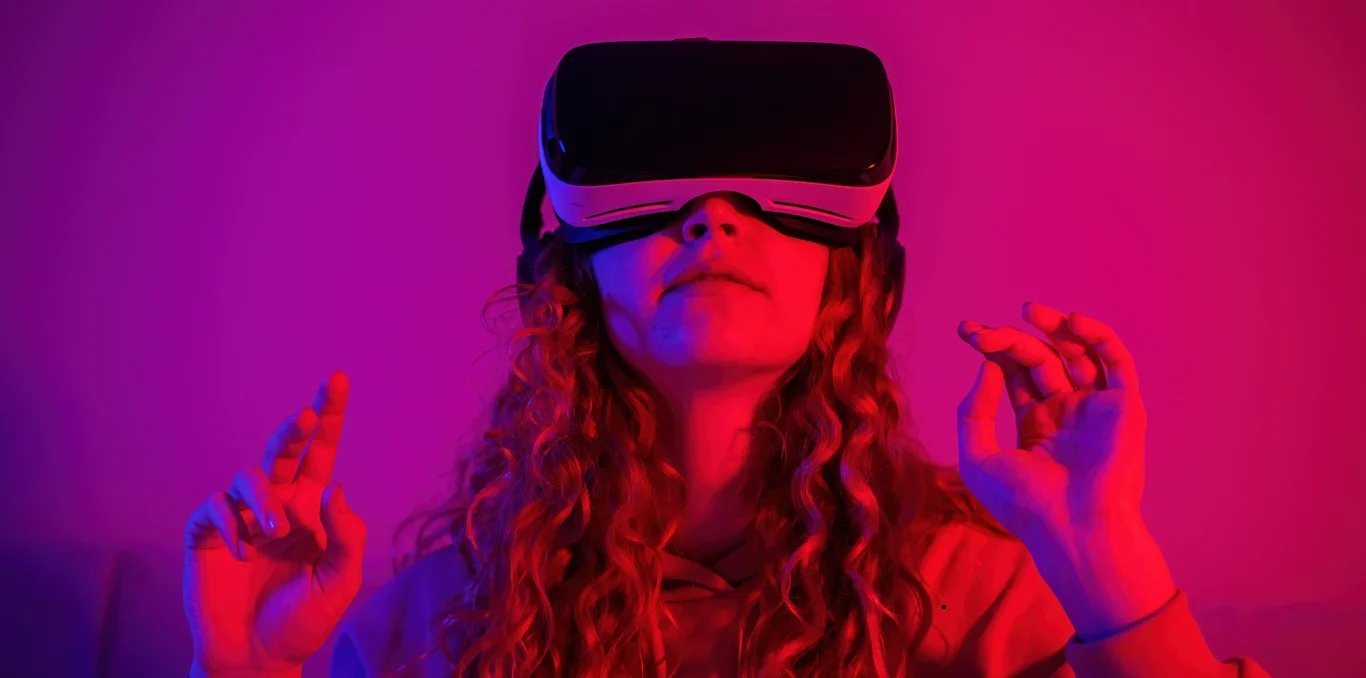

Type “virtual reality Barcelona” into any search bar and you’ll get two experiences that share a label and nothing else. The first is free-roam gaming: you strap on a headset and a backpack PC and physically walk across a huge arena, shooting zombies alongside your friends. The second is immersive exhibitions, where VR is one stop on a cultural walk-through that reconstructs Pompeii or the Roman Colosseum. Booking one when you wanted the other is the easiest mistake to make here, because the price, the minimum age, and the entire kind of outing are different.
Barcelona has become one of southern Europe’s strongest hubs for both, which is good news and a planning problem at once. The split below sorts every option by what you’re actually trying to do.
Quick decision by what you want
- Group of friends after action and adrenaline → Zero Latency — free-roam in a 500m² arena, up to 8 players, from €19.95
- Families with teenagers → RESET·XR in El Clot — 50-min gaming and VR escape rooms, with a gamer bar to wait in
- Couple or group wanting a different escape room → Virtua in Sant Antoni — cooperative VR escape rooms on Meta Quest 3
- Travelling with kids from age 8 who want culture → Eclipso at Las Arenas — Colosseum or Titanic in 45 min, suitable from 8
- History and art lover → Pompeii at IDEAL Montjuïc — 3,000m², 360° projections plus a VR room, from €11
- Rainy-day indoor plan → any central immersive exhibition — all covered and metro-connected
Is virtual reality in Barcelona worth it
Short answer: yes, if you match the format to your group, and especially as a wet-weather plan. Here’s the honest framing. A free-roam session at around €20-30 per person sits in the same price bracket as a paella cooking class or a cable-car round trip, and it’s the rare indoor activity that works equally well for teenagers and adults. The cultural VR exhibitions, from €11, undercut many of the city’s big-ticket attractions while offering something no static display can.
When is it not worth it? If you only have a couple of hours and they’re your only hours in the city, a VR room competes against the Sagrada Família and Park Güell, and those win on a first visit. VR earns its place on a second trip, a rainy afternoon, or a group day where everyone wants to do something together rather than queue at a monument. For first-timers weighing the icons first, the guide to Barcelona’s essential sights sets the priorities.
What free-roam VR actually means
Free-roam is the most advanced format and the one worth travelling for if you want maximum immersion. Instead of standing still with a controller, you move freely across a physical arena of hundreds of square metres while everything you see and hear is generated digitally. Your body becomes the controller. A headset, headphones, and a backpack PC make it work, with no cables, for total freedom of movement.
The difference from a standard VR arcade is physical. In free-roam you genuinely walk, climb to platforms at different heights, and dodge real obstacles that map to the virtual world. That’s why it calls for comfortable clothes and flat shoes. According to the venues, this untethered setup is also what keeps motion sickness low, because your real movement and the virtual world stay in sync.
Zero Latency, the free-roam benchmark
Zero Latency is the serious pick for large-format cooperative action. More than 1 million players have passed through its venues worldwide, and the Barcelona site is considered one of the most advanced in Europe. You play in groups of up to 8 moving through the arena together, with sensor-equipped replica weapons and voice comms between everyone.
The catalogue runs from zombie survival to military bases and space combat, with titles like Outbreak, Singularity, Engineerium, and the Ubisoft collaboration based on Far Cry. Pricing starts from €19.95 per player for groups of 1 to 8, with special rates on Tuesdays, and the session lasts 60 minutes including the pre-game briefing.
It sits inside the SOM Multiespai shopping centre, at Avinguda Rio de Janeiro 42, in the Nou Barris district. Opening hours run Tuesday to Thursday 16:00 to 21:00, Friday until 22:00, and weekends from 11:00. The Fabra i Puig and Llucmajor metro stops are about 9 minutes on foot. One correction worth noting, since several listings get it wrong: the venue is at SOM Multiespai in Nou Barris, not Sant Adrià or Sant Martí.
RESET·XR, the largest centre in the city
For a group that wants variety plus somewhere to eat and wait between sessions, RESET·XR is the call. Located in the heart of El Clot, it is a 700-square-metre virtual reality centre, the largest in the city, with wireless VR headsets and computers running NVIDIA 4070 graphics cards. It mixes shooters, virtual escape rooms, and educational experiences, and adds a bar-restaurant on site.
The two main formats are clear: 75-minute escape rooms and 50-minute gaming sessions, both for groups. The gaming catalogue includes After the Fall, Pavlov, and Vader Immortal, while the escape rooms run themes like Jungle Quest, Cyberpunk, and Survival. It’s at Carrer de la Muntanya 18, with the Clot metro stop 2 minutes away. The house advice is to skip alcohol before playing to avoid motion sickness.
Virtua, the VR escape room specialist
Virtua, in the Sant Antoni neighbourhood, was one of Barcelona’s first VR centres and ranks among the best-reviewed for arcade and escape-room play. It runs Meta Quest 3 headsets with simultaneous boxes and a broad catalogue spanning ocean floors, Everest climbs, zombie shooters, and vertigo challenges.
Its signature offering is the cooperative VR escape room. Each team member is equipped with a VR headset and two controllers to complete a mission across a 3x5-metre surface, moving freely and solving puzzles together. It’s at Carrer de Viladomat 95, well connected by metro and bus, with sessions from roughly €24.5 per person for an hour, available in English and Spanish, which makes it easy for international groups. Sant Antoni itself is a good base for the rest of the day, and the neighbourhood-by-neighbourhood guide to where to stay places it among the city’s areas.
Eclipso, cultural VR for all ages
When the plan is cultural but you want something more interactive than a museum, Eclipso is the most accessible option. It’s on the fourth floor of the Arenas shopping centre, at Gran Via de les Corts Catalanes 385, with two VR expeditions built on historical narrative. Both experiences last around 45 minutes and are suitable for ages 8 and up, available in five languages: Spanish, Catalan, English, French, and Chinese.
The headline is Colosseum, a recreation of first-century Rome. A ten-year-old Roman boy guides you through markets and temples before descending to the gladiators’ underground training areas, then up to the arena amid the roar of 80,000 spectators, led by the voice of the gladiator Flamma. The second experience, Titanic, takes you aboard the liner in 1912 to walk its salons and cabins. Metro lines L1, L3, and L8 stop right beside it, and being indoors it’s a reliable pick on a wet day, easy to slot into a first-time visitor’s plan for the city.
Pompeii at IDEAL, the year’s big immersive show
The most ambitious immersive experience on right now is The Last Days of Pompeii, at IDEAL’s temporary home on Montjuïc. It fills a 3,000m² space in the Palau Victòria Eugènia, with a route of 8 rooms moving through traditional exhibition spaces, an immersive hall, a VR experience in VR360 format, and a metaverse. Here VR isn’t the whole meal but the climax of a full sensory walk-through with enveloping projections, soundscapes, and even recreated smells.
The show arrives with credentials: it was awarded “Best Historical Exhibition 2024” by National Geographic after stops in Madrid, London, Vienna, and Beijing. The fact that matters for planning: it runs until 20 September 2026, with the centre open Wednesday to Sunday 10:00 to 22:00, last entry at 20:00, closed Tuesdays. Tickets start from €11 with rates varying by day and time slot, and children aged 0-3 enter free. It’s at Plaça de Carles Buïgas 7, with metro at Plaça Espanya (L1, L3) and the Montjuïc Funicular.
Comparison table of centres and experiences
| Centre | Type | Indicative price | Duration | Minimum age | Location |
|---|---|---|---|---|---|
| Zero Latency | Free-roam gaming | from €19.95 | 60 min | ~1.40m (12-14 yrs) | SOM Multiespai, Nou Barris |
| RESET·XR | Arcade + VR escape | €24-32 approx. | 50-75 min | 6-10 with adult | El Clot |
| Virtua | VR escape room | from €24.5 | 60 min | 8-10 with adult | Sant Antoni |
| Eclipso | Cultural VR | €17-22 approx. | 45 min | 8 yrs | Arenas, Eixample |
| IDEAL Pompeii | Exhibition + VR | from €11 | self-paced | all ages | Montjuïc |
What you can film, and what you can’t
This one rarely gets explained and it changes how you plan a visit if you’re recording the day. At the gaming centres, most venues let you film the briefing, the waiting area, and your group’s reactions, but not direct capture of the VR experience itself, for rights reasons. The practical fix is to narrate over reaction shots, since your audience can’t see the virtual world anyway. At the cultural exhibitions the rule flips: IDEAL Pompeii allows photos and clips inside the exhibition, but with no flash, no professional equipment, and no tripods. If content is part of why you’re going, confirm the specific policy when you book, because it differs centre by centre.
What to know before booking
Most VR experiences set minimum ages ranging from 8 for family and cultural options up to 12-14 for free-roam and the more intense experiences, and recommend adult supervision for minors. According to the venues, mild side effects like dizziness or eye fatigue are possible, so they advise against taking part if you have severe balance problems, epilepsy, or certain heart conditions.
Free-roam carries a few specific rules worth remembering: comfortable clothes, flat shoes without heels, and no heavy makeup because it smudges the headset lenses. In every case, booking online in advance is safest, since per-session capacity is small and afternoon and weekend slots sell out fast. If you’re costing out the trip, the daily budget breakdown for Barcelona helps fit these plans into the day’s spending.
For a screen-free evening, the TNC sells stalls seats from €12 to under-35s and the Teatre Lliure gives access from €14 with its free youth card, both compared in the Barcelona theatres guide. By daylight, the same curiosity about closed spaces leads to the sealed platforms and saved factories of the abandoned buildings guide.
Frequently asked questions about virtual reality in Barcelona
How much does a virtual reality experience in Barcelona cost?
It depends on the type. Free-roam gaming like Zero Latency starts at €19.95 per player for a roughly 60-minute session. VR arcades and escape rooms such as Virtua or RESET·XR run €24-32 per person. Immersive exhibitions with a VR room, like Pompeii at IDEAL, start from €11 per ticket.
What is the best virtual reality experience in Barcelona?
For action and free movement, Zero Latency is the benchmark: you walk untethered across a 500-square-metre arena in groups of up to 8. For culture, the Pompeii exhibition at IDEAL Montjuïc pairs 360-degree projections with a VR room. One is pure play, the other is immersive history.
What is the minimum age for virtual reality in Barcelona?
It varies by venue. Cultural exhibitions like Eclipso admit visitors from age 8. Family arcades usually allow ages 8-10 with an adult. Zero Latency’s free-roam requires a minimum height around 1.40m, roughly 12-14 years, because of the weight of the backpack and headset gear.
Can I wear my glasses with the VR headset?
At most venues, yes. At exhibitions like IDEAL and Eclipso, the VR headset goes over your prescription glasses. At Zero Latency’s free-roam, glasses are not allowed during play because of the headset type, so bring contact lenses if you wear them.
Virtual reality in Barcelona splits cleanly between those who want to play and those who want to time-travel, and the best session is the one that picks the right circuit before booking.