
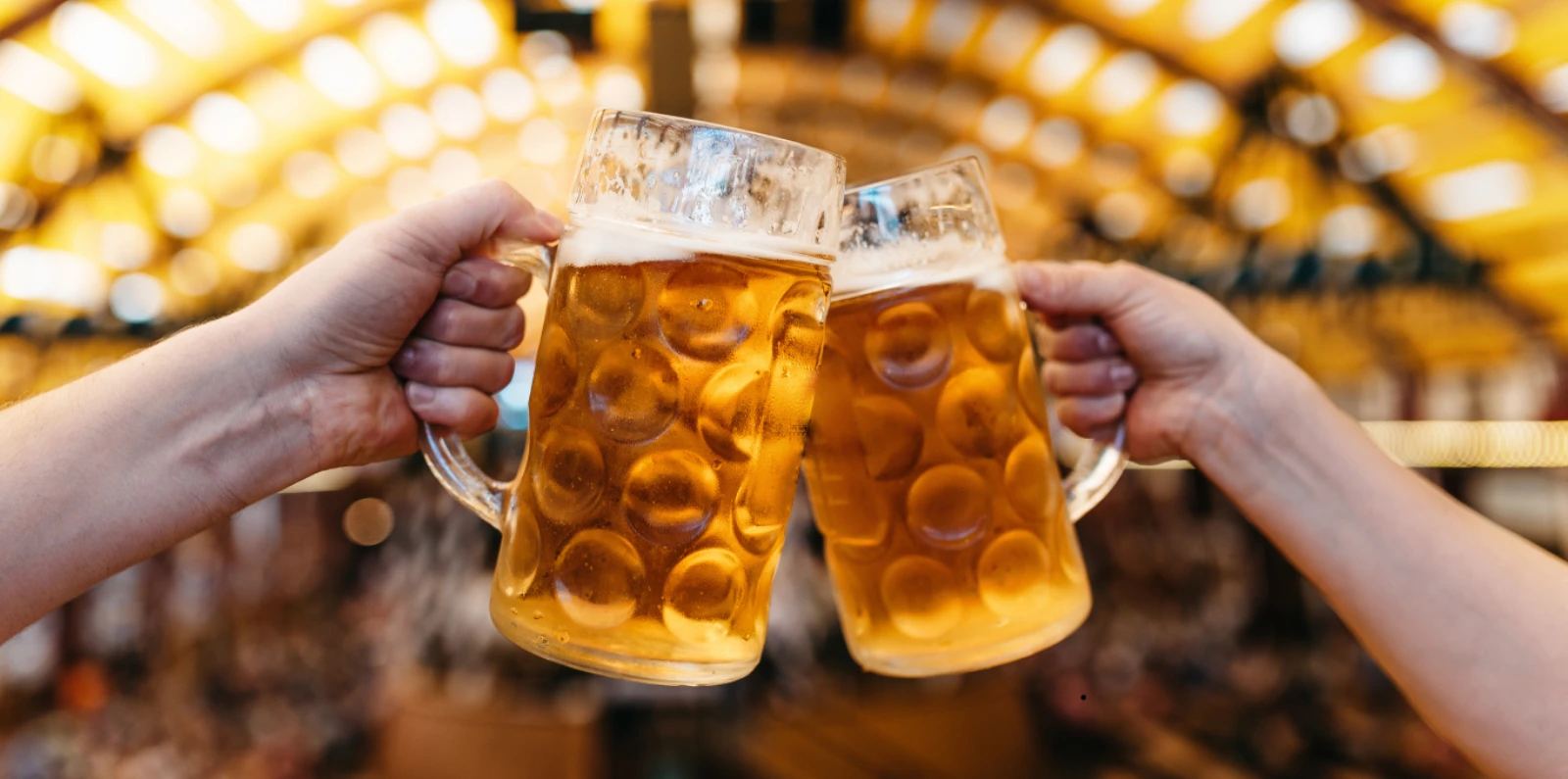

A one-litre Paulaner stein is heavier than it looks, and hoisting one while hundreds of people sing on the wooden benches around you is the image that sums up Barcelona’s Oktoberfest. For twelve days across late September and early October, the city’s biggest Bavarian party fills a vast hall with pork knuckle, sausages, live polka, and crowds in Lederhosen and Dirndl. The one thing worth settling before you go is expectations: this is a convincing recreation, not the six-million-strong Munich original, and there’s a venue change for 2026 that affects how you get there and when you book.
There’s a twist for 2026 that changes the practical planning: after twelve years in the same spot, the festival moves to a brand-new, much larger venue. That single change reshapes how you get there and when you need to book.
Is it worth it if you’ve been to Munich
Short answer: yes, with realistic expectations. Here’s the honest framing. Barcelona’s version runs at a fraction of Munich’s scale, and the crowd is more Mediterranean than Bavarian, so if you measure it against the real Wiesn it will fall short on sheer size. But the things that make Oktoberfest fun travel well: the litre Paulaner steins, the shared wooden tables, the live polka bands, and the costumes are all here, and the atmosphere under the tent is genuinely convincing.
When is it not worth it? If you’re only in Barcelona for a day or two of first-time sightseeing, a beer hall in a convention centre competes against Gaudí and the Gothic Quarter, and those win. Oktoberfest earns its place if you’re here in late September or early October anyway, travelling with a group, or simply want a big social night. For travellers weighing the icons first, the guide to Barcelona’s essential sights sets the priorities.
The exact 2026 dates, and why aggregators get them wrong
Oktoberfest Barcelona 2026 runs from 24 September to 11 October, open Thursday to Sunday only, which gives 12 festival days spread across those weekends. It’s the 13th edition. This matters because several event aggregators still list the 2025 dates, “2 to 19 October on Montjuïc,” which are last year’s and no longer apply.
The gap isn’t trivial: the 2025 edition was the 12th and, according to the organisers, set a record with over 110,000 attendees and 96% of tables booked in advance. For planning 2026, the official channels are the only reliable source, not pages carrying old data. If you’re timing a trip around these dates, the guide to the best time to visit Barcelona explains what early autumn in the city is like.
The new Gran Via venue, the year’s big change
The move to Fira Barcelona – Gran Via, Hall 4, is the headline of this edition. After twelve years on Montjuïc, the festival relocates to a setup of over 15,000m² with Bavarian decoration, live music from bands and DJs, traditional food, and a VIP area. The venue sits in L’Hospitalet, in the heart of the trade-fair district, and being a covered industrial hall it removes any risk of autumn rain that affected the old Montjuïc tent.
The change of location means rethinking how you arrive. Fira Gran Via is well connected by public transport: metro L9 Sud with Fira and Europa-Fira stops, metro L1 at Hospital de Bellvitge, and the FGC link at Europa-Fira. It’s about 12 km from El Prat airport, which makes it convenient for anyone landing and heading straight over. To get around the city on those days, the neighbourhood guide to where to stay in Barcelona helps you base yourself near a useful metro line.
What it costs, and the €5 catch nobody mentions
Entry to Oktoberfest is free most of the time, but there’s one exception that catches many visitors off guard. The afternoon sessions, from 17:00 onwards, on Fridays, Saturdays, and the eve of public holidays carry a €5 per-person charge as festival entry. Every other slot, mornings and weekdays, is free to enter.
A couple of details are worth knowing. Under-18s don’t pay that €5 at any session. And if you reserve a table in those paid afternoon slots, the €5 isn’t lost: it converts into a QR-code voucher redeemable against any purchase of equal or higher value, except at the food-truck area. So if you’re going to spend anyway, the afternoon entry effectively becomes free with a booking.
The beer, the food, and the steins
The official beer is Paulaner, one of the historic breweries authorised to serve at the original Munich Oktoberfest, poured in the Mass format, the one-litre glass stein, at roughly €10 each. There are three main varieties worth telling apart before you order:
- Münchner Hell (around 4.9%) — the classic golden lager, smooth and malty, the easiest to drink by the litre
- Weissbier (around 5.5%) — unfiltered wheat beer with fruity notes, more aromatic
- Salvator (around 7.8%) — a strong, toasted Doppelbock, high in alcohol, one to pace yourself with
Non-alcoholic and gluten-free options are available too. On the food side, the star plate is roast pork knuckle with potatoes, backed by up to six kinds of sausage including the classic Bratwurst, half a roast chicken, traditional salads, and the giant Brezel pretzels. There are vegan and gluten-free options, with a vegan burger cooked in a separate oven to avoid cross-contamination, and allergen sheets at the bars.
The atmosphere, the opening, and the costumes
The festival kicks off on 24 September, with the peak moment at 18:30 when the first keg is officially tapped. To the traditional cry of “O’zapft is!” (“It’s open!”), the 12 days of celebration begin. From that point the music doesn’t stop: live polka bands alternate with DJs to keep people toasting on their feet, often standing on the benches.
Dressing up is part of the game, though not required. You’ll see plenty of people in traditional Bavarian outfits: Lederhosen, the leather shorts with braces, for men, and the Dirndl, the dress with apron and blouse, for women. Many visitors join in for the full experience, and there are usually traditional-costume contests.
Watch out, there are three different Oktoberfests in Barcelona
Searching “Oktoberfest Barcelona” turns up three separate events, and only one is the big public festival. The first is the public festival at Fira Gran Via, the large one, the subject of this guide. The second is the German Chamber of Commerce (AHK) event, a Spanish-German business-networking evening in a hotel garden on Diagonal, with corporate seating, not the popular party. The third is a themed pub crawl, a commercial nighttime bar tour with a paid ticket, for over-18s only.
Booking a table at the wrong one is an easy mistake. The big festival is managed only through its official website, with two options: a general table, giving priority access with an individual QR-code ticket, and a VIP table at €36 per person, with a cashless wristband and pre-paid food and drink redeemable only in the VIP zone. To fit the plan into your trip budget, the daily cost breakdown for Barcelona helps you price the day.
Frequently asked questions about Oktoberfest Barcelona
When is Oktoberfest Barcelona in 2026?
From 24 September to 11 October 2026, open Thursday to Sunday only, which adds up to 12 days spread across those weekends. It is the 13th edition. The opening is on 24 September, with the first keg tapped at 18:30, marking the official start.
How much does it cost to enter Oktoberfest Barcelona?
Entry is free most of the time. The only exception is the afternoon sessions, from 17:00 onwards, on Fridays, Saturdays, and the eve of public holidays, which cost €5 per person. Under-18s do not pay that entry fee at any session.
Where is Oktoberfest Barcelona held in 2026?
In 2026 it changes venue after twelve years on Montjuïc. It moves to Fira Barcelona – Gran Via, Hall 4, in L’Hospitalet, with a setup of over 15,000m². Reach it by metro on the L9 Sud (Fira or Europa-Fira stops) and the L1 (Hospital de Bellvitge).
Is Oktoberfest Barcelona worth it if you have been to Munich?
Honestly, it is a recreation, not the original, so expect a smaller scale and a Mediterranean crowd. But the litre Paulaner steins, the live Bavarian bands, and the costumes capture the atmosphere convincingly, and free entry on most days makes it an easy yes for an autumn evening.
Barcelona’s Oktoberfest changes neighbourhood this year but not its spirit, and the best stein is the one poured by someone who knows the tent has moved.