
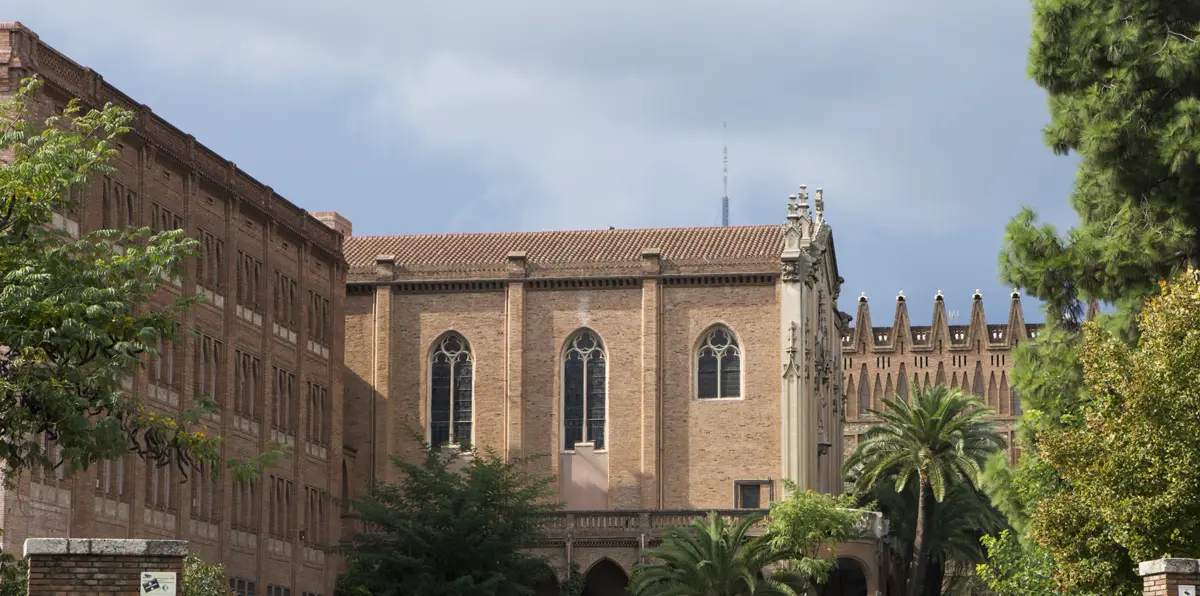

Millions of people visit a Gaudí building in Barcelona every year, yet almost none have set foot in this one. The Col·legi de les Teresianes, sealed behind a working convent school for almost 140 years, is being turned into the Museu Gaudí Teresianes — the first time the public will get regular access to it.
A Gaudí building sealed off for almost 140 years
The Museu Gaudí Teresianes corrects a long-standing oddity: a major Gaudí work that never joined the visitor circuit. Located on Carrer de Ganduxer in the Tres Torres area, the building has run continuously as a convent and school since it was built, which kept it effectively closed to the general public while the Sagrada Família, Casa Batlló and Park Güell drew millions of visitors a year.
This reshapes how a Gaudí-focused trip works, since the existing circuit clusters into a few central blocks. It is worth slotting the opening into the wider set of things worth seeing across the city, because it pulls the architect’s geography away from Passeig de Gràcia for the first time.
Where it sits and how to reach it
The museum will occupy the Col·legi de les Teresianes at Carrer de Ganduxer 85-105, in the Tres Torres area of the Sarrià-Sant Gervasi district. This is upper Barcelona, roughly 4 km from the tourist-heavy Gaudí cluster around Passeig de Gràcia, which decentralises the city’s Gaudí offer toward a quiet residential neighbourhood for the first time.
That distance has a practical consequence. The museum will fall outside the classic walking line between the Sagrada Família and Casa Batlló, so anyone wanting to include it should plan a dedicated trip. Working out those connections is easier with the Barcelona public transport guide. The trade-off is a calm setting, free of the Eixample crowds.
When the Museu Gaudí Teresianes opens
What is the new Gaudí museum in Barcelona and when does it open? It is the Museu Gaudí Teresianes, a new cultural centre inside Gaudí’s Col·legi de les Teresianes in the upper Sarrià-Sant Gervasi district, devoted to the architect’s spiritual, technical and personal sides. It opens in early 2028, carries Vatican authorisation, is led by IngeniaCultura, and combines heritage, exhibitions and immersive virtual-reality experiences.
Public opening is planned for early 2028. It does not coincide with the bulk of the centenary celebrations; instead it arrives in a later phase of the legacy strategy, once the building’s adaptation works are complete.
As of now the project is confirmed and officially presented, with defined backers and a settled architectural competition, but the works are not finished. There is no exact opening date, no dedicated official website, and no published ticket prices. Any fee figure circulating at this point is speculative, since the available information centres on the museographic concept and the indicative timeline.
Can you visit the building today?
Not on a regular basis. The Col·legi de les Teresianes is still a working school, with more than 125 years of continuous teaching, and its interior is closed to free visits. Until the museum opens, access has been limited to occasional guided routes such as the Any Gaudí’s lesser-known Gaudí itinerary, which pairs the Teresianes with Torre Bellesguard and the Finca Güell pavilions.
What you’ll be able to see inside
The route is conceived as an immersive experience rather than a simple door-opening. According to the project’s backers, the museum will run across three main exhibition blocks that carry the visitor from the architect’s biography to his creative process.
- Espai Gaudí 360º — a full floor devoted to Gaudí’s life and artistic path, designed as the permanent exhibition and the core of the route.
- Temporary exhibition rooms — built around the ideas that run through his work, such as light, transcendence and beauty, linking the historic building to current artistic practice.
- Virtual-reality room — a digital experience that invites visitors to follow Gaudí through his working process, closing the itinerary.
The museography will be high-specification, with audiovisual and multimedia resources, models, interactive modules, physical and virtual reconstructions, panoramic projections and architectural mappings. The approach echoes the IDEAL digital arts centre, also run by the same backers. For visitors drawn to that style, it pairs naturally with a day built around the best museums in Barcelona.
The free garden, the detail that changes the neighbourhood
Beyond the paid route, the project plans to open part of the gardens surrounding the school to the city — until now a restricted area. This entrance will be free and independent of the interior visit, creating a new spot to stroll and take in the facade in a part of town that lacked one.
It is a meaningful urban gesture: it turns a historically sealed compound into a semi-public space, in the spirit of other green spaces and parks around the city that work as breathing room within a dense grid. The brick facade, austere and almost defensive, will be visible up close without paying for a ticket.
Why this building matters so much in Gaudí’s work
The Col·legi de les Teresianes (1888-1890) marks the turning point toward Gaudí’s structural maturity. He took over a project already begun by Joan Baptista Pons i Trabal, of which only the foundations existed, and worked under extreme budget austerity imposed by the religious order.
That very limitation is what makes the building exceptional. With no money for stone or polychrome decoration, Gaudí raised plain brick to monumental status and solved the structure with parabolic — or catenary — arches that, far from decorative, hold up the ceiling and the upper floor, carrying heavy loads through very thin profiles. The white corridors on the first floor, with their run of arches, are its most recognisable space and anticipate the geometric solutions he would later apply at full scale in the Sagrada Família. Heritage specialists rate it one of his most coherent works, where interior and exterior form a single unit.
The Teresian symbolism that shapes the whole building
The square, castle-like plan is not an aesthetic whim but a literal reading of The Interior Castle (Las Moradas) by Saint Teresa of Ávila, the mystical guide that frames faith as a seven-stage journey toward union with God. Gaudí read the work to resolve the commission, and the symbol runs through the building.
The entrance gate encloses the hearts of the Virgin and Saint Teresa pierced by arrows; the battlements evoke the saint’s doctoral caps; four-armed crosses crown the corner towers; and helical brick pillars carry the Carmelite coat of arms in ceramic. Everything builds toward an atmosphere of retreat, intensified by the overhead light falling through the interior courtyards. The building is listed as a Cultural Asset of National Interest.
Who is behind the project
It helps to separate three roles the press tends to blur. The project is driven by IngeniaCultura, a spin-off of MagmaCultura and the founders of Barcelona’s IDEAL centre, responsible for the concept, the narrative and the museographic strategy. The competition to define the architectural proposal was won by Arquitectura Genís Planelles, a studio with recognised heritage experience — it restored the Verdaguer Institute and expanded the modernist fish market in Vilafranca del Penedès. Overall coordination sits with the Josep Cortina studio.
The project carries Vatican authorisation, a necessary condition because the building remains the property of the Company of Saint Teresa of Jesus. Its presentation was framed by three converging milestones: the visit of Pope Leo XIV, the Gaudí Year and the 150th anniversary of the congregation’s founding.
How it compares to other Gaudí sites
For an English-speaking visitor weighing where Gaudí’s lesser-known work fits, the table below sets the Teresianes against the spaces already open. The Teresianes wins on architectural rarity and access novelty; for sheer scale, the Sagrada Família remains unmatched.
| Site | Focus | Status | Best for |
|---|---|---|---|
| Museu Gaudí Teresianes | Essentialist, spiritual Gaudí | Opens early 2028 | First-time access to a sealed building |
| Casa Batlló Contemporary | Gaudí meets contemporary art | Open since 2026 | Design and immersive visuals |
| Casa Museu Gaudí (Park Güell) | Domestic, biographical Gaudí | Open, public-run | Original furniture and intimate scale |
| Sagrada Família | Monumental late Gaudí | Open, 172.5 m tower done | Scale and the architect’s final vision |
Why the announcement lands now
The timing is no accident. The presentation coincided with the completion of the Sagrada Família’s Tower of Jesus Christ, which reached its final height of 172.5 m after its cross was crowned on 20 February, and with the visit of Pope Leo XIV, who inaugurated it on 10 June, exactly a century after Gaudí’s death. That height hides a decision by the architect: the hill of Montjuïc stands 173 m tall, and he ruled that the temple should sit half a metre below it, because human work should not surpass nature’s.
It is the international attention from that moment the new museum aims to capture, even if its doors open two years later. To see how the whole Gaudí legacy concentrates into this period, it helps to read when the best time to visit Barcelona is.
Frequently asked questions about the new Gaudí museum
Where will the new Gaudí museum in Barcelona be located?
Inside the Col·legi de les Teresianes on Carrer de Ganduxer, in the Tres Torres area of the Sarrià-Sant Gervasi district. Gaudí designed the building between 1888 and 1890, and it has stayed closed to the general public for almost 140 years.
When does the Museu Gaudí Teresianes open?
Public opening is planned for early 2028, not during the 2026 centenary. The project is confirmed and the architectural competition is settled, but there is no exact opening date, no official website, and no published ticket prices yet.
Can I visit the Teresianes building right now?
Not on a regular basis. It is still a working school and the interior is closed to free visits. Access has only happened through occasional guided routes such as the Any Gaudí’s lesser-known Gaudí itinerary. Regular visits arrive with the museum in early 2028.
What will there be inside the museum?
A full floor on Gaudí’s life and work (the Espai Gaudí 360º), temporary exhibition rooms on light, transcendence and beauty, and a virtual-reality room on his creative process. Part of the garden will also open with free access, separate from the paid route.
Why does this building matter within Gaudí’s work?
It marks his shift toward essentialist, spiritual architecture. On a tight budget, Gaudí solved the structure with load-bearing parabolic brick arches that hold up the ceiling, anticipating the geometric solutions he later applied at full scale in the Sagrada Família.
Is this the same as the Casa Batlló Contemporary gallery?
No. The Casa Batlló Contemporary is a contemporary-art gallery that opened in 2026 inside Casa Batlló and is already operating. The Museu Gaudí Teresianes is a separate project in Sarrià, opening in 2028, focused on Gaudí’s essentialist and spiritual side.
Every Gaudí landmark in Barcelona is a building he made famous; the Teresianes is the one that made him. In 2028, the rehearsal finally goes on show.