
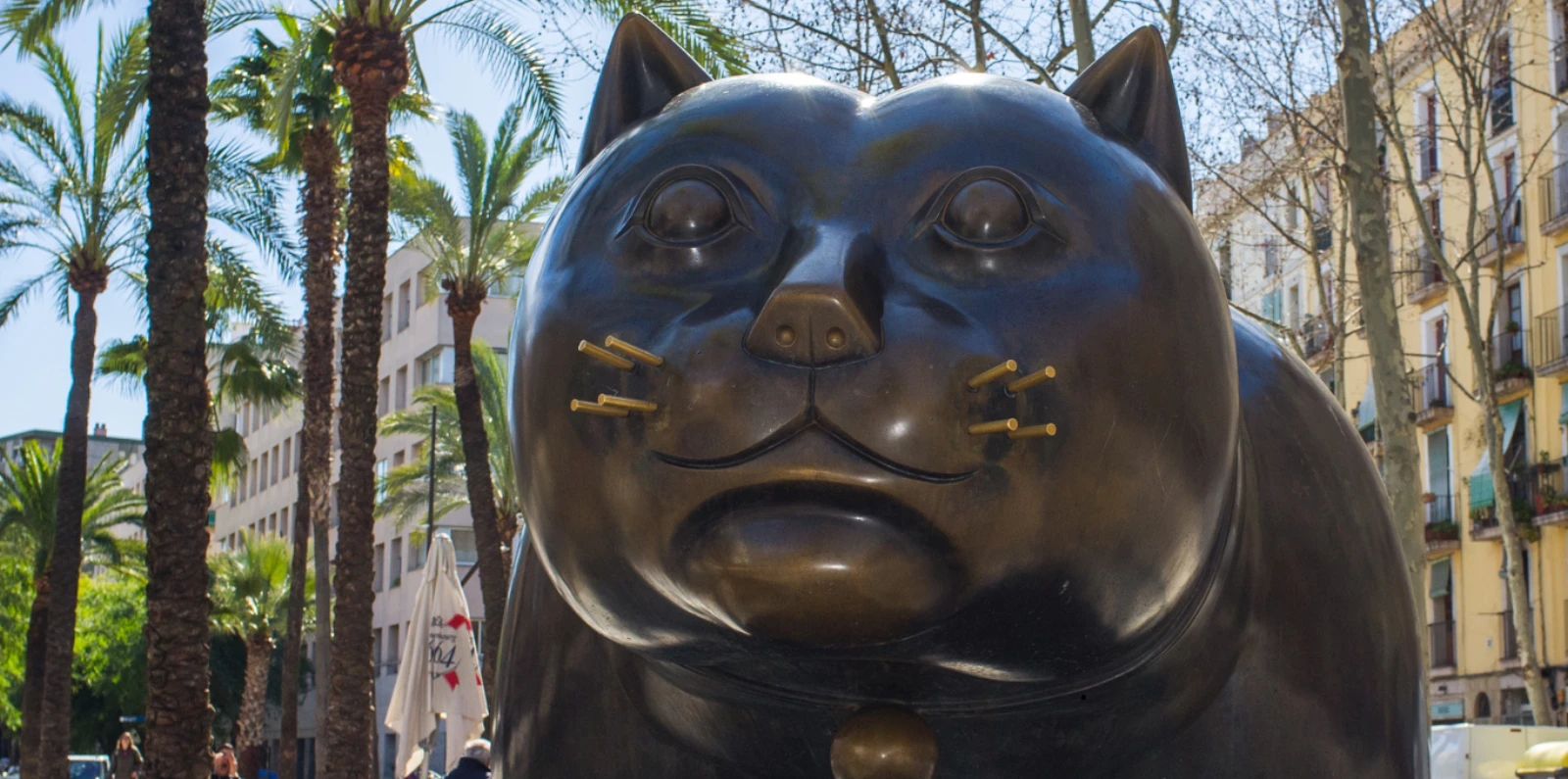

There’s a bronze cat in the Raval whose nose thousands of people rub each day, none of them aware it nearly never found a place in the city at all. There’s a submarine in a Guinardó park that only looks real when it rains. And there’s an iron Columbus at the harbour who has spent over a century pointing at a spot that isn’t the one everyone assumes. If you arrive in Barcelona wanting something beyond the Sagrada Família queues, the city holds an open-air museum scattered across neighbourhoods, beaches, and parks. This guide maps it by route, with the real story behind each piece.
Is it worth building a route around these
Short answer: yes, if you frame it right. These sculptures are free, spread across the city, and most sit a short walk from sights you’re seeing anyway, so they slot into an existing itinerary rather than demanding a dedicated day. The strongest cluster, the 1992 Olympic art along the waterfront, can be walked end to end in under an hour.
When is it not worth it? If you only have one or two days and haven’t yet seen the icons, chasing a submarine in a residential park competes with the Gothic Quarter and Park Güell, and those win. This works best as a second-layer trip, once the headline sights are done, or for a return visit. For first-timers still mapping the essentials, the guide to Barcelona’s must-see sights sets the order.
Botero’s Cat, 16 years looking for a home
The most photographed sculpture in the Raval is also Barcelona’s most well-travelled. Botero’s Cat, carved in 1990 by Colombian artist Fernando Botero, is a bronze feline 7 metres long weighing around 2,200 kg. The city acquired it in 1987, but it spent 16 years without a fixed spot before landing on the Rambla del Raval in 2003.
Its journey was long: it stood in the Parc de la Ciutadella by the zoo, at the Olympic Stadium in 1992, on a square behind the Drassanes, and in various municipal warehouses. Botero has “sibling” cats in Yerevan, New York, and Medellín. Today it’s the neighbourhood’s meeting point, and its nose and ears gleam from constant touching. If you’re exploring this area, it helps to know what the Raval is like after dark; the neighbourhood-by-neighbourhood safety guide covers it honestly.
A walkable waterfront itinerary, the Olympic art in one hour
The single most efficient sculpture route follows the 1992 Olympic makeover along the coast, and it works as a continuous walk. Here’s the sequence for the most common case.
- Cap de Barcelona (Passeig de Colom) — Roy Lichtenstein’s 15-metre head, tiled in ceramic trencadís as a pop-art nod to Gaudí; start here
- La Gamba (Passeig de Colom) — Javier Mariscal’s smiling 1989 prawn, a few metres along; Mariscal also designed Olympic mascot Cobi
- Peix (Port Olímpic) — Gehry’s 56-metre golden fish at the foot of Hotel Arts, the walk’s finale and best at sunset
The three line up along the seafront promenade, so the route doubles as a coastal walk. To base yourself near this stretch, the neighbourhood guide to where to stay breaks down the options.
The buried submarine, the piece that only surfaces in rain
The city’s most ingenious sculpture needs rain to fully work. In the Parc de les Aigües, in the Guinardó, sculptor Josep Maria Riera i Aragó installed the fins, stern, and conning tower of a submarine directly onto a sandy bed. When it rains hard and a puddle forms around it, the illusion is complete: a real submarine appears to surface from the earth.
Most visitors never see it, because it sits outside the tourist circuit in a local park. The effect depends on the weather, which turns it into a photo target for grey days, exactly when other routes lose their appeal. It’s one of the stops that separate a personal route from the standard list.
The giant animals, the route for travelling with kids
The most fun route for families mixes animals you can touch, climb, and photograph. The Mammoth of the Ciutadella, a giant-scale cement beast from 1907, is the lone survivor of a 19th-century plan to populate the park with extinct fauna; the rest were never built.
In the Parc de l’Espanya Industrial near Sants, a huge metal dragon by Andrés Nagel works as both sculpture and slide, with ramps for children to ride down. And on the Rambla de Catalunya, two 1972 sculptures by Josep Granyer give the avenue its character: the Coquettish Giraffe, in a vain pose, and the Thinking Bull, mimicking Rodin’s Thinker. They were installed at residents’ initiative to block a plan that would have turned the Rambla de Catalunya into a traffic artery.
The surreal pieces, art with a double meaning
Barcelona’s abstract art hides pieces that look like one thing and mean another. The Miraestels by Robert Llimós, two white 3.5-metre figures floating on the water at the Rambla de Mar since 2010, are not harbour decoration: they are a tribute to the poet Joan Brossa, born from a commission inspired by his poetry collection El Saltamartí, with an ecological reading about caring for the sea layered on top.
A few metres away, Rebecca Horn’s L’estel ferit, the four tilted metal cubes on Sant Miquel beach, evoke the old beach shacks and bars of Barceloneta that were demolished. And Joan Miró’s Dona i ocell, in the Parc Joan Miró near Plaça d’Espanya, is a 22-metre mass covered in colourful trencadís, one of the artist’s last major works, from 1983.
Carmela and the myth of Columbus’s finger
Two of the most-seen pieces in the centre hide facts that are almost always told wrong. Carmela, Jaume Plensa’s cast-iron girl’s head, is 4.5 metres tall and stands at the exterior corner of the Palau de la Música, not in El Born as is sometimes claimed. It was installed temporarily in 2016 and, far from being permanent, is on loan by agreement with the city council until 2032.
The Columbus Monument, from 1888, fuels the city’s most repeated myth: that its finger points to America. It doesn’t. The 7-metre bronze figure by Rafael Atché points out to the open sea, southward, not west towards the American continent. The choice was deliberate: had Columbus genuinely pointed at America, he would have been gesturing inland, towards the Ramblas. The “it points to Genoa” version doesn’t hold either, since Mallorca, not Italy, lies in that direction. The monument hides a viewing platform reached by lift at the statue’s feet.
Frequently asked questions about Barcelona’s quirky sculptures
Where is Botero’s Cat in Barcelona?
On the Rambla del Raval, in Ciutat Vella. Fernando Botero’s bronze cat, from 1990, is 7 metres long and weighs around 2,200 kg. It arrived in the city in 1987 and spent 16 years moving between locations before settling in the Raval in 2003.
Which way does the Columbus statue’s finger actually point?
Not towards America, as most people assume. The finger points out to the open sea, southward, not west where the American continent lies. The choice was deliberate: pointing at America would have left Columbus gesturing inland, towards the Ramblas.
What do the cubes on Barceloneta beach, L’estel ferit, represent?
L’estel ferit, by Rebecca Horn, is four stacked metal cubes from 1992 on Sant Miquel beach. They honour the old beach shacks and bars of Barceloneta that were demolished before the Olympic Games. Locals call them The Cubes.
How big is Frank Gehry’s golden fish in Barcelona?
Gehry’s Peix is 56 metres long and 35 metres high, according to Turisme de Barcelona. Built in 1992, it sits in the Port Olímpic at the foot of Hotel Arts, and its golden stainless-steel mesh shifts tone with the Mediterranean light.
Barcelona makes you look up at the Sagrada Família, but its secrets sit at eye level, in the bronze people touch without knowing the story behind it.