
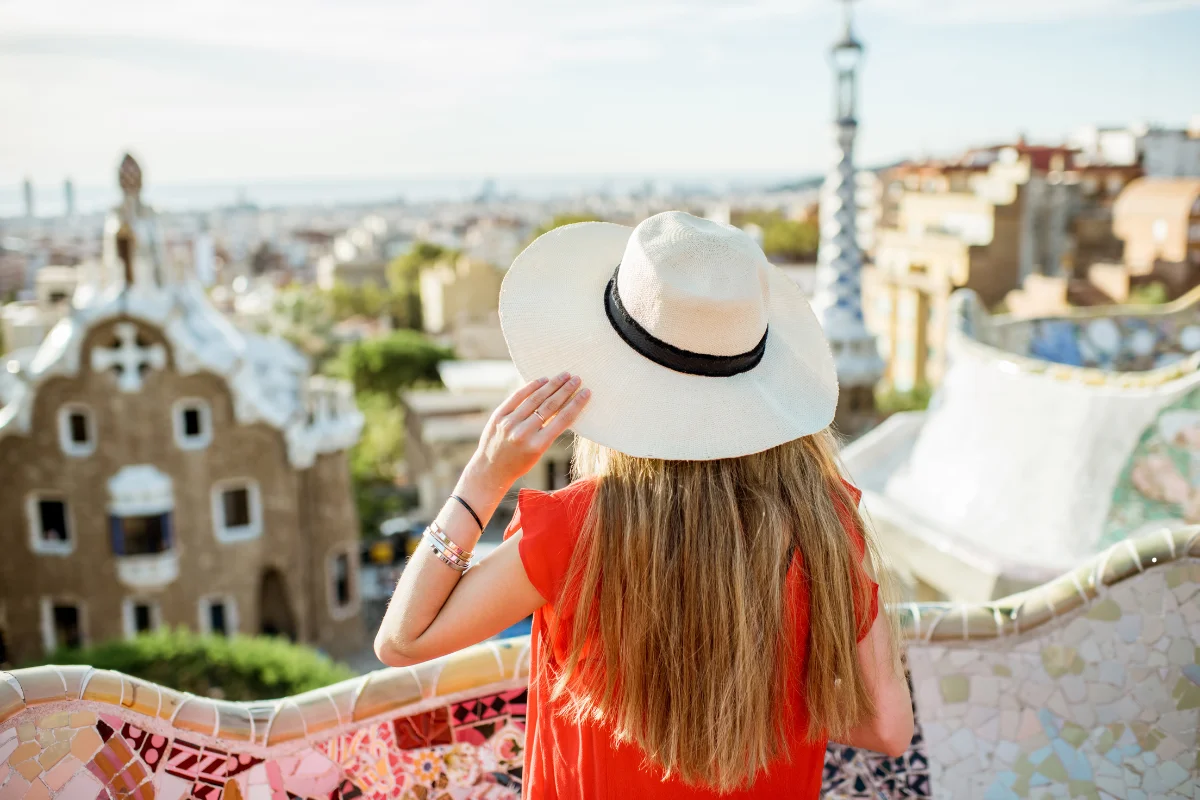

Park Güell gives you exactly 30 minutes from your booked entry time. Not 35. Not “around half an hour.” Thirty minutes — automated, logged and enforced. Arrive at minute 31 and the system shows you a red screen and a closed gate. No negotiation, no refund, no alternative entry.
This is the most important logistical fact for one day in Barcelona, and it determines the structure of the day. Everything that happens before Park Güell has to leave enough buffer to arrive at the park on time. Everything that happens after can be planned more loosely.
The second rule: the Sagrada Família requires advance online booking with a time slot. The third: its security checkpoint rejects oversized travel bags and backpacks. If you’re coming from the airport or your hotel with luggage, drop it before going.
Book these two before anything else:
Sagrada Família — online, time-slotted, from €26. Book 3–5 days ahead minimum. Park Güell monumental zone — online, time-slotted, €18. Book for late morning (10:30 or 11:00) to give the Sagrada Família visit time to complete first.
With those in place, here’s what one day looks like.
The Itinerary: 8 Stops, ~10km On Foot
09:00 — Sagrada Família
Arrive 15 minutes before your slot. Go through security without a large bag. The Nativity Facade (east) gets the best morning exterior light before 11:00 — photograph it on the way in.
Inside: the branching column forest reaching 45 meters, the directional stained glass (cool blues on the east, warm ambers on the west), and the recently completed Torre de Jesucristo at 172.5 meters — visible on the skyline from everywhere in the city now that the construction cranes are gone. The Sagrada Família interior guide goes deep on the structural symbolism if you want to prepare.
If you added tower access to your ticket, the Passion towers give the better city view for the one-day itinerary — they face the Eixample grid and the sea simultaneously.
Time: 2 hours.
11:00 — Recinte Modernista de Sant Pau (400m walk, worth it)
This is the most commonly skipped stop on a one-day itinerary and the one visitors most often regret not including. Sant Pau is 400 meters from the Sagrada Família down the Avinguda de Gaudí — a street literally designed to create a visual axis between the two buildings.
48 hospital pavilions by Lluís Domènech i Montaner (Gaudí’s main architectural rival), UNESCO listed, with trencadís mosaics, ceramic domes and wrought-iron ornament that you can actually walk up to and examine closely. The contrast with the Sagrada Família — where everything is at a distance — is immediate.
If the Park Güell slot is at 11:00, skip Sant Pau and go directly. If it’s 12:00 or later, a 30-minute stop at Sant Pau is achievable.
Entry: €18. Time: 30–45 minutes minimum.
11:30–12:00 — Park Güell (depending on your booked slot)
Transport from Sant Pau: bus V19 from Passeig de Sant Joan, approximately 20 minutes to the park. Or metro L5 to Diagonal, then bus.
The monumental zone: the wavy trencadís bench wrapping the upper esplanade, the Hypostyle Hall with 86 Doric columns, the two gingerbread houses at the entrance. From the upper esplanade: the Eixample in perfect grid below, the Sagrada Família to the right, the sea at the horizon. It’s the most complete panoramic framing of the city at a single viewpoint.
After the monumental zone: walk downhill into the Gràcia neighborhood, 15–20 minutes on foot.
Time: 1.5 hours in the monumental zone.
13:15 — Lunch in Gràcia
Gràcia was an independent municipality until 1897 — its plazas and street grid predate the Eixample’s logic. The Plaça del Sol has café terraces with local atmosphere that bears no resemblance to the tourist zones further south. Honest lunch at honest prices.
Time: 45 minutes.
14:30 — Passeig de Gràcia (metro or walk, 15 minutes)
The Block of Discord (numbers 35–45) has three consecutive Modernista buildings: Casa Batlló (43), Casa Amatller (41) and Casa Lleó i Morera (35). All three facades are visible from the pavement. For one day in Barcelona, the exterior walk plus one interior (if you add it) is more efficient than two interiors.
If you’re adding one: Casa Batlló has the most theatrical experience; La Pedrera’s rooftop with the warrior chimneys is the most architecturally specific element. Both require booking and add 1–1.5 hours plus cost (€29–39).
For the walking-only version: 30 minutes.
16:00 — Gothic Quarter
Ten minutes on foot south from the Passeig de Gràcia.
The Cathedral (13th–15th century Gothic, cloister with 13 geese), the Plaça del Rei (Palau Reial Major, medieval royal palace), the Plaça de Sant Felip Neri (Civil War shrapnel marks in the church wall — still there, unrestored, three minutes from the Cathedral). These three form the densest historical circuit in the quarter.
The MUHBA underground site beneath the Plaça del Rei — 1st-century Roman Barcino visible from elevated walkways — adds 45 minutes if time allows and energy permits.
Time: 1.5 hours.
17:30 — El Born
Ten minutes on foot from the Gothic Quarter.
Santa Maria del Mar: Gothic, 1329–1384, built by the harbor workers’ guild without royal funding. Three nearly equal-height naves, no lateral chapels, Catalan Gothic at its most structurally honest. A completely different spatial experience from the Cathedral.
The Fossar de les Moreres memorial (permanent flame, Catalan-language inscription) beside the basilica marks the burial site of the 1714 defenders. It’s at street level, three meters from the pedestrian flow, and essentially invisible to visitors who don’t know to look.
The Born CCM iron market building: free to enter and view the 1714 archaeological site from elevated walkways. The preserved street grid of the demolished neighborhood is under the 19th-century iron structure. No ticket required for the walkways.
Time: 45 minutes in El Born.
19:00 — Barceloneta for Sunset and Dinner
Metro L4 from Jaume I to Barceloneta: 4 minutes.
The Passeig Marítim at sunset, the Gehry fish sculpture at the Hotel Arts (best late-afternoon light from the west), and the harbor — the natural closing frame for a day that started at the Sagrada Família and moved progressively south.
The Barceloneta neighborhood guide covers the restaurant options (the quality-to-price ratio improves as you move away from the main promenade toward the interior streets) and the history of the neighborhood’s military engineering origins.
Time and Cost Summary
| Stop | Duration | Entry |
|---|---|---|
| Sagrada Família | 2h | €26+ |
| Sant Pau (optional but recommended) | 30–45min | €18 |
| Park Güell | 1.5h | €18 |
| Gràcia lunch | 45min | Food |
| Passeig de Gràcia | 30min | Free (exterior) |
| Gothic Quarter | 1.5h | Free (cathedral: small fee) |
| El Born | 45min | Free (Born CCM walkways) |
| Barceloneta | Evening | Food |
Total walking distance: approximately 8–10km. Total monument spend (minimum): €44 (Sagrada Família + Park Güell).
For full budget context across transport, food and accommodation: the Barcelona daily costs guide.
Who Is This Day For
Arriving from another city for the day → This sequence works as written. Start at 09:00, end at the sea by 19:00.
Connecting through Barcelona between flights → Cut to Sagrada Família + Passeig de Gràcia facades + El Born. Skip Park Güell — the 30-minute window creates too much pressure with uncertain transport.
First time in the city with children → Replace the Gothic Quarter with the Parc de la Ciutadella (10 minutes from El Born, free, lake with rowboats). Easier pacing.
Architecture focus → Add Sant Pau fully and one Modernista interior (La Pedrera rooftop is the best single-element return). Accept that the Gothic Quarter becomes a 30-minute walk rather than a stop.
Mistakes That Ruin the Day
- Arriving at Park Güell after the 30-minute window — the system is automated and final. Set an alarm for 30 minutes before the slot and leave wherever you are.
- Going to the Sagrada Família with a large travel bag — the X-ray scanner refuses them. There are no exceptions. Store luggage at the hotel or at a station locker before going.
- Treating Las Ramblas as one of the stops — walk through it once (15 minutes) as a transit corridor between the Gothic Quarter and the Born. It’s not a destination in a one-day itinerary.
- Not booking in advance — both the Sagrada Família and Park Güell book out. Planning to “try at the door” is not a strategy for either.
- Scheduling an interior Modernista visit without accounting for the time — Casa Batlló or La Pedrera each add 1–1.5 hours, from €29 and €25 respectively. In a one-day itinerary, this either replaces the Gothic Quarter or cuts El Born. Decide explicitly, not by accident.
Final Insight
One day in Barcelona is enough to understand the architectural logic of the city — why the Eixample grid exists, what Gaudí was arguing with the Sagrada Família, how the Gothic Quarter layers 2,000 years of urban decision-making. It’s not enough to understand the neighborhoods, which require slower time. The visitors who get the most from one day are the ones who prepared the logistics in advance, moved geographically rather than randomly, and left with enough clarity about what they missed to plan the return trip around it.
For extending to two or three days, the Barcelona 2-day itinerary organizes the additional time by geographic arc, and the Barcelona first-time visitor guide gives the broader context for any trip length.